1. Definition
What is a Needle Holder (Webster)?
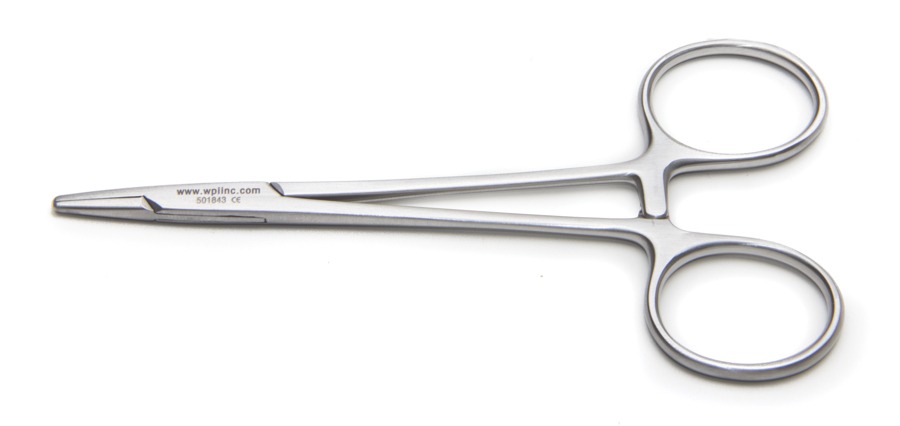
A Webster needle holder is a specialized, handheld surgical instrument primarily used in various surgical disciplines to grasp, hold, and manipulate suturing needles during wound closure and tissue approximation. It is a type of needle driver renowned for its fine, delicate tips and precise control, making it indispensable in procedures requiring meticulous work, such as plastic surgery, cardiovascular surgery, and other delicate reconstructive operations. Its primary function is to provide a firm, stable, and controlled grip on the needle, allowing the surgeon to pass it through tissue with accuracy and minimal trauma.
How it works
The working principle of a Webster needle holder is based on a simple lever and locking mechanism. The instrument is held in the palm of the hand, with the fingers operating the rings. Squeezing the handles brings the two jaws together, gripping the needle securely. Many models feature a ratchet lock mechanism near the rings. As the handles are squeezed, the ratchets engage, locking the jaws in a closed position without the surgeon needing to maintain constant hand pressure. This frees the surgeon to reposition their hand or perform other maneuvers while the needle remains firmly held. Releasing the lock requires a slight additional squeeze to disengage the ratchets, allowing the jaws to spring open.
Key Components
- Jaws: The tip of the instrument, designed with fine, smooth, or serrated grooves to grip the needle firmly without damaging it. They are typically short and stout to provide maximum control.
- Shank/Body: The central part connecting the jaws to the rings. It can be straight or curved, transmitting the force from the hand to the jaws.
- Ratchet/Lock: A series of interlocking teeth that click into place to hold the jaws closed. Typically, a Webster has 2-3 ratchet catches, providing varying degrees of closure force.
- Rings (Finger Rings): The circular openings where the surgeon’s thumb and ring finger are inserted to control the instrument.
- Box Lock: The pivotal joint where the two halves of the instrument meet. A high-quality box lock ensures smooth movement and long-term durability.
2. Uses
Clinical Applications
The Webster needle holder is the instrument of choice for fine, precision suturing.
- Plastic & Reconstructive Surgery: For closing skin layers, facial surgeries, and other procedures where cosmetic outcome is critical.
- Cardiovascular Surgery: For suturing delicate blood vessels and cardiac tissues.
- Ophthalmic Surgery: In specific procedures requiring fine sutures for the eye.
- Pediatric Surgery: Where smaller anatomical structures demand smaller instruments.
- Microsurgery: For anastomosing small nerves and vessels under a microscope.
- General Surgery: For fine work on the bowel, biliary tract, and other delicate tissues.
Who uses it
This instrument is primarily used by:
- Surgeons: Across various specialties (plastic, cardiovascular, general).
- Surgical Residents and Fellows: In training.
- Physician Assistants (PAs) and Surgical Assistants: Involved in wound closure.
Departments/Settings
- Operating Rooms (ORs) in hospitals and ambulatory surgical centers.
- Specialized clinics for plastic surgery or dermatology.
- Emergency Departments for complex laceration repairs.
- Trauma centers.
3. Technical Specs
Typical Specifications
- Length: Ranges from 12 cm to 18 cm (5 to 7 inches), with 14 cm being very common.
- Jaw Type: Smooth, fine serrations, or cross-grooved.
- Curvature: Jaws are typically straight, but the shank can be straight or curved.
Variants & Sizes
- Standard Webster: The classic model with fine, serrated jaws.
- Webster with Tungsten Carbide Inserts: Features hardened tungsten carbide inserts on the jaws for superior needle grip and extended instrument life.
- Delicate/Mayo-Hegar Pattern: Sometimes confused, but true Websters are generally finer and shorter than the more robust Mayo-Hegar needle holders.
- Size Variants: Ranges from “Junior” (smaller, ~12cm) to standard (~14cm) for different hand sizes and procedural needs.
Materials & Features
- Materials: Typically made from high-grade, medical-grade stainless steel (e.g., AISI 410, 420, 316) for corrosion resistance, durability, and ability to withstand repeated sterilization.
- Features:
- Tungsten Carbide Jaws: A premium feature that provides a non-slip grip on the needle, reduces hand fatigue, and significantly increases the instrument’s lifespan.
- Golden Handle: Often signifies the presence of tungsten carbide inserts.
- German Silver / Black Finish: Provides a non-glare surface for use under bright OR lights.
Models
While not branded like electronics, notable “models” are defined by their manufacturer and features:
- Sklar® Webster Needle Holder
- Miltex® Webster with Tungsten Carbide Inserts
- Scanlan® Fine Micro-Needle Holder (a specialized variant)
4. Benefits & Risks
Advantages
- Superior Control: The fine, short jaws allow for exceptional precision in needle placement.
- Reduced Needle Slippage: The specific jaw design minimizes the risk of the needle rotating or slipping during use.
- Durability: High-quality construction ensures a long service life.
- Ergonomics: Balanced design reduces hand fatigue during long procedures.
- Secure Locking: The ratchet mechanism provides reliable, hands-free needle retention.
Limitations
- Not for Heavy-Duty Use: Not suitable for holding large needles or suturing thick, tough tissues (e.g., fascia, skin in large animal surgery). A heavier needle holder like a Mayo-Hegar is required for such tasks.
- Skill-Dependent: Optimal use requires proper surgical technique and training.
Safety Concerns & Warnings
- Instrument Damage: Dropping the instrument can misalign the jaws or damage the box lock, compromising its function.
- Needle Damage: Using excessive force or gripping an incorrectly sized needle can damage both the needle and the instrument’s jaws.
- Incomplete Sterilization: Improper cleaning can lead to biofilm formation in the box lock, posing an infection risk.
Contraindications
The primary contraindication is the mismatch between instrument and task. A Webster needle holder is contraindicated for suturing that requires a large, strong needle (e.g., size 2 or greater) or when suturing very dense, tough tissue where a heavier, more robust needle holder is indicated.
5. Regulation
As a basic manual surgical instrument, the Webster needle holder is typically classified as a low-risk device.
- FDA Class: Class I (Exempt from premarket notification under 21 CFR 878.4800 – Surgical Instrument).
- EU MDR Class: Class I (Rule 1 – Non-invasive, for transient use).
- CDSCO Category (India): Class A (Low risk).
- PMDA Notes (Japan): Generally falls under “General Medical Devices” with a low-risk classification.
- ISO/IEC Standards:
- ISO 13485: Quality Management Systems for medical device manufacturers.
- ISO 7153-1: Materials for surgical instruments – Part 1: Metals.
- IEC 62366-1: Application of usability engineering to medical devices.
6. Maintenance
Cleaning & Sterilization
- Point-of-Use Cleaning: Wipe with a sterile water-moistened sponge immediately after use to prevent blood and debris from drying.
- Transport: Place in a designated container for contaminated instruments.
- Manual Cleaning: Clean thoroughly with a neutral pH enzymatic detergent, a soft brush, and lukewarm water. Pay special attention to the box lock and ratchets.
- Rinsing & Drying: Rinse with distilled water and dry completely to prevent spotting and corrosion.
- Sterilization: Sterilize using autoclaving (steam sterilization) at 121-134°C (250-273°F) for the recommended cycle time. Follow hospital SOPs.
Reprocessing
Reprocessing involves the complete cycle of cleaning, inspection, lubrication (if required), packaging, and sterilization. Single-use versions exist but are less common and environmentally contentious.
Calibration
Manual needle holders do not require electronic calibration. However, regular functional inspection is critical:
- Jaw Alignment: Check that the tips meet perfectly without gaps.
- Ratchet Function: Ensure the ratchets engage and disengage smoothly and hold securely.
- Box Lock: Check for any looseness or stiffness in the joint.
Storage
- Store in a clean, dry, and climate-controlled environment.
- Store individually or in trays to prevent contact with other instruments, which can cause damage to the fine jaws.
- Avoid humid conditions to prevent corrosion.
7. Procurement Guide
How to Select the Device
- Procedure Type: Match the instrument to the most common procedures performed (e.g., delicate plastic surgery requires a finer Webster).
- Surgeon Preference: Ergonomics and “feel” are highly subjective; offer trials from different manufacturers.
- Jaw Type: Decide between standard serrated jaws or premium Tungsten Carbide inserts for better grip and longevity.
- Length and Curvature: Choose based on the depth and location of the surgical site.
Quality Factors
- Material Quality: Ensure it’s made from high-grade, rust-resistant stainless steel.
- Craftsmanship: Look for a smooth box lock action, perfectly aligned jaws, and cleanly cut ratchets.
- Finish: A uniform, polished finish without burrs or sharp edges.
- Balance: The instrument should feel balanced in the hand.
Certifications
- Look for manufacturers certified under ISO 13485.
- For sales in the EU, the instrument must have a CE Mark.
- For the US, the manufacturer should be registered with the FDA.
Compatibility
The device is universally compatible as a standalone manual tool. Consider compatibility with instrument tracking systems (e.g., barcodes/RFID tags) for inventory management.
Typical Pricing Range
- Standard Stainless Steel Webster: $50 – $150
- Webster with Tungsten Carbide Inserts: $150 – $300+
8. Top 10 Manufacturers (Worldwide)
- Johnson & Johnson (Ethicon)
- B. Braun Melsungen AG
- Medtronic plc
- Integra LifeSciences
- Sklar Surgical Instruments
- Lawton GmbH & Co. KG
- BOWA-electronic GmbH & Co. KG
- Symmetry Surgical Inc.
- Mortech Manufacturing Company Inc.
- Robbins Instruments Inc.
9. Top 10 Exporting Countries (Latest Year)
- Germany
- United States
- Pakistan
- China
- Switzerland
- France
- United Kingdom
- Japan
- Italy
- Spain
10. Market Trends
- Current Global Trends: Steady growth driven by an increasing volume of surgical procedures globally, particularly in plastic and reconstructive surgery.
- New Technologies: Integration of ergonomic designs to reduce surgeon fatigue and the risk of Repetitive Strain Injury (RSI). The use of enhanced materials like diamond-like carbon coatings for even greater durability is emerging.
- Demand Drivers: Aging population, rising disposable incomes, and growing patient expectations for cosmetic outcomes.
- Future Insights: The market will continue to see a shift towards premium, high-durability instruments (e.g., with Tungsten Carbide) as hospitals focus on long-term cost-of-ownership. Sustainability in manufacturing and reprocessing will also become a key differentiator.
11. Training
Required Competency
Competency involves knowledge of instrument assembly/disassembly (if applicable), proper gripping technique (palm grasp), efficient needle loading/unloading, and an understanding of the ratchet mechanism.
Common User Errors
- Over-tightening the Ratchet: This can damage the needle and the instrument’s jaws.
- Using the Wrong Size: Using a small Webster for a large needle.
- Improper Needle Placement: Not placing the needle in the jaws correctly (should be about one-third to one-half from the needle tip).
- Poor Handling: Using the needle holder to grasp anything other than a suture needle.
Best-Practice Tips
- Always test the ratchet and jaw alignment before use.
- Load the needle perpendicular to the jaws in the correct position.
- Use the minimal ratchet lock necessary to hold the needle securely.
- Pass the instrument to colleagues in a way that they can immediately use it (e.g., “handled” with the rings towards them).
12. FAQs
1. What’s the difference between a Webster and a Mayo-Hegar needle holder?
A Webster has finer, shorter jaws and is used for delicate work and smaller needles. A Mayo-Hegar is heavier, longer, and used for standard suturing and larger needles.
2. Can a Webster needle holder be resterilized and reused?
Yes, high-quality stainless steel Websters are designed for repeated reprocessing and sterilization.
3. How do I know if the jaws are damaged?
If the needle slips, rotates easily, or if you can see a gap between the tips when closed, the jaws are likely misaligned or worn.
4. Why are the handles on some needle holders gold-colored?
The gold color typically indicates that the jaws are fitted with tungsten carbide inserts, which are harder and provide a better grip.
5. How long should a Webster needle holder last?
With proper care and use, a high-quality instrument can last for many years, even decades. Tungsten carbide models last significantly longer.
6. Can I use this to clamp a blood vessel?
No. Needle holders are not designed for this purpose and may damage the vessel. Use a dedicated hemostat or vascular clamp.
7. What does “1×2 teeth” mean on a product description?
This refers to the ratchet mechanism. It means one side of the ratchet has one tooth and the other has two, which provides a secure, fine lock.
8. Is there a left-handed version?
Most needle holders are ambidextrous, but some specialized models are designed specifically for left-handed surgeons.
13. Conclusion
The Webster needle holder is a fundamental instrument in the armamentarium of modern surgery, prized for its precision and control in delicate procedures. Its effective use hinges on a clear understanding of its design, proper applications, and meticulous maintenance. By selecting the right instrument for the task, ensuring its care through rigorous reprocessing, and employing best-practice techniques, surgical teams can maximize the instrument’s lifespan and, most importantly, contribute to optimal patient outcomes. As surgical techniques continue to advance, the enduring design of the Webster needle holder ensures it will remain a cornerstone of precision surgery for the foreseeable future.
14. References
- U.S. Food and Drug Administration (FDA). (2023). Product Classification – Needle Holder. [Link to FDA Database]
- European Commission. (2017). Regulation (EU) 2017/745 on medical devices (MDR).
- International Organization for Standardization (ISO). (2016). ISO 13485:2016 – Medical devices — Quality management systems.
- Geissler, W. (Ed.). (2019). Surgery: A Competency-Based Companion. Elsevier Health Sciences.
- Association of periOperative Registered Nurses (AORN). (2022). Guidelines for Perioperative Practice.