1. Definition
What is a Gelpi Self-Retaining Retractor?
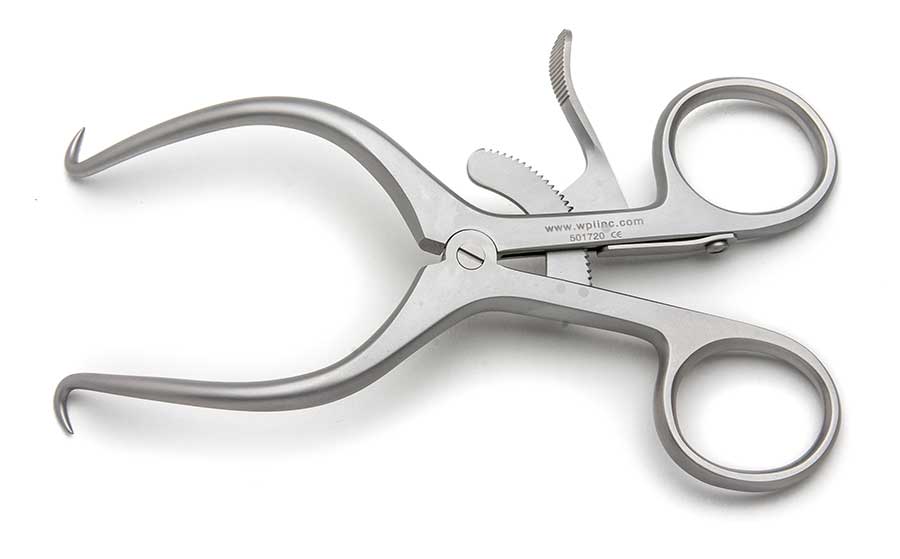
The Gelpi self-retaining retractor is a fundamental and specialized surgical instrument primarily designed to hold open a wound or surgical incision, providing continuous and stable exposure of the underlying anatomical structures. Unlike handheld retractors, which require an assistant to hold them, the Gelpi is “self-retaining,” meaning it locks in place once positioned, freeing up the surgical team’s hands. Its name is derived from its inventor, and it has become a staple in various surgical fields, particularly in orthopedic, spinal, and deep cavity procedures.
How it works
The Gelpi retractor operates on a simple yet effective spring-loaded pivot mechanism. It consists of two sharp, curved tips attached to arms that are connected at a central pivot point. When the surgeon squeezes the handles together, the tips separate. A locking mechanism, often a series of ratcheted teeth, engages automatically or manually to hold the retractor in this open position. This action pulls the edges of the incision apart and maintains that retraction until the surgeon releases the lock. This principle provides consistent, hands-free access to the surgical site.
Key Components
- Tips (or Blades): These are the sharp, pointed ends that are inserted into the tissue or筋膜 at the wound edges. They are designed to grip firmly without causing excessive trauma. They are typically fine and sharp for deep, focused exposure.
- Arms/Shanks: The long, slender bodies that connect the tips to the handle. They determine the depth the retractor can reach.
- Pivot Point (Fulcrum): The central joint where the two arms cross. This is the core of the scissor-like action that allows the tips to open and close.
- Ratchet/Locking Mechanism: Located on the handles, this is a set of interlocking teeth that engage as the handles are squeezed. It holds the retractor at the desired degree of opening until deliberately released.
- Handles/Finger Rings: The loops at the end of the instrument that the surgeon uses to apply and release pressure. They provide leverage for easy opening and secure closing.
2. Uses
Clinical Applications
The Gelpi retractor is used in any procedure where sustained, deep retraction is needed in a relatively confined space. Its applications include:
- Orthopedic Surgery: Crucial for exposing deep structures in spinal procedures (e.g., laminectomy, spinal fusion), hip and knee arthroplasties, and trauma surgery.
- Neurosurgery: Used to retract muscle and soft tissue to access the spine or skull.
- Vascular Surgery: Provides exposure for deep vessel repairs and bypass grafts.
- General Surgery: Occasionally used in deep abdominal or pelvic surgeries, though other broad-bladed retractors are more common for cavity work.
- Podiatric Surgery: Used in foot and ankle procedures for deep tissue retraction.
Who uses it
The primary users are:
- Surgeons: (Orthopedic, Neuro, Vascular, General)
- Surgical Assistants: (Physician Assistants, Registered Nurse First Assistants)
- Scrub Nurses/Technologists: Who prepare and pass the instrument to the surgeon.
Departments/Settings
- Operating Rooms (ORs) in hospitals and ambulatory surgical centers.
- Specialty Clinics with minor procedure rooms, particularly in orthopedics and podiatry.
3. Technical Specs
Typical Specifications
- Overall Length: Ranges from 15 cm (6 inches) to 25 cm (10 inches), with 18 cm (7 inches) being a common standard.
- Tip Sharpness: Extremely sharp to ensure minimal slippage and clean tissue penetration.
- Opening Width: Can typically achieve a spread of 5 cm to 10 cm (2 to 4 inches) between the tips when fully engaged.
Variants & Sizes
- Standard Gelpi: The classic design with sharp, single-point tips.
- Blunt Gelpi: Features slightly rounded or blunt tips to reduce the risk of neurovascular injury in delicate areas.
- Perineal Gelpi: A longer, more curved variant specifically designed for perineal and prostatic surgeries.
- Size Variations: Available in pediatric (smaller, finer) and adult sizes.
Materials & Features
- Materials: Almost exclusively made from medical-grade stainless steel (e.g., AISI 410, 420, or 316). This provides excellent strength, corrosion resistance, and the ability to withstand repeated sterilization.
- Features:
- Single-Piece Forging: High-quality Gelpis are forged from a single piece of steel for maximum durability and to prevent failure at the pivot point.
- Ratcheted Lock: Ensures secure holding power.
- Satfinish or Mirror Finish: A satin finish reduces glare under OR lights, while a mirror finish allows for easier cleaning.
Models
While often referred to generically, notable manufacturers have their own product lines, such as:
- Jarit Gelpi Retractor
- Miltex Gelpi Retractor
- Sklar Gelpi Retractor
4. Benefits & Risks
Advantages
- Hands-Free Operation: Liberates the surgical team, allowing for more efficient use of personnel.
- Consistent Exposure: Provides stable and unchanging retraction, which is crucial for delicate and lengthy procedures.
- Deep Wound Access: Its narrow profile and sharp tips are ideal for retracting deep tissue layers in confined spaces.
- Durability: Simple mechanical design with robust construction leads to a long operational lifespan.
- Cost-Effective: Relatively inexpensive and reusable thousands of times with proper care.
Limitations
- Localized Pressure: The sharp tips concentrate pressure on a small area, which can potentially lead to tissue trauma, ischemia, or nerve damage if placed incorrectly or with excessive force.
- Limited Field of View: Best for linear incisions; not suitable for retracting large tissue flaps or organs.
- Risk of Accidental Puncture: The exposed sharp tips pose a needlestick-like hazard to the OR staff during handling and passing.
Safety Concerns & Warnings
- Meticulous Placement: Tips must be placed under direct vision into stable tissue, avoiding nerves, blood vessels, and fragile organs.
- Avoid Over-Retraction: The ratchet should be engaged only to the point necessary for adequate exposure. Excessive force can tear tissue.
- Safe Handling: Always pass the retractor in a closed position, announcing “sharp!” to the receiver.
- Post-Procedure Inspection: The wound site should be inspected for any iatrogenic injury caused by the retractor tips.
Contraindications
There are no absolute medical contraindications, but its use is relatively contraindicated in:
- Extremely thin or compromised tissue that may necrose under the tip pressure.
- Surgical fields with a dense network of superficial nerves and vessels where placement cannot be guaranteed to be safe.
5. Regulation
As a simple, non-powered, reusable surgical instrument, the Gelpi retractor falls under low-risk regulatory categories globally.
- FDA Class: Class I (Exempt from premarket notification under 21 CFR 878.4800 – Surgical Instrument).
- EU MDR Class: Class I (Reusable surgical instrument, Rule 1).
- CDSCO Category (India): Class A (Low risk).
- PMDA Notes (Japan): Generally classified as a Class I “General Medical Device.”
- ISO/IEC Standards:
- ISO 13485:2016: Quality Management Systems for Medical Devices.
- ISO 7153-1: Specification for stainless steel used in surgical instruments.
- IEC 62366-1: Application of usability engineering to medical devices (for design and labeling).
6. Maintenance
Proper maintenance is critical for performance and patient safety.
Cleaning & Sterilization
- Point-of-Use Wipe: Immediately after use, wipe with a sterile water-moistened sponge to remove gross debris.
- Manual Cleaning: Clean thoroughly with a neutral pH enzymatic detergent, a soft brush, and lukewarm water. Pay close attention to the ratchet teeth and pivot point.
- Rinsing & Drying: Rinse thoroughly with distilled or deionized water. Dry completely with a lint-free cloth to prevent water spots and corrosion.
- Sterilization: Autoclaving is the preferred method. Use a steam sterilizer (autoclave) at a standard cycle (e.g., 132°C/270°F for 10-15 minutes). Ensure the ratchet is in the open position during sterilization to allow steam penetration.
Reprocessing
The Gelpi is designed for repeated reprocessing (cleaning, inspection, and sterilization). Inspect for damage (e.g., burrs on tips, worn or sticky ratchet, misalignment) after each cycle.
Calibration
No electronic or mechanical calibration is required. Functional “calibration” involves ensuring the ratchet mechanism holds securely without slipping and releases smoothly.
Storage
Store in a clean, dry, and temperature-controlled environment. It is best stored in a dedicated tray or rack, with the ratchet disengaged to maintain spring tension.
7. Procurement Guide
How to Select the Device
- Procedure Type: Choose standard, blunt, or perineal based on your surgical specialty.
- Size: Select length based on average incision depth (pediatric vs. adult).
- Ergonomics: The handles should feel comfortable and provide good leverage.
Quality Factors
- Material Integrity: Ensure it’s made from high-grade, rust-resistant stainless steel.
- Craftsmanship: Look for a smooth, seamless pivot point and finely sharpened, symmetrical tips.
- Mechanical Action: The ratchet should engage with distinct, audible clicks and release effortlessly.
Certifications
Purchase from suppliers who provide instruments from manufacturers with ISO 13485 certification and, where relevant, CE Marking or FDA Establishment Registration.
Compatibility
The Gelpi is a standalone instrument but is often part of a larger set (e.g., a major orthopedic set or a laminectomy set). Ensure the size and style match the other retractors and instruments in the set.
Typical Pricing Range
A single, high-quality, reusable Gelpi retractor typically costs between $80 and $250 USD, depending on the manufacturer, size, and vendor.
8. Top 10 Manufacturers (Worldwide)
- Johnson & Johnson (DePuy Synthes)
- Country: USA
- Profile: A global leader in medical devices, particularly in orthopedics and neurosurgery.
- Product Lines: DePuy Synthes orthopedic instruments.
- Medtronic plc
- Country: Ireland (operational headquarters in USA)
- Profile: A world leader in medical technology, with a strong focus on spinal and cranial procedures.
- Product Lines: Medtronic Spinal instruments.
- Stryker Corporation
- Country: USA
- Profile: A leading medical technology company with a broad portfolio, including orthopedics and neurosurgery.
- Product Lines: Stryker Spine and Orthopedics instruments.
- B. Braun Melsungen AG
- Country: Germany
- Profile: A major European provider of healthcare solutions, known for high-quality surgical instruments.
- Product Lines: Aesculap surgical instrumentation.
- Integra LifeSciences
- Country: USA
- Profile: Specializes in surgical instruments and neuroscience-focused products.
- Product Lines: Codman neurosurgical instruments.
- Sklar Surgical Instruments
- Country: USA
- Profile: A renowned manufacturer of precision surgical instruments for over 125 years.
- Product Lines: Sklar instrument catalog.
- Jarit Surgical Instruments
- Country: USA
- Profile: A specialized manufacturer of high-quality surgical instruments, particularly for minimally invasive and specialty procedures.
- Product Lines: Jarit instrument catalog.
- CareFusion (BD)
- Country: USA
- Profile: Now part of BD (Becton, Dickinson and Company), it provides instrumentation for infection prevention and surgical procedures.
- Product Lines: V. Mueller surgical instruments.
- Miltex (Integra)
- Country: USA
- Profile: Known for precision-crafted surgical and dissection instruments.
- Product Lines: Miltex instrument catalog.
- Surgical Holdings
- Country: UK
- Profile: A leading manufacturer and supplier of surgical instruments and sterilization equipment.
- Product Lines: Extensive range of general and specialty surgical instruments.
9. Top 10 Exporting Countries (Latest Year)
(Note: Based on HS Code 901890 for other surgical instruments and data trends.)
- United States: A dominant exporter of high-end, specialized surgical instruments.
- Germany: Renowned for precision engineering and high-quality steel instruments.
- Pakistan: A global hub for the manufacturing of surgical instruments, particularly in Sialkot.
- China: A major volume exporter, producing instruments across all price points.
- Japan: Known for high-quality, technologically advanced medical devices.
- Switzerland: Exports premium-precision instruments.
- United Kingdom: Home to several heritage and specialty instrument makers.
- France: Has a strong domestic medical device industry with significant exports.
- Ireland: Hosts numerous large medtech companies, making it a key export hub.
- Italy: Known for fine craftsmanship in surgical and diagnostic instruments.
10. Market Trends
Current Global Trends
- Rise of Minimally Invasive Surgery (MIS): While Gelpis are used in open surgery, the trend towards MIS drives demand for smaller, more specialized retractors.
- Focus on Cost-Efficiency: Hospitals are prioritizing durable, reusable instruments like the Gelpi over disposable versions to control long-term costs.
- Consolidation of Suppliers: Larger companies are acquiring smaller, specialized instrument makers.
New Technologies
- Enhanced Materials: Research into coatings (e.g., diamond-like carbon) to improve hardness, reduce friction, and enhance corrosion resistance.
- Ergonomic Designs: Improved handle designs with textured, non-slip grips to reduce surgeon fatigue.
Demand Drivers
- Aging Global Population: Increasing the volume of orthopedic and spinal surgeries (e.g., for osteoarthritis, degenerative disc disease).
- Growing Access to Healthcare: In emerging economies, leading to more surgical procedures.
- Advancements in Surgical Techniques: New procedures often still require fundamental instruments for exposure.
Future Insights
The Gelpi retractor will remain a staple in the OR for decades to come due to its timeless design. Future iterations may see incremental improvements in ergonomics and materials, but its core function is unlikely to be replaced. The market will continue to be driven by the steady demand for essential surgical tools.
11. Training
Required Competency
Competency involves knowledge of anatomy, surgical technique, and instrument handling. Trainees must understand:
- Correct placement and depth of insertion.
- Appropriate amount of retractive force.
- Safe handling and passing protocols.
Common User Errors
- Placing Tips Blindly: Risk of damaging underlying structures.
- Excessive Retraction: Using more ratchet clicks than necessary, causing tissue crush injury.
- Poor Handling: Passing the instrument with tips exposed, leading to staff injury.
- Incorrect Sizing: Using a tool that is too large or small for the incision.
Best-Practice Tips
- Visualize and Palpate: Always see and feel where the tip will be placed.
- “Walk” the Retractor: Engage the ratchet one click at a time while assessing exposure and tissue tension.
- Protect the Tips: Use radiopaque sponges or “tips guards” when not in use on the field.
- Inspect Before Use: A quick functional check of the ratchet and tips should be part of the pre-op setup.
12. FAQs
1. How is a Gelpi different from a Weitlaner retractor?
Both are self-retaining, but a Weitlaner has multiple, blunt, finger-like prongs on each side, creating a broader, shallower retraction. The Gelpi has two single, sharp points for deeper, more focused retraction.
2. Can the Gelpi retractor be used in superficial surgeries?
It can be, but it is over-engineered for most superficial work. A Weitlaner or a simple skin hook is often more appropriate to avoid unnecessary deep tissue trauma.
3. Is a disposable (single-use) Gelpi available?
Yes, some manufacturers produce single-use versions made of medical-grade plastic or lower-grade steel for specific infection control scenarios or in disposable procedure kits.
4. What should I do if the ratchet mechanism becomes stiff or slips?
Do not use it. A malfunctioning ratchet is a critical failure. The instrument should be removed from service and sent for repair or replacement.
5. How do I clean the difficult-to-reach pivot point?
Use a small, stiff brush (e.g., a toothbrush designated for instrument cleaning) and direct a stream of water and detergent through the joint during manual cleaning. Ultrasonic cleaners are also highly effective for this.
6. What is the typical lifespan of a Gelpi retractor?
With proper care, a high-quality Gelpi can last for thousands of cycles—essentially decades of use.
7. Why are the tips so sharp?
The sharpness allows for precise placement with minimal pushing and tearing of tissue. It helps the retractor grip firmly, preventing it from slipping out during a long procedure.
8. Can the Gelpi be used to retract bone?
No, its design is for soft tissue. Retracting bone requires different instruments like bone hooks or elevators.
13. Conclusion
The Gelpi self-retaining retractor is a testament to the power of simple, effective design in surgery. For over a century, its spring-loaded, sharp-tipped mechanism has provided surgeons with reliable, hands-free exposure in some of the most challenging deep-site procedures. Its durability, cost-effectiveness, and critical role in orthopedic, spinal, and neurosurgical operations ensure its continued place on the surgical tray. Mastery of this instrument—from understanding its mechanics and applications to adhering to strict safety and maintenance protocols—is a fundamental skill for any surgical professional involved in open procedures.
14. References
- U.S. Food and Drug Administration (FDA). (2023). Product Classification – Retractor. [Link to FDA Database]
- European Commission. (2017). Regulation (EU) 2017/745 on medical devices (MDR).
- International Organization for Standardization (ISO). (2016). ISO 13485:2016 – Medical devices — Quality management systems.
- Purdue University. (n.d.). Surgical Instrument Care Guide. [Online Resource]
- Geisler, J. W. (2019). Textbook of Orthopaedic Surgery Instruments. JP Medical Ltd.
- Association of periOperative Registered Nurses (AORN). (2021). Guidelines for Perioperative Practice.