1. Definition
What is an Orthopedic Plate Bender?
An orthopedic plate bender is a specialized surgical instrument designed to contour and shape metal bone plates during orthopedic, trauma, or reconstructive surgeries. Its primary function is to allow a surgeon to precisely bend a pre-manufactured metal plate so that it conforms perfectly to the unique anatomy of a patient’s bone. This precise contouring is critical for achieving optimal bone alignment, stable fixation, and successful healing. Without this tool, plates would sit awkwardly on bone surfaces, potentially leading to poor fixation, soft tissue irritation, delayed healing, or patient discomfort.
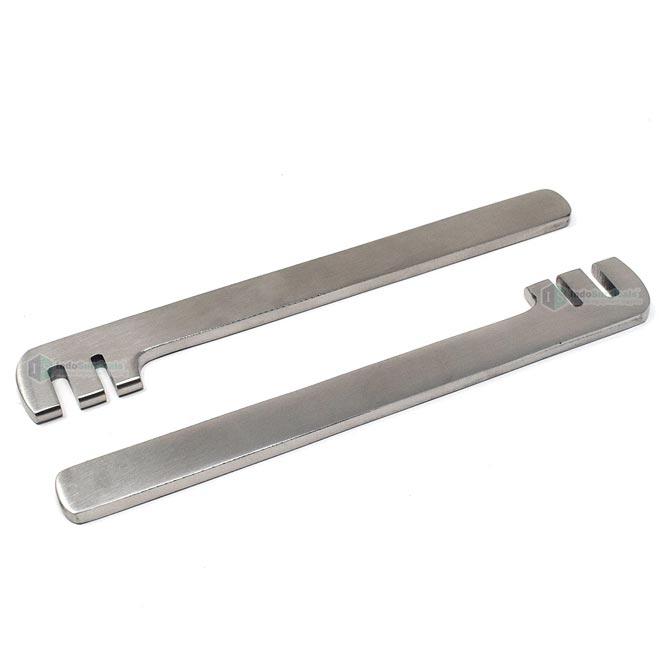
How it Works
The device operates on simple mechanical principles, primarily leveraging leverage and controlled force application. The bone plate is placed between specially designed jaws or anvils. The surgeon then applies manual force to the instrument’s handles. This force is transmitted through a geared mechanism or a simple pivot point, concentrating it onto a small, specific area of the plate. This causes the rigid metal to undergo plastic deformation—bending permanently—at the desired location. More advanced models allow for three-dimensional contouring, including twisting (torquing) the plate along its long axis.
Key Components
- Jaws/Bending Anvils: The core working ends of the instrument. They are specifically shaped (often with grooves or contours) to grip the plate securely and apply force without damaging its surface or the screw holes. Some have interchangeable heads for different plate types.
- Handles/Levers: Provide the surgeon with grip and mechanical advantage. Long handles increase leverage, allowing for easier bending of thicker, stronger plates.
- Pivot Point/Hinge: The fulcrum around which the handles and jaws rotate. Its design and placement determine the mechanical advantage and the smoothness of the bending action.
- Torque Mechanism (in Bender/Twisters): Found in combination instruments, this is a separate set of jaws or a grip that allows the application of rotational force to twist the plate.
- Locking Mechanism (in some models): A ratchet or lock that can hold a bend in place, allowing the surgeon to check the contour against the bone without losing the achieved angle.
- Scale/Protractor (in some models): A simple gauge to measure the angle of bend, providing quantitative feedback for symmetrical procedures (e.g., corrective osteotomies).
2. Uses
Clinical Applications
- Trauma Surgery: Contouring plates for fractures of long bones (femur, tibia, humerus), pelvic bones, and clavicles.
- Reconstructive Surgery: Shaping plates for corrective osteotomies (e.g., for limb deformity correction) or fracture non-unions.
- Orthopedic Oncology: Bending plates to fit after resection of bone tumors and reconstruction with grafts or prostheses.
- Spinal Surgery: While less common, specific plate benders are used for anterior cervical or thoracic spinal plates.
- Craniomaxillofacial (CMF) Surgery: Specialized, delicate benders are used to shape micro-plates for facial fractures and reconstructive procedures.
Who Uses It
Primarily orthopedic surgeons and trauma surgeons. In some settings, surgical assistants or scrub nurses may prepare (pre-bend) plates based on the surgeon’s instructions or using a sterilized model of the bone.
Departments/Settings
- Operating Rooms (OR) in hospitals and major trauma centers.
- Orthopedic Specialty Clinics with attached surgical facilities.
- Ambulatory Surgery Centers (ASCs) performing orthopedic procedures.
3. Technical Specs
Typical Specifications
- Size: Handheld instruments, typically 20-35 cm in length.
- Capacity/Bending Force: Rated for specific plate thicknesses (e.g., 1.0mm to 6.5mm systems). A bender for a 4.5mm LCDCP (Limited Contact Dynamic Compression Plate) is much heavier-duty than one for a 1.0mm mandibular plate.
- Bend Radius: The minimum radius a plate can be bent to without compromising its structural integrity.
Variants & Sizes
- Standard Plate Benders: For general long bone plates.
- Micro Plate Benders: For delicate CMF and hand surgery plates.
- Bender/Twister Combinations: Integrated tools that can both bend and twist plates.
- Precision Benders with Gauges: Feature angle measurement for high-accuracy corrective surgery.
- System-Specific Benders: Designed by implant manufacturers to work optimally with their specific plate geometry and metallurgy.
Materials & Features
- Materials: High-grade surgical stainless steel (e.g., AISI 420 or 17-4 PH) for durability, corrosion resistance, and ability to withstand repeated sterilization.
- Features: Ergonomic handles with knurling or grips for control; color-coded rings for quick size identification; passivation finish to enhance corrosion resistance; laser-etched markings for size.
Models
Notable models are often part of a manufacturer’s instrument set for a specific plating system (e.g., DePuy Synthes’ Bending Pliers and Bending Irons for their Locking Compression Plate (LCP) system, Stryker’s VariAx Bending Tools, Zimmer Biomet’s Bender for Periarticular Plates).
4. Benefits & Risks
Advantages
- Patient-Specific Contouring: Enables customized intraoperative fitting, leading to better anatomical reduction and stability.
- Improved Biomechanics: A well-contoured plate minimizes gaps, reduces stress on screws, and promotes even load sharing.
- Reduced Soft Tissue Irritation: A plate that lies flush to the bone is less likely to irritate overlying muscles, tendons, and nerves.
- Time Efficiency: Allows for rapid adjustment compared to ordering a custom-made plate.
- Cost-Effective: Utilizes standard inventory plates, avoiding the high cost of patient-specific implants for most cases.
Limitations
- Skill-Dependent: The quality of the bend is highly dependent on the surgeon’s skill and experience. Over-bending can weaken the plate.
- Work Hardening: Repeated bending at the same spot can make the metal brittle and prone to fracture—a phenomenon called “work hardening.”
- Not for All Plates: Some modern, highly complex anatomically pre-contoured plates are not designed to be bent further.
Safety Concerns & Warnings
- Metal Fatigue & Fracture: The primary risk is undetected micro-fractures or significant weakening of the plate due to improper bending technique. A fractured plate post-surgery is a severe complication.
- Screw Hole Deformation: Applying force incorrectly can distort the screw holes, preventing proper screw seating or locking mechanism engagement.
- Sharp Edges: Improper bending can create sharp edges that can damage soft tissues.
Contraindications
- The device should not be used on plates made from materials not intended for intraoperative contouring (e.g., some titanium alloys or composites with specific instructions).
- It should not be used to attempt to bend a plate through or across a screw hole, as this is a point of inherent weakness.
- Avoid bending the same segment of a plate more than 2-3 times to prevent work hardening.
5. Regulation
Plate benders are generally considered accessory instruments to the bone plates themselves.
- FDA Class: Typically Class I (exempt from premarket notification, 510(k)) as a manual surgical instrument. However, if sold as part of a specific plating system, it falls under the classification of the plate (usually Class II).
- EU MDR Class: Under EU MDR 2017/745, they are generally Class I devices.
- CDSCO Category: In India, they are categorized as Class A (low-risk) medical devices under the Medical Devices Rules, 2017.
- PMDA Notes: In Japan, they are treated as Class I medical devices, requiring notification to the PMDA.
- ISO/IEC Standards: Governed by ISO 13485 (Quality Management Systems) and specific standards for surgical instruments like ISO 7151:2016 (Surgical instruments – Non-cutting, articulated instruments).
6. Maintenance
Cleaning & Sterilization
- Point-of-Use Wiping: Wipe off blood and tissue immediately after use to prevent drying and corrosion.
- Cleaning: Thorough ultrasonic cleaning with enzymatic detergents is recommended to remove bioburden from hinges and jaw serrations.
- Sterilization: Autoclave sterilization (steam sterilization) is the standard method (e.g., 134°C for 3-5 minutes in a prevacuum cycle). Ensure instruments are dry before sterilization to prevent spotting.
Reprocessing
Inspect for debris after cleaning. Lubricate the hinge point periodically with a surgical instrument lubricant that is compatible with sterilization.
Calibration
No electronic calibration is needed. However, regular inspection for mechanical integrity is crucial. Check for:
- Loose or worn hinges
- Cracked or worn jaws
- Corrosion or pitting
- Proper alignment of jaws
Storage
Store in a clean, dry environment. Typically stored in instrument trays or sets within the sterile processing department. Avoid humid conditions.
7. Procurement Guide
How to Select the Device
- Compatibility: Ensure the bender is designed for the plate systems (brand, size, thickness) you most commonly use.
- Ergonomics: Test the handle comfort and required bending force. It should feel balanced and secure.
- Durability: Look for robust construction from reputable manufacturers.
- Functionality: Decide if you need a simple bender, or a bender/twister combo.
Quality Factors
- Finish: Smooth, polished surfaces without burrs or sharp edges.
- Mechanics: Smooth, precise action with no play or wobble in the hinge.
- Material Certification: Instruments should be made from certified medical-grade steel.
Certifications
Look for CE Marking (for EU), FDA Establishment Registration (for USA), and declaration of conformity to ISO 13485.
Compatibility
Must be physically and functionally compatible with your existing inventory of bone plates and other instrumentation trays.
Typical Pricing Range
Pricing varies widely. Individual benders can cost $200 – $800 USD. They are more commonly purchased as part of a full instrument set for a plating system, which can cost $2,000 – $15,000+ USD.
8. Top 10 Manufacturers (Worldwide)
- DePuy Synthes (Johnson & Johnson) – USA/Switzerland – The global leader in trauma, offers comprehensive bending iron sets for their vast LCP and other systems.
- Stryker Corporation – USA – Major player with bending tools for their VariAx, Gamma, and other trauma and joint systems.
- Zimmer Biomet – USA – Provides a wide range of orthopedic implants and corresponding contouring instruments.
- Smith & Nephew – UK – Offers bending tools for their PERI-LOC and other trauma plating systems.
- Medtronic – Ireland/USA – Through its spine business, provides benders for spinal plates and some trauma applications.
- aap Implantate AG – Germany – Specialized in trauma and biomaterials, with dedicated LOQTEQ system instruments.
- B. Braun Aesculap – Germany – Known for high-quality surgical instruments, including plate benders for their trauma line.
- Orthofix Medical Inc. – USA – Provides specialized benders for their limb reconstruction and trauma systems.
- Arthrex – USA – While strong in sports medicine, offers bending tools for their small bone and trauma fixation systems.
- Integra LifeSciences – USA – Through its Codman Neurosurgery and Orthopedics, offers benders for specialty plates.
9. Top 10 Exporting Countries (Latest Year)
(Based on HS Code 901890 for other instruments used in surgical operations)
- United States: Dominant exporter of high-value, branded orthopedic instrument sets.
- Germany: Renowned for precision surgical instrument manufacturing.
- Switzerland: Home to major players like Synthes (now J&J), with a strong export legacy.
- China: Major and growing exporter of cost-effective surgical instruments.
- United Kingdom: Hosts major players like Smith & Nephew.
- Japan: Exports high-quality precision instruments from companies like Mizuho.
- France: Home to players like Fixano and other instrument specialists.
- Italy: Known for fine surgical instrument craftsmanship.
- Pakistan: Sialkot is a globally significant hub for manufacturing basic surgical instruments.
- Ireland: Major medtech hub with significant exports from companies like Medtronic.
10. Market Trends
- Current Global Trends: Rising incidence of trauma and orthopedic disorders, growth in ambulatory surgery centers, and an aging population are driving steady demand.
- New Technologies: Patient-Specific Instruments (PSI) and 3D-printed pre-contoured plates are reducing, but not eliminating, the need for intraoperative bending for complex cases. However, the plate bender remains essential for intraoperative adjustments.
- Demand Drivers: Increasing volume of orthopedic surgeries globally; expansion of healthcare infrastructure in emerging markets.
- Future Insights: The plate bender will remain a fundamental, indispensable tool. Future evolution may include “smart” benders with integrated strain gauges to provide feedback on the degree of bend and warn of potential work hardening.
11. Training
Required Competency
Competency involves understanding metallurgy basics (work hardening), biomechanics of fixation, and hands-on skill in applying controlled, incremental force. Training is typically apprentice-based in surgical residencies and fellowships.
Common User Errors
- Bending Over a Screw Hole: Creates a focal stress riser. Always bend between holes.
- Using the Wrong Tool: Using a bender for a 3.5mm plate on a 4.5mm plate can damage both.
- “Kinking” the Plate: Applying force too aggressively, creating a sharp, weak angle instead of a smooth radius.
- Multiple Bends at Same Spot: Leading to work hardening and fracture.
Best-Practice Tips
- Plan the Bend: Visualize or trace the needed contour before bending.
- Bend Incrementally: Make small, sequential bends rather than one large bend.
- Use the Correct Fulcrum: Position the plate in the bender’s jaws so the bend occurs at the intended point.
- Check Frequently: Trial-fit the plate on the bone (or a sterilized bone model) often during the bending process.
12. FAQs
Q1: Can I bend any titanium bone plate?
A: Most, but not all. Always refer to the manufacturer’s instructions for use (IFU). Some highly engineered, pre-contoured titanium or composite plates are not designed for additional bending.
Q2: How many times can I safely bend a plate in the same area?
A: As a strict rule, avoid bending in the same spot more than 2-3 times. Each bend weakens the metal.
Q3: What’s the difference between a bender and a bender/twister?
A: A standard bender applies force perpendicular to the plate’s plane (creating an angle). A bender/twister has an additional mechanism to apply rotational force along the plate’s long axis, creating a twist.
Q4: Is it better to pre-bend a plate before surgery?
A: Pre-bending on a sterilized model of the patient’s anatomy (from CT scan) can save OR time. However, final adjustments are almost always needed intraoperatively.
Q5: What happens if a plate is over-bent?
A: Do not try to bend it back. This significantly increases the risk of work hardening and intraoperative or postoperative fracture. Discard it and use a new plate.
Q6: How do I clean bone fragments out of the bender’s jaws?
A: Use a stiff brush (e.g., a toothbrush designated for instrument cleaning) and an ultrasonic cleaner. Never use a metal tool that could scratch the precision surfaces.
Q7: Can plate benders be repaired if the hinge gets loose?
A: Often, yes. Many manufacturers or specialized surgical instrument repair services can re-tighten hinges and refurbish instruments at a fraction of the cost of replacement.
Q8: Are there disposable/plastic plate benders?
A: No. The forces required necessitate durable metal construction. They are always reusable instruments.
13. Conclusion
The orthopedic plate bender is a deceptively simple yet profoundly important tool in the armamentarium of the trauma and orthopedic surgeon. It represents the critical link between a standardized implant and the unique, complex geometry of the human skeleton. Its proper use demands not only manual skill but also a fundamental understanding of material science and biomechanics. While technological advancements like 3D-printed patient-specific implants are on the rise, the ability to intraoperatively customize fixation with a reliable plate bender remains an essential, cost-effective, and irreplaceable surgical skill. Mastery of this tool, coupled with adherence to maintenance protocols and safety principles, directly contributes to achieving stable fixation and optimal patient outcomes.
14. References
- AO Principles of Fracture Management (3rd Edition). Thieme, 2017.
- Handbook of Fractures (6th Edition). Wolters Kluwer, 2019.
- U.S. Food and Drug Administration (FDA). Classification of Medical Devices.
- European Commission. Regulation (EU) 2017/745 on medical devices (MDR).
- Central Drugs Standard Control Organization (CDSCO). Medical Device Rules, 2017.
- International Organization for Standardization (ISO). ISO 13485:2016 – Medical devices.
- Instrument Reprocessing Guidelines, Association of periOperative Registered Nurses (AORN).
- Manufacturer Instructions for Use (IFU) from DePuy Synthes, Stryker, Zimmer Biomet.