1. Definition
What is a Crash Cart (Emergency Trolley)?
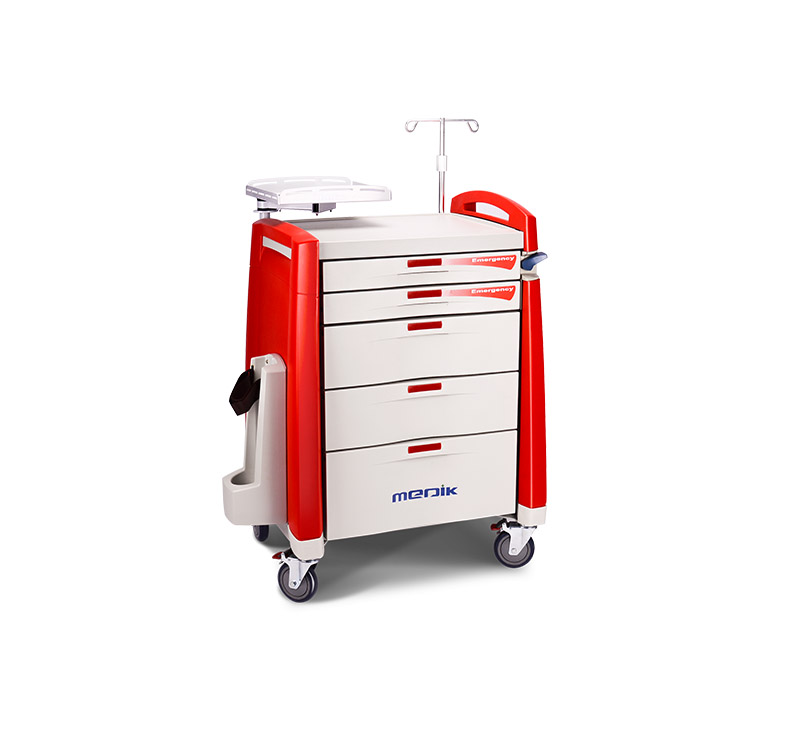
A crash cart, also known as an emergency trolley or code cart, is a specialized, mobile unit stocked with essential equipment, medications, and supplies required for advanced cardiac life support (ACLS), pediatric advanced life support (PALS), and other medical emergencies. It is a critical cornerstone of hospital emergency response systems, designed to be rapidly deployed to the bedside of a patient experiencing a life-threatening event such as cardiac arrest, respiratory failure, or severe trauma. Its primary function is to consolidate all necessary tools in one accessible, organized location to save crucial seconds during a crisis.
How it Works
The crash cart itself is a physical organizer and transporter. Its “working principle” is based on rapid accessibility and systematic organization. During an emergency (often announced as a “Code Blue” or “Code Red”), the cart is wheeled to the patient’s location. The standardized layout and clear labeling allow clinicians to intuitively find what they need without delay. It supports the structured algorithms of emergency protocols (like ACLS) by having the right drug, device, or piece of equipment available at the right moment, thereby facilitating a coordinated team response.
Key Components
A fully stocked crash cart is typically organized into drawers and external compartments with a standardized configuration. Core components include:
- Defibrillator/Monitor: Often mounted on top. Provides ECG monitoring, defibrillation, cardioversion, and sometimes pacing and non-invasive blood pressure monitoring.
- Medication Drawer: Contains pre-filled syringes and vials of emergency drugs. Common medications include:
- Adrenaline/Epinephrine (for cardiac arrest)
- Amiodarone (for arrhythmias)
- Atropine (for bradycardia)
- Sodium Bicarbonate (for metabolic acidosis)
- Adenosine (for SVT)
- Calcium Chloride
- Nitroglycerin (for angina/MI)
- Normal Saline for IV flush and dilution
- Airway Management Tray: Contains equipment for securing an airway:
- Laryngoscope handles and blades (various sizes)
- Endotracheal tubes (various sizes) and stylets
- Supraglottic airways (e.g., Laryngeal Mask Airway)
- Bag-Valve-Mask (Ambu bag) of adult, pediatric, and infant sizes
- Oxygen masks, nasal cannulas
- Suction catheters and a portable suction unit (sometimes mounted)
- IV Access & Fluids Drawer: Contains IV cannulas, extension sets, giving sets, IV poles (often attached to the cart), sterile dressings, and IV fluids (e.g., Normal Saline, Lactated Ringer’s).
- Procedure Tray: Holds supplies for invasive procedures: central line kits, chest tube trays, intraosseous access devices, sutures, and sterile gloves.
- Additional Equipment: May include a cardiac arrest board (for effective CPR), scissors for cutting clothing, flashlights, protective equipment (gloves, gowns, face shields), and documentation tools (code blue record, checklists).
2. Uses
Clinical Applications
Crash carts are used in any clinical scenario requiring immediate, protocol-driven intervention:
- Cardiopulmonary Resuscitation (CPR): The most common use, for patients in cardiac arrest.
- Acute Respiratory Distress/Failure: For rapid sequence intubation and ventilation support.
- Symptomatic Bradycardia/Tachycardia: To administer medications or provide electrical therapy.
- Severe Hypotension/Shock: For rapid fluid resuscitation and vasopressor administration.
- Acute Coronary Syndromes: To manage chest pain and arrhythmias.
- Anaphylaxis: For administering adrenaline and securing the airway.
- Major Trauma: For immediate access to fluids, airway equipment, and procedural trays.
- Pediatric Emergencies: Specialized pediatric crash carts contain age-appropriate drugs and equipment.
Who Uses It
Crash carts are used by a multidisciplinary emergency team, often referred to as the “code team”:
- Physicians (Emergency, Critical Care, Anesthesiologists, Cardiologists)
- Registered Nurses (often the first to initiate cart use)
- Respiratory Therapists (managing airway and ventilation)
- Pharmacists (assisting with drug preparation and dosing)
- Paramedics & Emergency Medical Technicians (in pre-hospital and ER settings)
Departments/Settings
- Hospitals: Emergency Departments (ED), Intensive Care Units (ICU), Cardiac Care Units (CCU), Operating Rooms (OR), Post-Anesthesia Care Units (PACU), general medical-surgical wards, and diagnostic areas (Radiology, Cath Lab).
- Outpatient Clinics & Surgical Centers: Especially those performing procedures with sedation.
- Dialysis Centers, Dental Clinics, and Rehabilitation Facilities: Where patients with significant comorbidities are treated.
- Sports Arenas and Large Public Venues: As part of their advanced medical response setup.
3. Technical Specs
Typical Specifications
- Dimensions: Height: ~1.2m – 1.5m; Width: ~0.6m – 0.8m; Depth: ~0.5m – 0.6m.
- Weight (Empty): 50-80 kg; (Fully Stocked): Can exceed 150 kg.
- Mobility: Four swivel casters, minimum two with locking brakes. Ergonomic push handles.
- Drawers: 4-8 drawers, often with customizable dividers and foam inserts for organization.
- Power: Equipped with electrical outlets for charging the defibrillator and other devices. May have a backup battery for mounted lighting.
Variants & Sizes
- Adult Crash Carts: Standard configuration for adult patients.
- Pediatric/Neonatal Crash Carts: Smaller, stocked with Broselow/Hinkle tape, and pediatric-specific drug dosages and equipment sizes.
- Anesthesia Carts (Anesthesia Workstations): Focused on advanced airway and anesthetic drugs.
- Massive Transfusion Carts: Designed specifically for trauma, stocked with blood products and rapid infusers.
- Wall-Mounted Crash Carts: For space-constrained areas like MRI suites or small procedure rooms.
- Disposable/Sealed Crash Carts: Used in isolation rooms; the entire sealed cart is exchanged after use.
Materials & Features
- Construction: High-grade, medical-grade stainless steel (304 or 316) for durability and easy cleaning. Aluminum for lighter models.
- Surfaces: Chemical-resistant, scratch-resistant powder coating.
- Features: One-handed drawer opening, soft-close mechanisms, clear, color-coded, and labeled drawers, transparent lids on medication trays, integrated sharps containers, waste bag holders, documentation clipboards, external oxygen tank holders, and modular designs for customization.
- Innovations: Smart Carts with RFID tracking of supplies, barcode scanners for medication verification, integrated tablets for accessing electronic health records (EHR) and drug libraries, and real-time inventory management systems linked to central supply.
Models
- HILL-ROM / BAXTER: Horizon™ and Advanta™ series are industry standards.
- Midmark: Alyne™ Mobile Workstations.
- Waterloo Healthcare: AFFINITY™ and E-Series Emergency Carts.
- Harloff: Various customizable emergency and anesthesia carts.
- JACO: Excel® and Ultra® series emergency carts.
(Note: Models vary greatly by region and hospital procurement contracts.)
4. Benefits & Risks
Advantages
- Time Efficiency: Saves critical minutes in life-threatening situations by centralizing resources.
- Organization & Standardization: Reduces cognitive load on staff, allowing them to focus on patient care.
- Improved Patient Outcomes: Directly contributes to higher survival rates from cardiac arrest by enabling prompt, effective intervention.
- Teamwork Facilitation: Serves as a physical and procedural hub for the code team.
- Safety: Built-in safety features like locked narcotic drawers and standardized drug concentrations reduce errors.
Limitations
- Static Resource: Can only be used where it is physically located or wheeled to.
- Restocking Burden: Requires meticulous, daily checks and post-use restocking to be ready for the next event.
- Cost: Initial investment and ongoing maintenance of equipment and stocked supplies are significant.
- Space: Requires dedicated storage space in easily accessible, uncluttered locations.
Safety Concerns & Warnings
- Outdated Supplies: The single greatest risk is expired medications or depleted batteries in equipment.
- Incorrect Stocking: Items placed in non-standard locations lead to dangerous delays.
- Clutter & Blockage: Carts stored in hallways or cluttered rooms may not be reachable in time.
- Equipment Failure: Defibrillator pads, laryngoscope bulbs, and suction units must be checked regularly.
- Security: Narcotics must be secured to prevent diversion.
Contraindications
A crash cart itself has no contraindications—its use is dictated by the patient’s condition. However, using adult-specific drugs and equipment on a pediatric patient from an adult cart is a critical error. Always use the age-appropriate cart.
5. Regulation
Crash carts as a system are typically not regulated as a single device. However, the individual medical devices and drugs on the cart are heavily regulated.
- FDA Class: Components like defibrillators are Class II or III devices. The cart itself, as furniture with drawers, is generally Class I (subject to general controls).
- EU MDR Class: Under EU MDR, crash carts could be classified as a system or procedure pack (Article 22). The classification depends on the highest class of device within the pack (e.g., if it contains a Class III device like certain defibrillators, specific rules apply).
- CDSCO Category (India): Individual components (defibrillators, IV sets) are licensed. The cart as a whole may be considered a “non-notified” medical device or fall under general standards for hospital furniture.
- PMDA Notes (Japan): Components require Shonin (approval). The assembly’s compliance would be assessed based on the regulations for its constituent parts.
- ISO/IEC Standards:
- ISO 23908: Sharps injury protection.
- IEC 60601-1: Safety of medical electrical equipment (for defibrillators, monitors).
- ISO 13485: Quality management systems for medical device manufacturers.
- ISO 7396-1: Medical gas pipeline systems (relevant if cart connects to hospital oxygen).
6. Maintenance
Cleaning & Sterilization
- Exterior & Drawers: Clean after every use and daily with hospital-grade disinfectant wipes. Pay attention to handles, drawer pulls, and casters.
- Internal Components: Non-disposable equipment (laryngoscope handles) must be removed, cleaned, and sterilized according to hospital protocol (often high-level disinfection or autoclaving).
- Spills: In case of blood/body fluid spill, clean with an approved tuberculocidal disinfectant.
Reprocessing
After a code, the entire cart must be reprocessed:
- Remove all used and opened supplies.
- Clean the cart thoroughly.
- Restock according to the master checklist.
- Check all equipment for function.
- Seal/secure the cart and document the check.
Calibration
- Defibrillator/Monitor: Requires regular scheduled calibration and performance verification per manufacturer instructions (often quarterly or annually) by biomedical engineering.
- Other Devices: Suction units, blood pressure cuffs may also have calibration requirements.
Storage
- Store in a designated, unobstructed, well-lit location marked with visible signage (e.g., “Crash Cart” or “Code Cart”).
- Ensure the storage area is temperature-controlled (as per drug storage requirements).
- The brakes should be locked when parked.
7. Procurement Guide
How to Select the Device
- Assess Needs: Determine primary use (Adult, Peds, Trauma, OR), expected frequency, and team size.
- Evaluate Ergonomics: Test maneuverability in tight spaces, drawer smoothness, and locking ease.
- Consider Customization: Look for modular drawers and adjustable dividers to fit your specific protocol.
- Integration: Can it seamlessly integrate with your existing defibrillator monitors and EHR systems?
- Durability: Check construction quality, weld points, and caster strength.
Quality Factors
- Smooth, quiet casters that can handle carpet and thresholds.
- Drawer suspension that allows full, one-handed access even when fully loaded.
- Clear, durable, and intuitive labeling system.
- Robust construction with rounded edges for patient and staff safety.
Certifications
Look for manufacturer certifications: ISO 13485, CE Marking (for EU), and FDA Registration. Ensure component devices are FDA-cleared/approved or CE-marked.
Compatibility
Verify mounting compatibility for your specific defibrillator/monitor models. Ensure drawer sizes accommodate your standard supply packaging.
Typical Pricing Range
- Basic Empty Cart: $1,500 – $3,000 USD.
- Fully Stocked Standard Cart (without top-mounted defibrillator): $5,000 – $15,000+ USD.
- High-End Smart Cart with integrated technology: $20,000 – $30,000+ USD.
(Defibrillator/monitors are purchased separately and can cost $15,000 – $30,000+)
8. Top 10 Manufacturers (Worldwide)
- Baxter International (Hillrom) (USA): Global leader post-acquisition, known for Horizon™ and Advanta™ carts. A standard in many hospitals.
- Stryker (USA): Major player in medical equipment, offering a range of emergency and hospital carts.
- Midmark Corporation (USA): Renowned for durable, ergonomic mobile workstations, including the Alyne™ series.
- Waterloo Healthcare (Canada): Specializes in healthcare carts, known for innovative designs like the AFFINITY™ EMS cart.
- Harloff Company (USA): Manufacturer of a wide variety of specialty carts for anesthesia, emergency, and procedure use.
- JACO Manufacturing (USA): Produces the Excel® and Ultra® series, focused on flexibility and durability.
- Armstrong Medical Industries (USA/UK): Known for simulation equipment and procedure carts, including the Code Runner™ system.
- Omnicell, Inc. (USA): While known for pharmacy automation, they offer medication management solutions integrated into emergency carts.
- InterMetro Industries (USA): Manufactures the Super Erecta® shelving system, often adapted for crash cart use, and specialized healthcare carts.
- Anetic Aid (UK): UK-based provider of a range of emergency, resuscitation, and procedure trolleys for the European market.
9. Top 10 Exporting Countries (Latest Year)
(Based on trade data for HS Code 9402 – Medical Furniture)
- United States: Dominant exporter of high-end, technologically integrated crash cart systems.
- Germany: Leading European exporter, known for precision engineering and compliance with stringent EU MDR.
- China: Major global supplier of cost-effective models and components, increasingly improving quality.
- Italy: Exports well-designed medical furniture and carts, strong in the European and Middle Eastern markets.
- Canada: Home to manufacturers like Waterloo, exporting durable carts, particularly to the US market.
- United Kingdom: Exports specialized carts and trolleys, with strength in Commonwealth markets.
- France: Exports medical equipment including crash carts, with a focus on design and ergonomics.
- Mexico: Growing exporter, often serving as a manufacturing hub for North American companies.
- Japan: Exports highly reliable, compact models, often with advanced integration features.
- India: Emerging as a significant exporter of competitively priced carts, serving South Asia, Africa, and the Middle East.
10. Market Trends
Current Global Trends
- Smart/Connected Carts: Integration of RFID, IoT sensors, and software for real-time inventory tracking, automatic expiration alerts, and restocking requests.
- Modularity & Customization: Hospitals demand carts tailored to specific departments (ED, ICU, Cath Lab).
- Focus on Ergonomics & Safety: Designs that reduce staff injury from pushing heavy loads and improve organization to prevent clinical errors.
New Technologies
- Augmented Reality (AR): Potential for AR glasses to guide less-experienced staff through drawer layouts during a code.
- AI-Powered Analytics: Using data from smart carts to analyze code response times, identify most-used supplies, and optimize stocking levels.
- Enhanced Integration: Direct interfacing between the defibrillator/monitor and the hospital’s EHR for automatic documentation of interventions.
Demand Drivers
- Aging Global Population: Increasing prevalence of chronic cardiac and respiratory diseases.
- Hospital Expansion & Renovation: Especially in emerging economies.
- Stringent Patient Safety Regulations: Mandating immediate access to resuscitation equipment.
- Rising Incidence of Out-of-Hospital Cardiac Arrests: Driving demand in clinics and public venues.
Future Insights
The crash cart will evolve from a passive storage unit to an active, intelligent participant in the resuscitation ecosystem. We will see greater predictive analytics, seamless documentation, and even robotic-assisted carts that can navigate to the code scene autonomously.
11. Training
Required Competency
All clinical staff must be trained on:
- Location: Knowing where every crash cart in their unit is stored.
- Operation: How to unlock it, open drawers smoothly, and access key compartments.
- Layout: Memorizing the standardized layout of drugs and equipment.
- Equipment Use: Competency in using the defibrillator/monitor, BVM, and suction unit.
- Restocking Procedures: Knowing how to report used supplies and perform basic checks.
Common User Errors
- Not Knowing the Layout: Fumbling through drawers during a code.
- Failure to Check: Not performing or documenting daily checks.
- Blocking Access: Storing personal items or other equipment on top of or in front of the cart.
- Not Calling for Help First: Focusing on getting the cart before activating the emergency response system.
- Ignoring Expiry Dates: Assuming someone else has checked them.
Best-Practice Tips
- Use the “ABC” Check: Perform a daily visual scan: Accessible, Blocked? (No), Complete? (Sealed, checklist signed).
- Standardize Everything: Use identical layouts and checklists across all carts in the facility.
- Implement a Reliable Check System: Use a colored tag system or digital log that is impossible to falsify.
- Simulate: Run regular mock codes using the actual cart to build muscle memory.
- Designate a “Cart Champion” on each unit for accountability.
12. FAQs
- Q: How often should a crash cart be checked?
- A: Every shift (at least daily) for seal integrity and general condition. A full inventory check against a checklist is typically done weekly.
- Q: Who is responsible for restocking the crash cart after a code?
- A: Usually the nursing staff from the unit where the code occurred, often with assistance from central supply or pharmacy for specialized items. A clear, facility-specific policy must exist.
- Q: Can we lock the crash cart?
- A: Yes, for security of controlled substances (narcotics). However, the main compartment must be instantly accessible in an emergency. Many carts have a break-glass mechanism, a simple numbered seal, or a lock with a universal code known to all staff.
- Q: What is the difference between a crash cart and an anesthesia cart?
- A: A crash cart is for broad emergencies (cardiac, respiratory arrest). An anesthesia cart is specifically stocked for planned and emergency anesthesia, with a wider array of anesthetic drugs, inhalation agents, and advanced airway tools.
- Q: Are crash carts used for COVID-19 or other isolation patients?
- A: Yes. In isolation rooms, a dedicated crash cart is placed inside or just outside the room. After use on an infectious patient, it may be quarantined, and a disposable/sealed cart system is ideal to minimize cross-contamination.
- Q: How do we manage crash cart supplies that expire frequently?
- A: Implement a “first-expiry, first-out” (FEFO) system. Use smaller package sizes if possible. Smart carts with RFID tracking can automate expiration alerts, sending them directly to pharmacy or supply chain.
- Q: What should you do if you discover an item missing during a code?
- A: Announce it clearly to the team lead so an alternative can be sourced immediately (e.g., “Epinephrine 1:10,000 not in drawer!”). After the code, this must be reported as a critical safety incident.
- Q: Are there crash carts for pediatric patients?
- A: Absolutely. This is non-negotiable. Pediatric crash carts use color-coded systems (like Broselow/Hinkle tapes) where each color corresponds to a drawer containing correctly sized equipment and pre-calculated drug doses for that weight/height range.
13. Conclusion
The crash cart is far more than a trolley with drawers; it is a vital, life-saving system at the heart of a hospital’s emergency response. Its effectiveness hinges not on advanced technology alone, but on the triad of meticulous organization, rigorous maintenance, and proficient staff training. From the basic stainless steel cart to the AI-integrated smart unit of the future, its core purpose remains unchanged: to deliver order, precision, and speed in the most chaotic and critical moments of patient care. Investing in the right cart, maintaining it flawlessly, and ensuring every team member knows its contents intimately is an investment in patient survival.
14. References
- American Heart Association. (2020). Advanced Cardiovascular Life Support (ACLS) Provider Manual.
- The Joint Commission. (2023). Hospital Accreditation Standards.
- U.S. Food and Drug Administration (FDA). Device Classification.
- European Commission. Medical Device Regulation (MDR) 2017/745.
- International Organization for Standardization (ISO). ISO 13485:2016 Medical devices — Quality management systems.
- Emergency Care Research Institute (ECRI). Guidelines for Emergency Department Crash Cart Configurations.
- World Health Organization (WHO). Emergency Triage Assessment and Treatment (ETAT) Guidelines.
- Market research reports from Grand View Research, Fortune Business Insights on the medical carts market.