1. Definition
What is a Kocher Forceps?
A Kocher forceps is a specialized surgical instrument primarily designed for grasping, holding, and retracting dense tissues. It is a type of hemostatic forceps, meaning its original and primary function is to clamp blood vessels to control bleeding (hemostasis) during surgical procedures. Named after the renowned Swiss surgeon, Dr. Emil Theodor Kocher (1841–1917), who pioneered its design, this instrument has become a fundamental and irreplaceable tool in surgical sets worldwide.
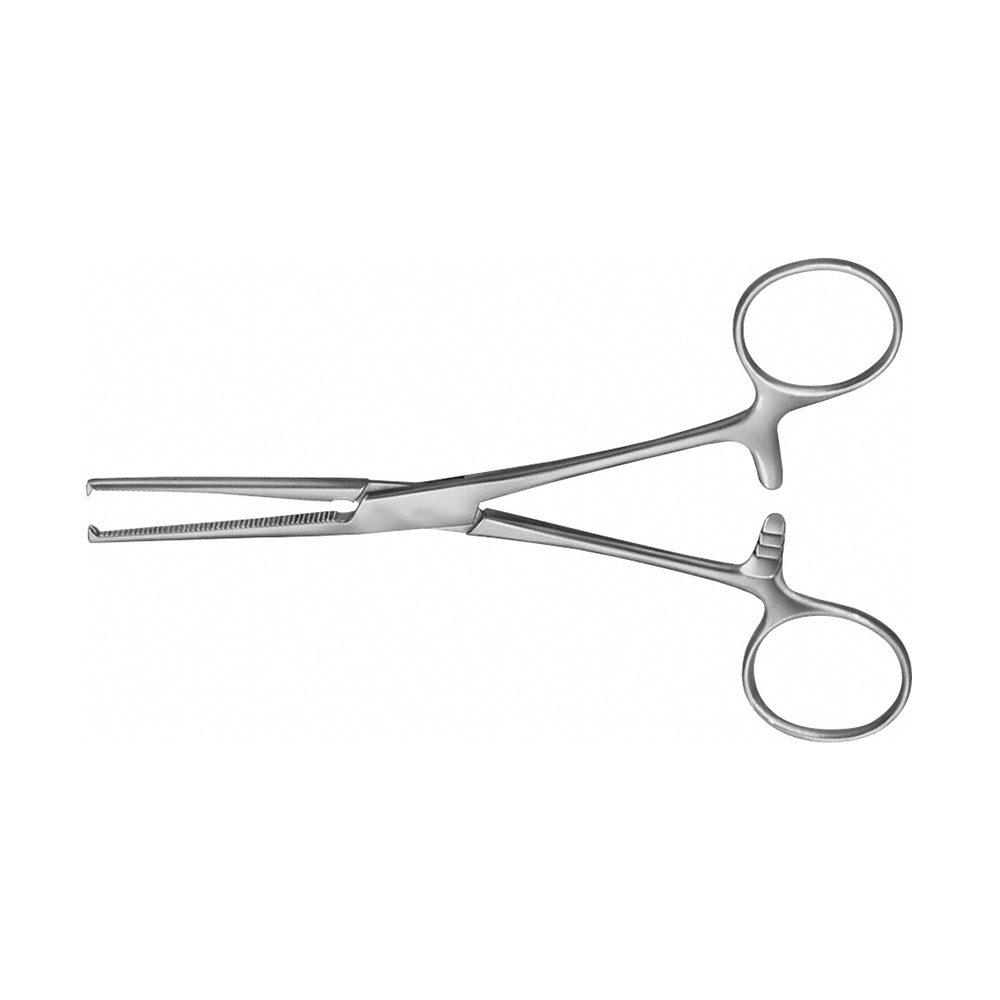
Its most distinguishing feature is the presence of sharp, interlocking teeth at the tip, which provides a secure, non-slip grip on tough tissues. This makes it exceptionally useful but also means it must be used with precision to avoid unnecessary tissue trauma.
How it Works
The working principle of the Kocher forceps is mechanical and straightforward. It operates on a simple lever and fulcrum system:
- The Handle: The surgeon applies pressure to the handles, or “finger rings,” with their fingers.
- The Ratchet: This pressure closes the jaws and engages a series of interlocking teeth, known as the ratchet. The ratchet locks the forceps into place, maintaining constant pressure without the surgeon needing to continuously squeeze the handles. This frees the surgeon’s hands for other tasks.
- The Jaws: The locked jaws firmly grasp the target tissue or structure. The teeth at the tip dig in slightly, preventing slippage even when pulling on resilient tissues like fascia, tendons, or large blood vessels.
- Release: To release, the surgeon simply applies a slight reverse pressure to disengage the ratchet, and the jaws spring open.
Key Components
- Jaws: The working end of the forceps. They are robust and feature 1×2 teeth (one tooth on one side fitting between two on the other) at the very tip. The part of the jaws just behind the teeth is often serrated to provide additional gripping surface.
- Shanks: The long, slender part connecting the jaws to the handle. They are designed to provide the necessary leverage for a firm grip.
- Ratchet (or Catch): A series of interlocking teeth located between the finger rings. It allows the instrument to be locked in a closed position at varying levels of tightness.
- Finger Rings (or Handles): The rings where the surgeon places their thumb and fingers (typically the ring finger) to operate the instrument. They are designed for a comfortable and secure grip.
- Box Lock: The pivotal joint where the two shanks meet. A high-quality box lock ensures smooth movement and long-term durability.
2. Uses
Clinical Applications
Kocher forceps are versatile, but their use is specific due to their traumatic nature:
- Hemostasis: The primary use is to occlude (clamp) medium to large-sized blood vessels before ligation (tying them off with suture). Its grip is secure enough to hold a vessel firmly while a suture is passed around it.
- Tissue Grasping and Retraction: Ideal for grasping and holding tough, fibrous tissues that are difficult to secure with smoother forceps. Common examples include:
- Fascia and aponeurotic layers during abdominal surgery.
- The breast tissue during a mastectomy.
- The uterine cervix.
- Dense scar tissue.
- Securing Surgical Drapes: In some instances, the forceps can be used to firmly attach sterile drapes to the skin at the edge of the surgical field, though towel clamps are more common for this purpose today.
Who Uses It
- Surgeons: Across all specialties, particularly General, Orthopedic, Trauma, and Gynecological surgeons.
- Surgical Assistants: To help with retraction and exposure of the surgical site.
- Scrub Nurses/Technicians: Who prepare the instrument set and may hand it to the surgeon.
Departments/Settings
- Operating Rooms (ORs): The primary location.
- Emergency Departments & Trauma Bays: For urgent procedures to control bleeding.
- Ambulatory Surgical Centers: For outpatient procedures.
- Labor & Delivery Suites: For certain obstetric procedures.
3. Technical Specs
Typical Specifications
- Length: Typically ranges from 14 cm (5.5 inches) to 25 cm (10 inches), with 18-20 cm being very common for general surgery.
- Tip Configuration: Characteristic 1×2 interlocking teeth.
Variants & Sizes
The main variants are defined by the pattern of the jaws:
- Straight Kocher: The jaws are straight from the shank. Best for superficial vessels and tissues.
- Curved Kocher: The jaws have a distinct curved profile. This is more common and versatile, allowing for easier access beneath vessels and around structures.
Materials & Features
- Materials: Primarily made from medical-grade Stainless Steel (ASTM Grade 410 or 420), which provides excellent strength, corrosion resistance, and the ability to withstand repeated sterilization.
- Finishes: Available in a standard polished finish or a matte (satin) finish to reduce glare from surgical lights.
- Features: Some modern versions may feature tungsten carbide inserts on the tips, which significantly increase durability and gripping power, reducing wear and tear.
Models
While often referred to generically, some manufacturers have specific model names, such as “Kocher Clamp,” “Kocher Intestinal Forceps,” or “Kocher-Roberts Forceps,” though the fundamental design remains consistent.
4. Benefits & Risks
Advantages
- Unmatched Grip: The toothed design provides the most secure grip of any hemostat, ideal for slippery or tough tissues.
- Secure Locking: The ratchet mechanism allows for hands-free operation once applied.
- Durability: Built from robust materials, it can last for decades with proper care.
- Versatility: A multi-purpose tool for clamping, grasping, and retracting.
Limitations
- Tissue Trauma: The primary limitation. The sharp teeth can crush, puncture, or devitalize tissue. It is not suitable for delicate tissues like bowel, blood vessels intended for repair (anastomosis), or any structure where a clean, non-crushed edge is crucial.
- Not for Fine Dissection: It is a gross grasping tool, not a precision instrument.
Safety Concerns & Warnings
- Avoid Delicate Tissues: Never use on intestine, ureter, nerves, or major blood vessels that are to be preserved.
- Correct Application: Apply only to the specific tissue intended. Accidental clamping of adjacent structures is a known surgical error.
- Instrument Passing: Should be passed to the surgeon in a manner that the curve (if curved) is oriented correctly for the intended use.
Contraindications
Kocher forceps are contraindicated for use on any delicate, friable, or vital tissue that could be irreparably damaged by its crushing grip.
5. Regulation
As a basic, manual surgical instrument with a long history of safe use, Kocher forceps are generally classified as low-risk devices.
- FDA Class: Class I. Exempt from premarket notification [510(k)] but subject to general controls (e.g., labeling, registration, Good Manufacturing Practices).
- EU MDR Class: Class I (under Rule 1 for non-invasive devices). Requires a CE marking based on a self-declaration of conformity for sterile devices, or full quality system assessment for reusable devices.
- CDSCO Category (India): Class A (low risk).
- PMDA (Japan): Generally classified as a “General Medical Device.”
- ISO/IEC Standards:
- ISO 13485: Quality Management Systems for Medical Devices.
- ISO 7151: Specific standard for surgical and dental instruments, particularly for materials and resistance to corrosion.
- ISO 17664: Provides guidance for the processing and sterilization of reusable medical devices.
6. Maintenance
Proper maintenance is critical for performance and patient safety.
Cleaning & Sterilization
- Point-of-Use Cleaning: Wipe with a sterile water-moistened sponge immediately after use to prevent blood and debris from drying.
- Transport: Send to the Central Sterile Services Department (CSSD) in a closed container.
- Cleaning: Thorough cleaning in an ultrasonic cleaner or washer-disinfector is essential to remove all bioburden from the box lock and ratchet.
- Inspection: Check for damage, rust, and proper alignment of the jaws and ratchet.
- Sterilization: Autoclave sterilization using steam under pressure (e.g., 121°C-135°C) is the standard and most effective method.
Reprocessing
Follow the manufacturer’s IFU (Instructions for Use) for detailed reprocessing steps. The instrument must be completely disassembled (if possible) or thoroughly cleaned, lubricated (with a water-soluble lubricant), and sterilized before each use.
Calibration
Unlike electronic devices, Kocher forceps do not require calibration. However, regular inspection for jaw alignment and ratchet function is a form of mechanical verification.
Storage
Store in a clean, dry, and climate-controlled environment. They are typically stored in perforated trays or sets, allowing for proper air circulation after sterilization.
7. Procurement Guide
How to Select the Device
- Procedure Type: Determine if straight or curved jaws are more applicable to your surgical specialty.
- Length: Choose a length that provides optimal reach and control for the intended procedures (e.g., longer for deep cavity surgery).
- Ergonomics: The finger rings should be comfortable and the instrument well-balanced in the hand.
Quality Factors
- Material Quality: Ensure it’s made from high-grade, corrosion-resistant stainless steel.
- Craftsmanship: The box lock should be smooth and free of play. The ratchet should engage and disengage easily and securely.
- Finish: A uniform, smooth finish without burrs or sharp edges on non-working surfaces.
Certifications
Look for suppliers that are ISO 13485 certified and whose products carry marks like CE (for Europe) and are registered with the FDA.
Compatibility
As a standalone manual instrument, it is universally compatible with all other surgical tools and systems.
Typical Pricing Range
A single Kocher forceps can range from $25 to $150 USD, depending on the manufacturer (e.g., budget Indian brand vs. premium German brand), material quality, and features (e.g., tungsten carbide tips increase the cost).
8. Top 10 Manufacturers (Worldwide)
- Johnson & Johnson (Ethicon) (USA): A global leader in surgical devices, known for high-quality, reliable instruments.
- B. Braun Melsungen AG (Germany): Renowned for precision German engineering and durability.
- Medtronic plc (Ireland/USA): Offers a wide range of surgical instruments through its various divisions.
- Integra LifeSciences (USA): A key player, especially in neurosurgery and reconstructive surgery instruments.
- Sklar Surgical Instruments (USA): A long-standing, trusted name in high-quality surgical instruments.
- Becton, Dickinson and Company (BD) (USA): Provides a comprehensive portfolio of surgical instruments.
- Symmetry Surgical (USA): Known for its own brands like ASSI (Accurate Surgical & Scientific Instruments), targeting high-precision needs.
- Rudolf Medical GmbH (Germany): A German manufacturer known for excellent craftsmanship.
- Surgical Holdings (UK): A major supplier and reprocessor of surgical instruments in the UK and beyond.
- GPC Medical Ltd. (India): A leading Indian manufacturer offering a cost-effective range of surgical instruments for the global market.
9. Top 10 Exporting Countries (Latest Year)
Based on analysis of global trade data for surgical instrument exports (HS Code 901890).
- Germany: The global leader in high-precision surgical instruments, synonymous with quality.
- United States: A major exporter of high-value, branded surgical devices.
- Pakistan (Sialkot): A world-renowned hub for the manufacturing of surgical instruments, offering a strong mix of quality and affordability.
- China: A dominant force in volume manufacturing, with quality rapidly improving in the mid-to-high range.
- Switzerland: Known for ultra-high-precision and specialized instruments.
- Mexico: A growing exporter, often serving as a manufacturing base for US companies.
- France: Home to several established medical device companies.
- United Kingdom: Exports niche and high-quality instruments.
- Italy: Known for design and craftsmanship in specialized areas.
- Japan: Exports high-quality, technologically advanced medical devices.
10. Market Trends
Current Global Trends
- Rising Surgical Volumes: An aging population and increased access to healthcare in developing nations are driving demand for all surgical instruments.
- Cost Pressure: Hospitals are balancing the need for high-quality instruments with budget constraints, benefiting manufacturers in Pakistan and China.
- Focus on Reprocessing: Increased emphasis on the longevity and easy reprocessing of reusable instruments to reduce costs and waste.
New Technologies
- Tungsten Carbide Inserts: Becoming more common in premium models for enhanced durability.
- Enhanced Ergonomics: Designs focused on reducing surgeon fatigue and the risk of repetitive strain injuries.
- Single-Use/Disposable Forceps: Gaining traction in specific scenarios to eliminate cross-contamination risks, though environmental concerns are a counter-trend.
Demand Drivers
- Increasing number of trauma and accident cases.
- Growth in orthopedic and gastrointestinal surgeries.
- Expansion of hospital infrastructure in emerging economies.
Future Insights
The Kocher forceps will remain a staple. Future developments may include more sophisticated ergonomic designs and the use of even more advanced, wear-resistant alloys. The market will continue to see a segmentation between premium, durable brands and cost-effective volume producers.
11. Training
Required Competency
Basic competency in surgical instrument handling is required. Surgeons and assistants must understand the instrument’s specific indications and the significant tissue trauma it can cause.
Common User Errors
- Using on the Wrong Tissue: Applying it to delicate structures like bowel or nerves.
- Improper Locking: Forcing the ratchet or applying excessive tightness, causing unnecessary crush injury.
- Poor Handling: Using it for tasks better suited to other instruments (e.g., tissue dissection).
Best-Practice Tips
- Respect the Teeth: Always assume the teeth will cause damage. Use it only when that level of secure grip is absolutely necessary.
- Check Function: Always check the ratchet and jaw alignment before use.
- Know Your Alternatives: Have a Babcock or Allis forceps for less traumatic grasping, or a smooth-jawed hemostat (like a Kelly or Crile) for finer work.
12. FAQs
1. What is the difference between a Kocher and a Kelly forceps?
A Kocher has teeth at the tip for a secure, non-slip grip on tough tissue. A Kelly forceps has horizontal serrations along the entire jaw but no teeth, making it less traumatic and more suitable for clamping smaller vessels and delicate tissues.
2. Can Kocher forceps be used on the intestine?
Absolutely not. The crushing action of the teeth would severely damage the intestinal wall, leading to leakage, peritonitis, and a high risk of post-operative complications.
3. Why are they sometimes called “Kocher clamps”?
The terms “forceps” and “clamp” are often used interchangeably for this type of instrument. “Clamp” emphasizes its role in occluding (clamping) vessels.
4. How do I choose between straight and curved?
Curved Kochers are more versatile for general surgery, as the curve allows you to get under vessels and around structures. Straight Kochers are used for more superficial, direct applications.
5. What does “1×2 teeth” mean?
It means one jaw has a single prominent tooth that fits securely between two smaller teeth on the opposing jaw when closed.
6. How long should a Kocher forceps last?
With proper care, cleaning, and sterilization, a high-quality Kocher forceps can last for 10-20 years or more.
7. What should I do if the ratchet becomes stiff or slips?
Do not use it. A malfunctioning ratchet is a critical failure. The instrument should be immediately removed from service and sent for repair or replacement.
8. Are there disposable Kocher forceps?
Yes, single-use versions made of medical-grade plastic or lower-grade steel exist and are used in certain settings to prevent disease transmission or for specific sterile procedures.
13. Conclusion
The Kocher forceps is a testament to timeless surgical design. For over a century, its simple yet effective mechanism has provided surgeons with an unparalleled ability to securely control bleeding and manage tough tissues. Its enduring presence in the operating room is a direct result of its reliability and specific utility. However, its power comes with responsibility; its traumatic nature mandates judicious and knowledgeable use. Understanding its proper applications, limitations, and maintenance is fundamental for any healthcare professional involved in surgical care, ensuring this classic instrument continues to serve patients safely and effectively for generations to come.
14. References
- American College of Surgeons. (2021). Surgical Instruments – A Pocket Guide.
- European Commission. (2017). Regulation (EU) 2017/745 on medical devices (MDR).
- U.S. Food and Drug Administration. (2020). Classify Your Medical Device.
- ISO 7151:2016. Surgical instruments — Metallic materials — Part 1: Stainless steel.
- Geis, W. P. (2018). The History of Surgical Instruments. Journal of the American College of Surgeons.
- UN Comtrade Database. (2023). Trade data for HS Code 901890.