1. Definition
What is a Laparoscopic Knot Pusher?
A laparoscopic knot pusher is a specialized surgical instrument designed to secure intracorporeal (inside the body) surgical knots during minimally invasive surgery (MIS). In open surgery, a surgeon’s fingers can easily tighten and push sutures down to the tissue. In laparoscopy, where access is through small ports, this is impossible. The knot pusher acts as an extension of the surgeon’s fingers, allowing them to manipulate, position, and tighten suture knots with precision and security deep within a body cavity. Its primary function is to ensure that ligatures and sutures are properly secured, which is fundamental to achieving hemostasis (control of bleeding) and approximating tissues for healing.
How it Works
The working principle is elegantly simple. A length of suture material is passed around the target tissue and an initial knot (often a half-hitch or a slip knot) is tied externally or internally. One end of the suture (the “post”) is threaded through the instrument’s tip, while the other end (the “loop”) remains free. The surgeon then inserts the knot pusher through a trocar port. By applying controlled, pushing pressure along the suture strand, the instrument guides the pre-tied knot down to the tissue site. Once the knot is snug against the tissue, the surgeon can tighten it further by pulling the free end of the suture while maintaining pressure with the pusher, creating a secure and reliable ligature.
Key Components
While designs vary, most knot pushers share three core components:
- Shaft: A long, slender, and rigid tube that traverses the trocar port. It is typically made of high-grade stainless steel and is available in various lengths (e.g., 30cm, 45cm) to accommodate different surgical depths and port sizes (typically 5mm).
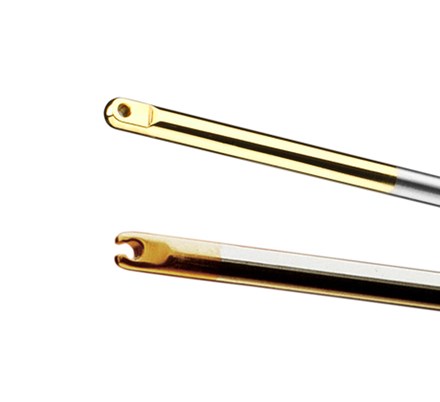
- Tip/End-Effector: This is the functional part of the instrument that contacts the knot. Common tip designs include:
- Closed Loop/Eyelet: A small hole through which the suture is threaded. It provides excellent control and prevents the suture from slipping off.
- Open Slot/Groove: A C-shaped or slotted tip that allows for quick loading and unloading of the suture without threading.
- Flat/Spatulated Tip: A smooth, flat end used to push flat or slip knots without catching.
- Handle: The proximal end held by the surgeon. It is usually ergonomically designed for a secure and comfortable grip, allowing for precise control during the pushing and tightening maneuver. Some advanced models may feature a ratcheting or locking mechanism for even greater control.
2. Uses
Clinical Applications
The knot pusher is indispensable in any laparoscopic procedure that requires suturing. Key applications include:
- General Surgery: Laparoscopic cholecystectomy (gallbladder removal), appendectomy, hernia repair (inguinal, ventral, hiatal), and fundoplication for GERD.
- Gynecological Surgery: Laparoscopic hysterectomy, myomectomy (removal of fibroids), tubal anastomosis, and treatment of endometriosis.
- Urological Surgery: Laparoscopic nephrectomy, pyeloplasty (repair of kidney obstruction), and prostatectomy.
- Bariatric Surgery: Gastric bypass and sleeve gastrectomy, where reinforcing sutures are often placed.
- Pediatric Surgery: For minimally invasive procedures in children, requiring smaller, more delicate instruments.
Who Uses It
This instrument is primarily used by surgeons trained in advanced laparoscopic techniques, including general surgeons, gynecologists, urologists, and bariatric surgeons. Surgical assistants and scrub nurses are also trained in its function to properly prepare and hand it to the surgeon, often pre-loading the suture to optimize operating room efficiency.
Departments/Settings
The primary setting is the Operating Room (OR) within hospitals and ambulatory surgical centers. It is a staple instrument in departments specializing in Minimally Invasive Surgery, General Surgery, Gynecology, Urology, and Bariatric Surgery.
3. Technical Specs
Typical Specifications
- Shaft Length: 30 cm, 35 cm, 45 cm (standard adult lengths).
- Shaft Diameter: 5 mm is the most common, fitting standard trocars. 3 mm and 10 mm variants exist for specific applications.
- Working Length: The functional length from the handle to the tip.
- Tip Design: Closed eye, open slot, or spatulated.
Variants & Sizes
Variants are primarily distinguished by their tip design and shaft configuration:
- Standard Straight Pusher: The most common type.
- Curved/Articulating Pusher: Features a curved shaft or tip to access difficult angles.
- Disposable vs. Reusable: Reusable pushers are made of durable stainless steel. Single-use, disposable pushers are made of medical-grade plastic, eliminating reprocessing costs and cross-contamination risks.
- Diameter-Specific: Micro-pushers for 3mm ports used in pediatric or microsurgery, and larger 10mm pushers for heavier sutures.
Materials & Features
- Materials: 304 or 316L Stainless Steel (for reusables), often with an anodized or electropolished finish for corrosion resistance and smooth operation. Disposable models use rigid, medical-grade polymers.
- Features: Ergonomic handle designs, laser-etched measurement markings on the shaft, and color-coded handles for easy size identification.
Models
While often sold as part of a laparoscopic instrument set, notable product lines come from manufacturers like:
- Medtronic: Endo Stitch™ assisted suturing system (includes knot pushing functionality).
- Johnson & Johnson (Ethicon): Various reusable and disposable knot pushers.
- Applied Medical: Suture and knot management products.
- B. Braun: Aesculap® laparoscopic instrument series.
4. Benefits & Risks
Advantages
- Essential for MIS: Enables secure knot tying where manual tying is impossible.
- Precision & Control: Allows for fine-tuned tension application, preventing overly tight knots that can necrose tissue or loose knots that fail.
- Efficiency: Significantly reduces the time required to secure intracorporeal knots compared to manual techniques.
- Versatility: Can be used with a wide variety of suture materials.
Limitations
- Learning Curve: Requires significant practice and skill to use effectively without breaking sutures or tying insecure knots.
- Suture Friction: Can generate heat and friction, potentially weakening certain monofilament sutures if not used correctly.
- Limited to Suturing: Its utility is confined to procedures involving suturing.
Safety Concerns & Warnings
- Suture Breakage: Excessive force can break the suture, potentially causing the knot to fail and leading to bleeding or leakage.
- Tissue Trauma: An improperly controlled tip can lacerate or puncture adjacent delicate tissues or vessels.
- Instrument Damage: The slender shaft can be bent or damaged if mishandled.
- Sterility Breach: For reusable models, improper cleaning and sterilization can lead to surgical site infections.
Contraindications
There are no direct medical contraindications for the device itself. Its use is contraindicated in any procedure where the surgeon lacks the necessary skill to perform laparoscopic suturing and knot tying safely.
5. Regulation
As a surgical instrument, the knot pusher is subject to regulatory oversight to ensure safety and performance.
- FDA Class: Typically classified as a Class I medical device (exempt from premarket notification [510(k)]), as it is a manual surgical instrument with a well-established technology.
- EU MDR Class: Under the European Union Medical Device Regulation, it is generally classified as Class I, reusable (Rule 13), which requires stricter post-market surveillance and technical documentation than non-reusable Class I devices.
- CDSCO Category: In India, the Central Drugs Standard Control Organization typically classifies it under Class B (moderate-low risk).
- PMDA Notes: In Japan, the Pharmaceuticals and Medical Devices Agency regulates it as a Class I medical device, requiring certification from a Registered Certified Body.
- ISO/IEC Standards:
- ISO 13485: Quality Management Systems for Medical Devices.
- ISO 7153-1: Materials for surgical instruments – Part 1: Metals.
- ISO 17664: Processing of re-usable medical devices.
- IEC 60601-1: Safety and essential performance of medical electrical equipment (if part of an electromechanical system).
6. Maintenance
Proper maintenance is critical, especially for reusable instruments.
- Cleaning & Sterilization: Immediate point-of-use cleaning is vital to prevent bio-material from hardening. This should be followed by thorough manual or ultrasonic cleaning in an enzymatic detergent. Sterilization is achieved via autoclaving (steam sterilization at 121-134°C) as per the manufacturer’s instructions.
- Reprocessing: For reusable models, the entire lifecycle from cleaning, inspection, lubrication (if required), packaging, to sterilization must be documented and validated.
- Calibration: Knot pushers are not typically calibrated devices like force gauges. However, they require regular functional inspection to ensure the tip is not burred, the shaft is not bent, and there are no cracks or signs of fatigue.
- Storage: Should be stored in a clean, dry environment, often in protective trays or containers to prevent damage to the delicate tip and shaft.
7. Procurement Guide
How to Select the Device
- Procedure Type: Consider the surgical specialty (e.g., gynecology may prefer finer tips, while bariatric surgery may require longer shafts).
- Tip Design: Choose between closed-loop (secure) and open-slot (fast-loading) based on surgeon preference and suture type.
- Reusable vs. Disposable: Weigh the upfront cost of reusables against the recurring cost and convenience of disposables, including reprocessing expenses.
- Ergonomics: The handle should be comfortable and provide a non-slip grip, even when wet.
Quality Factors
- Durability: For reusables, look for a single-piece construction or robust welding points.
- Finish: A smooth, electropolished finish reduces suture drag and corrosion.
- Precision: The tip should be perfectly formed with no sharp edges or burrs.
Certifications
Ensure the device has CE Marking (for Europe), FDA Clearance/Registration (for USA), and is compliant with relevant ISO standards, particularly ISO 13485.
Compatibility
Must be compatible with the hospital’s standard trocar sizes (e.g., 5mm) and sterilization systems.
Typical Pricing Range
- Reusable Knot Pusher: $150 – $400 per unit.
- Disposable Knot Pusher: $25 – $75 per unit.
- Pricing varies significantly based on manufacturer, brand, design complexity, and geographic region.
8. Top 10 Manufacturers (Worldwide)
- Medtronic plc (Ireland/USA): A global leader in medical technology, offering a comprehensive portfolio of laparoscopic instruments, including those under the Covidien brand.
- Johnson & Johnson (Ethicon Inc.) (USA): A pioneer in surgical sutures and staplers, with a vast array of knot pushers and laparoscopic devices.
- B. Braun Melsungen AG (Germany): Known for its high-quality Aesculap surgical instruments and extensive line of laparoscopic products.
- Stryker Corporation (USA): A major player in minimally invasive surgery with a strong portfolio of endoscopic and laparoscopic equipment.
- Olympus Corporation (Japan): Primarily known for endoscopes, but also a significant manufacturer of related laparoscopic surgical instruments.
- ConMed Corporation (USA): Specializes in surgical and patient monitoring products, offering a range of laparoscopic hand instruments.
- Applied Medical Resources Corporation (USA): Known for innovative trocars and vessel sealing systems, with dedicated suture management devices.
- CooperCompanies (CooperSurgical) (USA): A key supplier in the gynecological surgery market, providing specialized laparoscopic instruments.
- KARL STORZ SE & Co. KG (Germany): A renowned family-owned company famous for its endoscopes and complementary laparoscopic instrument sets.
- Richard Wolf GmbH (Germany): A leading manufacturer of endoscopy and MIS equipment, known for robust and reliable surgical instruments.
9. Top 10 Exporting Countries (Latest Year)
(Based on HS Code 901890 – Instruments and appliances used in medical sciences)
- United States: A dominant exporter of high-value, branded medical devices and surgical instruments.
- Germany: Renowned for precision engineering and high-quality surgical tools from companies like B. Braun, KARL STORZ, and Richard Wolf.
- Ireland: A major hub for medtech, largely due to the presence of Medtronic’s operational headquarters.
- Japan: Home to Olympus and other precision manufacturers, with a strong export market in Asia and globally.
- Mexico: A key manufacturing and export hub for the North American market, supplying many major US companies.
- China: A growing exporter of both low-cost and increasingly mid-to-high-tier medical instruments.
- Switzerland: Known for high-precision manufacturing and niche surgical instrument companies.
- France: Hosts several major medical device companies and has a strong domestic manufacturing base.
- United Kingdom: Despite Brexit, remains a significant player in the European and global medtech landscape.
- Netherlands: A key European logistics and distribution hub, facilitating re-exports of medical devices.
10. Market Trends
Current Global Trends
- Rise of Minimally Invasive Surgery: The global shift towards MIS is the primary driver for all laparoscopic instruments, including knot pushers.
- Cost-Pressure & Value-Based Healthcare: Hospitals are scrutinizing costs, boosting the market for high-quality reusables and cost-effective disposable options.
- Ambulatory Surgical Centers (ASCs): The growing number of procedures performed in ASCs increases demand for reliable, efficient laparoscopic tools.
New Technologies
- Robotic-Assisted Surgery: While robotic systems often have integrated knot-tying capabilities, manual knot pushers are still used in hybrid procedures and for training.
- Advanced Materials: Coatings like Parylene or Diamond-Like Carbon (DLC) are being explored to reduce friction and enhance durability.
- Articulating Instruments: Knot pushers with articulating tips are emerging, offering greater dexterity in complex anatomies.
Demand Drivers
- Increasing prevalence of conditions requiring surgery (hernias, obesity, cancers).
- Surgeon training and proficiency in advanced laparoscopic techniques.
- Patient preference for less painful, shorter-recovery procedures.
Future Insights
The market for knot pushers will remain stable and grow in parallel with laparoscopic surgery. The future may see a bifurcation: a market for sophisticated, connected instruments and a parallel market for ultra-low-cost, high-volume disposables. Integration with surgical simulation for training purposes will also become more critical.
11. Training
Required Competency
Surgeons must be proficient in:
- Fundamental laparoscopic skills (hand-eye coordination, depth perception).
- Intracorporeal and extracorporeal knot-tying techniques.
- Specific manipulation of the knot pusher, including loading the suture and applying appropriate tension.
Common User Errors
- “Sawing” Motion: Rubbing the suture against the tissue or trocar valve, which can fray or break it.
- Insufficient Tension: Failing to fully tighten the knot, leading to post-operative failure.
- Excessive Force: Applying too much pressure, leading to suture breakage or tissue damage.
- Misloading the Suture: Incorrectly threading the instrument, causing the knot to slip or jam.
Best-Practice Tips
- Practice Extensively: Use laparoscopic trainers and simulation boxes to build muscle memory.
- Maintain a Straight Line: Try to keep the knot pusher, suture, and tissue in a straight line to minimize friction.
- Use the “Follow-Through” Technique: After pushing the knot down, continue the motion slightly to ensure it is fully seated before tightening the final throw.
- Alternate Directions: When tying multiple half-hitches, alternate the direction of each throw to create a square knot, which is more secure.
- Inspect the Instrument: Always check the tip for burrs or damage before use.
12. FAQs
1. What is the difference between an open-slot and a closed-eye knot pusher?
An open-slot allows for quick loading/unloading of the suture, ideal for efficiency. A closed-eye provides more secure control and is less likely to lose the suture during manipulation but requires threading.
2. Can I use any suture with a knot pusher?
Most common sutures (both braided and monofilament) can be used. However, braided sutures may handle better due to less “memory,” while slick monofilaments require more careful control to prevent slipping.
3. How many times can a reusable knot pusher be sterilized?
A high-quality reusable knot pusher can withstand hundreds of sterilization cycles if handled and reprocessed correctly. Always refer to the manufacturer’s stated lifecycle.
4. My suture keeps breaking. What am I doing wrong?
This is often due to excessive force, a “sawing” motion that weakens the suture, a damaged/burred tip on the pusher, or using a suture material that is too fine for the application.
5. Is a disposable or reusable knot pusher better?
It depends on your priorities. Reusables have a higher upfront cost but can be more cost-effective over time. Disposables offer guaranteed sterility, no reprocessing burden, and are often preferred in cost-containment models.
6. Can a knot pusher be used in robotic surgery?
Typically, no. Robotic systems like the da Vinci® have specialized needle drivers and software that facilitate knot tying. A manual knot pusher is not compatible with the robotic arms.
7. What is the most critical step in using a knot pusher?
Ensuring the first knot (the first “throw”) is properly set with the correct tension. A poorly set first knot is very difficult to correct with subsequent throws.
8. How do I clean a reusable knot pusher?
Clean immediately after use. Flush any lumens, brush the tip and shaft under running water with an enzymatic detergent, and then place it in an ultrasonic cleaner before final rinsing and sterilization.
13. Conclusion
The laparoscopic knot pusher is a deceptively simple yet fundamentally critical instrument in the armamentarium of the modern surgeon. It bridges the gap between the need for secure tissue approximation and the physical constraints of minimally invasive surgery. Mastery of this tool, combined with an understanding of its proper selection, maintenance, and associated techniques, is essential for ensuring positive patient outcomes in a wide range of surgical disciplines. As MIS continues to evolve, the knot pusher will remain an enduring symbol of surgical precision and adaptability.
14. References
- Medtronic. (2023). Laparoscopic Instrument Catalog.
- Ethicon, Inc. (2022). Suture Manual: The Use and Handling of Sutures and Needles.
- European Commission. (2017). Regulation (EU) 2017/745 on Medical Devices (MDR).
- U.S. Food and Drug Administration. (2022). Classify Your Medical Device.
- International Organization for Standardization. (2016). ISO 13485:2016 – Medical devices — Quality management systems.
- Szabo, Z., & Berci, G. (2019). Surgical Laparoscopy. Wiley-Blackwell.
- UN Comtrade Database. (2023). HS Code 901890 – Trade Statistics.