1. Definition
What is Babcock Forceps?
Babcock forceps are a specialized type of non-crushing, atraumatic surgical instrument primarily used for grasping and manipulating delicate tissues, particularly hollow organs and soft structures like the intestine, fallopian tube, ureter, and appendix. They are a staple in both open and minimally invasive surgical sets. Unlike other grasping forceps that have teeth or serrated jaws, the Babcock forceps are designed to hold tissue securely without causing puncture, crushing, or ischemic damage (damage due to lack of blood flow), making them indispensable for procedures where tissue integrity is paramount.
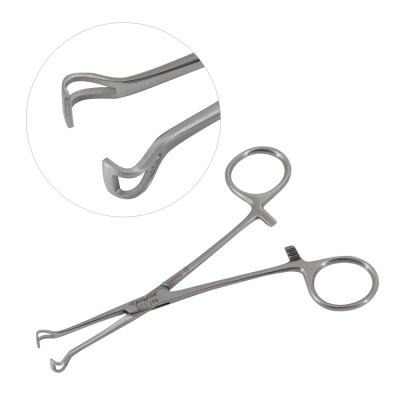
How it works
The working principle of Babcock forceps is based on atraumatic, compressive grasping. The instrument functions like a pair of pliers with a locking mechanism.
- The surgeon squeezes the finger rings at the handle, which pivots the shanks and opens the unique jaw tips.
- The delicate tissue is positioned within the open jaws.
- Releasing the handle allows the spring-loaded mechanism to close the jaws gently but firmly around the tissue.
- A ratchet lock on the handle can be engaged to hold the tissue in place without the surgeon maintaining constant manual pressure. The rounded, fenestrated (windowed) jaws distribute pressure over a wider surface area, preventing a concentrated, crushing force on the tissue.
Key Components
- Jaws: The most distinctive feature. They are rounded, smooth, and contain a fenestration (oval window). This design maximizes grip on slippery or delicate tissues while minimizing trauma.
- Shanks: The long, slender part connecting the handles to the jaws. They can be straight or curved, determining the angle of access to the surgical site.
- Box Lock: The pivotal joint where the two shanks meet. This robust hinge is engineered for smooth action and long-term durability.
- Handles/Finger Rings: The part held by the surgeon. The rings provide a secure grip for precise control.
- Ratchet: A interlocking teeth mechanism located on the handles. It allows the forceps to be locked in a closed position at varying degrees of tightness, providing hands-free stability during tissue manipulation.
2. Uses
Clinical Applications
Babcock forceps are versatile and used across numerous surgical disciplines:
- General and Gastrointestinal Surgery: For handling the bowel (small and large intestine), appendix, and stomach during resection, anastomosis (reconnection), or biopsy. Their non-crushing nature is critical to prevent post-operative leaks.
- Gynecological Surgery: For gently grasping the fallopian tubes (e.g., during tubal ligation), uterus, and ovaries. This is essential in procedures like hysterectomies or treatments for ectopic pregnancy.
- Urological Surgery: For manipulating the ureter and bladder without causing stenosis (narrowing) or damage to these sensitive tubular structures.
- Cardiothoracic and Vascular Surgery: For handling blood vessels, veins used for grafts (like the saphenous vein), and other delicate mediastinal tissues.
- Laparoscopic Surgery: Longer, shafted versions (often called Babcock graspers) are used in keyhole surgery to retract and position organs like the gallbladder or intestine through small incisions.
Who uses it
- Surgeons (General, Colorectal, Gynecological, Urological, Cardiothoracic, Vascular)
- Surgical Assistants
- Operating Room Nurses (for setup and passing)
Departments/Settings
- Operating Rooms (OR)
- Ambulatory Surgical Centers (ASCs)
- Labor and Delivery Suites
- Specialized Procedure Rooms in hospitals
3. Technical Specs
Typical Specifications
- Length: Ranges from 15 cm (6 inches) for superficial work to 30 cm (12 inches) or more for deep-cavity surgery. Laparoscopic versions can be 35-45 cm.
- Tip Width: The jaw width is typically between 10-15 mm.
Variants & Sizes
- Straight: For general use and superficial tissues.
- Curved: (e.g., 45° or 90° curve) for reaching around structures or working in deep anatomical planes.
- Length: Short, medium, long, and extra-long to suit different surgical depths.
- Laparoscopic: Shafted instruments with a handle mechanism that actuates the jaw at the distal end, available in 5mm and 10mm diameters.
Materials & Features
- Materials: Most are manufactured from high-grade, medical-grade stainless steel (e.g., AISI 410, 420, 316) for its superior strength, corrosion resistance, and ability to withstand repeated sterilization.
- Finishes: Can be mirror finish (easier to clean) or matte finish (reduces glare from surgical lights).
- Features:
- Atraumatic Jaws: The defining feature with smooth, fenestrated tips.
- Tungsten Carbide Inserts: Some premium models have TC inserts on the jaw surfaces, which dramatically increase durability, reduce wear, and provide a more secure, non-slip grip.
- Ergonomic Handles: Designed to reduce hand fatigue during prolonged procedures.
Models
While not typically branded with model names like “Mark IV,” they are categorized by their design (Straight Babcock, Curved Babcock) and manufacturer. Leading companies like J&J Ethicon, B. Braun Aesculap, and KLS Martin produce highly refined versions of these standard designs.
4. Benefits & Risks
Advantages
- Tissue Preservation: The primary benefit is the ability to grasp and retract delicate tissues without causing crush injuries, lacerations, or ischemia.
- Secure Grip: The fenestrated design provides a firm hold on slippery, tubular structures that might otherwise be difficult to manage.
- Versatility: A single instrument can be used across a wide range of surgical specialties and procedures.
- Improved Surgical Outcomes: By minimizing iatrogenic (surgeon-induced) tissue damage, they contribute to lower rates of post-operative complications like anastomotic leakage or fistula formation.
Limitations
- Not designed for grasping heavy, dense, or fibrous tissues (e.g., fascia, skin); other instruments like Allis or Kocher forceps are more appropriate and effective for that purpose.
- Can slip off very thick or rigid tissues if not applied correctly.
Safety Concerns & Warnings
- Misapplication: Using Babcock forceps on tissues it is not designed for (e.g., skin) can lead to damage and is ineffective.
- Over-tightening: Engaging the ratchet with excessive force can defeat the purpose of the instrument and cause a crush injury.
- Instrument Damage: Dropping the forceps can misalign the jaws or damage the box lock, compromising its function and potentially causing tissue trauma.
Contraindications
Babcock forceps are contraindicated for grasping:
- Skin edges
- Tough fascial layers
- Dense, fibrotic tissue
- Any structure where a traumatic, toothed grip is medically necessary.
5. Regulation
As a fundamental surgical instrument, Babcock forceps are generally classified as low-to-moderate risk devices.
- FDA Class: Typically Class I (exempt from premarket notification). However, if marketed for a specific life-supporting or critical use, it may be classified as Class II.
- EU MDR Class: Under Regulation (EU) 2017/745, they are generally Class I (reusable surgical instruments). If they have a measuring function, they might be Class IIa.
- CDSCO Category: In India, they fall under Class B (moderate to low risk).
- PMDA Notes: In Japan, they are classified as Class I medical devices under the Pharmaceuticals and Medical Devices Act.
- ISO/IEC Standards: Key standards include:
- ISO 13485: Quality management systems for medical devices.
- ISO 7153-1: Materials for surgical instruments (stainless steel).
- IEC 60601-1: Safety for electrosurgical instruments (if applicable to specialized variants).
6. Maintenance
Proper maintenance is critical for performance and patient safety.
- Cleaning & Sterilization: Immediate point-of-use cleaning with enzymatic detergent is essential to prevent biodebris from hardening. Followed by thorough manual or ultrasonic cleaning, rinsing, and drying. Sterilization is achieved via autoclaving (steam sterilization) at standard cycles (e.g., 135°C for 3-18 minutes).
- Reprocessing: Inspect jaws for alignment, box lock for smooth movement, and ratchet for proper engagement after every cycle. Check for signs of corrosion, pitting, or wear.
- Calibration: These are mechanical instruments and do not require electronic calibration. However, “functional calibration” involves ensuring the jaws meet correctly and the instrument opens and closes smoothly without stiffness or play.
- Storage: Should be stored in a clean, dry environment. Tray systems or protective tip guards are recommended to prevent damage to the delicate jaws during transport and storage.
7. Procurement Guide
How to Select the Device
Consider the primary surgical applications in your facility. A mix of straight and curved variants in different lengths is standard. For laparoscopic suites, ensure compatibility with existing trocar systems.
Quality Factors
- Material Quality: Ensure it’s made of high-grade, rust-resistant stainless steel.
- Craftsmanship: Check for a smooth box lock, precise jaw alignment, and a crisp, reliable ratchet.
- Finish: A uniform, polished finish without burrs or rough spots.
- Balance: The instrument should feel balanced and comfortable in the hand.
Certifications
Look for suppliers that are ISO 13485 certified. Products should have CE Marking (for Europe) and/or FDA Listing (for USA).
Compatibility
Laparoscopic Babcock graspers must be compatible with the diameter of the trocars (5mm vs. 10mm) and potentially the energy systems (if using insulated variants) in your OR.
Typical Pricing Range
- Standard Stainless Steel: $80 – $200 per forceps.
- Premium (Tungsten Carbide Jaws): $200 – $400 per forceps.
Pricing varies significantly based on manufacturer, quality, and distributor markup.
8. Top 10 Manufacturers (Worldwide)
- Johnson & Johnson (Ethicon)
- Country: USA
- Profile: A global leader in surgical devices and wound care.
- Product Lines: Comprehensive range of open and laparoscopic Babcock forceps.
- Medtronic
- Country: Ireland (operational HQ, USA)
- Profile: One of the world’s largest medical technology companies.
- Product Lines: Offers Babcock forceps through its surgical divisions.
- B. Braun (Aesculap)
- Country: Germany
- Profile: A leading European provider of surgical instruments known for exceptional quality.
- Product Lines: A wide array of precision-crafted Babcock forceps.
- KLS Martin Group
- Country: Germany
- Profile: A family-owned company specializing in surgical instruments and systems.
- Product Lines: High-quality, ergonomic forceps for cranio-maxillofacial, general, and pediatric surgery.
- Integra LifeSciences
- Country: USA
- Profile: Focuses on instruments for neurosurgery, reconstructive surgery, and general surgery.
- Product Lines: Includes a variety of delicate tissue forceps.
- Teleflex Medical
- Country: USA
- Profile: A major provider of medical devices for critical care and surgery.
- Product Lines: Offers a broad portfolio of general surgical instruments.
- Surgical Holdings
- Country: UK
- Profile: Manufacturer and distributor of surgical instruments with a strong global presence.
- Product Lines: Reliable and cost-effective Babcock forceps.
- Sklar Instruments
- Country: USA
- Profile: A trusted American manufacturer of surgical instruments since 1892.
- Product Lines: Durable and precise instruments for various specialties.
- CareFusion (BD)
- Country: USA
- Profile: Now part of BD (Becton, Dickinson and Company), focusing on infection prevention and surgical safety.
- Product Lines: Provides instruments and reprocessing solutions.
- Boss Instruments
- Country: USA
- Profile: A leading distributor and manufacturer of surgical instruments.
- Product Lines: Supplies a wide range of forceps to healthcare systems.
9. Top 10 Exporting Countries (Latest Year)
Based on analysis of the global surgical instrument trade.
- Germany: Renowned for precision engineering and high-quality manufacturing. A top exporter of premium instruments.
- United States: A major hub for both manufacturing and innovation, with large domestic companies serving global markets.
- Pakistan (Sialkot): A global center for the production of surgical instruments, known for cost-effective and quality craftsmanship.
- China: A dominant force in mass manufacturing, producing a wide range of instruments from economy to mid-tier quality.
- Switzerland: Known for high-precision, specialty instruments, often commanding a premium price.
- Japan: Exports high-quality devices, particularly those integrated with advanced technologies.
- France: Home to several established medical device companies with strong export markets in Europe and beyond.
- United Kingdom: Has a long history of surgical instrument manufacturing and continues to be a significant exporter.
- Mexico: A growing exporter, particularly to the North American market, due to proximity and trade agreements.
- Italy: Known for design and quality in specialized surgical instruments.
10. Market Trends
- Current Global Trends: The market is driven by rising surgical volumes globally, particularly in minimally invasive surgeries (MIS), which increases demand for laparoscopic Babcock graspers.
- New Technologies: Integration with robotics (e.g., instrument arms for the da Vinci Surgical System) and the development of single-use, disposable forceps to eliminate reprocessing costs and cross-contamination risks.
- Demand Drivers: Aging populations, increasing prevalence of chronic diseases requiring surgery (e.g., colorectal cancer), and expansion of healthcare infrastructure in emerging economies.
- Future Insights: Expect a continued focus on ergonomics to reduce surgeon fatigue, smarter instrument tracking for inventory management, and a dual market of both high-quality reusables and cost-effective, reliable disposables.
11. Training
Required Competency
Competency involves understanding the instrument’s purpose, proper application techniques, and limitations. This is typically gained through surgical residency and operating room nursing programs.
Common User Errors
- Using on the Wrong Tissue: Applying it to skin or fascia.
- Excessive Force: Cranking the ratchet too tightly, causing trauma.
- Poor Handling: Using the instrument for retraction beyond its mechanical limits, potentially leading to breakage.
- Improper Passing: Slapping the instrument into the surgeon’s hand, which can misalign the jaws.
Best-Practice Tips
- Always test the jaw alignment and ratchet before use.
- Apply the minimal ratchet lock needed to secure the tissue.
- For laparoscopic use, insert and remove the instrument through the trocar with the jaws closed to prevent damage.
- Participate in regular surgical instrument in-service trainings provided by manufacturers or hospital educators.
12. FAQs
1. What is the main difference between Babcock and Allis forceps?
Babcock forceps are non-crushing and have smooth, fenestrated jaws for delicate tissues. Allis forceps have sharp, interlocking teeth designed to grip tougher, slippery tissues like fascia, but they cause trauma and leave tooth marks.
2. Can Babcock forceps be used on the bladder?
Yes, they are commonly used in urological surgery to handle the bladder and ureters atraumatically.
3. Are Babcock forceps reusable or disposable?
They are primarily designed as reusable instruments. However, single-use disposable versions are available for specific settings or to mitigate infection control concerns.
4. How do I know if my Babcock forceps are damaged?
Signs of damage include misaligned jaws that don’t meet evenly, a stiff or wobbly box lock, a ratchet that slips, or visible pitting/corrosion.
5. What does “atraumatic” really mean?
It means the instrument is designed to minimize damage to the tissue it grasps, preserving blood flow and cellular structure to promote healing.
6. Why are some Babcock forceps curved?
The curve allows the surgeon to reach around anatomical structures (like a blood vessel or a segment of bowel) to grasp tissue that is not in a direct line of sight.
7. Can nurses handle Babcock forceps?
Yes, scrub nurses are trained to handle, assemble, and pass all surgical instruments, including Babcock forceps, to the surgeon in a sterile manner.
8. What is the purpose of the fenestration (window) in the jaw?
It increases the surface area of grip, distributes pressure more evenly, and allows tissue to bulge slightly into the space, providing a more secure hold without increasing crushing force.
13. Conclusion
Babcock forceps are a fundamental and elegantly designed surgical instrument whose value lies in its ability to provide secure, atraumatic manipulation of delicate tissues. Its distinctive fenestrated jaws have made it a critical tool in a surgeon’s arsenal for over a century, contributing directly to improved patient outcomes by minimizing iatrogenic tissue damage. A thorough understanding of its proper use, maintenance, and procurement considerations is essential for any healthcare facility committed to delivering high-quality surgical care. As surgery continues to evolve towards minimally invasive techniques, the core principles embodied by the Babcock forceps remain as relevant as ever.
14. References
- Association of Surgical Technologists (AST). (2023). Surgical Technology for the Surgical Technologist.
- U.S. Food and Drug Administration (FDA). (2023). Classification of Medical Devices.
- European Commission. (2017). Regulation (EU) 2017/745 on Medical Devices (MDR).
- Central Drugs Standard Control Organization (CDSCO). (2023). Medical Device Rules.
- International Organization for Standardization (ISO). ISO 7153-1:2016 – Surgical instruments — Materials — Part 1: Metals.
- Rothrock, J. C. (2019). Alexander’s Care of the Patient in Surgery. Elsevier Health Sciences.
- Surgical Instrument Manufacturer Guidelines (e.g., Ethicon, Aesculap, KLS Martin).