1. Definition
What is a Blood Bank Refrigerator?
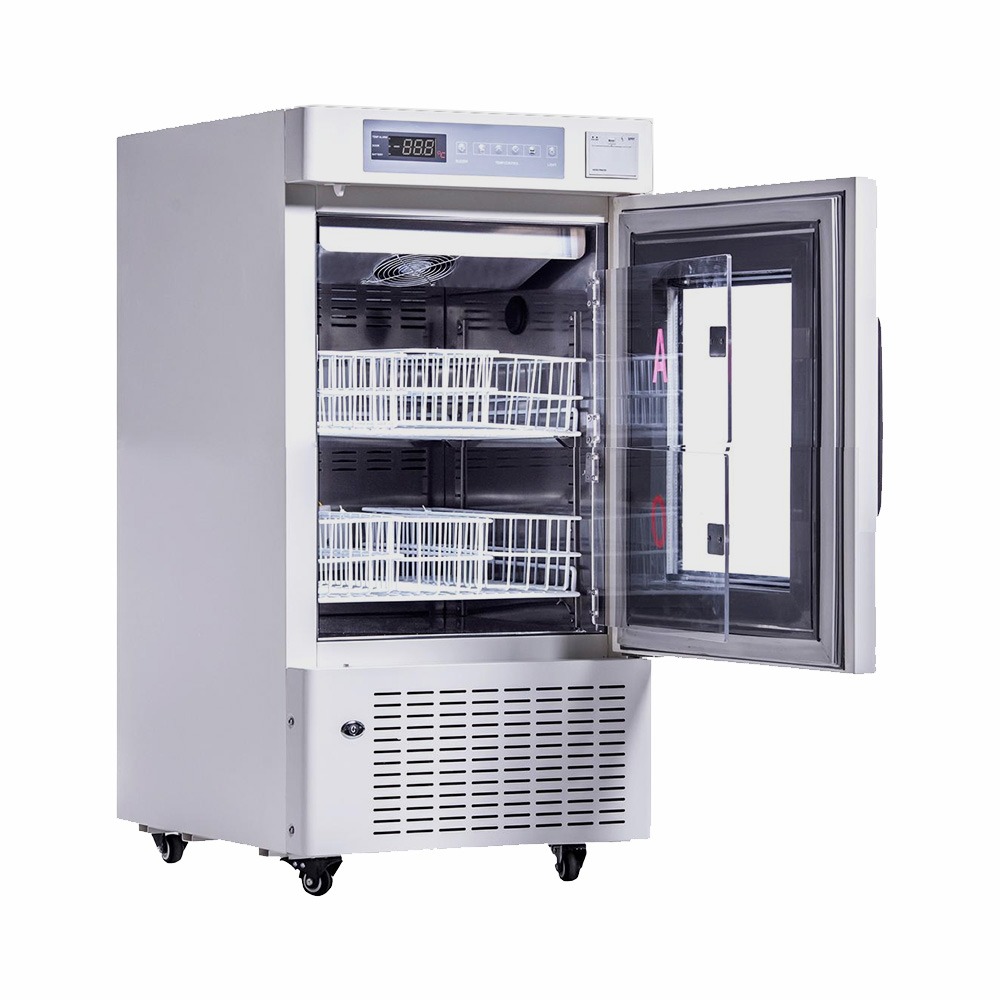
A blood bank refrigerator is a specialized medical refrigeration unit designed specifically for the safe, reliable, and temperature-controlled storage of whole blood, red blood cells, platelets, fresh frozen plasma, and other blood components. Unlike standard refrigerators, these devices maintain a tightly regulated temperature range, typically between +2°C to +6°C, as mandated by international health standards. They are engineered with advanced monitoring systems, alarms, and backup features to ensure the biological integrity and viability of life-saving blood products.
How it Works
Blood bank refrigerators operate on a precision-controlled cooling system. Here’s a simplified breakdown:
- Temperature Sensing: High-precision sensors continuously monitor the internal air temperature.
- Control System: A microprocessor-based controller receives data from the sensors. It compares this reading to the pre-set, critical temperature setpoint (e.g., +4°C).
- Cooling Activation: If the temperature rises above the setpoint, the controller activates the refrigeration compressor and evaporator fan.
- Air Circulation: A forced air circulation system (using fans) ensures uniform temperature distribution throughout the cabinet, eliminating warm spots.
- Cycle Completion: Once the temperature is restored, the compressor cycles off. This process repeats continuously to maintain stability.
- Monitoring & Alarms: Independent temperature monitoring systems with visual and audible alarms activate if temperatures deviate from the safe range or if a power failure occurs.
Key Components
- Insulated Cabinet: Constructed with high-density foam insulation, stainless steel interiors, and tight-sealing gaskets to maintain temperature integrity.
- Precision Compressor: The primary cooling unit, often with a backup or dual-compressor system for redundancy.
- Microprocessor Controller: The “brain” that regulates temperature, manages defrost cycles, and stores data.
- Temperature Sensors: Multiple probes (usually at least two) placed in critical locations, often with one probe in a simulated blood bag (a bottle of glycol or saline).
- Forced Air Circulation System: Includes evaporator fans and ducting for even air distribution.
- Alarm System: Features visual (flashing lights) and audible (siren) alarms for high/low temperature, door ajar, power failure, and sensor failure.
- Digital Data Logger: Records temperature at defined intervals (e.g., every 10 minutes) for compliance and audit trails.
- Door & Lock: Reinforced door with a secure lock to prevent unauthorized access. Glass doors are common for inventory visibility.
- Battery Backup (UPS): Provides temporary power to the alarm system and sometimes the compressor during short outages.
- Shelving: Adjustable, slotted, or mesh shelves designed for optimal air circulation around blood bags.
2. Uses
Clinical Applications
- Storage of Red Blood Cells (RBCs): Primary use. RBCs must be stored at +2°C to +6°C to maintain function and prevent bacterial growth.
- Storage of Whole Blood: For use in specific trauma or surgical situations.
- Storage of Fresh Frozen Plasma (FFP) & Cryoprecipitate: While primarily stored in freezers, they can be kept in a blood bank refrigerator for short-term thawed storage (up to 24 hours at +1°C to +6°C) prior to transfusion.
- Storage of Crossmatched & Reserved Units: Holding units specifically matched for scheduled surgeries or patients with antibodies.
- Quarantine Storage: Temporarily holding blood products pending further testing or investigation.
Who Uses It
- Blood Bank Technologists/Scientists: Primary operators responsible for storage, inventory management, and component issue.
- Laboratory Managers: Oversee the operation, maintenance, and compliance of the equipment.
- Transfusion Nurses: Access the refrigerator to retrieve blood products for patient transfusion.
- Hospital Biomedical Engineers/Technicians: Perform scheduled maintenance, calibration, and repairs.
Departments/Settings
- Hospital Blood Banks & Transfusion Services
- Standalone Blood Donation Centers (e.g., American Red Cross, national blood services)
- Large Clinical Pathology & Hematology Laboratories
- Major Hospital Operating Theater Complexes (for satellite storage)
- Large Specialty Clinics & Cancer Treatment Centers
- Military Medical Facilities and Disaster Response Units
3. Technical Specs
Typical Specifications
- Temperature Range: +2°C to +6°C, adjustable. Stability: ±1°C or better.
- Capacity: Ranges from under 100 bags to over 600 bags. Often measured in liters (e.g., 300L, 700L).
- Power Supply: 110-120V/60Hz or 220-240V/50Hz.
- Alarms: Audio (≥85 dB) and visual (LED) for high/low temp, door ajar, power failure, system failure, sensor fault.
- Data Recording: Continuous digital logging with memory for 30-90+ days.
- Construction: Exterior: Powder-coated steel. Interior: Stainless steel (304 or 316 grade).
- Defrost: Automatic, electrically heated defrost cycle.
Variants & Sizes
- Vertical Cabinet Refrigerators: Most common, space-efficient, with glass or solid doors.
- Chest Style (Horizontal) Refrigerators: Offer better temperature retention when opened, ideal for high-traffic areas.
- Undercounter Models: For smaller labs or satellite stations.
- Walk-in Rooms: For very high-volume blood centers.
- Dual-Zone Refrigerators: Separate compartments for different temperature requirements (e.g., platelets at +20-24°C and RBCs at +2-6°C).
Materials & Features
- Materials: Antimicrobial powder coat, stainless steel interiors, CFC-free insulation, tempered glass doors.
- Features: Digital touchscreen interface, WiFi/ethernet connectivity for remote monitoring, dual independent cooling circuits, battery backup systems (UPS), CO₂ or liquid nitrogen backup ports, lockable casters for mobility, USB/RS-232 data export.
Notable Models (Examples)
- Helmer Scientific: i.Series (i.S3, i.S6), Horizon Series
- Thermo Fisher Scientific: Forma Blood Bank Refrigerators
- Haier Biomedical: HBC-360, HBY-300 series
- Vestfrost Solutions: VBS Series
- LABCOLD: Pharma Series Blood Bank Refrigerators
4. Benefits & Risks
Advantages
- Preserves Blood Viability: Maintains strict temperature to maximize shelf-life (35-42 days for RBCs).
- Ensures Patient Safety: Prevents the transfusion of compromised blood that could cause bacterial sepsis or reduced efficacy.
- Regulatory Compliance: Built to meet stringent AABB, FDA, CE, and WHO standards.
- Inventory Management: Clear visibility and organization reduce waste and errors.
- Data Integrity & Traceability: Digital loggers provide an unalterable record for audits and quality control.
- Reliability & Redundancy: Backup systems minimize the risk of total failure.
Limitations
- High Initial Cost: Significantly more expensive than domestic refrigerators.
- Continuous Power Requirement: Vulnerable to prolonged power outages without generators.
- Space & Weight: Can be large and heavy, requiring dedicated floor space.
- Ongoing Costs: Requires annual preventive maintenance, calibration, and validation.
Safety Concerns & Warnings
- Temperature Excursions: The single biggest risk. Any storage outside +2°C to +6°C can render blood unsafe.
- Door Ajar: Leaving the door open can cause a rapid temperature rise.
- Overloading: Blocking air vents by overpacking shelves creates dangerous temperature gradients.
- Power Failure: Can lead to catastrophic loss of inventory.
- Alarm Failure: Regular testing of alarms is critical.
- Contamination: Spills must be cleaned immediately following strict biohazard protocols.
Contraindications
- Should NOT be used for storing vaccines (which often require +2°C to +8°C but have different standards), reagents, or food/beverages.
- Should NOT be placed in areas prone to extreme ambient temperatures, direct sunlight, or poor ventilation.
- Should NOT be operated without proper validation and routine performance qualification (PQ).
5. Regulation
Blood bank refrigerators are regulated as medical devices due to their critical role in patient safety.
- FDA Class: Class II Medical Device (in the US). Requires 510(k) premarket notification to demonstrate substantial equivalence to a predicate device.
- EU MDR Class: Class IIa Medical Device under Rule 10 for devices intended for controlling or monitoring a vital physiological process.
- CDSCO Category: Regulated as a “Medical Device” in India. Currently falls under Class B (moderate-low risk) as per the Medical Device Rules, 2017.
- PMDA Notes: In Japan, it is classified as a “Controlled Medical Device” (Class II) and requires approval from the PMDA.
- ISO/IEC Standards:
- ISO 13485: Quality management systems for medical device manufacturers.
- IEC 60601-1: Safety requirements for medical electrical equipment.
- IEC 61010-2-011: Specific safety requirements for refrigerating equipment.
- ISO 21969: Specific standard for blood refrigerators and freezers.
6. Maintenance
Cleaning & Sterilization
- Frequency: Weekly exterior cleaning; monthly interior cleaning; immediate cleanup of spills.
- Procedure: Unplug (if safe), remove contents to a validated holding fridge. Use a mild, non-abrasive detergent and water. Wipe all interior surfaces and shelves. Do not use phenolic disinfectants (e.g., Lysol) as they can damage plastics and seals. Rinse with water and dry. For disinfection, use a diluted bleach solution (1:10) or an EPA-registered hospital disinfectant, followed by rinsing.
- Sterilization: Not applicable, as it is a storage device, not a sterile processing device.
Reprocessing
Not applicable.
Calibration
- Frequency: At least annually (or per manufacturer’s recommendation and local policy).
- Procedure: Performed by qualified biomedical engineering staff or a certified technician. Involves verifying and adjusting the controller and display against a NIST-traceable reference thermometer placed in multiple locations (especially in the glycol bottle sensor). The independent temperature monitoring system must also be calibrated.
Storage
- During Use: Store in a climate-controlled room away from heat sources. Ensure 10-15 cm clearance on all sides for ventilation.
- When Not in Use: If decommissioned, it should be defrosted, cleaned thoroughly, dried, and stored unplugged with the door slightly ajar to prevent mold.
7. Procurement Guide
How to Select the Device
- Assess Capacity Needs: Calculate current and 5-year projected inventory. Allow for 20-30% growth.
- Consider Footprint: Measure available floor/wall space, doorways, and access routes.
- Evaluate Critical Features: Prioritize based on need (e.g., remote monitoring, battery backup, dual compressors).
- Review Compliance: Ensure the model meets national and international standards relevant to your region (AABB, FDA, CE, etc.).
- Check Service Support: Verify the manufacturer or distributor provides prompt local technical support and spare parts.
Quality Factors
- Temperature Uniformity: Should be ≤±1°C across all shelves under full load.
- Recovery Time: How quickly it returns to setpoint after a 30-second door opening.
- Alarm Reliability: Independent, fail-safe alarms.
- Build Quality: Robust hinges, sturdy shelving, high-quality door seals.
- Data Management: User-friendly software for downloading and archiving temperature logs.
Certifications
Look for: CE Marking (for EU), FDA 510(k) Clearance (for US), ISO 13485 certification of the manufacturer, and compliance with ISO 21969.
Compatibility
- Remote Monitoring Networks: Check compatibility with existing hospital building management systems (BMS) or laboratory information systems (LIS).
- Validation Protocols: Ensure it can be easily validated according to your institution’s protocols.
Typical Pricing Range
Wide variation based on size and features.
- Small undercounter models (50-150 bags): $3,000 – $8,000 USD
- Standard vertical models (200-400 bags): $8,000 – $20,000 USD
- Large capacity & premium models (500+ bags): $20,000 – $40,000+ USD
8. Top 10 Manufacturers (Worldwide)
- Thermo Fisher Scientific (USA): Global leader in life sciences. Notable line: Thermo Scientific Forma series.
- Helmer Scientific (USA): A subsidiary of B. Braun, specializing exclusively in blood and plasma storage equipment. Notable line: i.Series.
- Haier Biomedical (China): Part of the Haier Group, a massive global player with a wide, cost-competitive portfolio.
- Vestfrost Solutions (Denmark): Focused on high-quality, sustainable refrigeration for healthcare and scientific markets.
- LABCOLD (UK): Manufacturer of a wide range of medical and laboratory refrigerators/freezers.
- Dometic/Electrolux (Sweden): Offers medical refrigeration within its broader portfolio of cooling solutions.
- Philipp Kirsch GmbH (Germany): Historic German manufacturer known for high-quality “Orbital” forced air circulation systems.
- LEC Medical (USA): Manufactures laboratory and medical refrigeration, including blood bank units.
- Indrel (USA): Specializes in cold storage for blood, plasma, and pharmaceuticals.
- Angelantoni Life Science (Italy): Through its brands (e.g., LTE Scientific), provides biomedical and pharmaceutical refrigeration.
9. Top 10 Exporting Countries (Latest Year)
(Based on trade data for HS Code 8418 – Refrigerators, including medical types)
- China: Dominant global exporter, offering a wide range from budget to high-end models.
- Germany: Exports high-end, technologically advanced medical refrigeration equipment.
- United States: Major exporter of premium, specialized blood bank refrigerators.
- Italy: Significant European manufacturer and exporter.
- Mexico: Key exporter to the North and South American markets.
- South Korea: Growing exporter of high-tech medical devices, including refrigeration.
- United Kingdom: Exports specialized laboratory and medical cold chain equipment.
- Denmark: Home to Vestfrost, a notable exporter in the healthcare segment.
- Turkey: Emerging as a significant exporter to Europe, Asia, and the Middle East.
- India: Growing domestic manufacturing base serving both local and export markets.
10. Market Trends
Current Global Trends
- Integration & Connectivity: IoT-enabled fridges with real-time remote monitoring and predictive maintenance alerts.
- Energy Efficiency: Driven by rising costs and sustainability goals, models with green refrigerants and lower power consumption are favored.
- Consolidation: Larger players acquiring smaller specialists to expand market share and portfolios.
New Technologies
- Cloud-Based Monitoring: Data sent directly to secure cloud platforms accessible via web or mobile apps.
- Artificial Intelligence (AI): AI algorithms to predict compressor failure or optimize defrost cycles.
- Advanced Thermal Buffers: Improved phase-change materials to extend holdover time during power outages.
Demand Drivers
- Rising Number of Surgeries & Trauma Cases: Increases demand for blood products.
- Aging Global Population: Higher prevalence of chronic diseases requiring transfusion.
- Government Initiatives: Strengthening national blood transfusion services in developing countries.
- Stringent Regulatory Standards: Forcing upgrades from older, non-compliant equipment.
Future Insights
The market will see continued growth, especially in Asia-Pacific and Latin America. The focus will shift from simple storage to “smart” inventory management systems where the refrigerator becomes a node in a fully digitalized, traceable blood supply chain from donor to recipient.
11. Training
Required Competency
Operators must be trained to:
- Set and confirm temperature setpoints.
- Load and organize units correctly for air circulation.
- Respond appropriately to all alarm conditions.
- Perform daily temperature checks and weekly cleaning.
- Document all actions, alarms, and corrective measures.
- Follow SOPs for releasing blood after a temperature excursion.
Common User Errors
- Blocking Vents: Placing boxes or bags in front of the internal air circulation vents.
- Ignoring Door Alarms: Propping the door open during restocking.
- Incorrect Daily Check: Not verifying both the display temperature and the independent monitor/glycol bottle temperature.
- Poor Inventory Management: FIFO (First-In, First-Out) not followed, leading to wastage.
- Alarm Fatigue: Silencing an alarm without investigating and resolving the root cause.
Best-Practice Tips
- Daily Discipline: Check and record temperatures at the start of every shift.
- Organized Loading: Never store anything on the floor of the refrigerator. Use all shelves uniformly.
- Alarm Test: Test the audible and visual alarm functions weekly as per protocol.
- Power Protection: Connect to an emergency power circuit (generator) and consider a dedicated UPS.
- Plan for Failure: Have a written contingency plan for refrigerator failure, including the location of a validated backup unit.
12. FAQs
Q1: Can we use a regular household refrigerator for blood storage?
A: Absolutely not. Household refrigerators have wide temperature fluctuations, no forced air circulation, no alarms, and no data logging. They cannot ensure the consistent +2°C to +6°C range required for blood safety and are not compliant with any regulatory standard.
Q2: What should we do if the temperature alarm sounds?
A: 1) Acknowledge the alarm to silence the sound. 2) Assess – Check the display and independent monitor. Is the door ajar? Is the power out? 3) Act – Close the door, move contents to a backup refrigerator if needed. 4) Document – Record the time, alarm type, temperature, and your corrective actions. 5) Notify – Inform the blood bank supervisor or biomedical engineering.
Q3: How often should we defrost the blood bank refrigerator?
A: Modern units have automatic defrost cycles. Manual defrosting is typically not required. Never chip ice away with a sharp object, as this can damage cooling coils.
Q4: How long can blood be out of the refrigerator during issue or transport?
A: This is governed by strict “30-minute rule” policies. A unit should not be out of controlled refrigeration for more than 30 minutes total. If not transfused within that time, it generally cannot be returned to inventory. Check your local blood bank policy.
Q5: What is the purpose of the bottle of liquid (glycol) inside?
A: This is a “thermal buffer” or “temperature simulator.” It mimics the temperature of a bag of blood, which changes temperature more slowly than the air. Its sensor provides the most accurate representation of the actual blood product temperature.
Q6: Can we store anything else in the blood bank refrigerator?
A: Only other temperature-sensitive blood components (like thawed plasma) that require the same storage range. Do not store reagents, vaccines, or patient samples, as this increases door openings and risk of contamination.
Q7: Who is responsible for the refrigerator’s validation?
A: Initial validation (Installation Qualification, Operational Qualification, Performance Qualification – IQ/OQ/PQ) is often done by the manufacturer or a specialized service. Annual re-validation/recalibration is typically the joint responsibility of the Blood Bank and the Hospital’s Clinical Engineering/Biomedical department.
Q8: How long do these refrigerators typically last?
A: With proper preventive maintenance, a high-quality blood bank refrigerator has an expected service life of 10 to 15 years.
13. Conclusion
The blood bank refrigerator is far more than a simple cooling appliance; it is a critical, life-sustaining medical device at the heart of a safe and effective transfusion service. Its role in preserving the viability and safety of blood products is irreplaceable. Successful operation hinges on selecting the right equipment, adhering to rigorous regulatory standards, implementing a robust maintenance and calibration program, and ensuring comprehensive staff training. By understanding its principles, uses, and management as outlined in this guide, healthcare facilities can safeguard this precious resource and ensure it is available and effective for every patient in need.
14. References
- American Association of Blood Banks (AABB). Standards for Blood Banks and Transfusion Services. Current Edition.
- U.S. Food and Drug Administration (FDA). Code of Federal Regulations Title 21, Part 606 – Current Good Manufacturing Practice for Blood and Blood Components.
- World Health Organization (WHO). Guidelines on the Management of Blood and Blood Components for Transfusion.
- International Organization for Standardization. ISO 21969:2019 – Blood bank refrigerators and freezers.
- U.S. Centers for Disease Control and Prevention (CDC). Guidelines for Safe Storage and Handling of Blood Components.
- Medicines and Healthcare products Regulatory Agency (MHRA, UK). Guidance on Medical Device Standalone Software.
- Manufacturer technical manuals and specifications from Helmer Scientific, Thermo Fisher Scientific, and Haier Biomedical.