1. Definition
What is an Anesthesia Vaporizer?
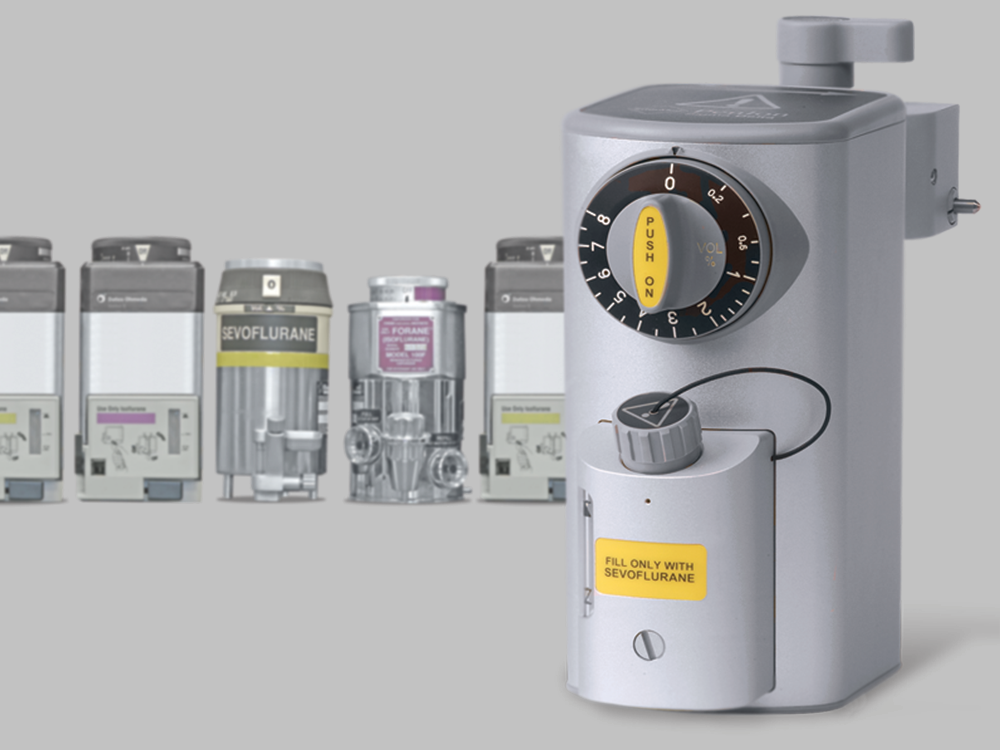
An anesthesia vaporizer is a precision medical device designed to convert liquid anesthetic agents into vapor and deliver a precise, controlled concentration of that vapor into the fresh gas flow of an anesthesia machine. Unlike universal vaporizers of the past, modern agent-specific vaporizers are calibrated and designed to work exclusively with a single inhaled anesthetic agent (e.g., sevoflurane, desflurane, isoflurane). They are the cornerstone of modern inhalational anesthesia, allowing anesthesiologists to safely induce and maintain general anesthesia with predictable and titratable effects.
How it Works
The fundamental principle is controlled vaporization. Here’s a simplified breakdown:
- Liquid Reservoir: The vaporizer contains a sump filled with a specific liquid anesthetic.
- Splitting Mechanism: The incoming fresh gas flow (oxygen, air, or nitrous oxide) from the anesthesia machine is divided into two streams.
- Carrier Gas Stream: One stream, the “carrier gas,” is diverted into the vaporizing chamber, where it becomes saturated with anesthetic vapor.
- Bypass Stream: The other stream bypasses the chamber entirely.
- Mixing & Control: The two streams recombine. The concentration dial, linked to a temperature-compensated variable bypass mechanism, controls the ratio of gas sent through the vaporizing chamber versus the bypass. This determines the final output concentration (%) of anesthetic vapor delivered to the patient’s breathing circuit.
The system is engineered to be temperature-compensated because vaporization cools the liquid, which would otherwise reduce vapor output. It is also agent-specific because the physical properties (vapor pressure, boiling point) of each anesthetic differ drastically, requiring unique internal calibrations and mechanisms.
Key Components
- Concentration Control Dial: The user interface for setting the desired vapor output (volume %). It often includes a safety interlock system (Selectatec, Draeger Docking System) to prevent simultaneous administration of multiple agents.
- Liquid Anesthetic Sump/Reservoir: The chamber that holds the liquid agent. It features a transparent window with level indicators and a filling port with a keyed filler system (to prevent accidental filling with the wrong agent).
- Bypass Chamber & Vaporizing Chamber: The heart of the vaporizer. The bypass chamber allows gas to flow around, while the vaporizing chamber contains wicks or baffles to increase the surface area for evaporation.
- Temperature-Compensation Device: Either a bimetallic strip or an expansion element that automatically adjusts the gas flow split in response to temperature changes, maintaining a constant output concentration.
- Safety Interlocks: Physical or electronic systems that allow only one vaporizer on a manifold to be turned on at a time, preventing anesthetic overdose.
- Pressure Relief Valve: A safety feature that vents excess pressure in the vaporizing chamber, protecting the internal components.
2. Uses
Clinical Applications
Agent-specific vaporizers are used whenever inhaled general anesthesia is required.
- Induction of Anesthesia: For both pediatric and adult patients, especially via mask induction with agents like sevoflurane.
- Maintenance of Anesthesia: Providing a steady-state concentration of anesthetic to keep the patient unconscious and immobile during surgery.
- Sedation in Critical Care: Occasionally used to provide long-term sedation in ICU ventilators equipped with vaporizer ports.
- Transport Anesthesia: Compact vaporizers are used on portable anesthesia machines for patient transport or in field settings.
Who Uses It
- Anesthesiologists
- Certified Registered Nurse Anesthetists (CRNAs)
- Anesthesia Assistants/Technicians (for setup and maintenance)
- Veterinary Anesthetists
Departments/Settings
- Operating Rooms (Primary setting)
- Day Surgery Units
- Obstetric Labor & Delivery (for cesarean sections)
- Interventional Radiology and Cardiology Suites
- Intensive Care Units (ICUs) with anesthesia-capable ventilators
- Dental Surgery Offices
- Veterinary Surgical Centers
3. Technical Specs
Typical Specifications
- Output Concentration Range: Typically 0.2% to 8% (up to 18% for Desflurane due to its low potency).
- Accuracy: Usually ± (0.1% + 15% of setting) of the dialed concentration across a range of flows (0.5 to 15 L/min) and temperatures (15°C to 35°C).
- Internal Capacity: 150 ml to 300 ml of liquid anesthetic.
- Residual Capacity: < 5 ml (minimal waste when changed).
- Weight: 4 to 8 kg when empty.
- Fresh Gas Flow Compatibility: 0.2 to 15 L/min.
Variants & Sizes
- Standard Platform-mounted: The most common type, mounted on the anesthesia workstation’s backbar (e.g., Datex-Ohmeda Tec 7, Draeger Vapor 2000).
- Desflurane-specific Vaporizers (Tec 6, D-Vapor): These are electrically heated and pressurized due to desflurane’s high vapor pressure and low boiling point (near room temperature). They are fundamentally different in operation from variable-bypass vaporizers.
- Portable/Stand-alone: Smaller, often battery-operated units for transport or field use.
Materials & Features
- Materials: Anodized aluminum or brass for the body, stainless steel internal components, tempered glass sight glass, and high-quality polymers.
- Key Features:
- Agent-specific keyed fillers: Prevents cross-filling.
- Anti-spill design: Prevents liquid agent from entering the bypass chamber if tipped.
- Dial lock: Prevents accidental setting changes.
- Digital output display/interface: On newer models (e.g., Draeger Perseus’s electronic vaporizer).
- Interlock systems: Prevent multiple vaporizer activation.
Models
- GE Datex-Ohmeda: Tec 7 (modern standard), Tec 6 (for desflurane), Tec 5 (older).
- Draeger: Vapor 2000 series, D-Vapor (for desflurane), Vapor 3000 (electronic, for Felix and Perseus machines).
- Penlon: Sigma Delta, Alpha (for desflurane).
- Spacelabs: Bellow’s type vaporizers.
4. Benefits & Risks
Advantages
- Precision & Safety: Delivers a highly accurate and predictable concentration, enhancing patient safety.
- Agent-Specific Design: Eliminates the risk of using the wrong calibration and simplifies use.
- Temperature Compensation: Consistent output despite cooling from vaporization.
- User-Friendly: Intuitive dial setting with clear markings.
- Durability: Engineered for years of reliable service with minimal maintenance.
Limitations
- Single Agent Use: Requires a separate, costly vaporizer for each anesthetic agent used in the practice.
- Potential for Malfunction: Though rare, sticking valves, leaks, or incorrect calibration can occur.
- Sensitive to Tilt/Position: While anti-spill designs exist, significant tipping can affect performance and potentially flood the circuit with liquid agent.
- Flow and Pressure Dependent: Accuracy decreases at very low (<0.5 L/min) or very high (>15 L/min) fresh gas flows. Positive pressure ventilation can cause a “pumping effect,” though modern vaporizers have baffles to minimize this.
Safety Concerns & Warnings
- Wrong Agent Filling: Despite keyed fillers, diligent checking (agent name on vaporizer and bottle) is mandatory.
- Leaks: Can cause environmental contamination and inadequate anesthesia.
- Overfilling: Can lead to liquid agent entering the bypass and causing overdose.
- Use with Incorrect Carrier Gas: Some older vaporizers calibrated for O₂/N₂O mixtures may be inaccurate with air/O₂.
- “Pumping Effect”: Rapid pressure fluctuations can force liquid into the bypass chamber.
Contraindications
- A vaporizer should never be used with an anesthetic agent other than the one it is specifically designed and labeled for.
- A malfunctioning or out-of-calibration vaporizer must be removed from service immediately.
- Should not be used outside its specified operating temperature, flow, or pressure ranges.
5. Regulation
Vaporizers are classified as critical, high-risk devices due to their direct impact on patient life.
- FDA Class: Class II (Special Controls). Requires 510(k) premarket notification demonstrating substantial equivalence to a predicate device.
- EU MDR Class: Class IIb (Rule 10: Devices intended to administer or exchange medicinal products or body liquids in a potentially hazardous way).
- CDSCO Category (India): Class C (Moderate to High Risk).
- PMDA (Japan): Classified as Controlled Medical Devices (Class II). Must comply with JPAL (Japanese Pharmaceutical Affairs Law).
- ISO/IEC Standards:
- ISO 80601-2-13: The primary international standard for anesthesia workstations, containing specific requirements for vaporizers.
- ISO 21647: Medical electrical equipment – Particular requirements for the basic safety and essential performance of anesthetic systems.
- IEC 60601-1: General standard for the basic safety and essential performance of medical electrical equipment.
6. Maintenance
Cleaning & Sterilization
- Exterior: Clean with a soft cloth dampened with mild soap and water or hospital-grade disinfectant. Do not immerse.
- Interior: Not user-serviceable. Internal cleaning or repair must be performed by certified technicians.
Reprocessing
Vaporizers are not single-use or sterilizable between patients. They are considered a part of the anesthesia machine’s permanent hardware. The patient circuit (breathing hoses, mask, reservoir bag) is changed between patients.
Calibration
- Frequency: Typically performed annually or as per manufacturer’s recommendation (e.g., after 1000 hours of use or 12 months).
- Process: Performed by trained biomedical engineers using a calibrated vapor analyzer (e.g., Datex-Ohmeda 5250 RGM, Draeger Vapor Check). The output concentration is measured against the dial setting at various flows and adjusted if outside specification.
Storage
- Store upright in a clean, dry environment.
- If not in use for prolonged periods, it is recommended to drain the agent and seal the ports.
- Avoid extreme temperatures (<10°C or >40°C).
- Follow local regulations for storage of devices containing halogenated agents.
7. Procurement Guide
How to Select the Device
- Agent Portfolio: Match the vaporizer model to the anesthetic agents your institution uses (Sevoflurane, Desflurane, Isoflurane).
- Anesthesia Machine Compatibility: Ensure compatibility with the mounting system (Selectatec, Draeger Docking, direct screw-in) of your existing or planned anesthesia workstations.
- Volume & Caseload: Consider the capacity and number of vaporizers needed for high-throughput ORs.
- Future-Proofing: Consider electronic vaporizers if upgrading to a fully integrated, electronic workstation.
Quality Factors
- Accuracy and Consistency across all flow rates.
- Build Quality and Durability: Robust construction from reputable manufacturers.
- Safety Features: Quality of interlock, anti-spill, and anti-tip mechanisms.
- Ease of Use: Clear dial, easy filling, and level indication.
Certifications
- Look for CE Marking (EU), FDA 510(k) Clearance (USA), and other regional approvals relevant to your market (e.g., JPAL for Japan).
- Manufacturer’s ISO 13485 certification is a good indicator of a quality management system.
Compatibility
- The single biggest factor is physical and mechanical compatibility with the anesthesia workstation’s backbar.
- Gas Line Compatibility: Ensure correct pressure and flow specifications.
Typical Pricing Range
- Standard Variable-Bypass Vaporizer (e.g., Tec 7): $3,000 – $5,500 USD.
- Desflurane Vaporizer (e.g., Tec 6): $5,000 – $7,500 USD due to its heated/pressurized mechanism.
- Electronic Vaporizer Module: Often sold as an integral part of a high-end anesthesia workstation (> $10,000 as part of the system).
8. Top 10 Manufacturers (Worldwide)
- GE Healthcare (USA/Finland): Global leader through its Datex-Ohmeda division. Famous for the Tec series (Tec 5, Tec 6, Tec 7).
- Draegerwerk AG (Germany): A dominant force in anesthesia. Key products: Vapor 2000 series, D-Vapor, electronic Vapor 3000.
- Mindray Medical (China): A rapidly growing global player offering cost-effective anesthesia machines and compatible vaporizers.
- Spacelabs Healthcare (USA): Known for its Bellow’s type vaporizers and integrated monitoring systems.
- Maquet (Getinge Group) (Sweden/Germany): Produces anesthesia workstations that often use Draeger or proprietary vaporizer systems.
- Penlon (UK): Manufacturer of the Sigma Delta and Alpha vaporizers, known for robust design.
- Heinen + Löwenstein (Germany): Produces anesthesia devices and compatible vaporizers for the European market.
- Metran Co., Ltd. (Japan): Major manufacturer of medical devices, including anesthesia systems and vaporizers for the Asian market.
- Spacelabs Healthcare (USA): Known for its Bellow’s type vaporizers and integrated monitoring systems.
- Acoma Medical Industry Co., Ltd. (Japan): Specializes in anesthesia equipment, including vaporizers, primarily for the Japanese and Asian markets.
9. Top 10 Exporting Countries (Latest Year – Based on HS Code 9018* trends)
(Note: Precise ranking for vaporizers specifically is complex due to trade code aggregation. This list reflects leading exporters of “medical instruments and appliances.”)
- United States: Dominant exporter of high-end anesthesia devices and components.
- Germany: Home to Draeger and a hub for precision medical engineering.
- China: Major and growing exporter of mid-range and budget anesthesia equipment.
- Japan: Exports advanced devices from Metran, Acoma, and others.
- United Kingdom: Historical expertise in medical devices; home to Penlon.
- Sweden: Exports through the Getinge/Maquet group.
- Finland: Exports through GE Healthcare’s Datex-Ohmeda operations.
- Italy: Strong in niche medical device manufacturing.
- Switzerland: Known for high-precision engineering in medical tech.
- Netherlands: Major European logistics and trade hub for medical devices.
10. Market Trends
Current Global Trends
- Shift towards Sevoflurane: The growing preference for sevoflurane over desflurane (due to environmental concerns and clinical profile) is influencing vaporizer demand.
- Integrated Workstations: Stand-alone vaporizer sales are giving way to sales as part of complete, integrated anesthesia delivery systems.
- Growth in Emerging Markets: Rising surgical volumes in Asia-Pacific, Latin America, and the Middle East are driving market growth.
New Technologies
- Electronic Vaporizers: Fully integrated, electronically controlled injection systems (e.g., Draeger Vapor 3000) that offer enhanced safety, automated agent logging, and closed-loop anesthesia delivery.
- Low-Flow Anesthesia Support: Modern vaporizers and workstations are optimized for ultra-low fresh gas flows, reducing agent consumption and pollution.
- Enhanced Safety Systems: Digital agent identification (e.g., barcode scanning of agent bottles) to prevent mis-filling.
Demand Drivers
- Increasing Global Surgical Volume.
- Rising Standards of Anesthesia Care worldwide.
- Replacement of Aging Equipment in developed markets.
- Stringent Environmental Regulations prompting upgrades to efficient, low-leak systems.
Future Insights
The future lies in digital integration. Vaporizers will become smart modules within networked ORs, streaming agent consumption data to electronic health records and hospital monitoring systems. Closed-loop anesthesia, where the vaporizer output is automatically adjusted based on real-time EEG (BIS) monitoring, will become more prevalent. Environmental pressures may also spur development for new, low-GWP (Global Warming Potential) anesthetic agents, requiring next-generation vaporizer designs.
11. Training
Required Competency
All users must understand:
- The physics of vaporization (vapor pressure, temperature compensation).
- The specific operating instructions for the models in their workplace.
- The pre-use checklist: Checking agent level, ensuring no leaks, verifying correct mounting and interlock function.
- How to safely fill the vaporizer using the keyed filler system.
Common User Errors
- Failing to Engage the Interlock: Leaving a second vaporizer turned on.
- Rushing the Filling Process: Leading to overfilling or spills.
- Not Checking the Agent Name: Assuming the vaporizer contains the intended agent.
- Turning the Dial Beyond the Stop: Attempting to set a concentration higher than the maximum can damage the mechanism.
- Using a Tipped Vaporizer Immediately: Not allowing time for liquid to drain back if a vaporizer is tipped >45 degrees.
Best-Practice Tips
- Always perform a pre-operative check. Include the “sniff test” at the common gas outlet to detect leaks or wrong agent.
- Fill at the start of the day or case, not between cases, to minimize contamination risk and allow stabilization.
- Turn the vaporizer OFF and set the dial to zero at the conclusion of anesthesia to prevent accidental delivery.
- If in doubt about performance (e.g., patient unexpectedly light or deep), bypass the vaporizer and use IV agents until the vaporizer can be checked.
12. FAQs
1. Why are vaporizers agent-specific?
Each anesthetic liquid has a unique vapor pressure. A vaporizer’s internal calibration and mechanisms are finely tuned for one specific agent’s physical properties to ensure accurate output.
2. Can I put isoflurane in a sevoflurane vaporizer?
Absolutely NOT. This will deliver an unpredictable and dangerously high concentration of isoflurane, risking patient overdose. The keyed filler is designed to prevent this.
3. What should I do if I accidentally tip over a filled vaporizer?
Turn it OFF, remove it from the backbar if possible, and leave it in an upright, well-ventilated area for at least 30 minutes. This allows any liquid that entered the wrong passages to drain or evaporate. Have it checked by engineering before use.
4. How often does a vaporizer need calibration?
Typically annually, but always follow the manufacturer’s schedule and your hospital’s policy. Any time there is a suspicion of inaccuracy, it should be tested.
5. Why is the desflurane vaporizer (Tec 6) so different?
Desflurane boils at 22.8°C, very near room temperature. A conventional variable-bypass design can’t control it. The Tec 6 electrically heats the agent to 39°C in a pressurized chamber and injects pure vapor into the fresh gas stream using an electronically controlled valve.
6. Is it safe to use a vaporizer at very low fresh gas flows (e.g., 0.5 L/min)?
Modern vaporizers are designed to be accurate down to ~0.2-0.5 L/min. However, at the extreme low end of their range, accuracy may slightly decrease. Consult your specific model’s manual.
7. Can I use the same vaporizer for pediatric and adult patients?
Yes. The vaporizer delivers a set concentration (%). The patient’s size and physiology determine the effect of that concentration. Lower concentrations are typically used for pediatric induction and maintenance.
8. What does the “pumping effect” mean?
During positive pressure ventilation, pressure waves can travel back into the vaporizer. If not properly baffled, this can force liquid anesthetic into the bypass chamber, causing a transient spike in delivered concentration. Modern vaporizers are designed to minimize this.
9. How do I know when to refill the vaporizer?
The transparent sight glass has minimum and maximum level indicators. Refill when the level nears the minimum, but always before it runs completely dry. Running dry can draw gas into the sump, potentially affecting performance.
10. Are electronic vaporizers better than mechanical ones?
They offer advantages: direct digital control, integration with workstation logs, and potential for advanced safety features. However, they are more expensive and rely on electrical power. Mechanical vaporizers remain the reliable, simple, and power-independent standard.
13. Conclusion
The agent-specific anesthesia vaporizer is a masterpiece of precision medical engineering that translates a potentially hazardous liquid into a precisely controlled therapeutic vapor. Its reliable, temperature-compensated operation is fundamental to the safe delivery of modern inhalational anesthesia. Understanding its principles of operation, adhering to strict safety protocols regarding agent-specific use, and committing to regular maintenance are non-negotiable responsibilities for every anesthesia provider. As technology advances, vaporizers are evolving from standalone mechanical devices into integrated, intelligent modules within the digital operating room, promising even greater safety, efficiency, and data integration for the future of anesthesia care.
14. References
- Davey, A., & Diba, A. (2012). Ward’s Anaesthetic Equipment (6th ed.). Elsevier.
- Brockwell, R. C., & Andrews, J. J. (2014). Understanding Your Anesthesia Machine. The Anesthesia Patient Safety Foundation (APSF).
- International Organization for Standardization. (2020). ISO 80601-2-13:2020 Medical electrical equipment — Part 2-13: Particular requirements for basic safety and essential performance of an anaesthetic workstation.
- Draeger. (2023). Vapor 2000 Series Instructions for Use. Draegerwerk AG & Co. KGaA.
- GE Healthcare. (2023). Tec 7 Vaporizer Service Manual. Datex-Ohmeda, Inc.
- Anesthesia Patient Safety Foundation (APSF) Newsletter. Various articles on vaporizer safety.
- U.S. Food and Drug Administration (FDA). Code of Federal Regulations Title 21.
- European Commission. Regulation (EU) 2017/745 on medical devices (MDR).