A Complete, In-Depth Blog-Style Guide
🌑 What is Depression (Brief Context)
Depression (major depressive disorder and related conditions) is more than sadness—it affects how you feel, think, behave, and even how your body functions.
It can be:
- Persistent (weeks, months, years)
- Episodic (comes and goes)
- Mild → severe → debilitating
🔍 FULL SPECTRUM OF SIGNS OF DEPRESSION
1. 🧠 Emotional & Psychological Signs
These are the most recognized—but often misunderstood.
Core Emotional Symptoms
- Persistent sadness, emptiness, or low mood
- Feeling hopeless or helpless
- Loss of interest or pleasure (anhedonia)
- Feeling numb (not sad—just nothing)
- Frequent crying or inability to cry
Deeper Emotional States
- Worthlessness or excessive guilt
- Feeling like a burden
- Self-hatred or harsh self-criticism
- Shame without clear reason
- Feeling “broken” or fundamentally flawed
Irritability & Emotional Instability
- Easily annoyed or angered
- Sudden mood swings
- Frustration over small things
⚠️ Note: In men and some cultures, depression often shows up more as irritability or anger than sadness.
2. 🧩 Cognitive (Thinking) Signs
Depression significantly affects how you think.
Negative Thought Patterns
- Constant negative thinking
- Catastrophizing (“everything will go wrong”)
- Black-and-white thinking
- Hopeless outlook on the future
Self-Perception Distortions
- “I’m not good enough”
- “Nothing I do matters”
- “I always fail”
Mental Function Changes
- Difficulty concentrating
- Poor memory
- Slowed thinking (“brain fog”)
- Indecisiveness (even small choices feel overwhelming)
3. ⚡ Behavioral Signs
These are often what others notice first.
Withdrawal & Avoidance
- Avoiding friends, family, social situations
- Canceling plans frequently
- Isolating yourself
Reduced Activity
- Loss of motivation
- Stopping hobbies or passions
- Neglecting responsibilities
Changes in Routine
- Staying in bed for long periods
- Procrastination or inability to start tasks
Risky or Escapist Behaviors
- Increased alcohol or drug use
- Overeating or undereating
- Excessive screen time or gaming
- Self-harm behaviors (cutting, etc.)
4. 💤 Physical & Biological Signs
Depression is not just “mental”—it’s deeply physical.
Sleep Disturbances
- Insomnia (can’t sleep)
- Hypersomnia (sleeping too much)
- Waking up early and unable to go back to sleep
Energy Levels
- Constant fatigue
- Feeling physically heavy or slowed down
- Low stamina for daily tasks
Appetite & Weight Changes
- Loss of appetite
- Emotional eating
- Significant weight loss or gain
Body Symptoms
- Headaches
- Muscle aches
- Digestive issues
- Unexplained physical pain
5. 🧍 Social Signs
Depression quietly reshapes relationships.
- Pulling away from loved ones
- Feeling disconnected even when around people
- Difficulty communicating
- Reduced empathy or emotional availability
- Feeling misunderstood or alone
6. 🧭 Motivational & Existential Signs
This is where depression becomes deeply internal.
- Loss of purpose or meaning in life
- Feeling like life is pointless
- Lack of goals or direction
- Feeling stuck or trapped
7. ⚠️ Serious & Critical Warning Signs
These require immediate attention.
- Thoughts of death or dying
- Suicidal thoughts (passive: “I wish I wasn’t here”)
- Active suicidal planning
- Giving away possessions
- Sudden calmness after deep depression (can be a warning sign)
👉 If you or someone else is experiencing these, it’s important to seek help immediately.
8. 🧒 Age-Specific Signs
In Children
- Irritability instead of sadness
- Clinginess
- School refusal
- Physical complaints (stomach aches, headaches)
In Teenagers
- Anger, rebellion
- Risky behavior
- Social withdrawal
- Drop in academic performance
In Older Adults
- Memory problems (can mimic dementia)
- Physical complaints
- Loss of interest in life
9. 🌍 Less Talked-About / Hidden Signs
These are often missed.
- High-functioning depression (appearing “fine” externally)
- Smiling depression (masking pain)
- Overworking to avoid feelings
- Perfectionism
- Emotional numbness instead of sadness
- Feeling tired of life, not actively suicidal
- Loss of libido
- Sensitivity to rejection
10. 🧠 Types of Depression (Signs May Vary)
Different forms show different patterns:
- Major Depressive Disorder
- Persistent Depressive Disorder (dysthymia)
- Seasonal Affective Disorder (winter depression)
- Postpartum depression
- Bipolar depression (alternates with mania)
🧪 When Do These Signs Become Depression?
Clinically, depression is typically considered when:
- Symptoms last 2+ weeks
- Affect daily functioning (work, relationships, self-care)
- Multiple categories are involved (emotional + physical + cognitive)
🚨 Common Misconceptions
- ❌ “You have to feel sad” → Some feel numb instead
- ❌ “Strong people don’t get depressed” → Completely false
- ❌ “It’s just in your head” → It affects the whole body
- ❌ “You can just snap out of it” → Not how it works
🧭 Final Thoughts
Depression is complex and deeply personal. Two people can have the same condition and experience it completely differently.
The most important takeaway:
Depression is not a single feeling—it’s a pattern across thoughts, emotions, body, and behavior.
This is one of the most important angles—because many people don’t realize they’re depressed precisely because the signs are subtle, normalized, or disguised as personality traits or “just life.”
Here’s a deep, honest breakdown of hidden signs of depression you might miss in yourself:
🧠 Hidden Signs of Depression You Might Overlook
1. “I’m just tired all the time”
Not dramatic exhaustion—just a constant baseline fatigue.
- You wake up tired even after sleeping
- Everything feels like more effort than it should
- You’re not burnt out, just… drained
👉 This isn’t laziness—it’s often mental exhaustion showing up physically.
2. You’re functioning… but barely inside
Also called high-functioning depression.
- You go to work, study, meet deadlines
- Others think you’re doing fine
- Inside, everything feels heavy or pointless
👉 The outside looks stable, but internally it’s a grind.
3. Loss of excitement (not just sadness)
You’re not necessarily sad—you just don’t feel alive.
- Things you used to enjoy feel “meh”
- No anticipation for events or goals
- You go through the motions
👉 This emotional flattening is anhedonia, a core depression sign.
4. You procrastinate… everything
Not because you’re lazy—but because starting feels overwhelming.
- Small tasks feel disproportionately hard
- You delay even things you want to do
- You feel guilty but still can’t act
👉 Often a mix of low energy + cognitive overload.
5. You isolate subtly
Not dramatic isolation—just quiet withdrawal.
- You reply less
- You avoid making plans
- You cancel “just because you don’t feel like it”
👉 It happens gradually, so you don’t notice the pattern.
6. You feel oddly irritable or short-tempered
Depression isn’t always sadness.
- Small things annoy you more than usual
- You snap at people or feel internally tense
- You feel “off” but can’t explain why
👉 This is especially common in men and high-stress individuals.
7. You overwork or stay constantly busy
This one hides extremely well.
- You avoid downtime
- You fill your schedule to the brim
- Silence or stillness feels uncomfortable
👉 Busyness becomes avoidance of internal feelings.
8. You numb out instead of feeling
Not sadness—just emotional flatness.
- You don’t feel joy or deep sadness
- Things that should affect you… don’t
- You feel disconnected from yourself
👉 This is often mistaken for “being calm” or “stable.”
9. Your self-talk is quietly negative
Not obvious self-hate—just constant low-grade criticism.
- “I should be better”
- “Why am I like this?”
- “Others handle this better than me”
👉 Over time, this becomes your default mental voice.
10. You don’t look forward to the future
This is a big one.
- No excitement about upcoming events
- Goals feel meaningless
- You feel stuck or directionless
👉 Not dramatic hopelessness—just a lack of forward pull.
11. You distract yourself constantly
Always needing something to fill your mind.
- Endless scrolling
- Binge-watching
- Gaming or content consumption for hours
👉 Silence might bring uncomfortable thoughts, so you avoid it.
12. Changes in appetite you normalize
- Eating more for comfort
- Forgetting to eat
- Eating out of boredom
👉 You may not connect it to mood at all.
13. You feel like you’re “not yourself”
Hard to explain, but very real.
- Something feels off internally
- You don’t feel like the person you used to be
- You can’t pinpoint when it changed
👉 This is often one of the earliest internal signals.
14. You minimize your own struggles
This is a huge hidden sign.
- “Others have it worse”
- “It’s not that bad”
- “I’m just being dramatic”
👉 This prevents recognition—and keeps depression hidden.
15. You feel guilty when resting
Rest doesn’t feel restorative—it feels wrong.
- You feel unproductive when relaxing
- You can’t enjoy downtime
- You constantly feel like you should be doing more
👉 This creates a cycle of exhaustion + guilt.
16. You laugh and joke—but feel empty after
- You can be social and even funny
- But afterward, you feel drained or hollow
- It feels like you were “performing”
👉 This is common in masked or smiling depression.
17. Your sleep is “off,” but you ignore it
- Staying up late for no reason
- Sleeping too much or too little
- Irregular sleep patterns
👉 Sleep disruption is often an early warning signal.
18. You avoid thinking deeply about your life
- You keep things surface-level
- You avoid introspection
- You distract yourself when deeper thoughts arise
👉 Because deeper thoughts might bring discomfort or sadness.
🧭 The Core Pattern Behind Hidden Depression
If you zoom out, most hidden signs fall into 3 patterns:
1. Avoidance
- Staying busy
- Distracting yourself
- Avoiding emotions
2. Numbness
- Lack of joy
- Emotional flatness
- Disconnection
3. Subtle Decline
- Less motivation
- Less engagement
- Less energy
⚠️ A Reality Check (Important)
If you recognize several of these, it doesn’t automatically mean clinical depression—but it does mean something is off and worth paying attention to.
The biggest risk is this:
Hidden depression often goes untreated because it doesn’t “look serious enough.”
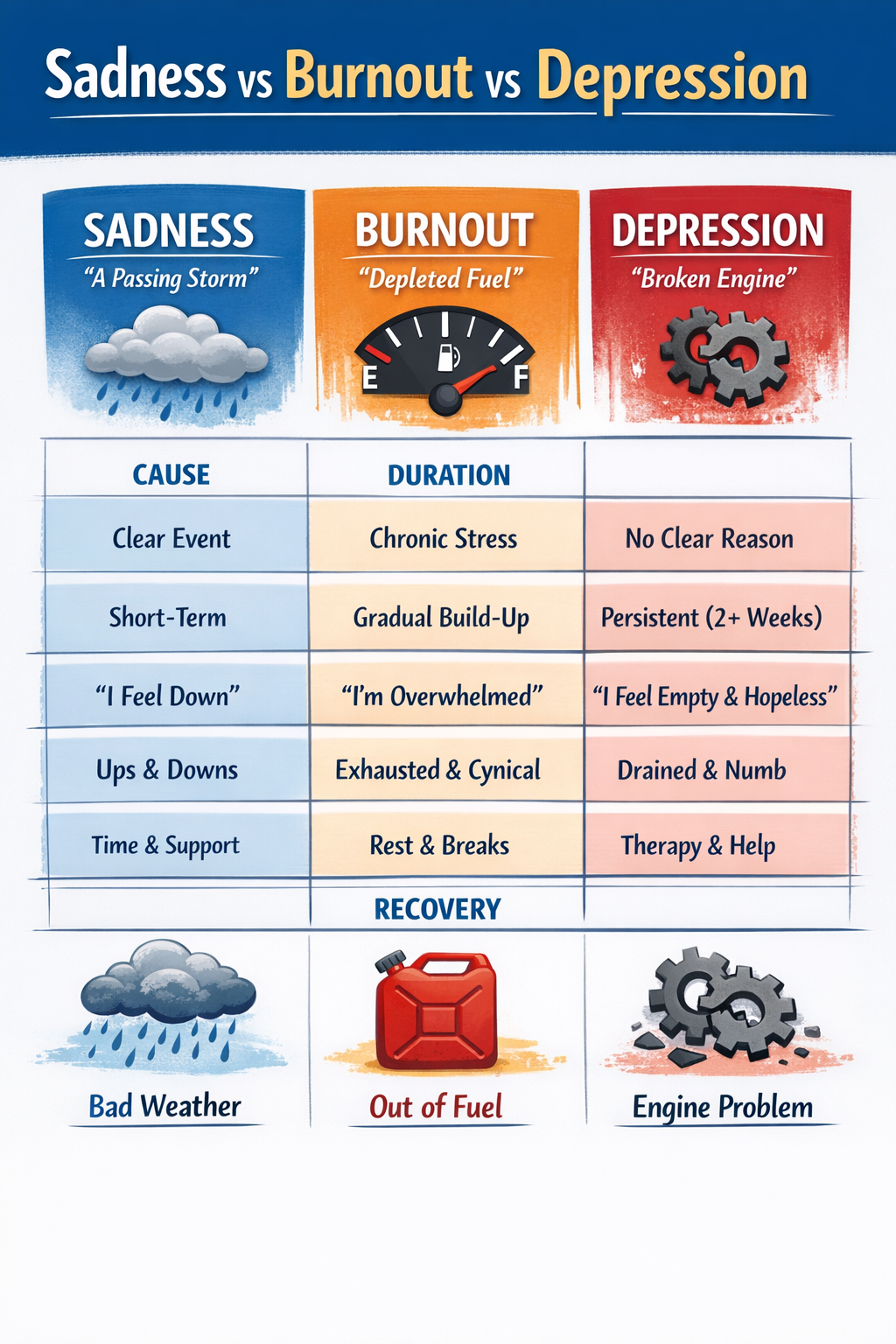
🧠 Sadness vs Burnout vs Depression
🌧️ 1. Sadness (Normal Emotional Response)
What it is:
A temporary emotional reaction to something specific.
🔍 Key Signs
- You can usually point to a reason
(loss, disappointment, conflict, bad day) - You still feel other emotions too
- Your sense of self is mostly intact
- It comes in waves
⏳ Duration
- Hours → days (sometimes a bit longer, but not persistent)
💡 Core Feeling
“Something bad happened, and I feel down.”
🔄 Important Trait
- It lifts with time, support, or positive experiences
🔥 2. Burnout (Chronic Stress Overload)
What it is:
A state of mental, emotional, and physical exhaustion caused by prolonged stress, usually work-related (but can be life-related too).
🔍 Key Signs
- Exhaustion (especially related to work/tasks)
- Cynicism or detachment (“I don’t care anymore”)
- Reduced performance
- Feeling overwhelmed but still pressured to keep going
🧠 Mental Pattern
- “I’m tired of this”
- “I can’t keep up”
- “What’s the point of trying so hard?”
⏳ Duration
- Builds gradually over weeks/months
💡 Core Feeling
“I’m drained and overwhelmed by demands.”
🔄 Important Trait
- Improves with rest, boundaries, or changing environment
🌑 3. Depression (Clinical / Deep State)
What it is:
A persistent mental health condition affecting mood, thinking, behavior, and body.
🔍 Key Signs
- No clear reason (or reason doesn’t match intensity)
- Loss of interest in almost everything
- Emotional numbness or deep emptiness
- Low energy + low motivation
- Negative self-view (“I’m worthless”)
- Hopelessness about the future
🧠 Mental Pattern
- “Nothing matters”
- “I’m the problem”
- “It won’t get better”
⏳ Duration
- At least 2+ weeks (often much longer)
💡 Core Feeling
“Something is wrong with me or life itself.”
🔄 Important Trait
- Does NOT reliably improve with rest or good events
⚖️ Side-by-Side Comparison
| Feature | Sadness | Burnout | Depression |
|---|---|---|---|
| Cause | Clear event | Chronic stress | May be unclear or internal |
| Duration | Short-term | Gradual, ongoing | Persistent (weeks+) |
| Energy | Mostly intact | Drained (especially for tasks) | Globally low |
| Motivation | Still present | Task-specific loss | Widespread loss |
| Joy | Still possible | Reduced (especially work-related) | Largely absent |
| Self-worth | Mostly intact | Frustrated with situation | Often very low |
| Recovery | Time/support | Rest/change | Needs deeper intervention |
🧭 The Easiest Way to Tell Them Apart
Ask yourself these 3 questions:
1. “Do I know why I feel this way?”
- Yes → likely sadness or burnout
- No / unclear → could be depression
2. “Do I still enjoy anything?”
- Yes → sadness or burnout
- Not really → depression
3. “Does rest or a break help?”
- Yes → burnout
- A little → sadness
- No → depression
⚠️ Where People Get Confused
1. Burnout turning into depression
This is very common.
- Long-term burnout → emotional exhaustion → hopelessness
- At some point, it stops being about work and becomes everything
2. High-functioning depression vs burnout
They look very similar:
- Both = tired, unmotivated, detached
👉 Key difference:
- Burnout → tied to specific stressors
- Depression → affects your entire life and identity
3. “I’m just sad” (when it’s actually depression)
People often downplay it:
- “I’ll get over it”
- “It’s just a phase”
👉 If it’s persistent and spreading across your life, it’s not just sadness.
🧠 A Simple Analogy
- Sadness = Bad weather 🌧️ (passes)
- Burnout = Running out of fuel 🔥 (you need rest)
- Depression = Engine problem ⚙️ (deeper system issue)
🧭 Final Thought
These states aren’t enemies—they’re signals:
- Sadness → something meaningful happened
- Burnout → you’re overloaded
- Depression → something deeper needs attention