1. Definition
What is an Orthopedic Chisel?
An orthopedic chisel is a specialized surgical instrument designed for cutting, shaping, or removing bone during orthopedic procedures. It is a fundamental tool in the orthopedic surgeon’s armamentarium, serving as an extension of the surgeon’s hands to achieve precise osseous (bone) modifications. Unlike woodworking chisels, orthopedic chisels are engineered for medical sterility, biocompatibility, and the specific mechanical demands of cutting human bone, which varies in density from the soft cancellous bone to the hard cortical bone.
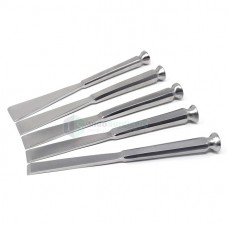
Think of it as a controlled, handheld osteotome (bone cutter) that allows for meticulous work in joint replacement surgeries, fracture repairs, spinal procedures, and bone graft harvesting.
How it Works
The working principle of an orthopedic chisel is based on controlled manual force transmission. The surgeon positions the sharp, beveled cutting edge against the target bone. Using a surgical mallet, controlled taps are applied to the chisel’s robust proximal end (the striking cap). This force is transmitted down the instrument’s shaft, concentrating energy onto its narrow cutting edge. This edge acts as a wedge, efficiently splitting or shearing the bone along the desired plane with minimal collateral damage to surrounding tissues. The design allows for fine sculpting, such as in acetabular preparation for a hip socket, or robust cutting, such as in osteotomies (intentional bone cuts to realign limbs).
Key Components
- Cutting Edge (Blade): The distal, sharpened portion that contacts the bone. Its width, shape (straight, curved, angled), and bevel (single or double) determine its specific function (e.g., fine detailing vs. broad cuts).
- Shaft/Shank: The body of the chisel. It is engineered to be rigid and transmit force efficiently without bending. It often features a textured or knurled surface to provide a secure, non-slip grip for the surgeon, even when wet.
- Neck: The section connecting the shaft to the cutting edge. In some designs, it may be offset or curved to improve visibility and access to the surgical site.
- Striking Cap/Head: The proximal, often widened and reinforced end designed to withstand repeated impacts from a metal or nylon surgical mallet. It is typically flattened to prevent the mallet from slipping during use.
2. Uses
Clinical Applications
Orthopedic chisels are versatile tools used across a wide spectrum of bone surgery:
- Joint Arthroplasty: Crucial for preparing bone surfaces to accept prosthetic implants. For example, shaping the acetabulum in total hip replacement or creating flat surfaces on the tibia and femur in total knee replacement.
- Osteotomies: Performing precise cuts to correct bone alignment (e.g., high tibial osteotomy for knee osteoarthritis, femoral osteotomies).
- Fracture Care: Trimming or debriding fractured bone ends, assisting in the reduction of fracture fragments, and removing callus during non-union repair.
- Spinal Surgery: Used in laminectomies (removing part of the vertebral bone to relieve pressure), for facet joint surgery, and during spinal fusion procedures to prepare bone surfaces.
- Bone Graft Harvesting: Extracting blocks or strips of bone, typically from the iliac crest (hip bone), for use in grafts elsewhere in the body.
- General Bone Sculpting: Removing osteophytes (bone spurs), contouring bone flaps in craniofacial surgery, or performing synovectomy in certain conditions.
Who Uses It
- Orthopedic Surgeons: The primary users, across all sub-specialties (joint, spine, trauma, sports medicine).
- Neurosurgeons: Utilize chisels in spinal and cranial procedures.
- Plastic & Reconstructive Surgeons: Employ them in craniofacial and mandibular reconstruction surgeries.
- Surgical Assistants & Scrub Nurses: Handle, prepare, and pass the chisels during surgery, and must be intimately familiar with their names and intended uses.
Departments/Settings
- Operating Rooms (ORs) in hospitals and ambulatory surgical centers.
- Orthopedic Specialty Clinics with attached procedure rooms.
- Trauma Centers for emergency fracture management.
3. Technical Specs
Typical Specifications
- Length: Ranges from 150mm to 350mm, with shorter chisels for fine work and longer ones for deep cavity access (e.g., the acetabulum).
- Cutting Edge Width: Varies from 4mm to 40mm or more. Narrow chisels (4-10mm) are for precision; wide chisels (20mm+) are for removing larger bone sections.
- Angle of Bevel: Typically 15° to 25° for a single-bevel chisel. Double-bevel chisels are also common for symmetrical cutting.
Variants & Sizes
The variety is extensive, categorized primarily by the shape and purpose of the cutting edge:
- Straight Chisels: The most common type, with a flat, straight cutting edge.
- Curved Chisels (Gouges): Feature a curved, U-shaped or V-shaped cutting edge for scooping or carving concave surfaces.
- Osteotomes: Often grouped with chisels, these have a double-beveled edge that cuts by splitting bone along its natural grain.
- Acetabular Chisels: Specifically curved to match the anatomy of the hip socket, often used in sets with progressively larger sizes.
- Angled/Offset Chisels: The shaft is angled to allow better visibility and mallet clearance in deep or confined surgical fields.
Materials & Features
- Materials: Primarily made from medical-grade stainless steel (AISI 410, 420, or 304) for its strength, corrosion resistance, and ability to hold a sharp edge. Premium versions may use tungsten carbide inserts on the cutting edge for extreme durability and long-lasting sharpness.
- Features:
- Laser Etching: For permanent size and product identification.
- Anti-Glare Finishes: Matte or satin finishes to reduce light reflection in the OR.
- Enhanced Ergonomics: Textured, contoured, or diamond-knurled handles for superior grip control.
- Compatibility: Designed to be struck with specific mallets (metal for dense bone, nylon for finer work).
Notable Models
Manufacturers produce comprehensive sets (e.g., “General Orthopedic Set,” “Total Hip Replacement Set”). Notable product lines include:
- DePuy Synthes (Johnson & Johnson): Comprehensive osteotome and chisel sets.
- Stryker: Range of procedure-specific chisels, including acetabular systems.
- Zimmer Biomet: Offers chisels integrated with their implant systems.
- Aesculap (B. Braun): Known for high-precision, German-engineered instruments.
4. Benefits & Risks
Advantages
- Precision: Allows for millimeter-level control in bone modification.
- Versatility: One of the most adaptable tools, usable in countless procedures.
- Tactile Feedback: Provides direct haptic feedback to the surgeon about bone density and cutting progress.
- Cost-Effective: Durable, reusable, and has a very long lifespan with proper care.
- Fundamental: Often allows for techniques that power tools cannot replicate safely near vital structures.
Limitations
- Requires Skill: Proficiency is entirely dependent on the surgeon’s training and experience. It is a “feel-based” instrument.
- Manual Force: Can be physically demanding in long procedures or on very dense bone.
- Risk of Splintering: If used incorrectly, can cause uncontrolled fracture lines or bone shattering.
- Limited in Very Hard Bone: May be less efficient than oscillating saws or burs in sclerotic (abnormally hardened) bone.
Safety Concerns & Warnings
- Misdirection/Slippage: The leading cause of intraoperative injury. A slip can damage surrounding nerves, vessels, tendons, or cartilage.
- Flying Debris: Bone fragments and metal splinters from the mallet strike can pose a risk to the surgical team’s eyes.
- Fatigue Failure: Repeated sterilization and use can lead to metal fatigue, potentially causing the instrument to break during surgery.
- Precautions: Always use sharp chisels (dull ones require more force and slip more easily). Ensure the striking cap is in good condition. Use appropriate eye protection. Always have a clear path for the chisel’s intended travel.
Contraindications
There is no absolute patient contraindication for the tool itself; contraindications are procedural. Its use is contraindicated in a specific surgical step if:
- The anatomy is such that safe, direct visualization and control are impossible.
- The bone is too osteoporotic (brittle) and would crumble rather than cut cleanly.
- Safer, more controlled alternative tools (like a burr under irrigation) are available for the specific task.
5. Regulation
Orthopedic chisels are typically classified as low to moderate risk reusable surgical instruments.
- FDA Class: Class I (exempt from premarket notification [510(k)]). However, chisels with specific coatings or those part of a specialized system may be Class II.
- EU MDR Class: Class I (reusable surgical instruments) under Rule 1. They require a technical file and adherence to general safety and performance requirements, but for reusable instruments, specific aspects of the MDR apply.
- CDSCO Category (India): Class B (moderate to low risk).
- PMDA (Japan): Generally classified as Class II controlled medical devices.
- ISO/IEC Standards:
- ISO 7153-1: Specification for materials for surgical instruments.
- ISO 13485: Quality management systems for medical devices.
- ISO 17664: Requirements for reprocessing information from manufacturers.
6. Maintenance
Cleaning & Sterilization
Immediate Post-Use: Wipe to remove gross bone and tissue debris.
Point-of-Use Cleaning: Soak in enzymatic detergent solution. Clean all surfaces, especially the textured grip and crevices, with a soft brush.
Ultrasonic Cleaning: Highly recommended to remove microscopic bioburden from joints and textures.
Sterilization: Autoclaving (steam sterilization) is the gold standard. Use wrapped or containerized cycles (typically 134°C for 4-18 minutes). Ensure instruments are completely dry before sterilization to prevent spotting or corrosion.
Reprocessing
Follow strict Central Sterile Services Department (CSSD) protocols. Inspect for damage (burrs, cracks, looseness) after each cycle. Lubricate hinges (if any) as per manufacturer guidelines to prevent “stiffening.”
Calibration
There is no electronic calibration. “Calibration” here refers to sharpness testing and maintenance. The cutting edge should be regularly inspected. It should be able to cleanly cut a plastic test rod or similar material without crushing it. Resharpening must be done by skilled technicians using medical-grade sharpening stones to preserve the original angle and geometry.
Storage
Store in a clean, dry, and temperature-controlled environment. Use dedicated trays or cassettes that protect the cutting edges from contact with other instruments. Avoid overcrowding in storage drawers.
7. Procurement Guide
How to Select the Device
- Procedure Mix: Purchase sets aligned with your hospital’s most common surgeries (e.g., a trauma set vs. an elective joint replacement set).
- Surgeon Preference: Involve lead surgeons in the evaluation. Ergonomics and “feel” are highly subjective.
- Durability vs. Cost: Balance initial investment against the expected instrument lifespan. Tungsten carbide edges cost more but last significantly longer.
Quality Factors
- Balance & Feel: The instrument should feel like an extension of the hand.
- Finish: Smooth, uniform, free of pits or scratches.
- Edge Sharpness: Razor-sharp out of the box.
- Marking: Clear, permanent size identification.
Certifications
Look for CE Marking (EU), FDA Establishment Registration, and evidence of ISO 13485 certification from the manufacturer.
Compatibility
Ensure chisels are compatible with standard sterilization systems and the mallets available in your OR. Procedure-specific chisels (e.g., for a particular knee implant system) must be compatible with the corresponding implant instrumentation trays.
Typical Pricing Range
Individual chisels range from $50 to $400 USD. A basic starter set may cost $1,500 – $3,000, while comprehensive, high-end sets with carbide inserts can exceed $8,000 – $12,000.
8. Top 10 Manufacturers (Worldwide)
- Johnson & Johnson (DePuy Synthes) – USA/Switzerland: Global leader with an exhaustive portfolio for trauma, joints, and spine.
- Stryker Corporation – USA: Innovator in surgical tech, offering advanced sets for orthopedics and neurosurgery.
- Zimmer Biomet – USA: Major player with chisels integrated into their market-leading joint replacement systems.
- Smith & Nephew – UK: Strong in sports medicine and arthroscopy, with complementary orthopedic hand instruments.
- B. Braun (Aesculap) – Germany: Renowned for premium, precision-crafted surgical instruments, including chisels.
- Medtronic – Ireland: A powerhouse in spinal surgery, offering specialized chisels for spinal procedures.
- Integra LifeSciences – USA: Significant in neurosurgery, craniofacial, and extremity reconstruction instruments.
- KLS Martin Group – Germany: Highly respected for manual and powered instruments in craniomaxillofacial (CMF) and neurosurgery.
- Olympus (formerly Winter & Ibe) – Japan/Germany: Known for high-quality gynecological and general surgical instruments, including bone chisels.
- FEATHER Safety Razor Co., Ltd. – Japan: Produces the popular “Feather” brand of ultra-sharp, disposable and reusable surgical blades and osteotomes.
9. Top 10 Exporting Countries (Latest Year)
(Based on trade data for HS Code 901890 – Instruments for surgical/medical use)
- Germany: The world’s premier exporter of high-precision surgical instruments.
- United States: Major exporter of high-tech and system-specific instrument sets.
- Switzerland: Home to precision manufacturing, especially for Synthes-related products.
- Japan: Exports high-quality steel instruments from companies like Feather and Mizuho.
- United Kingdom: Strong historical base in surgical manufacturing (e.g., Smith & Nephew).
- Pakistan (Sialkot): A global hub for the manufacturing of high-volume, cost-effective surgical instruments.
- France: Home to established medical device companies.
- China: Rapidly growing exporter, moving from low-cost to mid-tier quality instruments.
- Italy: Known for fine craftsmanship in surgical tools.
- Netherlands: A key European trade and distribution hub for medical devices.
10. Market Trends
- Current Trends: Growing demand due to rising volume of orthopedic procedures (aging population, sports injuries). Shift towards procedure-specific sets that improve OR efficiency.
- New Technologies: Integration of laser etching for traceability. Development of “smart” instrument trays with RFID tags to track sterilization cycles and usage. Continued adoption of tungsten carbide for longer life.
- Demand Drivers: Minimally invasive surgery (MIS) techniques require specialized, longer, and more angled chisels. Increased focus on reprocessing safety is driving demand for instruments with simpler, cleaner designs.
- Future Insights: While power tools advance, the manual chisel will remain indispensable for its precision and safety near critical structures. The future lies in enhanced materials science (even more durable coatings) and data integration into the surgical ecosystem for inventory and maintenance management.
11. Training
Required Competency
Proficiency is gained through surgical residency and fellowship. It involves understanding bone biomechanics, proper grip (“pencil grip” for fine control, “power grip” for osteotomies), mallet technique (using wrist, not shoulder), and correct angulation.
Common User Errors
- Using a Dull Chisel: Increases required force and risk of slippage.
- Improper Positioning: Not aligning the chisel perpendicular to the intended cut line.
- Excessive Force: Using heavy mallet blows instead of a series of controlled, lighter taps.
- Poor Visualization: Operating without a clear view of the cutting edge and its path.
- Striking with Improper Tools: Using a makeshift hammer instead of a balanced surgical mallet.
Best-Practice Tips
- Always Cut Away from vital neurovascular structures.
- Use the sharpest chisel available for the task.
- Let the instrument do the work; use controlled, guided taps.
- Maintain the instrument: Promptly send for professional resharpening when performance declines.
- Practice bone-cutting techniques on sawbones or cadaveric specimens to maintain skill.
12. FAQs
1. What’s the difference between a chisel and an osteotome?
An osteotome typically has a double-beveled edge designed to split bone along its natural grain, like a wedge. A chisel usually has a single-beveled edge designed to cut and shear bone.
2. How often should an orthopedic chisel be sharpened?
There’s no fixed timeline. It should be sharpened when it no longer cuts cleanly with minimal force, often after 10-20 uses, depending on bone density.
3. Can a chisel be used on cement (e.g., in revision surgery)?
No. Chisels are for bone. Using them on hardened bone cement will damage the cutting edge. Special cement osteotomes or ultrasonic devices are used for cement removal.
4. Are disposable chisels available?
Yes, primarily for procedures like rhinoplasty or where Cross-Infection risk is extremely high (e.g., prion disease). However, reusable chisels are the standard due to cost and performance.
5. What should I do if a chisel breaks during surgery?
Retrieve all fragments immediately. Inform the circulating nurse to document the incident per hospital policy. The instrument should be sent for failure analysis to the manufacturer or CSSD.
6. Why are some chisel handles color-coded?
Color coding indicates the width of the cutting edge (e.g., yellow for 10mm, blue for 16mm), allowing for quick identification in the sterile field.
7. Is it safe to sterilize chisels with other instruments?
Yes, but they should be placed in a dedicated tray or wrap that protects their edges and prevents them from damaging softer instruments.
8. How long can a well-maintained chisel last?
Decades. With proper use, cleaning, sterilization, and sharpening, high-quality stainless steel chisels can last for thousands of procedures.
13. Conclusion
The orthopedic chisel is a timeless and essential instrument in skeletal surgery. Its value lies not in technological complexity, but in the direct, precise control it offers the surgeon. Mastery of the chisel remains a core surgical skill. Successful outcomes depend on a triad: the surgeon’s skill, the instrument’s quality, and diligent hospital maintenance protocols. Understanding its applications, specifications, proper care, and the market landscape is crucial for OR managers, sterile processing teams, and the surgeons who wield them to restore patient mobility and function.
14. References
- American Academy of Orthopaedic Surgeons (AAOS). (2022). Orthopaedic Surgical Instruments Guide.
- ISO 7153-1:2016. Surgical instruments — Materials — Part 1: Metals.
- U.S. Food and Drug Administration. (2023). Classify Your Medical Device.
- European Commission. (2017). Regulation (EU) 2017/745 on medical devices (MDR).
- Pfeiffer, M., et al. (2020). Manual of Surgical Instruments. Thieme.
- UN Comtrade Database. (2023). Trade data for HS Code 901890.
- World Health Organization (WHO). (2016). Decontamination and Reprocessing of Medical Devices.
- Leading Manufacturer Catalogs & Technical Documentation (DePuy Synthes, Stryker, Aesculap).