1. Definition
What is an Osteotome?
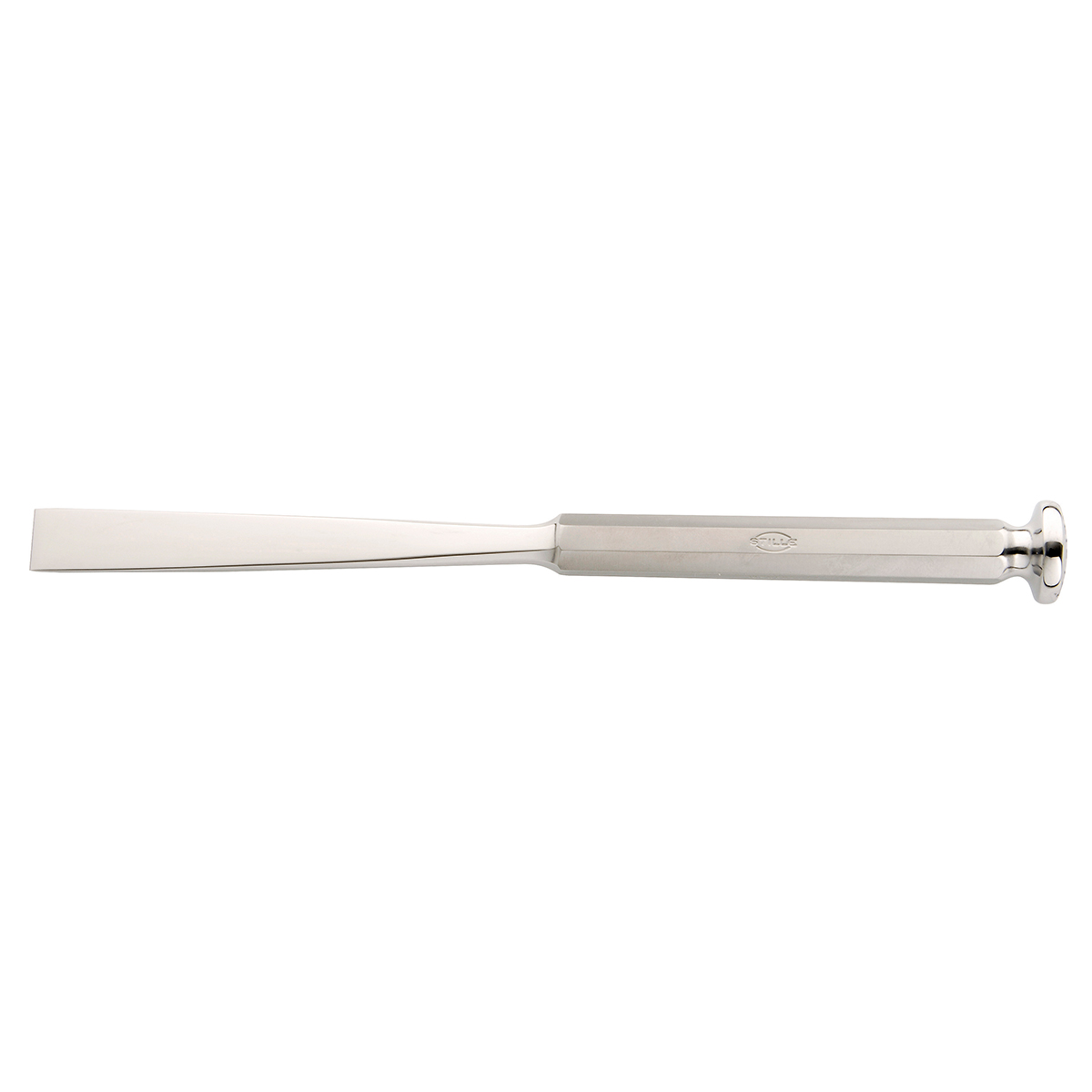
An osteotome is a specialized surgical instrument used in orthopedic, maxillofacial, neurosurgical, and plastic/reconstructive procedures to cut, shape, and prepare bone. Unlike a saw or a drill, an osteotome is a chisel-like tool designed to be struck with a mallet, allowing for controlled, precise bone removal or osteotomy (bone cutting). Its primary function is to achieve clean, sharp bone cuts with minimal thermal damage or microfracturing, preserving the bone’s vitality for healing.
How it Works
The working principle of an osteotome is based on controlled mechanical force. The surgeon positions the sharp, beveled cutting edge at the desired location on the bone. A surgical mallet is then used to deliver precise, repetitive taps to the osteotome’s striking head. This force drives the blade through the bone, cleaving it along the planned line. The design transfers energy efficiently, allowing the surgeon to feel the bone’s resistance and adjust force accordingly, enabling meticulous sculpting, splitting, or grafting of bone.
Key Components
- Blade/Cutting Edge: The business end of the instrument. It is typically single-beveled (like a chisel) or double-beveled. The sharpness, angle, and width determine its cutting characteristics.
- Shank/Neck: The slender body connecting the blade to the handle. It transmits the impact force and often features a flattened section for identification and grip.
- Striking Head/Butt: The proximal end, designed to be struck repeatedly with a mallet. It is usually broad and flat to absorb impact without deforming.
- Handle (if present): Some osteotomes, especially larger orthopedic models, have a textured, ergonomic handle for better control and to reduce hand fatigue.
- Depth Markings (on some models): Etched lines on the shank to indicate the depth of insertion, crucial for procedures requiring precise bone cuts to a specific depth.
2. Uses
Clinical Applications
- Orthopedic Surgery: Performing osteotomies (e.g., corrective cuts for deformities), preparing bone surfaces for joint replacement, harvesting bone grafts (from iliac crest, tibia), and fragmenting bone for grafting (corticocancellous chips).
- Maxillofacial & Oral Surgery: Ridge expansion/splitting for dental implants, segmental osteotomies for orthognathic (jaw correction) surgery, sinus lift procedures, and tooth extraction involving bone removal.
- Neurosurgery: Performing craniotomies (opening the skull) and craniectomies, particularly in pediatric or reconstructive cases where precise bone flap creation is vital.
- Plastic & Reconstructive Surgery: Shaping bone grafts for facial reconstruction (e.g., after trauma or cancer resection) and rhinoplasty (nasal bone shaping).
Who Uses It
Primarily surgeons: Orthopedic Surgeons, Oral & Maxillofacial Surgeons, Neurosurgeons, and Plastic/Reconstructive Surgeons. Surgical assistants or scrub nurses may handle and pass the instrument but do not operate it.
Departments/Settings
- Operating Rooms (OR) in hospitals and ambulatory surgical centers.
- Specialized clinics for dental/oral surgery and orthopedic procedures.
3. Technical Specifications
Typical Specifications
- Length: Ranges from 150mm to 250mm for general use.
- Blade Width: Varies from 2mm (fine micro-osteotomes) to 40mm (large bone graft harvesters).
- Blade Angle: Single bevel is common (e.g., 15°, 22.5°, 45°); double-bevel designs also exist.
- Weight: Typically 50 to 200 grams, depending on size and material.
Variants & Sizes
- Straight & Curved: Straight for linear cuts; curved for accessing difficult angles or following bone contours.
- Micro-Osteotomes: Ultra-fine (2-6mm width) for delicate facial or sinus surgery.
- Guarded Osteotomes: Feature a physical stop to prevent over-penetration.
- T-handle Osteotomes: Provide enhanced rotational control for tasks like ridge splitting.
- Graft Harvesting Osteotomes: Wide, thin designs for collecting strips or blocks of bone.
Materials & Features
- Materials: Most are made from high-grade German or Swedish surgical stainless steel (AISI 420/440C) for optimal sharpness retention, corrosion resistance, and durability. Tungsten carbide inserts on cutting edges offer extreme longevity.
- Features: Frosted (satin) finish to reduce glare; laser-etched depth markers; ergonomic, anti-roll handles; color-coded rings for quick size identification.
Notable Models
While not model-specific like electronics, osteotomes are distinguished by their pattern names from manufacturers:
- Lambotte Pattern: A classic, robust design with a flat striking head.
- Rhoton Pattern (Neurosurgery): Finer, more delicate instruments.
- Tessier/Michelet Pattern (Maxillofacial): Curved and angled variants for facial bones.
- Stryker® Hall® and Aesculap® lines are industry-standard brand families with extensive sets.
4. Benefits & Risks
Advantages
- Precision: Allows for extremely accurate, planned bone cuts.
- Bone Vitality Preservation: Minimizes thermal necrosis associated with power saws/drills, promoting better healing.
- Tactile Feedback: Surgeons can “feel” the bone density and adjust force, enhancing safety.
- Versatility: Can be used for cutting, splitting, elevating, and sculpting.
- Cost-Effective: No recurring costs for batteries, disposables, or maintenance beyond sharpening.
Limitations
- Requires Skill: Highly dependent on surgeon expertise and a steady hand.
- Physical Demand: Can be tiring over long procedures and may cause vibration-related strain.
- Less Efficient for Large Cuts: For extensive, straight-line cuts in thick bone, oscillating saws may be faster.
- Risk of Splintering: In brittle or osteoporotic bone, can cause unintended fractures if not used carefully.
Safety Concerns & Warnings
- Misdirection/Slippage: The instrument can slip, potentially damaging adjacent soft tissues (nerves, vessels), cartilage, or other critical structures.
- Over-Penetration: Uncontrolled force can drive the osteotome too deep.
- Flying Debris: Bone chips and splinters can become projectiles. Eye protection is mandatory for the entire OR team.
- Mallet Injury: Inaccurate strikes can injure the surgeon’s or assistant’s hand.
Contraindications
There are no absolute patient contraindications, as its use is dictated by surgical need. However, its application is relatively contraindicated in extremely sclerotic (hardened) or densely brittle bone where controlled cutting is exceptionally difficult, and alternative tools (diamond burs, ultrasonic devices) might be preferred.
5. Regulation
FDA Class
Class I (510(k) exempt for manual osteotomes) or Class II, depending on specific design and claims. They are regulated under 21 CFR Part 878.4800 (Surgical Instrument).
EU MDR Class
Typically Class I (if reusable and non-invasive) or Class IIa (if intended for long-term surgical use and modifying biological structure). Must carry CE marking.
CDSCO Category (India)
Classified as a Medical Device. Typically falls under Class B (low-moderate risk) as per the Medical Device Rules, 2017.
PMDA Notes (Japan)
Regulated as a medical device. Must comply with the Pharmaceutical and Medical Device Act (PMD Act). Typically classified as a Class II controlled medical device.
ISO/IEC Standards
- ISO 7151: Specification for materials for surgical instruments.
- ISO 13485: Quality management systems for medical devices.
- ISO 15223-1: Symbols used on labels and documentation.
- ISO 17664: Requirements for reprocessing information.
6. Maintenance
Cleaning & Sterilization
- Immediate Post-Use: Wipe to remove gross bone and tissue.
- Cleaning: Use enzymatic detergent, ultrasonic cleaner, and manual brushing under water (to avoid aerosolization) to clean the entire instrument, especially the blade-shank junction.
- Rinsing & Drying: Rinse thoroughly with distilled/deionized water and dry completely to prevent spotting and corrosion.
- Sterilization: Autoclave (Steam Sterilization) is standard. Use a validated cycle (e.g., 134°C for 3-18 minutes). Ensure instruments are not overcrowded to allow steam penetration. Do not use chemical/plasma sterilization if the instrument has tungsten carbide inserts, unless verified by the manufacturer.
Reprocessing
Inspect for damage (burrs, cracks, bending) after each cleaning. Lubricate hinged or moving parts as per manufacturer instructions. Package in sterilization pouches compatible with steam.
Calibration
Osteotomes do not require electronic calibration. However, regular sharpness testing is critical. A blunt osteotome requires excessive force, increasing risk. Use a professional sharpening service or specialized equipment.
Storage
Store in a clean, dry, temperature-controlled environment. Use dedicated trays or racks to protect the cutting edges from contact with other instruments. Avoid humidity to prevent corrosion.
7. Procurement Guide
How to Select the Device
Consider the specialty (orthopedic sets differ from dental), common procedure types, and surgeon preference. A basic set includes straight osteotomes in widths of 4, 6, 8, 10, 12, and 16mm, and curved osteotomes in common sizes.
Quality Factors
- Steel Quality: Look for instruments forged from a single piece of high-carbon stainless steel.
- Balance & Feel: The instrument should feel balanced in the hand.
- Finish: A uniform, smooth, satin finish is preferred.
- Sharpness: The blade should be razor-sharp out of the box.
Certifications
Look for CE Mark (EU), FDA Registration (USA), and potentially UKCA Mark (UK). ISO 13485 certification of the manufacturer is a strong indicator of quality.
Compatibility
Ensure the instrument’s size and design are compatible with the mallets (plastic, metal) used in your OR and with any sterilization tracking systems in place.
Typical Pricing Range
- Single Osteotome: $50 – $300 USD, depending on brand, size, and material (TC inserts are more expensive).
- Basic Set (6-12 pieces): $400 – $2,500 USD.
- Specialty/Comprehensive Sets: Can exceed $5,000 USD.
8. Top 10 Manufacturers (Worldwide)
- Johnson & Johnson (DePuy Synthes) – USA/Switzerland: Global leader; offers comprehensive, high-quality orthopedic and trauma instrument sets.
- Stryker Corporation – USA: Major player in orthopedic and neurosurgery with the renowned Stryker Hall line.
- B. Braun (Aesculap) – Germany: Known for exceptional German-engineered surgical instruments, including extensive osteotome sets.
- Integra LifeSciences – USA: Strong in neurosurgery and reconstructive surgery instruments.
- Zimmer Biomet – USA: Provides a wide array of instruments for joint reconstruction and orthopedic surgery.
- KLS Martin Group – Germany: A world leader in maxillofacial and cranio-maxillofacial surgery instruments.
- Medtronic – Ireland/USA: Offers neurosurgical and spinal instruments through its different divisions.
- Symmetry Surgical (formerly Symmetry Medical) – USA: Manufactures surgical instruments for multiple OEMs and under its own brands.
- SurgiField – France: A leading French manufacturer of high-precision surgical instruments.
- SHINING – India: A significant and growing manufacturer offering cost-effective, quality surgical instruments.
9. Top 10 Exporting Countries (Latest Year – Based on HS Code 901890)
- Germany: The world’s premier exporter of high-precision surgical instruments, renowned for quality.
- United States: Major exporter of advanced, branded instrument sets.
- Pakistan: A global hub for the manufacture and export of high-volume, cost-effective surgical instruments (Sialkot region).
- China: Exports a vast range from low-cost to medium-quality instruments.
- Switzerland: Home to premium brands known for precision in orthopedics and dentistry.
- France: Exporter of specialized, high-quality surgical tools.
- United Kingdom: Hosts several established surgical instrument firms.
- Italy: Known for fine craftsmanship in specialized instruments.
- Japan: Exporter of high-quality, precision instruments, particularly for niche applications.
- India: A rapidly growing exporter with improving quality and competitive pricing.
10. Market Trends
Current Global Trends
- Minimally Invasive Surgery (MIS): Demand for smaller, longer, and more angled osteotomes to work through limited incisions.
- Customization & Patient-Specific: Rise of 3D-printed surgical guides used in conjunction with osteotomes for perfectly planned osteotomies.
- Ergonomics: Increased focus on instruments that reduce surgeon fatigue and hand/wrist strain.
New Technologies
- Piezoelectric Surgery Devices: Ultrasonic osteotomes that cut mineralized tissue while sparing soft tissue, gaining ground in delicate areas.
- Laser-Etched Identification: Permanent, sterilization-proof size marking.
- Advanced Coatings: Diamond-like carbon (DLC) coatings to enhance hardness and reduce friction.
Demand Drivers
- Aging population (increasing joint and spinal surgeries).
- Rising prevalence of dental implant procedures.
- Growth in cosmetic and reconstructive surgeries.
- Expansion of healthcare infrastructure in emerging markets.
Future Insights
The manual osteotome will remain a fundamental, irreplaceable tool due to its tactile precision. Its use will become more complementary to technology—guided by navigation systems and robotics for planning, but executed with the surgeon’s feel. The market will see growth in disposable, single-use osteotomes for specific procedures to eliminate reprocessing costs and infection risks.
11. Training
Required Competency
Proficiency requires formal surgical residency training. Competency includes: understanding bone biomechanics, precise preoperative planning, secure instrument grip, controlled mallet strikes, and the ability to interpret tactile feedback during cutting.
Common User Errors
- Improper Angle: Holding the osteotome at an incorrect angle to the bone surface, causing skiving or uneven cuts.
- Excessive Force: Using the mallet too vigorously, leading to uncontrolled fractures.
- Poor Stabilization: Not holding the instrument firmly or bracing the patient’s limb, leading to slippage.
- Dull Instrument: Persisting with a blunt osteotome, which is dangerous and inefficient.
- Incorrect Mallet: Using a metal mallet where a rawhide or plastic one is needed for finer control.
Best-Practice Tips
- Always Use a Sterile Mallet: Never use another metal instrument as a hammer.
- “Follow the Line“: Use sequential, overlapping taps along the cut line rather than trying to cut deeply in one spot.
- Protect Soft Tissues: Always use a broad retractor or a specialized guard (e.g., a Langenbeck) between the osteotome and vulnerable tissues.
- Two-Hands When Possible: Use one hand to guide and angle the osteotome, the other to deliver controlled mallet strikes.
- Sharpen or Replace: Maintain a sharp edge. A sharp osteotome is a safe osteotome.
12. FAQs
Q1: What’s the difference between an osteotome and a chisel?
A: An osteotome is a type of surgical chisel specifically designed for cutting bone. Its blade is typically stronger, with a more acute or specialized bevel to cleave mineralized tissue efficiently.
Q2: Can an osteotome be reused?
A: Yes, most are designed for multiple reuses after proper reprocessing (cleaning and sterilization). However, single-use/disposable osteotomes are also available.
Q3: How often should osteotomes be sharpened?
A: There’s no fixed schedule; they should be sharpened as soon as they lose their edge. This depends on frequency of use and bone density. Regular inspection is key.
Q4: What type of mallet should I use?
A: Use the mallet recommended for the procedure. Plastic/Rawhide mallets provide more controlled, softer strikes for delicate work. Metal mallets deliver greater force for dense, thick bone.
Q5: Why is my osteotome causing the bone to splinter?
A: This is often due to using a blunt instrument, incorrect angle, or excessive force. It can also occur in osteoporotic bone. Ensure the blade is sharp and use gentle, sequential taps.
Q6: Are there power-assisted osteotomes?
A: Yes. Piezoelectric devices are essentially ultrasonic osteotomes that offer high precision with selective cutting. However, the traditional manual osteotome remains a staple for its feel and control.
Q7: How do I choose the right width?
A: Choose the narrowest osteotome that is appropriate for the task. This increases precision and control. Wider osteotomes are used for initial scoring, levering, or harvesting larger grafts.
Q8: What does “single-bevel” and “double-bevel” mean?
A: A single-bevel blade is sharpened on one side only, like a wood chisel. It tends to deflect toward the flat side, which can be used strategically. A double-bevel (sharpened on both sides) cuts more symmetrically and is common for general osteotomies.
Q9: Can osteotomes be used on the skull?
A: Yes, specifically in neurosurgery and craniofacial surgery. Specialized, finer osteotomes (like Rhoton patterns) are used for craniotomies, especially in children where the bone is thinner.
Q10: How should I store my osteotome set?
A: In a dedicated, compartmentalized tray or rack that prevents the cutting edges from touching each other or other metal instruments. Store in a dry environment.
13. Conclusion
The osteotome is a timeless and essential instrument in the surgeon’s armamentarium. Its elegance lies in its simplicity—transforming controlled manual force into precise biological sculpting. While technological advancements in power and ultrasonic tools continue, the osteotome’s unparalleled tactile feedback and versatility ensure its continued central role in bone surgery across specialties. Mastery of this tool, combined with an understanding of its proper maintenance, selection, and safety protocols, is fundamental for achieving optimal surgical outcomes in procedures ranging from dental implantology to complex spinal reconstructions.
14. References
- American Academy of Orthopaedic Surgeons (AAOS). Surgical Instrumentation. AAOS Comprehensive Orthopaedic Review.
- Hupp, J. R., & Tucker, M. R. (Eds.). (2018). Contemporary Oral and Maxillofacial Surgery (7th ed.). Elsevier.
- ISO Standards: ISO 7151, ISO 13485. International Organization for Standardization.
- U.S. Food and Drug Administration (FDA). Classification of Surgical Instruments. 21 CFR Part 878.
- European Commission. Medical Device Regulation (EU) 2017/745.
- Surgical Instrument Sharpening Guidelines. Association of Surgical Technologists (AST).
- Market Analysis Reports: Grand View Research. Surgical Instruments Market Size, Share & Trends Analysis Report (Latest Edition).
- Manufacturer Technical Catalogues: DePuy Synthes, Stryker, B. Braun (Aesculap), KLS Martin.