1. Definition
What is a Scalpel Handle?
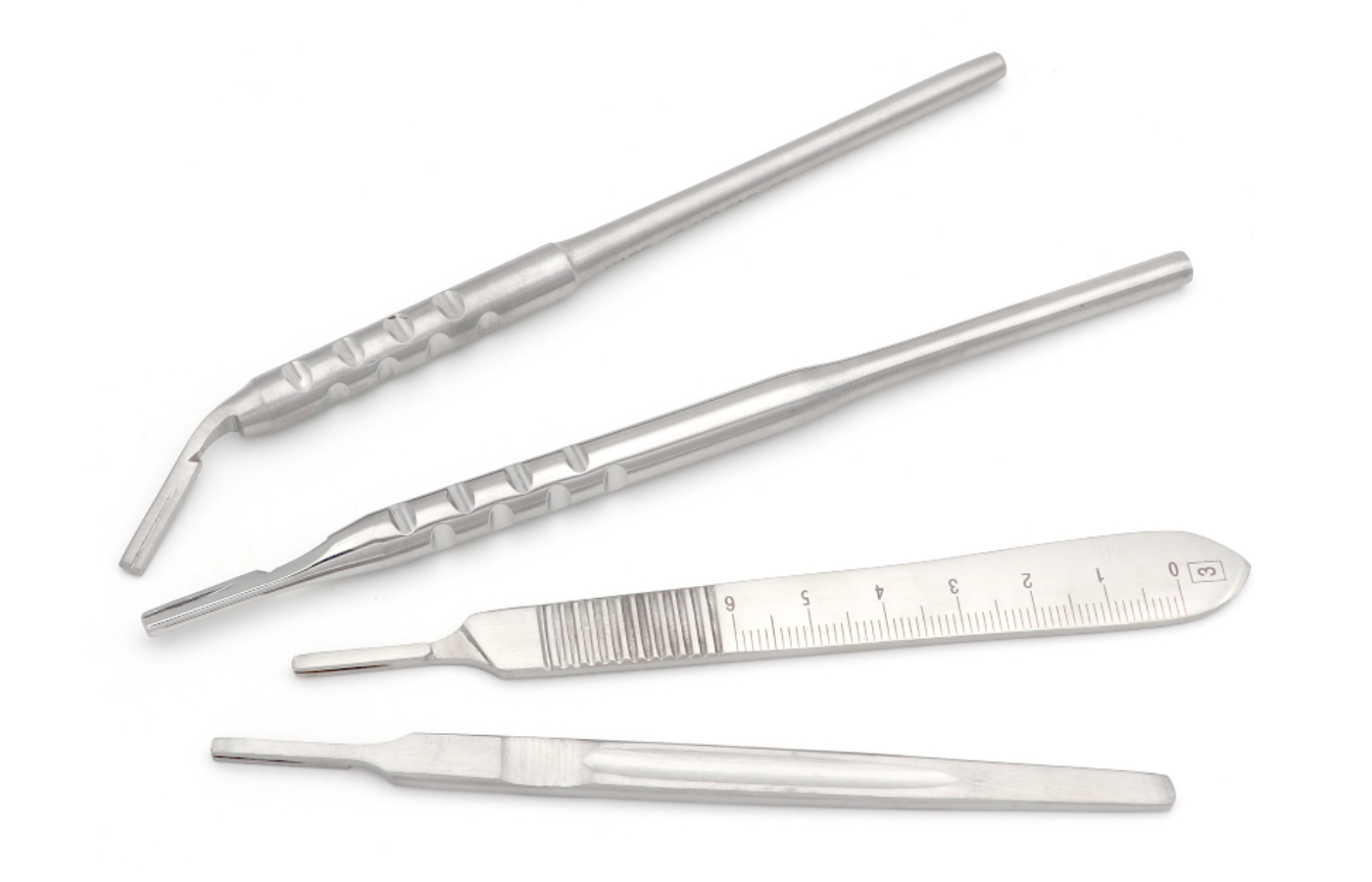
A scalpel handle is a fundamental surgical instrument designed to securely hold a disposable scalpel blade. It is the ergonomic and precision-extending component that a surgeon or medical professional grips to perform cuts with exceptional control and accuracy. While the blade is the part that incises tissue, the handle provides the stability, balance, and leverage necessary for procedures ranging from minor superficial cuts to complex dissections in deep cavities. It is an indispensable tool in virtually every surgical and procedural specialty.
How it Works
The working principle of a scalpel handle is elegantly simple. It acts as an extension of the surgeon’s hand, transforming gross motor movements into fine, precise incisions. The user selects an appropriate blade for the task, which is then attached to a specific fitting on the handle’s end. This creates a single, rigid unit. The surgeon’s grip on the textured, contoured handle allows for the application of varying degrees of pressure, direction, and angle, which is directly transmitted to the blade’s cutting edge. The length and weight of the handle provide balance, reducing hand fatigue and improving control during delicate maneuvers.
Key Components
Despite its simple appearance, a scalpel handle comprises several key components:
- Body/Shank: The main, elongated part of the handle. It is designed for a comfortable and secure grip, often with knurling or ridges to prevent slipping. Its length and diameter vary to suit different procedures.
- Blade Attachment Mount (or “Nose”): The specific mechanism at the distal end of the handle where the blade is affixed. The most common types are the flat, slotted groove for #3, #3L, and #4 handles, and the more complex locking mechanism for #7 handles.
- Finger Grip/Rest: A flattened or contoured area, typically at the junction of the handle and the attachment mount. It provides a stable platform for the index finger to rest and apply precise downward pressure, enhancing control.
- Distal Tip: The very end of the handle, which can be blunt or pointed. A blunt tip is often used for blunt dissection or probing tissue, while a pointed tip (like on a #7 handle) can be used for finer dissection.
2. Uses
Clinical Applications
Scalpel handles are used in any clinical scenario requiring a sharp, clean cut. Their applications are vast:
- Surgical Incisions: Creating the initial skin incision in major surgery (e.g., laparotomy, thoracotomy).
- Minor Procedures: Lancing abscesses, removing small skin lesions, biopsies, and debriding wounds.
- Plastic & Reconstructive Surgery: Performing precise, cosmetically favorable incisions.
- Ophthalmic Surgery: Using specialized, smaller handles for procedures on the eye.
- Cardiovascular Surgery: Dissecting vessels and creating precise arteriotomies.
- Orthopedic Surgery: Releasing tendons or ligaments and incising deep fascia.
- Autopsy and Pathology: For organ dissection and tissue sampling.
Who Uses It
- Surgeons (across all specialties)
- Procedural Physicians (Dermatologists, Podiatrists)
- Physician Assistants (PAs) and Nurse Practitioners (NPs)
- Registered Nurses (RNs) in emergency departments or procedural units
- Emergency Medical Technicians (EMTs) and Paramedics
- Dentists and Veterinary Surgeons
- Pathologists and Morticians
Departments/Settings
- Operating Rooms (OR)
- Emergency Departments (ED)
- Outpatient Procedure Rooms & Clinics
- Labor & Delivery Suites
- Intensive Care Units (ICU) for bedside procedures
- Pathology and Microbiology Laboratories
- Dental and Veterinary Clinics
- Field Medicine (Military, Disaster Response)
3. Technical Specs
Typical Specifications
- Length: Ranges from 9 cm (3.5 inches) for ophthalmic handles to 18 cm (7 inches) for general surgery.
- Weight: Typically 10-30 grams, designed to be lightweight to prevent fatigue.
- Reusability: Designed for repeated use after proper sterilization.
- Blade Compatibility: Defined by the handle number (e.g., #3, #4, #7).
Variants & Sizes
Scalpel handles are standardized by number, which denotes their size and blade compatibility:
- Handle #3: The most common, general-purpose handle. Fits blades #10, 11, 12, 15, etc.
- Handle #3L: A longer version of the #3, providing greater reach.
- Handle #4: Similar to #3 but larger and heavier, fits blades #20-25. Used for larger incisions.
- Handle #7: A longer, finer handle with a distinct pointed tip, preferred for precision work in plastic and oral surgery. Fits blades #10-16.
- Handle #9: A small, lightweight handle for ophthalmic surgery.
- Handle #5: A smaller version of the #3, used in veterinary and pediatric surgery.
Materials & Features
- Materials: Most are manufactured from high-grade, medical-grade stainless steel (e.g., 420, 304) for durability, corrosion resistance, and autoclave safety. Some disposable or low-cost versions are made of medical-grade plastics.
- Features:
- Knurling: A diamond-patterned texture for a non-slip grip, even when wet.
- Depth Guards: Some models include a removable guard to control incision depth.
- Ergonomic Designs: Contoured handles to reduce strain and prevent conditions like carpal tunnel syndrome.
- Magnetic Resonance (MR) Safe: Non-magnetic versions for use in MRI suites.
Models
While manufacturers have their own brand names, the industry operates on the standardized numbering system (#3, #4, #7, etc.). Notable product lines include:
- Swann-Morton: The “System” handles, known for global reliability.
- B. Braun Aesculap: “Golden Standard” series.
- Integra Miltex: Precision-crafted stainless steel handles.
- Feather: Disposable and reusable handles known for sharp blade compatibility.
4. Benefits & Risks
Advantages
- Precision: Unmatched control for clean, sharp incisions that promote better healing.
- Versatility: A single handle can be used with a variety of blades for countless procedures.
- Durability: High-quality stainless steel handles can last for years with proper care.
- Cost-Effectiveness: As a reusable instrument, it has a low long-term cost.
- Tactile Feedback: Provides direct sensation from the blade to the surgeon’s hand.
Limitations
- Requires Skill: Demands significant training and practice to use effectively and safely.
- Risk of Sharps Injury: The primary hazard is accidental needlestick or cut injuries.
- Limited Function: Primarily designed for cutting; other instruments are needed for dissection, retraction, etc.
Safety Concerns & Warnings
- Sharps Injuries: The greatest risk. Always use a “neutral zone” for passing, never hand-to-hand. Use a one-handed scoop technique for blade removal.
- Cross-Contamination: Improper sterilization can lead to transmission of infections.
- Blade Detachment: An improperly secured blade can detach during use, becoming a projectile or lost in a wound.
Contraindications
There are no direct medical contraindications for the handle itself. The contraindication lies in the user’s skill level. An untrained individual should not use a scalpel. The choice of a scalpel over electrocautery may be contraindicated in patients with bleeding diatheses where cautery is preferred for hemostasis.
5. Regulation
Scalpel handles are typically classified as low-to-moderate risk devices.
- FDA Class: Class I (exempt from premarket notification). However, if described for use in cardiovascular or neurological procedures, it may be classified as Class II.
- EU MDR Class: Class I (reusable surgical instrument rule applies, requiring stricter post-market surveillance and technical documentation).
- CDSCO Category (India): Class A (low risk).
- PMDA Notes (Japan): Generally classified as Class I medical devices.
- ISO/IEC Standards:
- ISO 13485: Quality Management Systems for Medical Devices.
- ISO 7151: Specific standard for surgical and dental instruments, including scalpels.
- ISO 7864: Standard for sterile single-use hypodermic needles and lancets (relevant for associated blades, not the handle itself).
6. Maintenance
Cleaning & Sterilization
Immediate point-of-use cleaning is critical to prevent bioburden from drying on the instrument.
- Cleaning: After use, the handle should be thoroughly cleaned with enzymatic detergent and a soft brush, paying close attention to the blade attachment area and knurling. Ultrasonic cleaners are highly effective.
- Rinsing & Drying: Rinse thoroughly with distilled water and dry completely to prevent spotting and corrosion.
- Sterilization: The standard method is steam autoclaving (e.g., 134°C for 3-5 minutes at 2.25 bar). Packaging in sterilization pouches is required to maintain sterility until use.
Reprocessing
Reprocessing involves the complete cycle of cleaning, inspection, packaging, sterilization, and storage. Handles should be inspected after each cycle for damage, corrosion, or malfunction of the blade attachment mechanism.
Calibration
Scalpel handles do not require electronic calibration. However, regular inspection for mechanical integrity (e.g., ensuring the blade fits snugly and does not wobble) is a form of functional “calibration.”
Storage
- Store in a clean, dry, and cool environment.
- Keep in sealed sterilization pouches until ready for use.
- Avoid storing in chlorine-based environments which can cause pitting corrosion.
7. Procurement Guide
How to Select the Device
- Procedure Type: Select the handle number (#3, #4, #7) based on the most common procedures performed.
- User Preference: Surgeons often have a personal preference for weight, balance, and knurling pattern.
- Durability vs. Cost: Balance the initial investment in a premium, long-lasting handle against the lower cost of disposable options for single-use scenarios.
Quality Factors
- Material: Ensure it’s made of high-grade, rust-resistant stainless steel.
- Knurling: Check for deep, uniform knurling that provides a secure grip.
- Balance: The handle should feel balanced in the hand, not tip-heavy.
- Blade Fit: Test with a blade; it should click into place securely with no lateral movement.
Certifications
Look for manufacturers with ISO 13485 certification and products with a CE Mark (for Europe) and/or FDA Establishment Registration.
Compatibility
The primary compatibility is with the standardized blade numbering system. Ensure your stocked blades (e.g., #10, #11, #15) match the handles you are purchasing (e.g., #3, #7).
Typical Pricing Range
- Reusable Stainless Steel Handle: $5 – $25 per unit.
- Disposable Plastic Handle: $0.50 – $2.00 per unit.
Bulk purchasing through contracts with group purchasing organizations (GPOs) significantly reduces per-unit cost.
8. Top 10 Manufacturers (Worldwide)
- Swann-Morton (UK): A world leader, renowned for quality and reliability. Notable for their comprehensive “System” range.
- B. Braun (Germany): A global medical device giant offering the Aesculap brand of surgical instruments, including scalpel handles.
- Integra LifeSciences (USA): Through its Miltex brand, provides high-precision instruments for surgery and podiatry.
- Feather (Japan): Known for exceptionally sharp blades and compatible, high-quality handles.
- Hill-Rom (Bard-Parker) (USA): Bard-Parker is a historic name in scalpels, now part of Hill-Rom.
- Medline Industries (USA): A major supplier of medical supplies, offering both branded and private-label instruments.
- Cardinal Health (USA): Another large distributor and manufacturer of medical products, including surgical instruments.
- Johnson & Johnson (Ethicon) (USA): While famous for sutures, they also supply a range of surgical blades and handles.
- KAI Group (Japan): A leading cutlery manufacturer that produces medical blades and handles.
- Ribbel International Ltd. (India): A leading Indian manufacturer and exporter of surgical instruments, including scalpel handles.
9. Top 10 Exporting Countries (Latest Year)
(Based on analysis of trade data for HS Code 901890 – Instruments and appliances used in medical sciences)
- Germany: A global hub for high-precision engineering and surgical instruments.
- United States: Home to several major manufacturers and a large domestic market.
- China: A dominant producer of cost-effective medical instruments.
- Pakistan: Specifically Sialkot, is a world-renowned center for handcrafted surgical instruments.
- United Kingdom: Largely due to the strong export presence of Swann-Morton.
- Japan: Known for high-quality manufacturing from companies like Feather and KAI.
- Switzerland: A source of high-end, precision surgical tools.
- France: Hosts several key medical device companies.
- Mexico: A growing exporter, often serving the North American market.
- India: An emerging, cost-competitive manufacturer with a growing export footprint.
10. Market Trends
Current Global Trends
- Rise of Disposables: Increased focus on infection control is driving the market for single-use, sterile scalpel handle/blade combinations.
- Cost Containment: Hospitals are seeking value through bulk purchasing and GPO contracts.
- Ergonomics: Growing awareness of Repetitive Strain Injury (RSI) is fueling demand for ergonomically designed handles.
New Technologies
- Safety-Engineered Devices: Scalpels with integrated blade shielding or retraction mechanisms to reduce sharps injuries.
- Enhanced Materials: Use of advanced alloys and coatings to improve durability and corrosion resistance.
- Procedure-Specific Handles: Customized handles for robotic-assisted and minimally invasive surgery.
Demand Drivers
- Rising global surgical volume due to an aging population.
- Increasing number of outpatient surgical procedures.
- Strict regulatory mandates for sharps safety.
- Growth in healthcare infrastructure in emerging economies.
Future Insights
The reusable scalpel handle will remain a staple due to its cost-effectiveness and familiarity. However, the future will see greater integration of safety features and a parallel growth in the disposable segment. Smart handles with sensors to track usage or pressure are a distant but plausible innovation.
11. Training
Required Competency
Competency involves knowledge of assembly/disassembly, proper gripping techniques (fingertip, pencil, palm), and safe handling to prevent self-injury or contamination. This is typically gained through surgical rotations and skills labs.
Common User Errors
- Improper Blade Loading/Removal: Leading to sharps injuries.
- Wrong Grip: Using a power grip for a task requiring a precision grip, reducing control.
- Excessive Force: Letting the sharp blade do the work; excessive pressure can lead to loss of control.
- Poor Hand Positioning: Fingers obstructing the view of the incision site.
Best-Practice Tips
- Always use a needle holder or forceps to remove the blade.
- Use the “Time Out” to confirm the correct blade is loaded before the incision.
- Keep your non-dominant (assisting) hand clear of the blade’s path.
- Change blades frequently; a dull blade requires more force and is more dangerous.
- Always have a designated “sharps” bowl on the field for safe disposal.
12. FAQs
- What is the difference between a #3 and a #7 handle?
A #3 is a general-purpose handle with a blunt end. A #7 is longer, finer, and has a pointed tip, making it ideal for more precise, detailed work like plastic or dental surgery. - Can I autoclave a scalpel handle with the blade attached?
No. The blade should always be removed before sterilization. Autoclaving with the blade on can cause corrosion and damage both the blade and the handle’s attachment mechanism. - How often should a reusable scalpel handle be replaced?
There is no set expiry. It should be replaced when the knurling is worn smooth, if it shows signs of corrosion, or if the blade attachment becomes loose or faulty. - Is it safe to use a scalpel handle from one brand with blades from another?
Generally, yes, as long as the numbering system is compatible (e.g., a Swann-Morton #3 handle will fit a Feather #15 blade). However, for optimal performance and security, manufacturers recommend using their own blades. - What should I do if the blade is stuck on the handle?
Do not use your fingers. Use a needle holder or a dedicated blade remover to grip the blade firmly and carefully rock it off the mount, directing it away from yourself and others. - Are there “left-handed” scalpel handles?
The standard handles are ambidextrous. The blade is what determines the cutting geometry. Some blades (e.g., #12, a hook blade) are handed, but the handles themselves are not. - What is the proper way to pass a scalpel?
The safest method is to place it in a designated “neutral zone” or kidney dish for the surgeon to pick up. If hand-to-hand passing is unavoidable, announce “sharp passing,” and the receiver should pick it up by the handle, not the blade end. - Why does my scalpel handle have rust spots?
This is usually due to improper cleaning (organic material left on), inadequate drying before autoclaving, or exposure to chlorinated solutions. Regular inspection and proper reprocessing can prevent this.
13. Conclusion
The scalpel handle is a deceptively simple instrument that remains the very symbol of surgery. Its value lies in its ability to provide a secure, ergonomic, and precise interface between the surgeon’s skill and the scalpel blade’s cutting edge. From selecting the correct handle and blade for the procedure, to mastering its use and ensuring its meticulous maintenance and safety, a deep understanding of this fundamental tool is essential for every healthcare professional involved in procedural care. Despite advancements in energy-based and robotic surgery, the scalpel handle, in its elegant simplicity, will continue to be a cornerstone of effective medical intervention for the foreseeable future.
14. References
- U.S. Food and Drug Administration (FDA). (2023). Classification of Surgical Instruments.
- European Commission. (2017). European Medical Device Regulation (MDR) 2017/745.
- International Organization for Standardization (ISO). (2015). ISO 7151:2015 – Surgical instruments — Scalpels with detachable blades.
- Swann-Morton. (2023). Product Catalogue and Surgical Blades Guide.
- World Health Organization (WHO). (2021). Guidelines on Core Components of Infection Prevention and Control Programmes.
- Association of periOperative Registered Nurses (AORN). (2023). Guidelines for Perioperative Practice.