1. Definition
What is a UV-C Disinfection Robot/Unit?
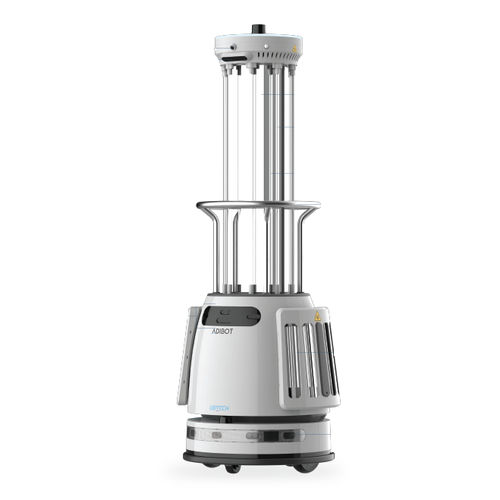
A UV-C disinfection robot (often called an autonomous or automated UV disinfection unit) is a mobile, self-navigating device designed to disinfect unoccupied spaces using ultraviolet C (UV-C) light. Its primary function is to supplement—not replace—manual cleaning protocols by delivering a germicidal dose of UV-C radiation to high-touch surfaces and the air, thereby inactivating a broad spectrum of pathogens, including bacteria, viruses, and fungi.
Think of it as a powerful, robotic assistant for your infection prevention and control (IPC) team. It operates autonomously in empty rooms, meticulously ensuring that shadowed areas receive adequate exposure, thereby reducing the bioburden and the risk of Healthcare-Associated Infections (HAIs).
How it Works
The operating principle is elegantly simple but scientifically potent:
- Pathogen Inactivation: The robot emits UV-C light within a specific wavelength range (typically 254 nm, which is highly germicidal). This UV-C radiation penetrates the cells of microorganisms and is absorbed by their DNA and RNA. The energy damages the nucleic acids, creating lesions (primarily thymine dimers) that prevent the microbes from replicating and rendering them harmless.
- Autonomous Operation: Using a combination of sensors—LiDAR (Light Detection and Ranging), cameras, ultrasonic sensors, and bump sensors—the robot maps the room, navigates around obstacles, and positions itself to ensure optimal light coverage. Advanced units calculate “dose delivery” based on room size, geometry, and reflectivity, ensuring all surfaces receive the lethal UV-C fluence (measured in mJ/cm²).
- Cycle Completion: A typical disinfection cycle lasts 10-20 minutes per room. The robot may use multiple lamp positions or a pulsing xenon lamp to reach shadowed areas. Upon completion, it returns to its docking station for recharging and data upload.
Key Components
- UV-C Lamps: The core germicidal element. Can be low-pressure mercury lamps (continuous emission at 254 nm) or pulsed xenon lamps (broad-spectrum flashes, including UV-C). Lamps are often housed in protective chambers that only open in unoccupied spaces.
- Sensor Suite: LiDAR for mapping and navigation, 360° cameras for obstacle detection, ultrasonic sensors for close-range object avoidance, and cliff sensors to prevent falls.
- Onboard Computer & Software: The “brain” that processes sensor data, runs navigation algorithms, stores room maps, and logs disinfection cycle data for compliance reporting.
- Mobile Base: Robust wheels and motors that allow for quiet, autonomous movement. Includes a high-capacity battery for hours of operation.
- Safety Systems: Multiple redundant systems: motion sensors to shut off UV-C if movement is detected, remote activation keys, audible/visual pre-cycle warnings, and emergency stop buttons.
- User Interface: A touchscreen or tablet for selecting disinfection cycles, viewing logs, and managing the device. Often accompanied by a web-based dashboard for centralized management across a fleet of robots.
2. Uses
Clinical Applications
- Terminal Room Disinfection: Used after patient discharge, especially following isolation cases (e.g., MRSA, C. diff, COVID-19).
- Operating Room (OR) Turnover: Disinfects the OR suite between surgeries, targeting surfaces that are difficult to clean manually.
- ICU & Isolation Rooms: Critical for high-risk environments to break chains of transmission.
- Burn Units & Immunocompromised Wards: Provides an extra layer of protection for vulnerable patients.
- Emergency Departments & Waiting Areas: Can be used during low-occupancy periods to reduce environmental pathogen load.
- Laboratories & Pharmacies: Ensures sterile working environments.
Who Uses It
- Environmental Services (EVS) Staff: Primary operators who integrate the robot into room turnover workflows.
- Infection Prevention & Control (IPC) Teams: Managers who oversee protocol compliance and analyze disinfection data.
- Facilities/Clinical Engineering: Personnel responsible for maintenance, charging, and software updates.
Departments/Settings
Most commonly deployed in acute care hospitals, particularly in ICUs, ORs, Emergency Departments, and Transplant/Oncology wards. Their use is expanding to outpatient surgery centers, long-term care facilities, dental clinics, ambulances, and even public spaces like airports and hotels.
3. Technical Specifications
Typical Specifications
- UV-C Output: 20 – 200+ Watts (germicidal power).
- Disinfection Cycle Time: 10-25 minutes for a standard patient room.
- Coverage Area: Capable of disinfecting a 4m x 5m room in a single cycle; larger rooms may require multiple positions.
- Fluence/Dose Delivery: Programmable from 12 mJ/cm² to over 100 mJ/cm², tailored to target specific pathogens.
- Autonomy: 3-5 hours of operation on a single charge.
- Dimensions: Varies, but often similar to a small washing machine (approx. H: 150cm, W: 60cm, D: 70cm).
- Weight: 50-150 kg.
Variants & Sizes
- Tower/Mobile Units: Most common hospital type.
- Ceiling-Mounted Units: Permanently installed, disinfect rooms automatically after motion sensors detect vacancy.
- Handheld/Smaller Units: For spot disinfection of equipment or ambulances.
- Air Disinfection Units: Incorporate HEPA filters and UV-C for continuous air treatment.
Materials & Features
- Housing: Durable, medical-grade plastics and aluminum.
- Features: Dose Mapping (graphical proof of coverage), Fleet Management Software, Integration with Hospital Information Systems (HIS), 360° Safety Zones, and Voice Prompts.
Notable Models
- Xenex Disinfection Services: LightStrike™ (Pulsed Xenon).
- STERIS: Spectra™ UV Disinfection System.
- TRU-D SmartUVC: 360° ROVER.
- Skytron: UV Guardian.
- Blue Ocean Robotics (UVD Robots): Autonomous UVD Robot.
4. Benefits & Risks
Advantages
- Enhanced Efficacy: Proven to reduce HAIs (like C. diff and MRSA) by up to 30-70% when combined with manual cleaning.
- Consistency & Documentation: Delivers a measured dose every time and provides digital logs for accreditation (JCI, CDC).
- Labor Efficiency: Frees EVS staff for detailed manual cleaning while the robot handles disinfection.
- Chemical-Free: No toxic residues, safe for sensitive electronics.
- Broad-Spectrum: Effective against bacteria, viruses, spores, and fungi, including multi-drug resistant organisms.
Limitations
- Line-of-Sight: UV-C light does not bend around corners; shadowed areas require reflective surfaces or multiple lamp positions.
- Room Occupancy: Cannot be used with people, plants, or animals present.
- Surface Dependency: Efficacy can be reduced on dirty, textured, or porous surfaces. Pre-cleaning is mandatory.
- High Initial Capital Cost.
Safety Concerns & Warnings
- UV Exposure Hazard: Direct exposure to UV-C can cause severe eye injury (photokeratitis) and skin burns in seconds.
- Ozone Generation: Some lamps (below 254 nm) can produce ozone, a respiratory irritant. Ozone-free lamps are preferred.
- Mercury Content: Low-pressure mercury lamps contain hazardous material requiring special disposal procedures.
- Mitigation: Strict safety protocols, motion sensors, remote operation, and comprehensive training are non-negotiable.
Contraindications
The device is contraindicated for use in occupied spaces. It should not be used as a standalone method without prior manual cleaning of surfaces. It is not suitable for disinfecting grossly contaminated or soiled surfaces where organic matter can shield pathogens.
5. Regulation
UV-C disinfection robots are regulated as medical devices in most regions, with classifications based on risk.
- FDA Class: Typically Class II (moderate to high risk). Requires 510(k) clearance, demonstrating substantial equivalence to a predicate device.
- EU MDR Class: Generally Class IIb (devices for disinfecting medical devices) or Class I if making environmental claims only (though scrutiny is increasing).
- CDSCO Category: In India, classified as Class B or Class C medical devices.
- PMDA (Japan): Treated as a medical device, requiring Shonin approval. Standards often reference JIS T 0901.
- ISO/IEC Standards:
- ISO 15858: UV-C devices – Safety information – Permissible human exposure.
- IEC 62471: Photobiological safety of lamps and lamp systems.
- ISO 9001: Quality management systems.
- IEC 60601-1: Medical electrical equipment safety.
6. Maintenance
- Cleaning & Sterilization: Exterior housing wiped down daily with a mild disinfectant. UV-C lamps are not cleaned; they are replaced as per manufacturer schedule.
- Reprocessing: Not applicable between rooms. The unit itself is not a sterile device.
- Calibration: Annual calibration of UV-C dose sensors and verification of output intensity is critical. Navigation sensors may also require periodic checks.
- Storage: Store in a clean, dry, temperature-controlled charging dock. Avoid environments with extreme temperatures or high humidity.
7. Procurement Guide
How to Select the Device
- Conduct a Needs Assessment: Identify target pathogens (e.g., C. diff requires a higher dose), room types, and workflow integration points.
- Evaluate “Dose Assurance”: Prioritize robots that provide verifiable, map-based proof of delivered UV-C dose, not just cycle time.
- Assess Safety Features: Ensure multiple, redundant safety systems are in place.
Quality Factors
- Clinical Evidence: Peer-reviewed studies showing HAI reduction.
- Ease of Use: Intuitive interface for EVS staff.
- Durability & Service Support: Robust build quality and local, responsive service network.
- Software & Data: Quality of reporting and fleet management tools.
Certifications
Look for FDA 510(k) Clearance, CE Marking (under MDR), and ISO 13485 certification. IEC 62471 compliance is essential for safety.
Compatibility
Ensure the robot’s software can integrate with your hospital’s Real-Time Location System (RTLS), EHR, or work order systems for seamless operation tracking.
Typical Pricing Range
Wide range: $50,000 to $150,000 USD per unit. Many manufacturers offer Robotics-as-a-Service (RaaS) leasing models with monthly fees that include maintenance and updates.
8. Top 10 Manufacturers (Worldwide)
- Xenex Disinfection Services (USA): Market pioneer with pulsed xenon LightStrike™ robots. Strong clinical data portfolio.
- STERIS plc (USA/UK): Global IPC leader. Offers the Spectra™ UV system, often integrated with its broader instrument and endoscope reprocessing ecosystem.
- Blue Ocean Robotics (Denmark): Manufactures the autonomous UVD Robot, distributed through a vast global partner network.
- TRU-D SmartUVC (USA): Known for its “360°” column design and sophisticated dose-mapping software.
- Skytron (USA): Part of the STERIS family, offers UV Guardian for the surgical environment.
- Acheron (Belgium): Focus on Hepa+UV air and surface disinfection units for healthcare.
- Onyx (South Korea): A leading Asian manufacturer with a range of mobile and ceiling-mounted UV disinfection devices.
- Surfacide (USA): Unique triple-emitter system using three autonomous units simultaneously to reduce cycle times.
- Hygiene Solutions / Purple Sun (USA): Offers high-intensity, focused UV systems.
- Fetch Robotics (USA – now part of Zebra Technologies): While not exclusively medical, provides autonomous mobile robots (AMRs) that can be adapted with UV-C modules.
9. Top 10 Exporting Countries (Latest Year)
(Based on HS Code 8543.70 – “Photon generators”)
- China: Dominant volume exporter, manufacturing hub for components and complete units.
- United States: High-value exports of advanced, technologically sophisticated robotic systems.
- Germany: Exports precision-engineered medical and laboratory UV-C devices.
- Denmark: Significant exporter due to Blue Ocean Robotics’ global distribution model.
- South Korea: Growing exporter of integrated robotic solutions.
- Japan: Exports high-quality, precision UV-C components and niche devices.
- Italy: Strong in design and engineering of medical disinfection equipment.
- Netherlands: Re-exports and distribution hub for the European market.
- United Kingdom: Home to several specialized UV technology firms.
- Israel: Exports innovative, high-tech disinfection solutions.
10. Market Trends
- Current Trends: Rapid adoption post-pandemic, shift towards “No-Touch” disinfection tech, and integration of robotics into routine EVS workflows.
- New Technologies: UV-C LEDs (more compact, no mercury), Far-UVC (222 nm) promising safer use in occupied spaces (still under research), and AI-powered navigation for more efficient room mapping.
- Demand Drivers: Rising HAI costs, antibiotic resistance (AMR), stricter hospital accreditation standards, and heightened public awareness of hygiene.
- Future Insights: Convergence with other technologies—robotics, IoT sensors, and big data analytics—will lead to “Smart IPC” ecosystems. Expect wider adoption in non-hospital settings (transport, hospitality) and more affordable, modular systems.
11. Training
Required Competency
Operators must understand: UV-C hazards & safety protocols, device operation, pre-cleaning requirements, interpreting dose reports, and basic troubleshooting.
Common User Errors
- Skipping Manual Pre-Cleaning: Rendering UV-C less effective.
- Overcrowding the Room: Leaving carts or too much equipment creates shadows.
- Ignoring Safety Protocols: Entering the room during a cycle.
- Poor Placement: Not positioning the robot to optimize coverage.
Best-Practice Tips
- Follow the Sequence: Clean (manually) -> Disinfect (UV-C) -> Verify (with logs).
- Prepare the Room: Remove trash, open drawers and doors, pull back curtains, and position the robot centrally.
- Review the Dose Map: After every cycle, check the report for any low-dose zones and remediate if needed.
- Wear Personal Protective Equipment (PPE) during room prep and when handling the robot if post-isolation.
12. FAQs
Q1: Does the UV-C robot replace housekeeping staff?
A: Absolutely not. It is a complementary tool. Staff are essential for removing physical dirt, dust, and organic matter. The robot then disinfects the pre-cleaned surfaces.
Q2: How do I know if it’s working?
A: High-quality robots provide a Dose Map or Cycle Report showing the UV-C dose delivered to every square foot of the room, verified by onboard sensors.
Q3: Is it safe to be in the hallway outside the room?
A: Yes. UV-C radiation does not penetrate solid walls or doors. The safety risk is confined to the immediate, enclosed space where the cycle is running.
Q4: Can it damage equipment or furnishings?
A: Prolonged, repeated exposure to UV-C can degrade certain plastics and fabrics (causing yellowing or brittleness). Most hospital equipment is resistant, and cycle times are designed to be germicidal without causing material damage. Check with sensitive equipment manufacturers.
Q5: How often should the lamps be replaced?
A: Typically every 1-2 years or after a set number of operating hours (e.g., 10,000 hours). The device software usually tracks this and provides replacement alerts.
Q6: What’s the difference between mercury and pulsed xenon lamps?
A: Mercury lamps provide continuous UV-C at 254 nm. Pulsed xenon lamps produce intense, full-spectrum flashes (including UV-C) in milliseconds, which some manufacturers claim reduces shadowing and cycle time.
Q7: Can it inactivate C. difficile spores?
A: Yes, but it requires a higher dose (often > 50 mJ/cm²) than vegetative bacteria. Ensure your device is programmed for a “C. diff cycle.”
Q8: How do I justify the ROI (Return on Investment) to hospital administration?
A: Focus on cost avoidance: The average HAI costs $20,000-$50,000. Preventing just a few infections per year can pay for the robot. Also cite reductions in length of stay, improved patient safety scores, and accreditation support.
13. Conclusion
UV-C disinfection robots represent a significant technological leap in the fight against healthcare-associated infections. They are not magic bullets but powerful, data-driven tools that bring consistency, measurability, and scientific rigor to environmental disinfection. Successful implementation hinges on understanding their role as part of a bundled approach—meticulous manual cleaning followed by automated UV-C disinfection, all underpinned by rigorous staff training and safety protocols. For healthcare facilities striving to enhance patient safety, improve operational efficiency, and meet the highest standards of infection prevention, investing in a well-chosen UV-C disinfection system is a forward-looking strategic decision.
14. References
- Centers for Disease Control and Prevention (CDC). (2022). Guidelines for Environmental Infection Control in Health-Care Facilities.
- International Organization for Standardization (ISO). ISO 15858:2016 – UV-C devices – Safety information.
- Weber, D. J., et al. (2016). “Role of hospital surfaces in the transmission of emerging health care-associated pathogens.” American Journal of Infection Control.
- U.S. Food and Drug Administration (FDA). (2020). “UV Lights and Lamps: Ultraviolet-C Radiation, Disinfection, and Coronavirus.”
- Memarzadeh, F., et al. (2012). “Application of ultraviolet germicidal irradiation disinfection in health care facilities.” US Department of Health and Human Services.
- Peer-reviewed journals: Infection Control & Hospital Epidemiology, American Journal of Infection Control, Journal of Hospital Infection.