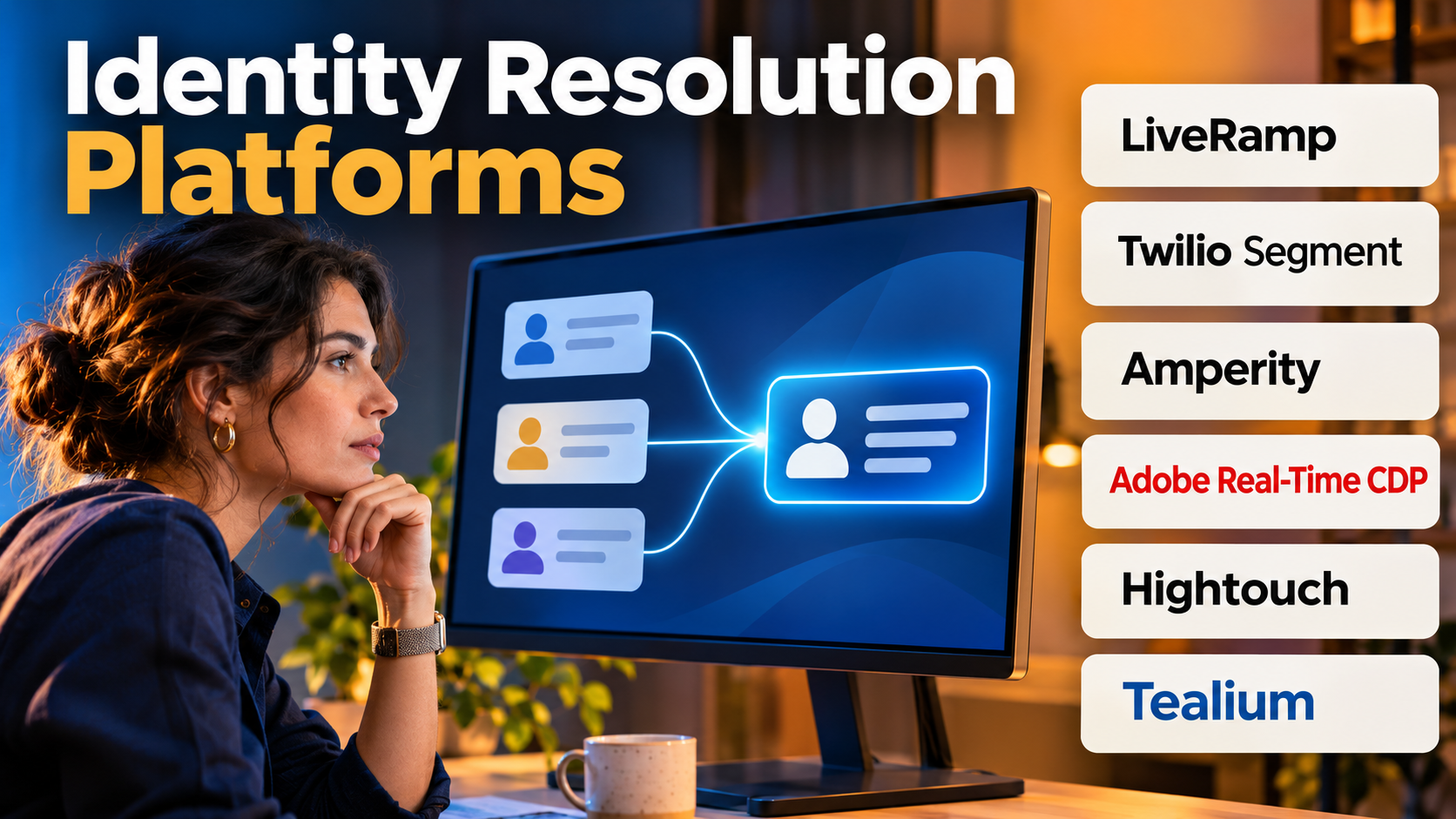
Introduction
Customers interact with businesses through websites, mobile applications, physical stores, customer service departments, email campaigns, and other channels.
These interactions often create separate records in different systems.
A customer might register for an account using one email address, make an in-store purchase using a loyalty card, and contact customer support using a telephone number.
Without a reliable method for connecting these records, the organization may treat the same customer as several unrelated individuals.
Identity resolution platforms help address this problem.
They identify relationships between customer records, reconcile eligible identifiers, and support the creation of more consistent customer profiles.
For marketing teams, identity resolution can improve audience analysis, campaign measurement, and customer experience coordination.
For data teams, it can support record deduplication, customer data quality, and consistent reporting.
However, identity resolution introduces important privacy and accuracy challenges.
Incorrectly combining records can expose information to the wrong person, distort analytics, and cause inappropriate personalization. Excessive identity matching can also conflict with customer expectations or applicable privacy requirements.
A reliable identity resolution strategy therefore requires clear matching rules, appropriate data permissions, confidence assessment, and ongoing governance.
This guide compares ten identity resolution platforms, explains their capabilities and limitations, and provides a practical framework for implementation.
What Are Identity Resolution Platforms?
Identity resolution platforms are software solutions that identify, connect, and reconcile records believed to represent the same individual, household, device, organization, or other defined entity.
Their objective is to improve consistency across fragmented data sources.
An identity resolution system may work with information such as:
- Customer account identifiers.
- Email addresses.
- Telephone numbers.
- Loyalty program identifiers.
- CRM contact records.
- Transaction references.
- Device or application identifiers.
- Authorized partner identifiers.
- Business account identifiers.
The specific identifiers used depend on the business purpose, technical environment, and applicable privacy requirements.
Identity resolution does not necessarily mean discovering someone’s real-world identity.
In many analytical systems, the goal is to connect permitted records to a consistent internal identifier.
How Identity Resolution Works
Step 1: Collect Eligible Records
The organization identifies customer records from approved systems.
These may include CRM databases, commerce platforms, customer support systems, and application accounts.
Step 2: Standardize Identifiers
Normalize relevant fields to improve comparison.
For example, email addresses may require consistent handling of capitalization, while telephone numbers may need standardized international formatting.
Normalization rules must avoid introducing incorrect equivalences.
Step 3: Identify Candidate Matches
The platform compares records using selected identifiers and attributes.
Some matches may be exact. Others may require probabilistic analysis.
Step 4: Evaluate Match Confidence
Determine whether records are sufficiently likely to represent the same entity.
Low-confidence matches should not automatically be merged.
Step 5: Create Identity Relationships
The system connects approved records through an identity graph or another structured representation.
Step 6: Resolve Conflicts
When records contain different values, the organization applies documented rules for choosing, retaining, or reconciling information.
Step 7: Maintain the Identity Graph
New records, changed identifiers, and corrected information require ongoing updates.
Step 8: Enforce Privacy and Access Controls
Only authorized applications and personnel should use the resulting identity relationships for approved purposes.
Deterministic vs. Probabilistic Identity Resolution
| Method | Description | Strength | Main Limitation |
|---|---|---|---|
| Deterministic matching | Connects records using defined matching evidence | Clearer matching rules | May miss valid relationships |
| Probabilistic matching | Estimates whether records belong to the same entity | Can identify less obvious relationships | May produce incorrect matches |
| Hybrid matching | Combines deterministic and probabilistic approaches | Balances coverage and confidence | Requires careful governance |
Deterministic Matching
A deterministic approach may connect records that share an approved, verified customer identifier.
This can provide strong evidence of a relationship.
However, matching on a common field does not always prove that records belong to the same individual. Shared email accounts, recycled telephone numbers, and data entry errors can create false matches.
Probabilistic Matching
Probabilistic approaches evaluate multiple signals and estimate the likelihood of a match.
They may improve coverage when exact identifiers are unavailable.
However, these methods require careful confidence thresholds and validation.
Identity Graphs
An identity graph represents relationships between identifiers, records, and entities.
It can support analysis across multiple systems, but its reliability depends on the evidence used to create each relationship.
Benefits of Identity Resolution Platforms
Improve Customer Data Quality
Identity resolution can reduce duplicate records and inconsistent customer information.
Support Consistent Customer Experiences
Organizations can coordinate eligible interactions across channels when records are connected reliably.
Improve Marketing Measurement
Identity resolution can help connect permitted marketing interactions with conversions and customer outcomes.
Support Customer Service
A more consistent customer profile can help authorized support teams understand previous interactions.
Improve Audience Management
Organizations can reduce duplicate audience records and apply consistent segmentation rules.
Support Privacy Operations
A well-governed identity system can help locate records associated with an individual when responding to applicable data rights requests.
However, identity resolution must not become a justification for excessive data collection.
Top 10 Identity Resolution Platforms
1. LiveRamp
Best For: Enterprises requiring identity connectivity across advertising, marketing, and data collaboration ecosystems.
Overview
LiveRamp provides identity and data collaboration capabilities that help organizations connect eligible customer and audience information across supported environments.
Its solutions are particularly relevant to advertising, retail media, publisher collaboration, and marketing measurement.
For example, a retailer may need to connect approved customer records with advertising-related datasets to evaluate aggregate campaign outcomes.
LiveRamp can support identity-enabled collaboration workflows while applying relevant platform and partner controls.
Its ecosystem connectivity is a major consideration for organizations working with multiple advertising partners.
However, the quality and permitted use of identity relationships depend on available identifiers, partner coverage, contracts, and privacy governance.
Key Features
- Identity Connectivity: Links eligible identifiers across supported environments.
- Identity Graph Capabilities: Supports structured identity relationships.
- Audience Matching: Connects approved audience datasets.
- Data Collaboration: Supports controlled partner analytics.
- Advertising Integration: Works with participating marketing ecosystems.
- Measurement Support: Enables selected cross-platform measurement workflows.
- Data Governance Controls: Helps manage permitted identity uses.
- Partner Connectivity: Supports collaboration across participating organizations.
Benefits
LiveRamp can help enterprises establish identity-enabled marketing and data collaboration processes across multiple partners.
Pros
- Extensive marketing ecosystem relevance.
- Identity and collaboration capabilities.
- Useful for retail media networks.
- Supports audience matching.
- Relevant to enterprise marketing measurement.
Cons
- Matching coverage depends on available data.
- Integration can be complex.
- Commercial arrangements require evaluation.
- Privacy governance is essential.
- Not primarily designed for internal CRM deduplication.
Practical Use Cases
- Retail media identity matching.
- Publisher and advertiser collaboration.
- Audience overlap analysis.
- Marketing measurement.
Best For: Large marketing organizations with cross-partner identity requirements.
2. Adobe Real-Time Customer Data Platform
Best For: Enterprises connecting customer identity resolution with real-time profile management and audience activation.
Overview
Adobe Real-Time Customer Data Platform is a customer data platform built on Adobe Experience Platform.
It helps organizations bring together eligible customer information and create profiles that support customer experience and marketing workflows.
Identity resolution is an important component of this process.
For example, a retailer may collect customer interactions through its website, application, loyalty program, and commerce systems.
Adobe’s identity capabilities can help connect eligible records within the platform’s identity framework.
The resulting profiles can support segmentation and permitted activation.
However, organizations must establish clear identity namespaces, matching rules, and data governance policies.
Incorrect relationships can affect multiple downstream applications.
Key Features
- Identity Graph: Supports relationships between customer identifiers.
- Unified Profiles: Combines eligible customer information.
- Data Ingestion: Connects supported customer data sources.
- Real-time Profile Updates: Supports timely profile changes.
- Audience Segmentation: Creates customer groups from available information.
- Activation Integrations: Connects profiles with supported destinations.
- Governance Controls: Supports data usage policies.
- Customer Journey Integration: Works within Adobe’s experience ecosystem.
Benefits
Adobe Real-Time CDP helps enterprises connect identity resolution with broader customer data management and personalization.
Pros
- Enterprise customer data capabilities.
- Identity graph functionality.
- Supports profile unification.
- Integrates with Adobe services.
- Suitable for omnichannel environments.
Cons
- Requires significant implementation planning.
- Identity rules must be carefully configured.
- Enterprise procurement may be costly.
- Data quality affects profile accuracy.
- Privacy obligations remain with the organization.
Practical Use Cases
- Omnichannel customer profiles.
- Retail loyalty integration.
- Enterprise audience segmentation.
- Customer experience coordination.
Best For: Enterprises using Adobe’s customer experience infrastructure.
3. Salesforce Data Cloud
Best For: Organizations connecting identity resolution with CRM, customer profiles, and Salesforce workflows.
Overview
Salesforce Data Cloud provides customer data unification and analytical capabilities within the Salesforce ecosystem.
Its identity resolution features help organizations connect eligible records from different data sources.
For example, a business may have separate customer information in its sales CRM, service platform, commerce environment, and marketing systems.
Salesforce Data Cloud can support matching and reconciliation workflows to build more consistent customer profiles.
These profiles can then support approved business processes.
However, successful implementation depends on carefully designed matching rules and source data quality.
Organizations should test whether the system incorrectly combines customers who share similar information.
Key Features
- Identity Resolution Rules: Supports configurable record matching.
- Unified Customer Profiles: Combines eligible records.
- CRM Integration: Connects with Salesforce applications.
- Data Ingestion: Supports multiple customer data sources.
- Profile Reconciliation: Applies rules for conflicting information.
- Segmentation: Supports customer audience creation.
- Data Activation: Connects approved profiles with business workflows.
- Governance Capabilities: Supports access and data management.
Benefits
Salesforce Data Cloud can reduce customer record fragmentation across connected Salesforce and external systems.
Pros
- Strong CRM integration.
- Configurable matching rules.
- Supports customer profile unification.
- Relevant to sales and service workflows.
- Enterprise data management capabilities.
Cons
- Implementation requires technical planning.
- Incorrect matching can affect downstream systems.
- Costs depend on usage and configuration.
- Integration complexity increases with data sources.
- Not a universal external advertising identity graph.
Practical Use Cases
- CRM customer unification.
- Sales and service profile consistency.
- Commerce customer analysis.
- Marketing audience management.
Best For: Salesforce-centered enterprises.
4. Twilio Segment
Best For: Digital businesses seeking identity stitching within customer data collection and profile workflows.
Overview
Twilio Segment is a customer data platform that helps organizations collect, organize, and route customer event information.
Its identity-related capabilities can connect eligible anonymous and known interactions within supported customer profile workflows.
For example, a SaaS business may record website activity before a visitor creates an account.
After registration, the organization may want to connect permitted earlier events with the new customer account.
Segment’s identity functionality can support these relationships when the implementation provides appropriate identifiers and rules.
This is particularly useful for digital products that need consistent customer analytics.
However, teams must carefully manage identity events and avoid connecting unrelated users through shared devices or incorrect identifiers.
Key Features
- Event Collection: Collects configured customer interactions.
- Identity Stitching: Connects eligible anonymous and identified activity.
- Customer Profiles: Supports unified profile workflows.
- Source Integrations: Connects supported digital systems.
- Destination Integrations: Routes approved data to downstream tools.
- Identity Rules: Supports identity relationship management.
- Audience Capabilities: Enables selected customer segmentation.
- Data Quality Controls: Helps standardize event collection.
Benefits
Twilio Segment can help digital teams maintain more consistent customer event and identity information across applications.
Pros
- Strong event collection ecosystem.
- Supports identity stitching.
- Useful for SaaS and digital products.
- Extensive integration orientation.
- Connects analytics with customer profiles.
Cons
- Identity design requires expertise.
- Incorrect identifiers can merge unrelated journeys.
- Costs depend on product and usage.
- Not primarily an advertising identity marketplace.
- Privacy controls require careful implementation.
Practical Use Cases
- SaaS customer profiles.
- Anonymous-to-known journey analysis.
- Product analytics integration.
- Customer data routing.
Best For: Digital product companies with established event tracking.
5. Tealium AudienceStream
Best For: Enterprises requiring customer identity stitching and real-time audience management.
Overview
Tealium AudienceStream is a customer data platform that supports customer profile enrichment and identity-related workflows.
It helps organizations connect eligible interactions across digital channels and create actionable customer profiles.
For example, a travel company may want to connect website browsing, application activity, and account information.
Tealium can support identity stitching and profile updates within configured rules.
The platform is relevant to organizations that require event-based customer data processing and audience activation.
However, the quality of identity resolution depends on reliable identifiers and appropriate governance.
Key Features
- Identity Stitching: Connects eligible customer interactions.
- Real-time Profiles: Updates customer information from events.
- Audience Segmentation: Creates groups using profile attributes.
- Event Processing: Handles supported customer interactions.
- Data Integrations: Connects multiple systems.
- Profile Enrichment: Adds permitted information to profiles.
- Activation Workflows: Sends approved audiences to destinations.
- Data Governance: Supports controlled customer data use.
Benefits
Tealium AudienceStream helps enterprises coordinate customer data and identity relationships across marketing technologies.
Pros
- Strong real-time data orientation.
- Supports identity stitching.
- Enterprise integration capabilities.
- Useful for omnichannel marketing.
- Combines profiles and activation.
Cons
- Requires implementation expertise.
- Identity errors can propagate.
- Commercial costs may be substantial.
- Governance is operationally demanding.
- Not a dedicated external identity graph provider.
Practical Use Cases
- Omnichannel customer engagement.
- Customer profile enrichment.
- Marketing audience management.
- Cross-channel experience coordination.
Best For: Enterprises requiring real-time customer data workflows.
6. Treasure Data CDP
Best For: Enterprises consolidating large customer datasets with identity resolution and analytics.
Overview
Treasure Data provides an enterprise customer data platform that supports customer information integration, profile unification, and analytical workflows.
It is relevant to organizations with fragmented data across commerce, marketing, and operational systems.
For example, a global retailer may maintain separate customer records for online purchases, loyalty membership, and customer support.
Treasure Data can help connect eligible records to support more consistent customer analysis.
Its enterprise orientation is useful when organizations need data processing and segmentation capabilities alongside identity management.
However, successful deployment requires a well-defined data model and matching strategy.
Key Features
- Customer Data Integration: Consolidates supported sources.
- Identity Unification: Connects eligible customer records.
- Customer Profiles: Supports consolidated information.
- Data Processing: Handles analytical data workflows.
- Audience Segmentation: Builds customer groups.
- Analytics Integration: Supports customer insights.
- Activation Capabilities: Connects profiles with approved systems.
- Governance Controls: Helps manage enterprise data use.
Benefits
Treasure Data can help enterprises reduce fragmented customer records and support consistent customer analytics.
Pros
- Enterprise-scale data orientation.
- Supports identity unification.
- Relevant to complex customer datasets.
- Combines analytics and activation.
- Suitable for omnichannel environments.
Cons
- Requires data engineering resources.
- Implementation may be lengthy.
- Identity quality depends on source data.
- Commercial costs require evaluation.
- Profile governance can be complex.
Practical Use Cases
- Enterprise customer 360 programs.
- Retail customer unification.
- Customer lifecycle analytics.
- Cross-channel segmentation.
Best For: Data-intensive enterprises.
7. Amperity
Best For: Consumer brands and retailers requiring customer identity resolution across fragmented records.
Overview
Amperity is a customer data platform with a strong focus on customer identity resolution and profile unification.
It is particularly relevant to businesses with substantial customer records distributed across commerce, loyalty, and marketing systems.
For example, a retail brand may have several records representing one customer because of different email addresses, purchase channels, or account histories.
Amperity’s identity capabilities help organizations evaluate and connect these records.
This can support more consistent customer analytics and audience management.
However, probabilistic or algorithmic identity matching must be validated carefully.
A larger unified profile is not necessarily more accurate if unrelated records are combined.
Key Features
- Customer Identity Resolution: Connects eligible fragmented records.
- Profile Unification: Creates consolidated customer views.
- Data Integration: Connects customer information sources.
- Matching Analysis: Supports evaluation of identity relationships.
- Customer Segmentation: Creates analytical audiences.
- Customer Analytics: Supports behavioral and commercial analysis.
- Activation Integrations: Connects approved customer profiles with destinations.
- Data Quality Workflows: Helps improve record consistency.
Benefits
Amperity can help consumer businesses improve customer data quality and reduce duplicate identities.
Pros
- Strong identity resolution orientation.
- Relevant to retail and consumer brands.
- Supports fragmented customer datasets.
- Combines identity and analytics.
- Useful for customer profile consistency.
Cons
- Requires substantial source data preparation.
- Matching confidence must be evaluated.
- Implementation can be complex.
- Enterprise procurement considerations apply.
- Privacy governance remains essential.
Practical Use Cases
- Retail customer deduplication.
- Loyalty data integration.
- Customer lifetime value analysis.
- Omnichannel audience management.
Best For: Consumer enterprises with fragmented customer records.
8. Zeotap
Best For: Marketing organizations requiring customer data unification and identity-related capabilities.
Overview
Zeotap provides customer data and identity-related solutions for marketing environments.
Its capabilities are relevant to organizations that need to connect eligible customer records and support audience workflows.
For example, a consumer brand may have first-party customer information distributed across websites, applications, and marketing systems.
A customer data platform can help organize this information into more consistent profiles.
Zeotap’s identity-related functionality can support these processes within the available product offering.
However, buyers should verify which identity capabilities are included in the specific product and commercial arrangement.
Organizations should also distinguish first-party profile unification from external identity matching.
Key Features
- Customer Data Unification: Connects eligible customer information.
- Identity-related Matching: Supports selected identity workflows.
- Profile Management: Organizes customer attributes.
- Audience Segmentation: Creates marketing audiences.
- Data Integrations: Connects supported systems.
- Marketing Activation: Supports approved downstream use.
- Customer Analytics: Helps investigate audience behavior.
- Governance Controls: Supports controlled data use.
Benefits
Zeotap can help marketing teams improve the consistency of customer information and audience workflows.
Pros
- Customer data platform capabilities.
- Relevant to marketing identity use cases.
- Supports profile unification.
- Enables audience management.
- Connects multiple data sources.
Cons
- Product capabilities require verification.
- Identity matching depends on available identifiers.
- Integration can require significant work.
- Privacy controls must be reviewed.
- Not every offering supports the same identity methods.
Practical Use Cases
- First-party customer data unification.
- Marketing audience management.
- Customer profile enrichment.
- Cross-channel campaign coordination.
Best For: Marketing teams combining identity management with customer data activation.
9. Reltio
Best For: Enterprises requiring identity resolution through master data management and entity matching.
Overview
Reltio is a master data management platform that helps organizations unify and govern information about important business entities.
Its entity resolution capabilities are relevant to customer identity management, particularly when organizations need consistent records across operational systems.
For example, an insurance company may maintain customer information in policy administration, billing, and service applications.
Reltio can support matching and consolidation workflows designed to improve record consistency.
Unlike advertising identity platforms, its focus is broader enterprise data management.
This makes it particularly relevant when identity resolution must support operational accuracy, governance, and trusted master records.
Key Features
- Entity Resolution: Matches records representing the same entity.
- Master Data Management: Supports consistent enterprise records.
- Matching Rules: Enables configurable record comparison.
- Data Quality Management: Helps identify inconsistent information.
- Profile Consolidation: Supports unified entity views.
- Relationship Management: Represents connections between entities.
- Data Governance: Supports controlled master data operations.
- Enterprise Integration: Connects operational systems.
Benefits
Reltio helps organizations improve customer record consistency across enterprise applications.
Pros
- Strong enterprise data management focus.
- Supports entity matching.
- Useful for operational systems.
- Provides governance capabilities.
- Relevant to regulated industries.
Cons
- More complex than marketing-only identity tools.
- Requires data modeling expertise.
- Implementation can be substantial.
- Not primarily an advertising identity platform.
- Matching rules require ongoing maintenance.
Practical Use Cases
- Insurance customer records.
- Financial services master data.
- Enterprise CRM consolidation.
- Customer data quality programs.
Best For: Enterprises requiring operational customer identity consistency.
10. Experian Identity Solutions
Best For: Organizations requiring identity matching and data quality capabilities within supported consumer data environments.
Overview
Experian provides identity, data quality, and customer information solutions used across marketing and other business environments.
Its identity-related capabilities can support selected record matching, customer data enhancement, and audience management workflows.
For example, an organization may need to improve the consistency of customer records before conducting approved marketing analysis.
Experian’s data and identity capabilities may support this requirement, depending on the specific product.
However, identity-related services vary considerably across Experian’s portfolio.
Buyers must identify the exact offering, permitted data uses, geographic coverage, and applicable contractual restrictions.
The availability of third-party identity information should never be treated as permission to use it for any purpose.
Key Features
- Identity Matching: Supports selected record linkage.
- Data Quality Capabilities: Helps improve record consistency.
- Customer Data Enhancement: Supports eligible enrichment workflows.
- Audience-related Services: Supports selected marketing use cases.
- Record Standardization: Helps normalize customer information.
- Data Integration: Connects supported business systems.
- Identity Verification-related Capabilities: Available through relevant products, distinct from marketing identity resolution.
- Governance and Compliance Controls: Supports defined data use requirements.
Benefits
Experian can provide identity and data quality services for organizations requiring additional matching capabilities.
Pros
- Established data services portfolio.
- Supports selected identity workflows.
- Relevant to customer data quality.
- Offers multiple business-oriented solutions.
- Can complement existing customer platforms.
Cons
- Capabilities differ by product.
- Geographic coverage varies.
- Data licensing requires careful review.
- Not a single universal identity resolution platform.
- Privacy and permitted-purpose restrictions are essential.
Practical Use Cases
- Customer record quality.
- Eligible audience matching.
- Customer information standardization.
- Marketing data preparation.
Best For: Organizations evaluating specialized identity and data quality services.
Identity Resolution Platforms Comparison Table
| Platform | Primary Focus | Main Strength | Best-Fit Users |
|---|---|---|---|
| LiveRamp | Marketing identity | Partner connectivity | Advertisers and retailers |
| Adobe Real-Time CDP | Customer profiles | Enterprise identity graph | Omnichannel enterprises |
| Salesforce Data Cloud | CRM identity | Record matching and reconciliation | Salesforce customers |
| Twilio Segment | Digital identity stitching | Event-to-profile connections | SaaS businesses |
| Tealium AudienceStream | Real-time customer profiles | Identity stitching | Enterprise marketers |
| Treasure Data | Enterprise CDP | Customer data unification | Data-intensive organizations |
| Amperity | Consumer identity | Fragmented customer matching | Retailers |
| Zeotap | Marketing CDP | Profile and identity workflows | Marketing teams |
| Reltio | Master data management | Enterprise entity resolution | Operational data teams |
| Experian | Identity and data quality services | Matching and enrichment | Specialized enterprise use cases |
How to Choose the Right Identity Resolution Platform
Step 1: Define the Entity
Determine whether the organization needs to resolve individual customers, households, business accounts, or another entity type.
Mixing these concepts can create serious matching errors.
Step 2: Identify Business Outcomes
Specify whether the objective is CRM deduplication, customer analytics, marketing measurement, customer service, or audience collaboration.
Step 3: Audit Source Systems
List all relevant systems and the identifiers they contain.
Review data completeness, formatting, and accuracy.
Step 4: Evaluate Matching Methods
Determine whether the platform supports deterministic matching, probabilistic matching, or both.
Ask how match confidence is calculated and exposed.
Step 5: Establish Error Tolerances
Define acceptable false-positive and false-negative rates.
For sensitive customer service or account access workflows, false merges may be especially harmful.
Step 6: Review Identity Graph Management
Determine how the platform handles changed identifiers, conflicting evidence, and incorrect merges.
Look for capabilities to split records when a previous match is found to be wrong.
Step 7: Evaluate Privacy Requirements
Review lawful processing purposes, data minimization, consent where required, and permitted downstream uses.
Step 8: Test Integrations
Verify compatibility with CRM, commerce, analytics, and customer data systems.
Step 9: Conduct a Representative Pilot
Use records with known relationships to evaluate matching accuracy.
Include difficult cases such as shared households, changed telephone numbers, and duplicate accounts.
Step 10: Establish Ongoing Governance
Assign responsibility for matching rules, quality monitoring, corrections, and access management.
Best Identity Resolution Software by User Type
| User Type | Suitable Platforms | Main Requirement |
|---|---|---|
| Retail media networks | LiveRamp | Partner identity matching |
| Adobe enterprises | Adobe Real-Time CDP | Unified customer profiles |
| Salesforce organizations | Salesforce Data Cloud | CRM-connected identity |
| SaaS product teams | Twilio Segment | Event identity stitching |
| Enterprise marketers | Tealium AudienceStream | Real-time profiles |
| Large consumer businesses | Treasure Data, Amperity | Customer unification |
| Marketing data teams | Zeotap | Audience identity workflows |
| Operational data teams | Reltio | Master record consistency |
| Specialized identity projects | Experian | Data quality and matching |
Practical Example: Resolving Duplicate Customer Records
Consider a retailer with customer records in its online store, loyalty program, and customer support system.
Step 1: Define the Objective
The retailer wants to reduce duplicate records and improve customer service consistency.
Step 2: Identify Sources
Collect eligible customer identifiers from the three systems.
Step 3: Standardize Fields
Normalize telephone numbers, email formatting, and relevant address information.
Step 4: Apply Deterministic Rules
Connect records with strong verified matching evidence.
Step 5: Evaluate Additional Matches
Use carefully controlled probabilistic methods for unresolved records where appropriate.
Step 6: Review Ambiguous Cases
Do not automatically merge records with conflicting evidence.
Step 7: Create Unified Profiles
Assign consistent internal customer identifiers to approved matches.
Step 8: Reconcile Attributes
Define which source is authoritative for each field.
For example, the loyalty system may govern loyalty membership status.
Step 9: Validate Accuracy
Review a sample of matched and unmatched records.
Measure false merges and missed matches.
Step 10: Monitor Changes
Update identity relationships as customers change contact information or correct records.
Common Identity Resolution Mistakes
- Treating a shared identifier as definitive proof: Families and organizations may share contact details.
- Prioritizing match volume over accuracy: More matches can create more false merges.
- Ignoring source data quality: Inaccurate records undermine matching.
- Failing to separate people and households: Different entity types require different rules.
- Overlooking identity changes: Telephone numbers and email addresses can change ownership.
- Ignoring privacy requirements: Identity matching must have an appropriate purpose and legal basis.
- Failing to support corrections: Incorrect relationships need a reliable remediation process.
- Using identity graphs without confidence information: Uncertain matches should not be treated as verified.
- Activating profiles before validation: Errors can spread into customer-facing systems.
- Neglecting ongoing monitoring: Matching quality changes as data sources evolve.
Frequently Asked Questions About Identity Resolution Platforms
1. What is identity resolution?
It is the process of identifying and connecting records believed to represent the same entity.
2. What is an identity graph?
It is a structured representation of relationships between identifiers, records, and entities.
3. What is deterministic matching?
It connects records using defined matching evidence.
4. What is probabilistic matching?
It estimates the likelihood that records represent the same entity using multiple signals.
5. Which matching method is better?
The appropriate method depends on data quality, business purpose, and acceptable error rates.
6. What is identity stitching?
It is the process of connecting eligible interactions or identifiers into a consistent identity relationship.
7. Is identity resolution the same as identity verification?
No. Resolution connects records, while verification evaluates whether an identity claim is authentic.
8. What is customer identity resolution?
It connects eligible customer records across systems.
9. What is household identity resolution?
It associates records with a household rather than assuming every record belongs to one person.
10. Can identity resolution improve CRM data?
Yes. It can help reduce duplicates and improve record consistency.
11. Can identity resolution support marketing attribution?
Yes, when permitted identifiers help connect eligible interactions and conversions.
12. Does identity resolution require cookies?
Not necessarily. Methods vary by platform and use case.
13. Is a hashed email address anonymous?
Not automatically. It may remain linkable to an individual.
14. What is a false-positive match?
It occurs when unrelated records are incorrectly connected.
15. What is a false-negative match?
It occurs when records belonging to the same entity are not connected.
16. Why are false merges dangerous?
They can expose information, distort analytics, and trigger incorrect customer actions.
17. What is profile reconciliation?
It is the process of resolving conflicting information across connected records.
18. Can identity graphs be corrected?
Well-designed systems should support correcting or separating incorrect relationships.
19. What is an identity namespace?
It identifies the type or system associated with an identifier.
20. Can identity resolution work across devices?
Some platforms support eligible cross-device relationships, subject to available signals and privacy restrictions.
21. What is account-level identity resolution?
It connects information associated with a business account or organization.
22. What is the role of a customer data platform?
A CDP can collect, unify, and activate customer data, often using identity resolution as one component.
23. Is identity resolution legal?
Its permissibility depends on the data, purpose, jurisdiction, and applicable legal requirements.
24. How should matching accuracy be measured?
Evaluate precision, recall, false-positive rates, and false-negative rates using representative validated data.
25. What is the most important implementation principle?
Prioritize reliable identity relationships, appropriate permissions, and the ability to correct mistakes.
Final Thoughts
Identity resolution platforms help organizations connect fragmented records and improve customer data consistency.
LiveRamp focuses on identity connectivity across marketing ecosystems.
Adobe Real-Time CDP, Salesforce Data Cloud, Twilio Segment, Tealium AudienceStream, Treasure Data, and Zeotap connect identity capabilities with customer data management.
Amperity emphasizes customer identity resolution for consumer businesses, while Reltio supports broader enterprise entity management. Experian offers specialized identity and data quality services.
The right platform depends on the entity being resolved, available identifiers, matching accuracy requirements, and intended business workflows.
Successful identity resolution requires more than creating larger customer profiles.
Organizations should focus on trustworthy matching, transparent confidence levels, controlled downstream use, and reliable correction procedures.