Introduction
Print-on-demand has changed how independent creators and businesses launch physical products.
Instead of purchasing hundreds of shirts, posters, mugs, or accessories before making a sale, merchants can arrange production after a customer places an order.
This reduces the financial risk associated with unsold inventory.
Print-on-demand is particularly useful for artists, designers, content creators, small clothing brands, and entrepreneurs testing new product ideas.
However, the business model introduces important tradeoffs.
Merchants have less direct control over manufacturing, production costs can be higher than bulk purchasing, and delivery experiences depend on suppliers.
A successful print-on-demand business therefore requires careful platform selection.
The right service should provide suitable products, reliable printing, acceptable shipping performance, clear integrations, and sustainable margins.
This guide compares ten print-on-demand platforms, explains their strengths and limitations, and provides a practical framework for selecting a production partner.
What Are Print-on-Demand Platforms?
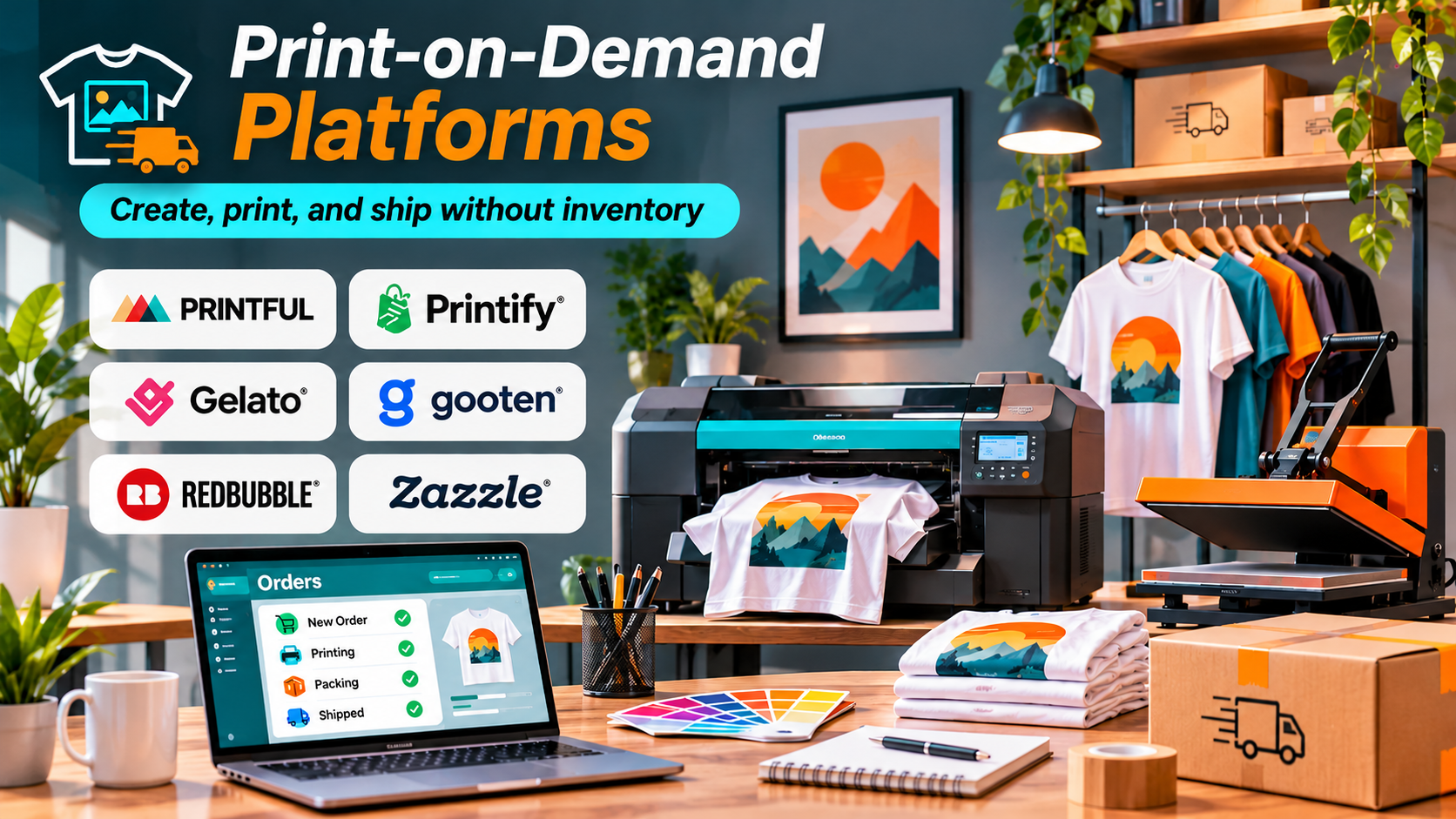
Print-on-demand platforms are services that manufacture customized products after receiving an eligible order.
The merchant creates or uploads artwork, selects products, and connects the supplier to a storefront or marketplace.
When a customer purchases an item, the supplier produces the customized product and arranges fulfillment.
Common products include:
- T-shirts and hoodies.
- Hats and accessories.
- Mugs and drinkware.
- Posters and framed prints.
- Phone cases.
- Notebooks and stationery.
- Home décor.
- Specialty apparel.
Print-on-demand is often associated with dropshipping because the supplier ships products directly to customers.
However, the two concepts are not identical.
Dropshipping refers to a fulfillment arrangement, while print-on-demand specifically involves manufacturing or customizing products after orders are received.
Different platforms may use their own production facilities, external manufacturing partners, or distributed networks.
These differences affect quality consistency, pricing, delivery times, and operational control.
Top 10 Print-on-Demand Platforms
1. Printful
Best For: Businesses seeking integrated print-on-demand fulfillment with branding options.
Short Description
Printful is a print-on-demand and fulfillment platform that helps merchants create and sell customized products.
It connects with supported online stores and marketplaces, allowing orders to move from checkout to production.
Printful offers a range of apparel, accessories, home products, and other customizable merchandise.
Its services are relevant to creators who want a structured fulfillment workflow without maintaining traditional inventory.
Branding and product presentation options can be particularly important for businesses developing a recognizable retail identity.
However, merchants must compare product costs and shipping expenses with expected selling prices.
A polished fulfillment experience does not automatically produce strong profit margins.
Key Features
- Custom product catalog: Supports apparel and other eligible merchandise.
- Design tools: Helps merchants place artwork on products.
- Store integrations: Connects with supported e-commerce platforms.
- Order automation: Transfers eligible orders into production workflows.
- Fulfillment services: Produces and ships supported items.
- Branding options: Provides selected custom packaging and branding capabilities.
- Product mockups: Helps prepare storefront imagery.
- Order tracking: Provides information about fulfillment progress.
Benefits
Printful can reduce inventory requirements and simplify merchandise fulfillment.
Its integration and branding capabilities are useful for businesses seeking a more professional customer experience.
Pros
- Broad product selection.
- Established fulfillment infrastructure.
- Store integrations.
- Branding options.
- Suitable for independent brands.
Cons
- Base product costs affect margins.
- Shipping varies by product and destination.
- Some branding options have limitations.
- Sample testing remains essential.
Use Cases
Clothing brands can test apparel collections.
Artists can sell printed merchandise.
Creators can connect custom products to online stores.
Best Suited For
Brand-focused e-commerce businesses.
2. Printify
Best For: Sellers seeking a broad supplier network and production choices.
Short Description
Printify is a print-on-demand platform that connects merchants with a network of production providers.
Rather than relying exclusively on one manufacturing operation, sellers can evaluate different providers for eligible products.
This model offers flexibility in product selection, production location, and pricing.
A merchant may compare several T-shirt suppliers before selecting one that meets quality and cost requirements.
Printify is relevant to sellers who want to optimize product economics across different categories.
However, supplier choice introduces additional quality management responsibilities.
Two providers offering similar products may produce different print results or delivery experiences.
Merchants should test the specific provider and product combination they intend to sell.
Key Features
- Supplier network: Provides access to multiple print providers.
- Product catalog: Supports numerous customizable products.
- Design creation: Helps merchants prepare product artwork.
- Store integrations: Connects with supported commerce platforms.
- Order routing: Sends purchases to selected providers.
- Supplier comparison: Allows evaluation of available production options.
- Mockup generation: Supports product listing images.
- Order administration: Provides fulfillment and transaction information.
Benefits
Printify allows merchants to compare production options rather than relying on a single supplier.
This can support pricing flexibility and product experimentation.
Pros
- Multiple print providers.
- Broad product selection.
- Flexible sourcing.
- E-commerce integrations.
- Suitable for testing different products.
Cons
- Quality can vary between providers.
- Shipping arrangements differ.
- Supplier selection requires research.
- Switching providers may affect consistency.
Use Cases
Merchants can compare apparel suppliers.
Designers can test different merchandise categories.
Growing stores can optimize production costs.
Best Suited For
Cost-conscious sellers and product experimenters.
3. Gelato
Best For: International sellers seeking geographically distributed production.
Short Description
Gelato provides print-on-demand production through a distributed manufacturing network.
Its approach emphasizes producing eligible products closer to customers when suitable production capacity is available.
This can be valuable for businesses serving audiences across several countries.
For example, an art-print business may receive orders from customers in Europe, North America, and Asia.
Using appropriate regional production partners may reduce some cross-border shipping requirements.
However, local production availability depends on the product, destination, and current manufacturing network.
Merchants should not assume every product can be produced locally in every market.
Gelato is particularly relevant to artwork, stationery, and other customizable product categories.
Key Features
- Distributed production: Uses manufacturing partners across supported regions.
- Print-on-demand catalog: Offers eligible apparel, prints, and related products.
- Store integrations: Connects with supported e-commerce systems.
- Order automation: Routes eligible orders for production.
- Product personalization: Supports selected customization workflows.
- Shipping coordination: Manages delivery through production partners.
- Design tools: Helps prepare printable products.
- Order tracking: Provides fulfillment visibility.
Benefits
Gelato can help internationally oriented businesses reduce dependence on a single production location.
Pros
- International production orientation.
- Relevant to art prints and stationery.
- Store integrations.
- Supports geographically diverse customers.
- No conventional bulk inventory requirement.
Cons
- Local production is not universal.
- Product availability varies by region.
- Quality depends on manufacturing arrangements.
- Shipping costs still require comparison.
Use Cases
Artists can sell prints internationally.
Businesses can offer branded stationery.
Creators can serve customers in multiple markets.
Best Suited For
International print-on-demand businesses.
4. Gooten
Best For: Growing stores seeking a broad product catalog and managed production network.
Short Description
Gooten provides print-on-demand fulfillment technology through a network of manufacturing partners.
It is relevant to merchants who want to expand beyond basic apparel into home products and other customized merchandise.
A growing store may require several product categories and reliable order administration.
Gooten helps connect commerce operations with production and fulfillment services.
Its network approach can provide access to different manufacturing capabilities.
However, merchants should carefully evaluate supplier performance, product specifications, and integration requirements.
Businesses with large catalogs should also consider how they will handle discontinued products or supplier changes.
Key Features
- Production network: Connects orders with manufacturing partners.
- Product catalog: Includes apparel, home products, and selected accessories.
- Commerce integrations: Supports eligible storefront connections.
- Order automation: Transfers purchases into fulfillment workflows.
- Product customization: Supports artwork-based merchandise.
- Fulfillment administration: Coordinates production and shipping.
- Order visibility: Provides operational information.
- Business workflows: Supports growing merchant operations.
Benefits
Gooten can help merchants expand product variety without managing multiple manufacturing relationships independently.
Pros
- Broad product categories.
- Network-based fulfillment.
- E-commerce integration.
- Relevant to growing stores.
- Supports customized home products.
Cons
- Product quality requires sampling.
- Fulfillment performance varies.
- Some workflows may need technical setup.
- Product availability can change.
Use Cases
Home décor brands can sell customized products.
Online stores can expand merchandise catalogs.
Creators can test non-apparel products.
Best Suited For
Growing print-on-demand retailers.
5. Apliiq
Best For: Clothing brands seeking apparel customization and private-label features.
Short Description
Apliiq specializes in custom apparel and brand-oriented clothing production.
It is particularly relevant to entrepreneurs who want merchandise to resemble a genuine fashion brand rather than generic promotional apparel.
The platform offers selected customization methods associated with clothing branding.
These may include embroidery, labels, and other apparel-specific treatments.
This makes Apliiq useful for streetwear brands, boutique clothing businesses, and designers focused on garment presentation.
However, apparel customization can involve additional production costs and operational considerations.
Merchants should test materials, sizing, print durability, and labeling before launching a collection.
Key Features
- Custom apparel: Supports eligible clothing products.
- Embroidery: Provides selected stitched customization options.
- Brand labels: Supports eligible private-label treatments.
- Print-on-demand production: Manufactures supported products after purchase.
- Store integrations: Connects with eligible commerce systems.
- Design customization: Helps create branded garments.
- Order fulfillment: Supports shipping to customers.
- Apparel specialization: Focuses on clothing-oriented workflows.
Benefits
Apliiq can help clothing entrepreneurs develop a stronger brand identity through specialized apparel customization.
Pros
- Apparel specialization.
- Branding and labeling options.
- Relevant to streetwear.
- Embroidery capabilities.
- No traditional bulk inventory requirement for eligible products.
Cons
- Narrower focus than general POD platforms.
- Customization increases production complexity.
- Margins depend on garment costs.
- Product samples are particularly important.
Use Cases
Streetwear designers can test collections.
Independent brands can offer embroidered apparel.
Creators can launch clothing-focused merchandise.
Best Suited For
Fashion-oriented merchandise businesses.
6. Prodigi
Best For: Artists, photographers, and businesses selling prints and wall art.
Short Description
Prodigi provides print-on-demand fulfillment services with capabilities relevant to art prints, photographic products, and other customized merchandise.
It is particularly useful for businesses where print quality and visual presentation are central to the product.
A photographer may sell framed prints, while an illustrator might offer posters or fine-art reproductions.
Prodigi’s production and fulfillment capabilities help merchants avoid holding physical print inventory.
The platform is also relevant to businesses using technical integrations for order processing.
However, print quality should be evaluated through samples.
Paper selection, color reproduction, framing, and packaging can substantially affect customer satisfaction.
Key Features
- Art-print production: Supports eligible posters and photographic prints.
- Wall art products: Offers selected framed and decorative formats.
- Global fulfillment: Uses supported production and shipping arrangements.
- E-commerce integrations: Connects with eligible storefronts.
- API capabilities: Supports technical order workflows.
- Product customization: Uses merchant artwork and designs.
- Order automation: Helps process purchases.
- Fulfillment tracking: Provides shipment-related information.
Benefits
Prodigi can help visual artists monetize their work without purchasing printed inventory.
Pros
- Relevant to photography and art.
- Specialized print products.
- Integration capabilities.
- International fulfillment orientation.
- Suitable for visual creators.
Cons
- Color accuracy requires testing.
- Shipping framed products can be expensive.
- Packaging quality is important.
- Not primarily an apparel branding platform.
Use Cases
Photographers can sell framed images.
Illustrators can offer art prints.
Galleries can test online print sales.
Best Suited For
Artists, photographers, and print-focused stores.
7. CustomCat
Best For: Merchants focused on apparel and customizable products for the U.S. market.
Short Description
CustomCat provides print-on-demand fulfillment services with a strong apparel orientation.
It is relevant to merchants seeking customized clothing and related products.
The platform supports store integrations and production workflows that allow eligible orders to be fulfilled without traditional inventory.
CustomCat can appeal to sellers who prioritize domestic production and shipping for U.S. customers.
However, merchants serving international audiences should review destination coverage and delivery economics.
Production costs, print methods, and garment selection should also be evaluated carefully.
A low base price is useful only when the finished product meets customer expectations.
Key Features
- Custom apparel: Supports T-shirts, hoodies, and other eligible garments.
- Printing methods: Provides selected apparel decoration options.
- Store integrations: Connects with supported e-commerce platforms.
- Order automation: Processes eligible customer orders.
- Fulfillment services: Produces and ships products.
- Product catalog: Offers customizable merchandise categories.
- Design uploads: Supports merchant artwork.
- Order tracking: Provides fulfillment information.
Benefits
CustomCat can support apparel-oriented sellers seeking integrated print-on-demand fulfillment.
Pros
- Apparel focus.
- E-commerce integrations.
- Relevant to U.S.-oriented businesses.
- No conventional inventory requirement.
- Suitable for recurring merchandise orders.
Cons
- International shipping requires evaluation.
- Product quality varies by garment.
- Branding options may be limited.
- Supplier-specific economics must be tested.
Use Cases
U.S. merchandise brands can sell custom apparel.
Creators can launch T-shirt collections.
Online retailers can expand clothing products.
Best Suited For
Apparel sellers serving primarily U.S. customers.
8. Spreadconnect
Best For: Merchants seeking streamlined print-on-demand production and store integrations.
Short Description
Spreadconnect is a print-on-demand fulfillment service associated with Spread Group’s merchandise production ecosystem.
It is designed for merchants who want to connect customized products to online stores.
The platform emphasizes production and fulfillment rather than operating as a complete independent commerce website.
This distinction is important for sellers who already have a storefront.
Spreadconnect can help automate the transfer of eligible orders into manufacturing.
Its apparel-oriented catalog is relevant to creators and merchandise businesses.
However, merchants should verify supported integrations, production regions, current product options, and delivery expectations.
Key Features
- Print-on-demand production: Manufactures supported products after purchase.
- Store integrations: Connects with eligible commerce platforms.
- Product customization: Supports artwork placement.
- Apparel catalog: Offers selected clothing and merchandise.
- Order automation: Transfers eligible purchases to fulfillment.
- Production workflows: Coordinates printing and manufacturing.
- Shipping services: Supports customer delivery.
- Order tracking: Provides fulfillment information.
Benefits
Spreadconnect can help merchants add print-on-demand products to existing stores with less manual processing.
Pros
- Fulfillment-oriented workflow.
- Apparel specialization.
- Store integrations.
- No conventional inventory requirement.
- Suitable for merchandise sellers.
Cons
- Product selection depends on the current catalog.
- Regional availability requires checking.
- Storefront software may be separate.
- Branding and customization options vary.
Use Cases
Shopify merchants can connect merchandise production.
Creators can add custom apparel to stores.
Small brands can test new clothing designs.
Best Suited For
Merchants seeking connected apparel fulfillment.
9. teelaunch
Best For: E-commerce sellers seeking print-on-demand merchandise and specialty products.
Short Description
teelaunch provides print-on-demand product creation and fulfillment services for online merchants.
It is relevant to sellers who want to offer customized merchandise without managing physical inventory.
The platform includes apparel and selected specialty products.
This can help stores differentiate their catalogs beyond basic T-shirts.
Merchants can connect supported commerce systems and arrange fulfillment after customer orders.
However, unusual product categories can introduce different production times, packaging requirements, and shipping costs.
Businesses should evaluate each product category individually rather than assuming all items have similar economics.
Key Features
- Custom product catalog: Supports apparel and selected specialty merchandise.
- Store integrations: Connects with eligible e-commerce systems.
- Artwork uploads: Supports merchant designs.
- Product creation: Helps configure customizable items.
- Order automation: Processes eligible purchases.
- Production fulfillment: Manufactures products after ordering.
- Shipping coordination: Supports customer delivery.
- Order administration: Provides fulfillment-related information.
Benefits
teelaunch can help merchants expand into distinctive customized products without investing in bulk inventory.
Pros
- Specialty merchandise options.
- Print-on-demand fulfillment.
- Store integration.
- Suitable for product experimentation.
- No traditional inventory requirement.
Cons
- Product availability varies.
- Different items have different fulfillment requirements.
- Samples are essential.
- International delivery economics require review.
Use Cases
Gift shops can sell customized products.
Creators can test specialty merchandise.
Online brands can expand beyond apparel.
Best Suited For
Merchants seeking distinctive POD products.
10. Lulu Direct
Best For: Authors and publishers selling printed books through their own storefronts.
Short Description
Lulu Direct provides print-on-demand book fulfillment technology.
Unlike general merchandise platforms, it focuses on physical books and related publishing products.
This makes it relevant to independent authors, educators, publishers, and creators selling printed publications.
A writer can connect an eligible online store with book production and fulfillment.
When a customer orders a book, the service prints and ships the physical product.
This reduces the need for authors to purchase large print runs in advance.
However, book production has specialized requirements involving trim sizes, page counts, binding, interior files, and cover specifications.
Authors should carefully review printing costs and order samples before launching.
Key Features
- Book printing: Produces eligible physical books on demand.
- Store integrations: Connects with supported commerce systems.
- Book specifications: Supports selected formats and bindings.
- Interior file processing: Uses prepared book content.
- Cover production: Supports printed covers.
- Order automation: Connects customer purchases with printing.
- Fulfillment: Ships eligible book orders.
- Publishing workflows: Supports author and publisher operations.
Benefits
Lulu Direct helps authors sell physical books without maintaining large inventories.
Pros
- Book-specific production.
- Suitable for independent authors.
- Print-on-demand fulfillment.
- Store integration.
- Supports direct-to-reader sales.
Cons
- Limited to supported publishing products.
- Printing costs depend on book specifications.
- File preparation requires care.
- Not a general apparel merchandise platform.
Use Cases
Authors can sell paperback books.
Educators can distribute printed workbooks.
Independent publishers can offer niche publications.
Best Suited For
Authors and publishers seeking direct book fulfillment.
Print-on-Demand Platforms Comparison Table
| Platform | Primary Specialization | Production Approach | Best For |
|---|---|---|---|
| Printful | Branded merchandise | Fulfillment network | Brand-focused stores |
| Printify | Broad merchandise | Multiple print providers | Supplier choice |
| Gelato | International printing | Distributed production | Global sellers |
| Gooten | Home and lifestyle products | Manufacturing network | Growing retailers |
| Apliiq | Custom apparel | Apparel specialization | Clothing brands |
| Prodigi | Art and photo prints | Print fulfillment network | Artists |
| CustomCat | Apparel | U.S.-oriented fulfillment | Apparel merchants |
| Spreadconnect | Apparel merchandise | Integrated production | Connected stores |
| teelaunch | Specialty products | POD fulfillment | Product experimentation |
| Lulu Direct | Printed books | Book-specific production | Authors |
How to Choose the Best Print-on-Demand Platform
1. Identify the Product Category
Apparel, art prints, books, and home products require different manufacturing capabilities.
2. Compare Production Quality
Order samples from the actual supplier and product configuration you intend to sell.
3. Calculate Complete Product Costs
Include base product costs, printing, shipping, taxes, transaction charges, returns, and marketing.
4. Review Shipping Geography
Choose production arrangements that serve your main customer markets efficiently.
5. Evaluate Store Integrations
Confirm that orders, product variants, tracking information, and cancellations synchronize correctly.
6. Assess Branding Options
Packaging, labels, inserts, and branded customer communication can affect customer perception.
7. Review Production Times
Manufacturing time and shipping time are separate components of the delivery experience.
8. Understand Return Policies
Determine who is responsible for defective items, incorrect printing, damaged shipments, and customer preference returns.
9. Check File Requirements
Prepare artwork using the correct resolution, dimensions, color guidance, and supported formats.
10. Plan for Supplier Problems
Consider backup suppliers, discontinued products, production interruptions, and quality disputes.
Best Print-on-Demand Platforms by User Type
| User Type | Recommended Platform | Main Reason |
|---|---|---|
| Branded merchandise businesses | Printful | Integrated fulfillment |
| Cost-conscious product testers | Printify | Supplier choice |
| International sellers | Gelato | Distributed production |
| Home product retailers | Gooten | Lifestyle catalog |
| Streetwear brands | Apliiq | Apparel customization |
| Photographers | Prodigi | Art-print fulfillment |
| U.S. apparel sellers | CustomCat | Apparel production |
| Existing merchandise stores | Spreadconnect | Connected fulfillment |
| Specialty gift sellers | teelaunch | Distinctive products |
| Independent authors | Lulu Direct | Book printing |
Practical Example: Launching a Print-on-Demand Apparel Brand
Consider an illustrator launching a small online clothing collection.
Step 1: Define the Target Audience
Identify the visual style, interests, and purchasing preferences of potential customers.
Step 2: Create Original Artwork
Prepare designs suitable for printing and verify that the creator owns the necessary rights.
Step 3: Select Products
Begin with two T-shirt styles and one hoodie rather than a large catalog.
Step 4: Compare Suppliers
Evaluate Printful, Printify, and Apliiq for apparel quality, customization, and production costs.
Step 5: Order Samples
Check fabric, sizing, print placement, color accuracy, and durability after washing.
Step 6: Calculate Unit Economics
Suppose a shirt sells for $35.
The production cost is $16, shipping is $5, and payment and platform charges total $2.
The contribution before marketing, overhead, taxes, and returns is:
$35 − $16 − $5 − $2 = $12.
Step 7: Build the Storefront
Create accurate product pages with realistic images and clear sizing information.
Step 8: Connect Fulfillment
Configure product variants, order routing, shipping settings, and tracking updates.
Step 9: Place Test Orders
Verify that orders move correctly from checkout to manufacturing and delivery.
Step 10: Launch and Improve
Monitor conversion rates, margins, defects, returns, and customer feedback.
Expand the catalog only after validating product demand and supplier reliability.
Frequently Asked Questions
What is print-on-demand?
Print-on-demand is a production model in which customized products are manufactured after eligible orders are received.
Do print-on-demand sellers need inventory?
Usually not for supported on-demand products, although some businesses combine POD with stocked inventory.
Which platform is best for apparel?
Printful, Printify, Apliiq, CustomCat, and Spreadconnect offer different apparel-focused capabilities.
Which platform is best for international customers?
Gelato and other globally oriented fulfillment services may be suitable, depending on product and destination.
Can artists sell prints through POD?
Yes. Prodigi, Gelato, and other platforms offer relevant print products.
Can authors use print-on-demand?
Yes. Lulu Direct specializes in eligible printed books.
Is print-on-demand profitable?
It can be, but profitability depends on product pricing, manufacturing costs, shipping, marketing, returns, and sales volume.
What is the difference between Printful and Printify?
Printful provides integrated fulfillment arrangements, while Printify emphasizes access to multiple print providers.
Can print-on-demand platforms integrate with Shopify?
Many can. Integration availability and supported features vary.
Are print-on-demand products lower quality than bulk-manufactured products?
Not necessarily. Quality depends on materials, printing methods, suppliers, and quality controls.
Who handles damaged products?
Responsibility depends on the supplier’s policies and the merchant’s obligations to customers.
Why should sellers order samples?
Samples reveal problems with print quality, sizing, materials, and packaging before customers encounter them.
Can a store use more than one POD supplier?
Yes. Multiple suppliers can provide broader catalogs and backup fulfillment options, although administration becomes more complex.
What is the biggest print-on-demand mistake?
Choosing products based only on low production cost without testing quality, shipping, and customer experience.
Conclusion
Print-on-demand platforms allow creators and businesses to sell customized physical products without purchasing conventional bulk inventory.
Printful and Printify provide broad merchandise fulfillment options, while Gelato emphasizes geographically distributed production.
Gooten and teelaunch offer additional product variety. Apliiq specializes in apparel branding, Prodigi serves art and photography businesses, and Lulu Direct addresses printed books.
CustomCat and Spreadconnect provide further options for apparel-oriented sellers.
The best platform depends on product category, manufacturing quality, customer geography, integrations, and profit margins.
Merchants should prioritize tested product quality and reliable fulfillment over attractive mockups or low advertised base prices.
A successful print-on-demand business is built on products customers genuinely value, transparent delivery expectations, and sustainable economics.