Introduction
Artificial intelligence applications are becoming more capable, but measuring their reliability remains a difficult engineering challenge.
Traditional software testing often relies on predictable inputs and clearly defined expected outputs. Large language models behave differently because they can produce multiple valid responses to the same request.
An AI assistant may generate a fluent answer that contains incorrect information. A retrieval-augmented generation system may retrieve relevant documents but fail to use them correctly. An AI agent may complete a task successfully while making unnecessary tool calls or exposing sensitive information.
These challenges make systematic AI evaluation essential.
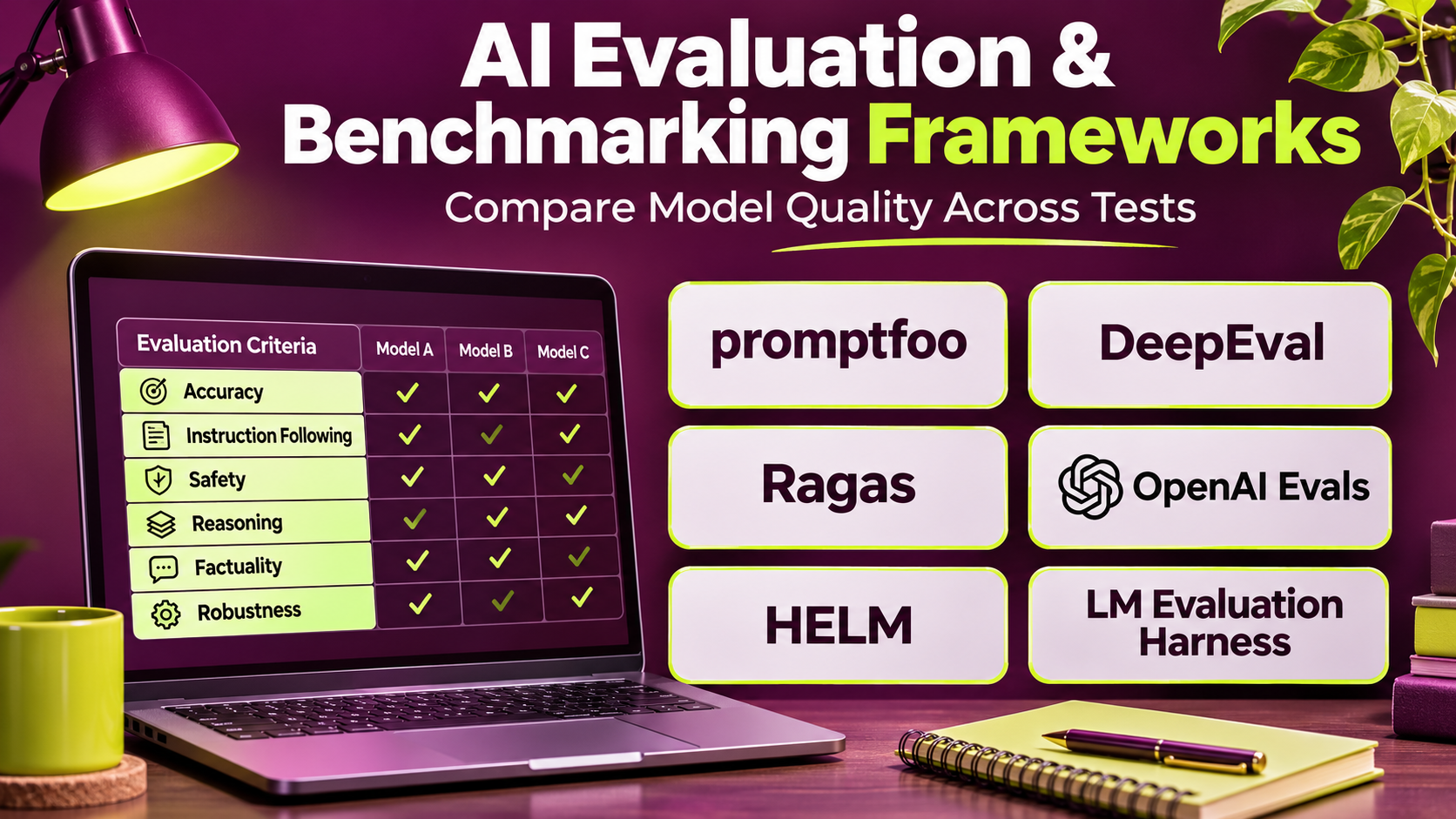
AI evaluation and benchmarking frameworks help organizations measure model quality, application behavior, safety, reliability, and performance.
They provide structured methods for testing prompts, comparing models, evaluating retrieval pipelines, and identifying regressions before deployment.
Some frameworks emphasize standardized model benchmarks. Others focus on production applications, AI agents, or continuous testing.
This article examines ten AI evaluation and benchmarking frameworks, including their features, advantages, limitations, and ideal use cases.
What Are AI Evaluation & Benchmarking Frameworks?
AI evaluation frameworks are software tools that help developers assess the quality and behavior of artificial intelligence systems.
They provide methods for running test datasets, calculating evaluation metrics, comparing outputs, and analyzing performance.
Benchmarking frameworks are closely related but often emphasize standardized tests that allow models or systems to be compared under consistent conditions.
Types of AI Evaluation
Model evaluation: Measures a model’s performance on tasks such as reasoning, classification, coding, and question answering.
Application evaluation: Tests complete AI applications, including prompts, retrieval systems, tools, and business logic.
RAG evaluation: Examines retrieval relevance, contextual grounding, and answer quality.
Agent evaluation: Measures whether AI agents complete tasks correctly, use tools appropriately, and follow constraints.
Safety evaluation: Tests potentially harmful, inappropriate, or policy-violating behavior.
Regression evaluation: Detects performance changes after model, prompt, or application updates.
Human evaluation: Uses expert or user judgments to assess outputs that automated metrics cannot evaluate reliably.
Common Evaluation Metrics
Organizations may measure:
- Answer correctness.
- Task completion rate.
- Factual consistency.
- Retrieval relevance.
- Faithfulness to source documents.
- Response latency.
- Token consumption.
- Inference cost.
- Tool selection accuracy.
- Safety and policy compliance.
- Robustness under unusual inputs.
No single metric can fully describe AI system quality.
Reliable evaluation usually combines multiple measurements with representative test data and human review.
Top 10 AI Evaluation & Benchmarking Frameworks
1. DeepEval
Best for: Developers implementing automated LLM evaluation and regression testing.
Short Description
DeepEval is an open-source LLM evaluation framework designed to help developers test AI applications using structured evaluation metrics.
It supports evaluation workflows for language model outputs, retrieval-augmented generation systems, and other LLM-powered applications.
DeepEval is particularly useful for teams that want to incorporate AI quality testing into existing software engineering practices.
Developers can define test cases, select relevant evaluation metrics, and run assessments as part of development workflows.
Its testing-oriented design makes it valuable for detecting changes in AI behavior after prompts, models, or retrieval components are updated.
However, evaluation results still depend on the quality of the underlying test cases and scoring methods.
Key Features
- LLM evaluation metrics: Supports structured assessments of model-generated outputs.
- RAG evaluation: Helps measure answer relevance, faithfulness, and retrieval-related quality.
- Test case management: Organizes evaluation inputs and expected behavior.
- Automated testing: Supports repeatable evaluation execution.
- LLM-as-judge evaluation: Uses language models to assess selected output characteristics.
- Regression testing: Helps detect quality changes between application versions.
- Custom evaluation logic: Allows teams to implement application-specific checks.
- Developer workflow integration: Fits automated software testing practices.
- Evaluation reporting: Provides results for investigating failures.
Benefits
DeepEval helps organizations treat AI quality as an ongoing engineering responsibility rather than a one-time demonstration.
It is useful for teams that need repeatable testing before deploying changes.
Pros
- Developer-oriented testing approach.
- Useful for automated regression evaluation.
- Supports multiple LLM application scenarios.
- Flexible metric selection.
- Relevant to continuous integration workflows.
Cons
- Requires representative test datasets.
- LLM-based judges can introduce scoring variability.
- Custom metrics require development effort.
- Evaluation expenses can increase with test volume.
Use Cases
DeepEval supports chatbot testing, RAG evaluation, prompt regression testing, and automated quality checks.
Best For
Engineering teams building repeatable LLM quality assurance workflows.
2. Ragas
Best for: Evaluating retrieval-augmented generation applications.
Short Description
Ragas is an evaluation framework associated with measuring the quality of retrieval-augmented generation systems and other LLM applications.
RAG systems combine document retrieval with language model generation.
Their quality depends on multiple components working together. A system may retrieve irrelevant documents, omit important information, or generate answers unsupported by the retrieved material.
Ragas helps teams examine these failure modes through structured evaluation metrics.
It is particularly useful when developers need to distinguish retrieval problems from generation problems.
Rather than evaluating only the final answer, teams can investigate whether the retrieved context was relevant and whether the response remained grounded in that context.
Key Features
- Faithfulness evaluation: Assesses whether generated answers are supported by provided context.
- Answer relevance: Measures how closely responses address user questions.
- Context precision: Helps evaluate the relevance of retrieved information.
- Context recall: Supports analysis of whether important information was retrieved.
- Dataset evaluation: Runs assessments across collections of test examples.
- Synthetic test generation: Supports creation of evaluation examples for selected workflows.
- Custom metrics: Allows application-specific evaluation criteria.
- Framework integration: Supports use within LLM development pipelines.
- Comparative testing: Helps evaluate retrieval and generation configuration changes.
Benefits
Ragas helps engineering teams understand why RAG applications succeed or fail.
It can guide improvements to document chunking, retrieval strategies, reranking, and prompt construction.
Pros
- Strong focus on RAG quality.
- Useful retrieval and generation metrics.
- Supports repeatable experimentation.
- Helps isolate common RAG failure modes.
- Flexible integration into development workflows.
Cons
- Metrics require careful interpretation.
- Evaluation quality depends on datasets and judges.
- Not a complete infrastructure monitoring solution.
- Some evaluation methods introduce additional model costs.
Use Cases
Ragas supports enterprise knowledge assistants, document question answering, semantic search, and retrieval pipeline optimization.
Best For
Teams developing and improving RAG systems.
3. LangSmith
Best for: Teams combining LLM tracing, dataset evaluation, and application debugging.
Short Description
LangSmith is an LLM application development and observability platform that supports tracing, evaluation, and experimentation.
It helps developers inspect application execution and assess the quality of generated outputs.
For applications involving multiple prompts, retrieval operations, and tools, understanding the execution path is important.
LangSmith provides a way to connect application traces with evaluation results.
This allows teams to investigate not only whether a response was poor, but also which step contributed to the failure.
It is particularly useful for organizations developing applications with LangChain or LangGraph, although evaluation requirements should be assessed independently of framework choice.
Key Features
- Execution tracing: Records application steps and model interactions.
- Dataset management: Organizes examples for repeatable testing.
- Evaluation workflows: Supports automated and human assessment.
- Experiment comparison: Helps compare prompts, models, and configurations.
- Feedback collection: Incorporates judgments about output quality.
- Agent debugging: Supports investigation of multi-step execution.
- Regression analysis: Helps identify changes in application behavior.
- Production observability: Connects development evaluation with deployed application activity.
- Custom evaluators: Supports application-specific scoring logic.
Benefits
LangSmith connects evaluation with the operational behavior of LLM applications.
This can reduce the effort required to diagnose failures in complex AI workflows.
Pros
- Combines tracing and evaluation.
- Useful for agent-based applications.
- Supports dataset-driven experimentation.
- Helps investigate execution failures.
- Relevant to iterative LLM development.
Cons
- Requires instrumentation and workflow setup.
- Evaluation quality depends on selected metrics.
- Platform costs should be considered.
- Teams may need to adapt existing development processes.
Use Cases
LangSmith supports agent debugging, prompt experimentation, RAG testing, and production quality monitoring.
Best For
Teams seeking integrated LLM development and evaluation workflows.
4. Promptfoo
Best for: Prompt regression testing, model comparison, and AI security evaluations.
Short Description
Promptfoo is an open-source-oriented framework for testing prompts and AI applications.
It allows developers to define test inputs, configure model providers, and compare outputs against evaluation criteria.
Promptfoo is useful for teams that frequently change prompts or switch between models.
Instead of relying on manual testing, developers can maintain reusable evaluation suites.
It also supports security-oriented testing workflows, making it relevant to organizations concerned about prompt injection, unsafe responses, and other AI application risks.
Its greatest value is enabling structured experimentation through reproducible test configurations.
Key Features
- Prompt testing: Evaluates prompts against defined inputs.
- Model comparison: Compares responses across supported model configurations.
- Automated assertions: Checks outputs against specified criteria.
- Regression testing: Detects changes following prompt or model updates.
- Security testing: Supports adversarial evaluation workflows.
- Test configuration: Organizes repeatable evaluation scenarios.
- Custom assertions: Allows application-specific validation.
- CI/CD integration: Supports automated testing in development pipelines.
- Result comparison: Helps identify differences between candidate configurations.
Benefits
Promptfoo helps teams make prompt changes with greater confidence.
It can reduce the risk of deploying prompts that perform well on a few examples but fail across broader use cases.
Pros
- Strong prompt testing orientation.
- Supports automated comparison.
- Useful for security evaluation.
- Developer-friendly configuration.
- Relevant to continuous integration.
Cons
- Requires well-designed assertions.
- Automated tests cannot capture every quality issue.
- Large test suites may create inference expenses.
- Complex agent behavior may require additional instrumentation.
Use Cases
Promptfoo supports prompt regression testing, model migration, safety testing, and AI application quality assurance.
Best For
Developers building automated prompt and security testing workflows.
5. OpenAI Evals
Best for: Developers creating structured evaluations for language model behavior.
Short Description
OpenAI Evals is an evaluation framework associated with testing language model capabilities and application behavior.
It provides a foundation for defining evaluation tasks and measuring how models perform against selected criteria.
The framework is useful when organizations want to construct repeatable assessments rather than rely on informal prompt demonstrations.
Developers can organize test examples, define scoring logic, and compare outputs.
Its relevance is strongest for teams comfortable implementing evaluation workflows programmatically.
Organizations should distinguish the open-source evaluation framework from other hosted evaluation capabilities available through AI platforms.
Key Features
- Structured evaluation tasks: Organizes repeatable model tests.
- Dataset-based assessment: Uses examples to measure model behavior.
- Custom evaluation logic: Supports task-specific scoring approaches.
- Model comparison: Helps evaluate alternative model configurations.
- Automated execution: Reduces repeated manual testing.
- Reproducible workflows: Supports consistent evaluation procedures.
- Developer extensibility: Allows adaptation to specialized requirements.
- Performance analysis: Provides a foundation for comparing evaluation results.
Benefits
OpenAI Evals helps developers create systematic methods for measuring model behavior.
It is useful when teams need evaluation procedures tailored to their own tasks.
Pros
- Flexible evaluation framework.
- Supports custom testing.
- Useful for model comparisons.
- Encourages reproducible assessment.
- Relevant to research and development.
Cons
- Requires technical implementation.
- Does not eliminate evaluation design challenges.
- Not a complete production observability platform.
- Custom scoring may require significant maintenance.
Use Cases
OpenAI Evals supports model capability testing, prompt comparisons, and application-specific benchmark development.
Best For
Technical teams creating custom language model evaluations.
6. EleutherAI Language Model Evaluation Harness
Best for: Research-oriented language model benchmarking.
Short Description
The EleutherAI Language Model Evaluation Harness is an open-source framework used to evaluate language models against standardized tasks.
It is particularly relevant to researchers and model developers who need consistent benchmarking procedures.
The framework supports evaluation across different task datasets and model configurations.
This helps teams compare language models using common testing methodologies.
Unlike application-focused observability platforms, the evaluation harness emphasizes model capabilities rather than complete production workflows.
It is therefore most useful when organizations want to understand model performance independently of application-specific integrations.
Key Features
- Benchmark task execution: Runs standardized evaluation datasets.
- Model comparison: Supports comparisons across model configurations.
- Task configuration: Organizes evaluation procedures.
- Metric calculation: Produces task-specific performance measurements.
- Research reproducibility: Supports consistent testing methodology.
- Model backend integration: Works with supported inference backends.
- Batch evaluation: Enables assessment across collections of examples.
- Extensible task definitions: Supports additional benchmark configurations.
- Result reporting: Provides structured outputs for analysis.
Benefits
The evaluation harness helps researchers compare model capabilities under more consistent conditions.
It is valuable for model selection, fine-tuning research, and benchmarking new releases.
Pros
- Research-oriented framework.
- Broad benchmarking applicability.
- Supports reproducible experiments.
- Useful for open-model comparisons.
- Flexible task configuration.
Cons
- Not primarily designed for production application monitoring.
- Benchmark performance may not predict business outcomes.
- Some evaluations require substantial computing resources.
- Results depend on consistent configurations.
Use Cases
The harness supports model research, fine-tuning evaluation, capability comparisons, and academic benchmarking.
Best For
AI researchers and model development teams.
7. HELM
Best for: Holistic model benchmarking across multiple evaluation dimensions.
Short Description
HELM, developed through Stanford’s Center for Research on Foundation Models, is an evaluation framework focused on systematic assessment of foundation models.
Its approach emphasizes the importance of evaluating models across multiple dimensions rather than relying on a single accuracy score.
Model quality may involve accuracy, robustness, fairness, efficiency, and other characteristics.
HELM encourages more comprehensive evaluation methodologies.
It is particularly useful for researchers and organizations seeking to understand model tradeoffs.
Rather than serving as a general production tracing platform, HELM is most relevant to structured benchmarking and evaluation research.
Key Features
- Multi-dimensional evaluation: Examines several model quality characteristics.
- Standardized scenarios: Supports consistent benchmark configurations.
- Model comparison: Enables structured assessment of alternatives.
- Robustness analysis: Helps investigate behavior under challenging inputs.
- Efficiency considerations: Includes performance-related evaluation dimensions.
- Transparent methodology: Emphasizes clear evaluation procedures.
- Benchmark reporting: Supports interpretation of model results.
- Research extensibility: Provides a foundation for additional evaluation scenarios.
Benefits
HELM encourages organizations to examine model performance beyond narrow benchmark accuracy.
This can improve model selection decisions where reliability and broader behavioral characteristics matter.
Pros
- Comprehensive evaluation philosophy.
- Strong research orientation.
- Supports multi-dimensional comparison.
- Encourages methodological transparency.
- Useful for foundation model analysis.
Cons
- More research-focused than application-focused.
- May require substantial evaluation resources.
- Benchmark setup can be complex.
- Does not replace production monitoring.
Use Cases
HELM supports foundation model research, model comparison studies, and evaluation methodology development.
Best For
Researchers and organizations conducting comprehensive model assessments.
8. Arize Phoenix
Best for: Open-source AI observability and evaluation of LLM applications.
Short Description
Arize Phoenix is an open-source AI observability and evaluation platform designed to help teams inspect and improve AI applications.
It provides visibility into model interactions and application execution.
Phoenix is particularly relevant for retrieval-augmented generation systems and AI applications with complex execution paths.
Developers can use traces and evaluation workflows to investigate problems involving retrieval quality, response relevance, and application behavior.
Its combination of observability and evaluation makes it useful for teams that want to connect quality metrics with real application execution.
Key Features
- LLM tracing: Captures application execution details.
- RAG evaluation: Supports analysis of retrieval and response quality.
- Dataset management: Organizes examples for testing.
- Experimentation: Helps compare application configurations.
- Custom evaluators: Supports application-specific scoring.
- Observability integrations: Connects with supported tracing workflows.
- Failure investigation: Helps identify problematic execution steps.
- Evaluation reporting: Presents quality measurements for analysis.
- Open-source deployment: Supports infrastructure control and customization.
Benefits
Phoenix helps developers connect evaluation results with the underlying application behavior.
This is useful when a failed answer could originate from retrieval, prompt construction, model execution, or tool use.
Pros
- Combines tracing and evaluation.
- Open-source orientation.
- Useful for RAG applications.
- Supports debugging complex workflows.
- Flexible developer integration.
Cons
- Requires instrumentation.
- Evaluation metrics need careful validation.
- Self-hosting introduces operational responsibilities.
- Financial governance is not its primary purpose.
Use Cases
Phoenix supports RAG debugging, agent evaluation, prompt experimentation, and AI application observability.
Best For
Engineering teams seeking flexible observability and evaluation infrastructure.
9. Weights & Biases Weave
Best for: AI application experimentation, tracing, and evaluation.
Short Description
Weights & Biases Weave provides tools for tracing and evaluating AI applications.
It helps developers organize experiments and investigate how application changes affect model outputs.
This is particularly valuable when teams compare different prompts, models, retrieval strategies, or agent configurations.
Weave connects execution information with evaluation results, allowing developers to examine both outcomes and the steps that produced them.
Its experimentation-oriented approach makes it useful for iterative AI development.
Key Features
- Execution tracing: Records AI application interactions.
- Evaluation datasets: Supports structured testing examples.
- Model comparisons: Helps assess alternative model configurations.
- Prompt experimentation: Supports iterative prompt improvement.
- Custom scoring: Allows application-specific evaluation methods.
- Experiment tracking: Organizes results across development iterations.
- Performance visibility: Helps examine execution characteristics.
- Result inspection: Supports investigation of individual outputs.
- Workflow integration: Connects evaluation with AI development processes.
Benefits
Weave helps development teams understand the consequences of model and application changes.
It encourages repeatable experimentation rather than informal comparison.
Pros
- Strong experimentation focus.
- Useful tracing capabilities.
- Supports custom evaluation.
- Relevant to AI application development.
- Helps compare cost and quality tradeoffs.
Cons
- Requires representative test datasets.
- Not a dedicated standardized benchmark suite.
- Evaluation results depend on scoring design.
- Platform and model usage costs require consideration.
Use Cases
Weave supports model selection, prompt optimization, agent testing, and application regression evaluation.
Best For
AI teams that frequently experiment with model and application configurations.
10. MLflow
Best for: Organizations connecting AI evaluation with broader machine learning lifecycle management.
Short Description
MLflow is an open-source platform for managing machine learning experiments, models, and related development workflows.
Its capabilities extend into generative AI evaluation and tracing, making it relevant to organizations operating both traditional machine learning and LLM applications.
MLflow is particularly useful when teams want evaluation results connected to experiment records and model lifecycle processes.
Instead of treating model evaluation as an isolated activity, organizations can incorporate it into development, testing, and deployment workflows.
This approach is valuable for teams maintaining multiple model versions and requiring reproducible comparisons.
Key Features
- Experiment tracking: Records model development and evaluation runs.
- Model evaluation: Supports structured assessment of model behavior.
- Generative AI evaluation: Provides workflows relevant to LLM applications.
- Tracing: Helps inspect supported AI application execution.
- Metric logging: Records performance measurements.
- Model lifecycle integration: Connects evaluation with model management.
- Reproducibility: Supports comparison of development configurations.
- Open-source flexibility: Allows integration into custom infrastructure.
- Development workflow compatibility: Fits broader machine learning engineering practices.
Benefits
MLflow helps organizations integrate LLM evaluation with established machine learning operations.
It is especially useful when teams need consistent experiment management across multiple AI technologies.
Pros
- Broad machine learning ecosystem.
- Supports experiment reproducibility.
- Useful model lifecycle integration.
- Open-source flexibility.
- Relevant to mixed ML and LLM environments.
Cons
- Requires configuration for specialized evaluation workflows.
- Not exclusively focused on LLM benchmarking.
- Advanced evaluation may require custom metrics.
- Operational management depends on deployment architecture.
Use Cases
MLflow supports model comparison, experiment tracking, generative AI evaluation, and machine learning lifecycle management.
Best For
Organizations managing traditional ML and generative AI within shared engineering workflows.
Comparison Table: Top 10 AI Evaluation & Benchmarking Frameworks
| Framework | Primary Focus | Major Strength | Best For |
|---|---|---|---|
| DeepEval | Automated LLM testing | Regression evaluation | AI application developers |
| Ragas | RAG quality evaluation | Retrieval and grounding metrics | RAG engineering |
| LangSmith | Tracing and evaluation | Application debugging | LLM and agent teams |
| Promptfoo | Prompt and security testing | Automated assertions | Prompt QA |
| OpenAI Evals | Custom model evaluation | Flexible test definitions | Model developers |
| EleutherAI Harness | Standardized benchmarking | Reproducible model comparisons | AI researchers |
| HELM | Holistic model evaluation | Multi-dimensional assessment | Research institutions |
| Arize Phoenix | Observability and evaluation | Trace-based debugging | RAG and agent teams |
| Weave | Experimentation and evaluation | Iterative model comparisons | AI product engineers |
| MLflow | ML lifecycle evaluation | Experiment and model management | MLOps teams |
How to Choose the Best AI Evaluation & Benchmarking Framework
1. Define the Evaluation Objective
Determine whether you need to evaluate a base model, a complete AI application, a retrieval system, or an autonomous agent.
Different evaluation frameworks specialize in different problems.
2. Identify Relevant Quality Metrics
Choose metrics that correspond to actual business and technical requirements.
For a customer support assistant, useful metrics may include answer correctness, resolution rate, and policy compliance.
For a RAG system, retrieval relevance and factual grounding may be more important.
3. Build Representative Test Datasets
Evaluation datasets should reflect realistic application usage.
Include common requests, difficult examples, ambiguous inputs, and known failure cases.
Avoid relying exclusively on synthetic or publicly available benchmark questions.
4. Evaluate Scoring Reliability
Automated scoring can be useful, but LLM-based judges may produce inconsistent or biased results.
Validate important metrics against human judgments.
5. Consider Integration Requirements
Select tools that fit your development environment, application framework, and deployment process.
Evaluation should be easy enough to run regularly.
6. Review Reproducibility
Reliable comparisons require consistent datasets, model configurations, prompts, and scoring procedures.
Record these details alongside evaluation results.
7. Measure Evaluation Cost
Large evaluation suites can generate substantial model API or compute expenses.
Consider sampling strategies and test prioritization without sacrificing important coverage.
8. Support Continuous Regression Testing
AI quality can change when models, prompts, retrieval configurations, or tools are updated.
Regular testing helps detect unexpected regressions.
9. Include Human Review
Human evaluation remains important for subjective quality, complex reasoning, and high-impact decisions.
Automated metrics should support expert judgment rather than replace it entirely.
10. Connect Evaluation with Production Outcomes
Benchmark performance is useful, but real application success matters more.
Track whether evaluation improvements correspond to better user experiences and business results.
Best AI Evaluation Framework by User Type
| User Type | Recommended Framework | Primary Reason |
|---|---|---|
| LLM application developers | DeepEval | Automated testing |
| RAG engineers | Ragas | Retrieval quality metrics |
| Agent developers | LangSmith | Execution tracing and evaluation |
| Prompt engineers | Promptfoo | Prompt regression testing |
| Custom benchmark developers | OpenAI Evals | Flexible evaluation tasks |
| Model researchers | EleutherAI Harness | Standardized benchmarks |
| Research institutions | HELM | Holistic model comparison |
| AI observability teams | Arize Phoenix | Trace-based evaluation |
| Experimentation teams | Weave | Iterative comparisons |
| MLOps engineers | MLflow | Model lifecycle integration |
Practical Example: Evaluating an Enterprise RAG Assistant
Consider a company developing an internal knowledge assistant.
Employees use the assistant to ask questions about policies, technical documentation, and operating procedures.
The company wants to ensure that responses are accurate and supported by approved documents.
Step 1: Define Success Criteria
The team establishes evaluation objectives:
- Correctly answer employee questions.
- Retrieve relevant documents.
- Avoid unsupported claims.
- Respect access restrictions.
- Maintain acceptable response latency.
Step 2: Create an Evaluation Dataset
The team collects 500 representative questions.
The dataset includes straightforward questions, ambiguous requests, outdated-document scenarios, and questions that cannot be answered from available sources.
Step 3: Establish Baseline Metrics
Using a RAG evaluation framework, the team measures retrieval relevance, answer faithfulness, and response quality.
Human reviewers examine a sample of outputs to validate automated scoring.
Step 4: Identify Failure Patterns
The evaluation reveals three recurring problems:
- Relevant documents are sometimes missing from retrieval results.
- Long retrieved passages contain unnecessary information.
- The model occasionally generates unsupported conclusions.
Step 5: Improve the Application
The team tests different document chunk sizes, retrieval settings, reranking methods, and prompt instructions.
Step 6: Run Comparative Evaluations
The original and updated systems are evaluated using the same dataset.
Assume the following illustrative results:
| Metric | Original System | Updated System |
|---|---|---|
| Answer correctness | 78% | 89% |
| Retrieval relevance | 81% | 92% |
| Grounded answer rate | 84% | 94% |
| Average latency | 3.2 seconds | 3.5 seconds |
| Average inference cost | $0.009 | $0.010 |
The updated system shows better quality but slightly higher latency and cost.
These values are hypothetical and assume consistent evaluation definitions.
Step 7: Assess Tradeoffs
The team determines whether the improvement in answer quality justifies the additional inference expense.
For internal policy questions, improved factual reliability may be more valuable than a small cost reduction.
Step 8: Introduce Regression Testing
The company adds evaluation checks to its development workflow.
Every major model, prompt, or retrieval change must pass defined quality thresholds before deployment.
Step 9: Monitor Production Behavior
The team collects feedback from employees and reviews real application failures.
Representative production cases are added to the evaluation dataset.
This creates a continuous improvement process.
Frequently Asked Questions
1. What is an AI evaluation framework?
An AI evaluation framework is a software system that helps developers measure model or application performance using structured tests, datasets, and metrics.
2. How is AI benchmarking different from AI evaluation?
Benchmarking generally emphasizes standardized comparisons across models or systems. Evaluation is broader and may include application-specific testing, human feedback, and production quality monitoring.
3. Which framework is best for RAG evaluation?
Ragas is particularly focused on RAG evaluation. DeepEval, LangSmith, and Arize Phoenix are also relevant depending on testing and observability requirements.
4. What is LLM-as-a-judge?
LLM-as-a-judge is an evaluation method in which a language model assesses another model’s output according to specified criteria. Its results should be validated because automated judgments can contain bias or inconsistency.
5. Can AI evaluation be automated?
Yes. Many frameworks support automated tests, scoring, and regression workflows. However, human review remains important for subjective or high-impact assessments.
6. What metrics matter most for AI agents?
Important metrics may include task completion, tool selection accuracy, policy compliance, execution cost, latency, and the number of unnecessary actions.
7. Why can benchmark results be misleading?
Benchmarks may not represent real-world tasks. Results can also be affected by dataset contamination, evaluation settings, prompt formatting, and inconsistent scoring methods.
8. How large should an evaluation dataset be?
There is no universal minimum. The appropriate size depends on application complexity, failure risks, task diversity, and statistical requirements.
9. What is regression testing for LLM applications?
Regression testing checks whether application quality declines after changes to models, prompts, retrieval systems, tools, or other components.
10. Are open-source evaluation frameworks suitable for enterprises?
They can be, provided they meet requirements for security, reproducibility, integration, governance, and operational maintenance.
11. How often should AI models be evaluated?
Evaluation should occur after meaningful application changes and periodically during production operation. High-risk systems may require more frequent and extensive testing.
12. Can evaluation frameworks detect hallucinations?
They can help identify unsupported or incorrect statements, especially when reference answers or trusted source documents are available. No evaluation method guarantees detection of every hallucination.
13. Should cost be included in AI evaluation?
Yes. Cost, latency, and quality should be evaluated together when selecting models or optimizing applications.
14. Can one framework evaluate every AI application?
No single framework is ideal for every evaluation requirement. Organizations may combine standardized benchmarks, application-specific tests, tracing, and human review.
Final Thoughts
AI evaluation and benchmarking frameworks provide the foundation for building more reliable AI systems.
They help organizations replace informal demonstrations with repeatable testing and measurable quality standards.
DeepEval and Promptfoo are relevant to automated application testing. Ragas specializes in retrieval quality. LangSmith, Arize Phoenix, and Weave connect evaluation with application execution.
OpenAI Evals provides flexible evaluation workflows, while the EleutherAI Evaluation Harness and HELM support structured model benchmarking.
MLflow helps organizations integrate evaluation with broader machine learning lifecycle management.
The best framework depends on the type of AI system being evaluated, the metrics that matter, and the organization’s development practices.
Successful AI evaluation requires more than selecting software. Teams must build representative datasets, validate scoring methods, investigate failures, and monitor real-world outcomes.
Organizations that make evaluation a continuous engineering practice are better positioned to improve model quality, control operational risk, and deploy AI applications with confidence.