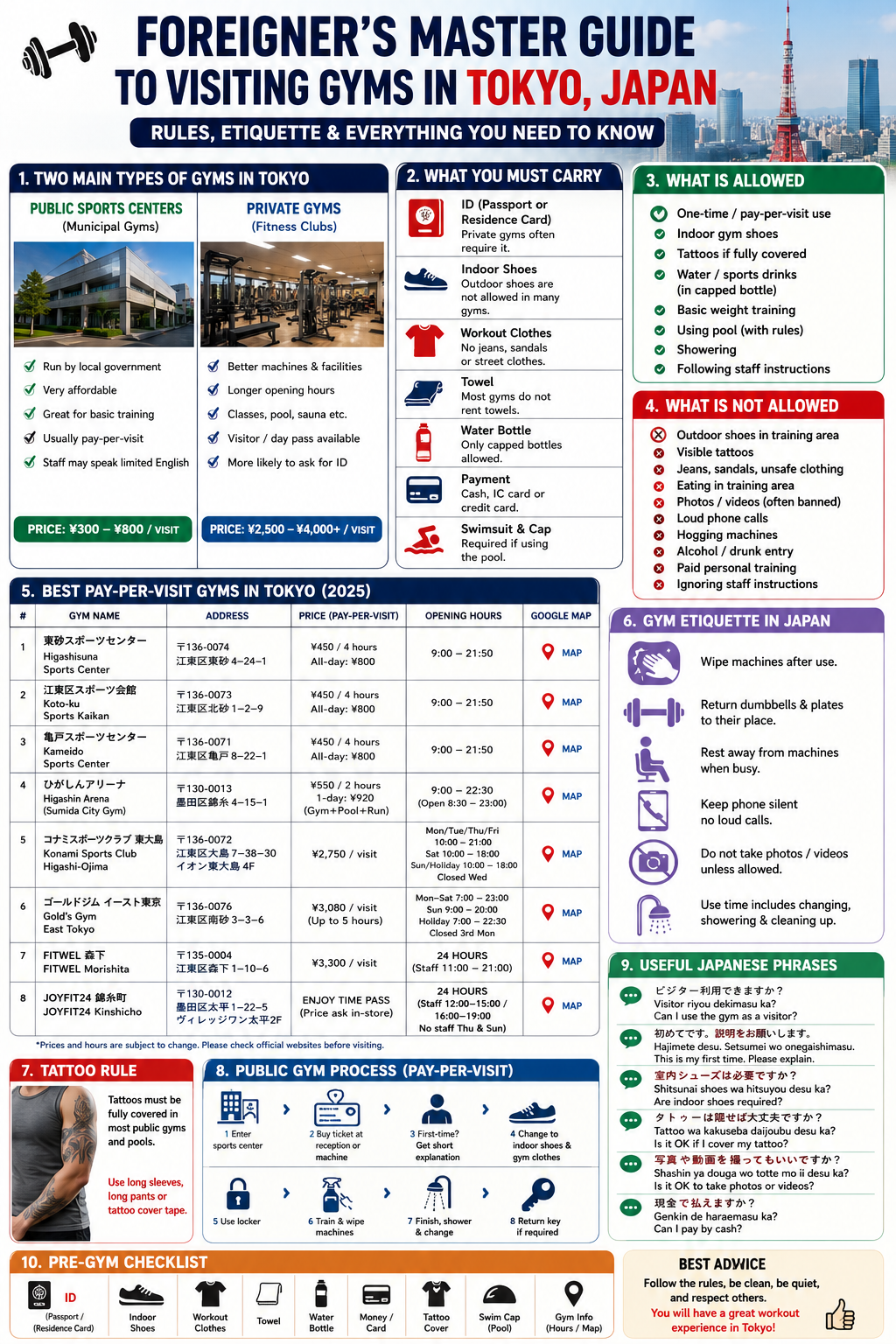
Tokyo has many excellent gyms, from cheap public sports centers to premium private gyms like Gold’s Gym and Konami Sports Club. Foreigners can use many of them, but there are some important rules you should understand before going. The most common mistakes are forgetting indoor shoes, not carrying ID, showing visible tattoos, or assuming every gym allows one-day use.
This guide explains what foreigners must carry, what is allowed, what is not allowed, and how to use a Tokyo gym smoothly.
1. First Understand: Public Gym vs Private Gym
Tokyo has two main types of gyms.
| Gym Type | Example | Typical Price | Good For | Foreigner-Friendly Notes |
|---|---|---|---|---|
| Public sports centers | Koto City Sports Centers, Tokyo Metropolitan Gymnasium, Shinjuku Sports Center | Around ¥300–¥800 | Cheap pay-per-visit use | Usually simple, but staff may speak limited English |
| Private gyms | Gold’s Gym, Konami Sports Club, FITWEL | Around ¥2,500–¥4,000+ for visitor use | Better machines, heavier weights, longer hours | More likely to ask for passport/ID and registration form |
Public gyms are usually the best for casual daily training. For example, Koto City sports centers allow individual ticket use, and even people outside Koto-ku can use the facilities. The adult training-room fee is listed as ¥450 for up to 4 hours.
Private gyms are better if you want premium equipment, bodybuilding-style machines, classes, pool, or longer opening hours. Konami officially describes its “都度利用プラン” as a pay-only-when-you-use plan with no time limit during that visit, although re-entry after checkout is not allowed.
2. What You Must Carry Before Visiting a Gym in Tokyo
| Item | Why You Need It |
|---|---|
| Passport or residence card | Private gyms may ask for ID. Gold’s Gym East Tokyo says visitor use requires ID, and non-Japanese users must present passport or foreign registration-type ID; they may also take a copy. |
| Indoor-only gym shoes | Many gyms do not allow outdoor shoes in the training area. Koto City sports centers clearly say outdoor shoes are prohibited and indoor-only shoes are required. |
| Workout clothes | Jeans and non-stretch clothing are often not allowed. Koto City says users should wear exercise-appropriate clothing and avoid jeans or non-stretch clothing. |
| Towel | Many public gyms do not rent towels. Koto City says clothing, shoes, and towels are not rented out. |
| Water bottle with cap | Drinks are usually allowed only for hydration and must be in a capped container. Koto City and Shinjuku Sports Center both mention capped containers for hydration. |
| Cash / IC card / credit card | Public gyms often use ticket machines. Some may accept cash or IC card; private gyms may accept card or app payment. |
| Swimsuit + swim cap if using pool | Many public pools require swim cap. Shinjuku Sports Center says swimsuit and swimming cap are required for pool use. |
3. Indoor Shoes Rule: Very Important in Japan
This is the rule foreigners forget most.
In many Tokyo gyms, especially public sports centers, you cannot use the same shoes you wore outside. You need a clean pair of indoor-only training shoes.
Koto City sports centers say the training room is 土足厳禁, meaning outdoor shoes are strictly prohibited, and users must wear indoor-only shoes. Shinjuku Sports Center also says the training room should be used with exercise clothes and indoor-only shoes.
Best practice
Carry your gym shoes in a bag and change after entering. Even if your shoes look clean, if you wore them outside, many facilities will not allow them.
Japanese phrase:
室内シューズは必要ですか?
Shitsunai shoes wa hitsuyou desu ka?
“Are indoor shoes required?”
4. Tattoo Rule: Cover It Before Entering
Tattoo rules in Japan can be strict, especially in public pools, public gyms, sento/onsen-style facilities, and some private gyms.
Koto City sports centers say users with tattoos must cover them with clothing or similar so they are not visible. Shinjuku Sports Center says people with tattoos in the pool should wear a rash guard or supporter to cover them.
Gold’s Gym’s English visitor guide also says tattoos must be fully covered with long sleeves, long pants, or tape, and larger tattoos may require an agreement form.
Best practice
If you have tattoos, carry:
- Long-sleeve compression shirt
- Long training pants
- Tattoo cover tape
- Rash guard if using pool
Japanese phrase:
タトゥーは隠せば利用できますか?
Tattoo wa kakuseba riyou dekimasu ka?
“Can I use the gym if I cover my tattoo?”
5. First-Time Use: You May Need a Short Explanation
At many public gyms, first-time users must receive a quick explanation from the staff before using the training room. Koto City sports centers say first-time users must receive a staff explanation.
This is usually not a full training class. It is just a basic safety and rules explanation: how to use machines, where to clean equipment, where to change shoes, and what not to do.
Japanese phrase:
初めて利用します。説明をお願いします。
Hajimete riyou shimasu. Setsumei wo onegaishimasu.
“This is my first time using the facility. Please explain.”
6. ID Rules for Foreigners
Public sports centers may not always ask for passport for normal adult one-time use, but private gyms often do.
Gold’s Gym East Tokyo lists visitor use as 1 visit up to 5 hours and says ID is required; for non-Japanese users, passport or foreign registration-type ID is required, and a copy may be taken.
Best practice
Carry one of these:
- Passport, especially if you are a tourist
- Residence card, if you live in Japan
- My Number card, if applicable
- Japanese driving license, if you have one
For private visitor gyms, passport is safest.
Japanese phrase:
外国人ですが、ビジター利用できますか?
Gaikokujin desu ga, visitor riyou dekimasu ka?
“I am a foreigner. Can I use the gym as a visitor?”
7. Photos, Videos, and Phone Use
Do not assume you can record yourself lifting weights. Many public gyms restrict photography and video recording.
Shinjuku Sports Center clearly says camera and video recording are not allowed inside the facility. It also asks users to avoid mobile phone/smartphone use in the training room and to keep phones on silent mode.
Best practice
Do not film unless you ask staff first. Even if nobody stops you immediately, filming other users in Japan is a big etiquette problem.
Japanese phrase:
動画を撮ってもいいですか?
Douga wo totte mo ii desu ka?
“Is it okay to take video?”
In most public gyms, expect the answer to be no.
8. Food, Drinks, and Cleanliness
Most gyms allow water or sports drinks, but not food inside the training room.
Koto City says food and drink are not allowed in the training room except hydration drinks, and those drinks must be in a capped container that will not spill easily. Shinjuku Sports Center also says users should bring drinks in capped containers and wipe sweat from machines and mats after use.
Best practice
Carry a bottle with a cap. After using a machine, wipe it with the provided paper or towel. Put dumbbells and plates back exactly where you found them.
9. Machine Etiquette in Japan
Japanese gyms are usually quiet and orderly. The equipment rules are simple:
| Do | Do Not |
|---|---|
| Wipe machine after use | Leave sweat on bench/machine |
| Return dumbbells and plates | Leave weights on the floor |
| Keep phone silent | Talk loudly on phone |
| Rest away from machine when busy | Sit on a machine scrolling Instagram |
| Follow staff instructions | Argue with staff about rules |
| Use machines safely | Drop weights loudly unless allowed |
Shinjuku Sports Center asks users to return dumbbells to their original place, wipe machines after use, avoid sitting on machines during rest, and stop the treadmill belt completely before stepping away. Koto City also asks users not to occupy machines for a long time.
10. Clothing Rules
Tokyo gyms usually expect proper gym clothing.
Allowed:
- T-shirt
- Gym shorts
- Track pants
- Sports leggings
- Training shoes
- Compression wear
- Sweat towel
Usually not allowed:
- Jeans
- Formal pants
- Sandals
- Outdoor shoes
- Barefoot training, except in martial arts rooms
- Clothes with poor stretch or unsafe design
Koto City sports centers specifically say users should wear exercise-appropriate clothing and avoid jeans or non-stretch clothing.
11. Pool Rules
If you use a public pool in Tokyo, rules are stricter than gym rules.
Common pool requirements:
- Swim cap is usually required
- Shower before entering
- Remove makeup, hair products, sunscreen, and oils before entering
- Remove watches, earrings, necklaces, and jewelry
- Cover tattoos
- No pool use if drunk or injured
- No diaper use in many pools
Shinjuku Sports Center says swimsuit and swim cap are required, makeup and hair products must be washed off, accessories must be removed, tattoos must be covered with rash guard/supporter, and only water can be brought poolside. Koto City’s public pool rules similarly require swimwear and swim cap, prohibit jewelry/accessories, and require tattoo coverage.
12. Age Restrictions
Training rooms may have age restrictions.
Koto City lists the training room as not available for junior-high-school students and younger children. Tokyo Metropolitan Gymnasium lists its training room/pool common ticket for people of high-school age or above. Gold’s Gym East Tokyo says membership eligibility is from age 16 after junior-high graduation, and minors need parental consent.
For an adult foreign visitor, this is usually not a problem.
13. Public Gym Payment Process
At many public gyms, the process is like this:
- Enter the sports center.
- Go to reception or ticket machine.
- Buy a training-room ticket.
- Tell staff it is your first time if needed.
- Change shoes and clothes.
- Use locker.
- Use training room.
- Wipe equipment after use.
- Finish, shower/change, return locker key if required.
Important: usage time often includes changing, showering, and cleanup time. Koto City says usage time includes preparation, cleanup, cleaning, and changing clothes. Shinjuku Sports Center also says usage time includes preparation, changing, and shower time.
So if your ticket is for 2 hours or 4 hours, do not treat it as pure workout time only.
14. Private Gym Visitor Process
At private gyms like Gold’s Gym or Konami, expect more paperwork.
Typical process:
- Go during staffed hours.
- Say you want visitor/day use.
- Show passport or residence card.
- Fill visitor form.
- Pay visitor fee.
- Confirm tattoo/shoe rules.
- Use locker and gym.
- Leave before time limit if applicable.
Gold’s Gym East Tokyo lists visitor use as ¥3,080 for one visit up to 5 hours, with ID required. Konami’s one-time-use plan has category-based pricing, with normal prices listed from ¥2,530 to ¥3,630 per visit, tax included, depending on facility category.
15. What Is Allowed and Not Allowed
Usually Allowed
| Allowed | Notes |
|---|---|
| One-time public gym use | Many public sports centers allow ticket-based use |
| Foreigner use | Many facilities allow non-residents, but some ward gyms restrict use to residents/workers/students |
| Indoor gym shoes | Required at many facilities |
| Water bottle | Usually allowed if capped |
| Tattoos if covered | Commonly accepted if fully hidden |
| Basic weight training | Machines and free weights vary by facility |
| Pool use | Usually requires swim cap and strict hygiene rules |
| Shower use | Usually available, but some places restrict soap/shampoo |
Usually Not Allowed
| Not Allowed | Notes |
|---|---|
| Outdoor shoes in training room | Very common rule |
| Visible tattoos | Cover them fully |
| Jeans / sandals / unsafe clothing | Wear proper gym clothes |
| Eating inside training area | Use lobby/rest area |
| Taking photos/videos | Often banned, especially in public gyms |
| Loud phone calls | Keep phone silent |
| Machine hogging | Rest away from machine when busy |
| Paid personal training | Public gyms usually ban commercial coaching |
| Alcohol/drunk entry | Not allowed |
| Ignoring staff instructions | Can lead to refusal of use |
16. Japanese Phrases Every Foreigner Should Know
For pay-per-visit use
ビジター利用できますか?
Visitor riyou dekimasu ka?
“Can I use the gym as a visitor?”
都度利用できますか?
Tsudo riyou dekimasu ka?
“Can I use it on a pay-per-use basis?”
トレーニング室を1回利用したいです。
Training room wo ikkai riyou shitai desu.
“I want to use the training room one time.”
For first-time use
初めてです。
Hajimete desu.
“It is my first time.”
使い方を教えてください。
Tsukaikata wo oshiete kudasai.
“Please show me how to use it.”
For rules
室内シューズは必要ですか?
Shitsunai shoes wa hitsuyou desu ka?
“Are indoor shoes required?”
タトゥーは隠せば大丈夫ですか?
Tattoo wa kakuseba daijoubu desu ka?
“Is it okay if I cover my tattoo?”
写真や動画を撮ってもいいですか?
Shashin ya douga wo totte mo ii desu ka?
“Is it okay to take photos or videos?”
For payment
現金で払えますか?
Genkin de haraemasu ka?
“Can I pay by cash?”
クレジットカードは使えますか?
Credit card wa tsukaemasu ka?
“Can I use a credit card?”
17. Foreigner’s Pre-Gym Checklist
Before leaving home or hotel, check this:
- Passport or residence card
- Indoor-only gym shoes
- Gym clothes
- Towel
- Water bottle with cap
- Cash / card / IC card
- Tattoo cover tape or long sleeves if needed
- Swim cap if using pool
- Gym address and opening hours
- Staffed hours if visiting a private gym
- Whether visitor use is available today
18. Best Advice for Foreigners in Tokyo
For your first gym visit in Tokyo, choose a public sports center if you want cheap and simple training. Choose Gold’s Gym or Konami if you want better machines, heavier weights, or a more premium private-gym environment.
The safest setup is:
Passport + indoor shoes + towel + capped water bottle + tattoo covered + proper gym clothes.
If you carry these, you will avoid 90% of problems.
Japan gyms are not difficult. They are just rule-based. Follow the rules, be quiet, wipe your machine, return your weights, and you will be perfectly fine.