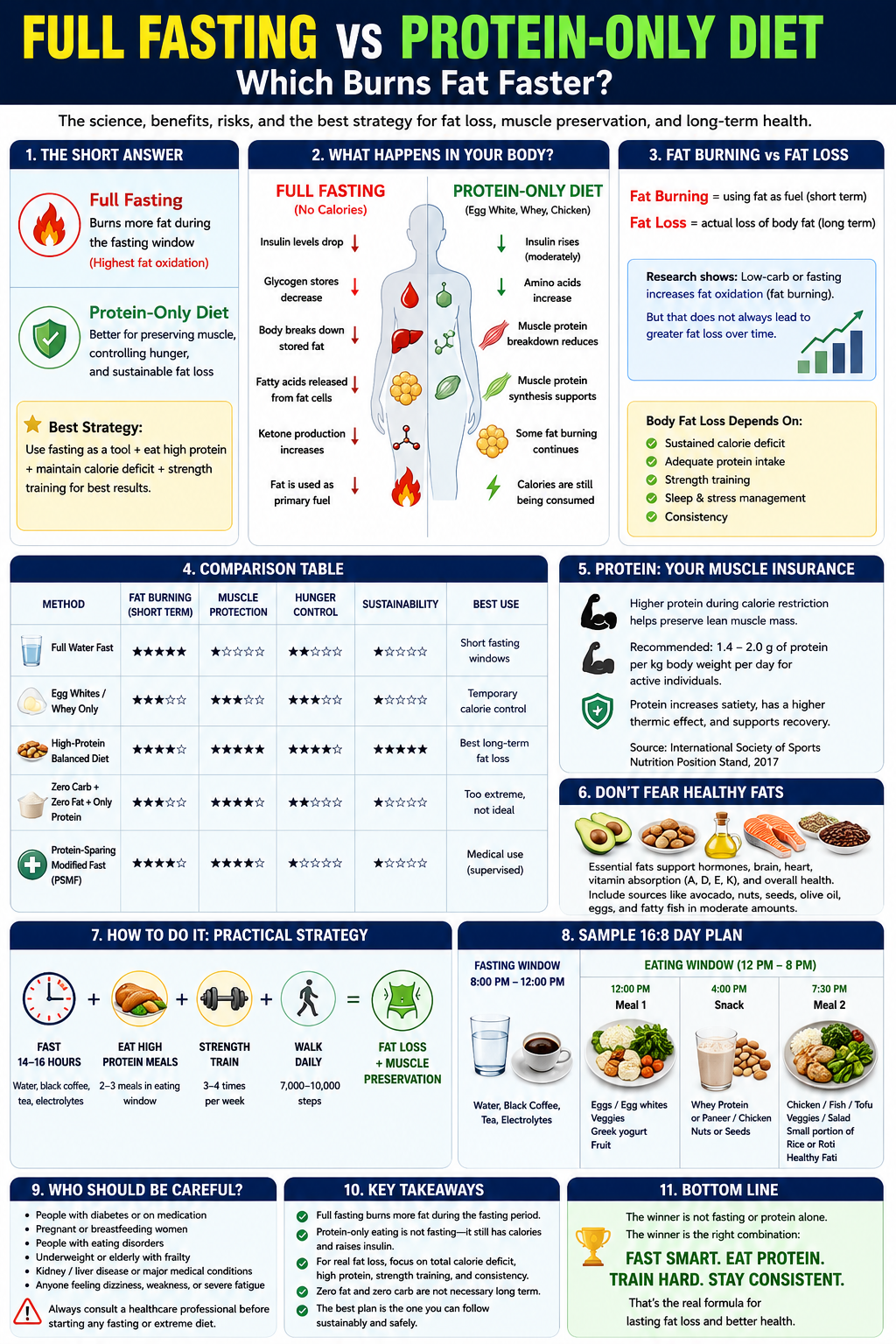
The Science-Backed Guide to Fat Burning, Fasting, Protein, Muscle Protection, and Real Fat Loss
Introduction: The Big Fat-Loss Confusion
One of the most common questions in weight loss is:
“Will I burn fat faster if I do a full fast, or if I eat only protein foods like egg whites, whey protein, chicken breast, or other zero-carb and zero-fat foods?”
At first, the answer looks simple: fasting burns more fat because there is no food coming in. But the real science is more interesting.
There are two different things people often mix up:
- Fat burning during a specific time window
- Actual body-fat loss over days, weeks, and months
These are not the same.
You can burn more fat during a fasted period but still fail to lose body fat if you overeat later. You can eat protein during the day and burn slightly less fat in that moment, but still lose more body fat overall if your calories, protein, exercise, and recovery are better controlled.
So the expert answer is:
Full fasting creates the strongest short-term fat-burning state. But a high-protein fat-loss diet is usually better for preserving muscle, controlling hunger, and achieving sustainable body-fat loss.
Let’s break this down properly.
The Short Answer
If your question is:
“When is my body burning the most stored fat right now?”
The answer is:
During full fasting.
When you are not eating, insulin levels fall, stored glycogen gradually decreases, and the body shifts more toward using fatty acids and ketones for energy. Fasting physiology research describes this metabolic shift from glucose use toward triglyceride breakdown, fatty acids, glycerol, and ketone production.
But if your question is:
“What is best for losing body fat while keeping muscle and looking lean?”
The better answer is:
Use fasting as a tool, but eat enough protein during your eating window.
Protein-only eating is not true fasting, but protein can protect muscle, improve fullness, increase diet quality, and make fat loss easier to sustain. The International Society of Sports Nutrition notes that protein plus resistance exercise supports muscle protein synthesis, and its position stand commonly places protein needs for healthy exercising individuals around 1.4–2.0 g/kg/day depending on goals and training status.
What Happens During Full Fasting?
During a full fast, you consume no calories. Usually this means water, plain tea, black coffee, and sometimes electrolytes.
In the early fasting phase, the body uses available blood glucose and stored glycogen. As the fast continues, the body increases the breakdown of stored fat. Triglycerides stored in fat cells are broken into free fatty acids and glycerol. The liver can use fatty acids to produce ketones, which become an alternative energy source for the brain and other tissues.
This is why fasting is often described as a “fat-burning state.”
During fasting, the body generally shifts toward:
- Lower insulin
- Higher fat mobilization
- Greater fatty acid oxidation
- Increased ketone production after glycogen drops
- Reduced incoming dietary energy
This is powerful.
But it is not magic.
Fasting increases reliance on stored energy, but long-term fat loss still depends on the total energy balance over time. If a person fasts for 18 hours and then overeats during the eating window, the fat-loss advantage can disappear.
What Happens When You Eat Only Protein?
Now let’s compare fasting with eating “100% protein foods” such as:
- Egg whites
- Whey protein isolate
- Chicken breast
- White fish
- Fat-free Greek yogurt
- Lean turkey
- Protein powder with no carbs and no fat
This kind of diet is very low in carbs and very low in fat, but it is not fasting.
Protein contains calories. Protein digestion raises amino acids in the blood. Amino acids can stimulate hormonal responses including insulin, glucagon, and incretin hormones. Reviews on dietary amino acids show that amino acids are sensed by pancreatic and gut hormone systems and can influence insulin and glucagon secretion.
So protein-only eating is metabolically different from fasting.
Protein-only eating does three major things:
- It gives the body calories
- It provides amino acids to protect muscle
- It reduces hunger better than many carb-heavy or fat-heavy foods
That means protein-only eating may reduce the maximum fasting effect, but it can make dieting easier and safer for many people.
Fat Burning vs Fat Loss: The Most Important Difference
This is the part most people miss.
Fat burning means your body is using fat as fuel.
Fat loss means your body has lost stored body fat over time.
They are related, but they are not identical.
A controlled metabolic-ward study led by Kevin Hall compared calorie-for-calorie carbohydrate restriction versus fat restriction. Carbohydrate restriction increased fat oxidation, meaning the body burned more fat as fuel. But in that short controlled setting, dietary fat restriction produced more calculated body-fat loss. The big lesson was clear: burning more fat fuel in the moment does not automatically mean losing more body fat overall.
This is the “fitness industry confusion point.”
A low-carb diet or fasting window can make the body burn more fat during that window. But actual fat loss depends on what happens across the whole day and week.
The body-fat equation is closer to this:
Body fat loss = sustained calorie deficit + enough protein + resistance training + sleep + consistency
Fasting can help create the deficit. Protein can help protect muscle and control appetite. But neither works if the total plan is chaotic.
Which Burns Fat Faster: Full Fast or Protein-Only Food?
During the fasting window
Full fasting burns more stored fat than protein-only eating.
Why? Because there are no incoming calories. Insulin is generally lower, and the body must rely more on stored fuel.
During a full day
It depends.
A person doing 16 hours of fasting and overeating at night may lose less fat than someone eating three high-protein meals in a controlled calorie deficit.
During several weeks
The winner is usually the plan that creates a calorie deficit while preserving muscle.
That is why the best fat-loss strategy is not “fasting only” or “protein only.”
The best strategy is usually:
Controlled fasting + high protein + resistance training + moderate calorie deficit.
Is Protein-Only Eating the Same as a Protein-Sparing Modified Fast?
There is a clinical diet called a Protein-Sparing Modified Fast, often shortened to PSMF. It is a very-low-calorie, very-low-carbohydrate diet that provides mostly lean protein while keeping calories extremely low. It is designed to force rapid weight loss while reducing muscle loss.
But this is not a casual lifestyle diet.
Medical literature describes PSMF as a controlled form of severe calorie restriction and notes that it should be done under medical supervision, especially in people with obesity-related medical conditions or diabetes.
A PSMF may be effective for rapid fat loss in selected cases, but it is aggressive. It can involve risks such as fatigue, constipation, electrolyte issues, gallstones, nutrient deficiencies, and poor long-term adherence.
So if someone is thinking:
“I will eat only egg whites and whey protein for many days.”
That is not a casual diet. That is moving toward a medical-style crash diet and should be treated carefully.
Why Protein Is So Important During Fat Loss
When losing weight, the goal should not be simply to become lighter.
The real goal is:
Lose fat. Keep muscle. Improve health. Look better. Feel better.
If you lose muscle along with fat, your metabolism, strength, posture, and body shape can suffer.
Higher protein intake during calorie restriction is associated with better lean-mass preservation. In one study using pooled data from adults with overweight or obesity, higher protein intake during calorie restriction was associated with improved diet quality and reduced loss of lean body mass.
Protein also helps with satiety. Reviews on high-protein diets describe several mechanisms for weight-loss support, including increased fullness, higher thermic effect of food, and support for fat-free mass.
Protein helps fat loss because it:
- Keeps you full
- Reduces cravings
- Preserves lean muscle
- Supports recovery from exercise
- Has a higher thermic effect than carbs or fat
- Makes calorie control easier
This is why protein is not the enemy of fat loss. Protein is the protector.
Why Zero Fat Is Not a Good Long-Term Idea
A diet with zero carbs and zero fat may sound like the fastest fat-loss hack, but it is not ideal long-term.
The body needs essential fatty acids. Omega-3 fatty acids such as ALA, EPA, and DHA play roles in cell membranes, the brain, eyes, heart, blood vessels, lungs, immune system, and endocrine function.
Dietary fat also supports absorption of fat-soluble vitamins such as A, D, E, and K.
So while very low-fat, high-protein meals can be useful temporarily, a permanent zero-fat diet is not a smart health strategy.
Healthy fat sources include:
- Whole eggs
- Fatty fish
- Olive oil
- Avocado
- Nuts
- Seeds
- Greek yogurt
- Paneer or tofu in controlled portions
Fat does not need to be high, but it should not be zero forever.
Is Zero Carb Necessary for Fat Loss?
No.
Low-carb dieting can help some people reduce hunger and control calories. But carbs are not automatically fattening.
Carbohydrates can be useful if you train, walk a lot, lift weights, or need good energy and mood. The problem is usually not rice, oats, fruit, or potatoes in controlled amounts. The bigger issue is overeating highly processed foods, sugary drinks, fried snacks, desserts, and large portions.
Some people do well with lower carbs. Some do better with moderate carbs.
The best fat-loss diet is the one you can follow consistently while maintaining a calorie deficit and enough protein.
Intermittent Fasting: What the Research Really Says
Intermittent fasting can work, but it is not magic.
Some studies show time-restricted eating can help with weight loss and fat loss, especially when the eating window naturally reduces calorie intake. A JAMA Internal Medicine trial on early time-restricted eating found greater weight loss in the time-restricted eating group in its trial context, though the authors noted that larger studies are needed for fat-loss conclusions.
However, other controlled research has found that when calories are matched, time-restricted eating may not be superior to daily calorie restriction. A New England Journal of Medicine trial found that time-restricted eating was not more beneficial than daily calorie restriction for reducing body weight, body fat, or metabolic risk factors among patients with obesity.
The expert interpretation is:
Fasting works mainly because it helps many people eat fewer calories.
It may also improve meal structure, reduce late-night eating, improve insulin dynamics in some people, and simplify decision-making. But fasting does not cancel calories.
The Best Practical Strategy for Fat Loss
The best strategy is not extreme fasting and not only protein powder.
The best strategy is:
Use fasting to create structure. Use protein to protect muscle. Use strength training to shape the body. Use a moderate calorie deficit to lose fat.
The ideal fat-loss formula
14–16 hour fast + high-protein meals + controlled calories + resistance training + daily walking
This gives you the benefits of fasting without destroying your muscle, energy, mood, or long-term consistency.
A Simple Fat-Loss Protocol
Option 1: Beginner-Friendly Fat Loss
Best for most people.
Fasting: 12–14 hours
Eating window: 10–12 hours
Protein: Moderate to high
Exercise: Walking + 2–3 strength sessions weekly
Example:
- Dinner at 8 PM
- First meal at 9–10 AM
- 2–3 protein-rich meals
- No late-night snacking
This is easy, sustainable, and low-risk.
Option 2: Strong Fat-Loss Plan
Best for people who already have some discipline.
Fasting: 16 hours
Eating window: 8 hours
Protein: High
Exercise: 3–4 strength sessions weekly
Steps: 7,000–10,000 daily if possible
Example:
- Last meal: 8 PM
- First meal: 12 PM
- Eating window: 12 PM to 8 PM
- 2 large protein-rich meals + 1 protein snack
This is the sweet spot for many people.
Option 3: Aggressive Short-Term Cut
Best only for experienced people and not for long-term use.
Fasting: 16–18 hours
Eating window: 6–8 hours
Protein: High
Carbs: Low to moderate
Fat: Low to moderate
Exercise: Strength training, but avoid overtraining
This can work, but it should not become punishment dieting.
What to Eat After Fasting
Breaking the fast is important.
Do not break a fast with a giant sugary or fried meal. That often causes overeating, sleepiness, bloating, and cravings.
Best first meal after fasting
A good post-fast meal should include:
- High-quality protein
- Fiber-rich vegetables
- Some healthy fat
- Optional controlled carbs
Example meals:
Meal 1: Egg-Based
- 2 whole eggs + 3 egg whites
- Salad or cooked vegetables
- Small bowl of curd or Greek yogurt
- Optional: one fruit
Meal 2: Chicken/Fish
- Grilled chicken or fish
- Vegetables
- Small rice or potato portion if training
- Olive oil or avocado
Meal 3: Indian Style
- Paneer/tofu/chicken/fish
- Dal or curd
- Vegetables
- Controlled rice or roti portion
- Avoid deep-fried sides
Meal 4: Quick Protein Meal
- Whey protein
- Greek yogurt
- Fruit
- Nuts or seeds
Protein powder is fine as a tool, but it should not replace real food all the time.
Egg Whites vs Whole Eggs
Egg whites are excellent for lean protein. They are low in calories, low in fat, and useful when someone wants to increase protein without increasing calories too much.
But whole eggs are more nutrient-dense because the yolk contains fat-soluble vitamins, choline, and other nutrients.
A smart approach is:
Use both.
Example:
2 whole eggs + 3–5 egg whites
This gives you protein, nutrients, taste, and better fullness.
Whey Protein: Good or Bad for Fat Loss?
Whey protein can be very useful for fat loss because it is convenient, high in protein, and easy to measure.
But whey is not magic. It is food in powder form.
Whey protein still has calories and can stimulate insulin and other hormonal responses, especially because certain amino acids are insulinotropic.
Use whey when:
- You cannot meet protein from food
- You need a quick post-workout option
- You want a low-calorie protein snack
- You struggle with hunger
Avoid relying only on whey because whole foods provide more micronutrients and chewing satisfaction.
Full Fast vs Protein-Only: Practical Comparison
| Method | Short-Term Fat Burning | Muscle Protection | Hunger Control | Sustainability | Best Use |
|---|---|---|---|---|---|
| Full water fast | Very high | Lower if prolonged | Mixed | Hard | Short fasting windows |
| Egg whites only | Moderate | Good | Moderate | Poor long-term | Temporary calorie control |
| Whey protein only | Moderate | Good | Moderate | Poor long-term | Supplement only |
| High-protein balanced diet | Good | Excellent | Good | Strong | Best long-term fat loss |
| Protein-sparing modified fast | High | Good | Hard | Medical use | Only with supervision |
Biggest Mistakes People Make
Mistake 1: Thinking fasting burns unlimited fat
Fasting increases fat use, but it does not override overeating later.
Mistake 2: Eating only protein and ignoring nutrition
Protein is important, but the body also needs fiber, vitamins, minerals, electrolytes, and essential fats.
Mistake 3: Doing long fasts without strength training
This can increase the risk of muscle loss.
Mistake 4: Cutting both carbs and fats too aggressively
A diet with only protein is very hard to sustain and may lead to fatigue, constipation, cravings, and nutrient gaps.
Mistake 5: Measuring only weight
The scale can drop from water, glycogen, and food volume. The real goal is fat loss with muscle preservation.
Who Should Be Careful With Fasting?
Intermittent fasting is not suitable for everyone. Mayo Clinic resources note that fasting can cause side effects such as hunger, fatigue, insomnia, irritability, reduced concentration, nausea, constipation, and headaches.
People should speak with a qualified healthcare professional before fasting if they:
- Have diabetes or take glucose-lowering medication
- Are pregnant or breastfeeding
- Have a history of eating disorders
- Are underweight
- Have kidney disease, liver disease, or major medical conditions
- Are adolescents or elderly with frailty risk
- Take medication that requires food
- Experience dizziness, fainting, or severe weakness during fasting
Fasting should improve life, not damage it.
The Best Expert Recommendation
For most healthy adults trying to lose fat, the best plan is:
1. Fast, but do not overdo it
Start with 12–14 hours. Move to 16 hours only if it feels good and does not cause binge eating.
2. Prioritize protein
Aim for a protein-rich diet, especially if exercising. Many active people do well around 1.4–2.0 g/kg/day, depending on body size, training, and medical status.
3. Keep calories controlled
Fasting without calorie control is just delayed overeating.
4. Lift weights
Strength training tells the body: “Keep this muscle.”
5. Walk daily
Walking is underrated fat-loss medicine. It burns calories, improves blood sugar control, helps digestion, and reduces stress without exhausting the body.
6. Do not fear healthy fats
Keep some essential fats in the diet from eggs, fish, olive oil, nuts, seeds, or avocado.
7. Use carbs strategically
Carbs are not mandatory, but they can help performance, mood, sleep, and training. Use quality carbs in controlled portions.
Sample One-Day Fat-Loss Meal Plan With 16:8 Fasting
Fasting Window
8 PM to 12 PM
Allowed:
- Water
- Black coffee
- Plain tea
- Electrolytes without calories, if needed
Meal 1 — 12 PM
- 2 whole eggs + 4 egg whites
- Vegetables
- Greek yogurt or curd
- One fruit
Snack — 4 PM
- Whey protein or paneer/tofu/chicken
- Nuts or seeds in small quantity
Meal 2 — 7:30 PM
- Chicken, fish, tofu, paneer, or dal
- Big salad or cooked vegetables
- Small rice/roti/potato portion if training
- Olive oil, avocado, or whole egg for healthy fat
This is far better than starving all day and eating randomly at night.
Final Verdict
So, which is better for fat burning?
Full fasting burns more stored fat during the fasting period.
But which is better for real fat loss?
A high-protein, calorie-controlled diet with fasting is better for most people.
And which is best for looking lean, healthy, and strong?
Fasting + protein + strength training + moderate calorie deficit.
The smartest strategy is not “eat nothing forever” and not “only protein powder.”
The smartest strategy is:
Fast long enough to control insulin and appetite. Eat enough protein to protect muscle. Include enough nutrients to protect health. Train enough to shape the body. Stay consistent long enough to see results.
Fat loss is not won by suffering the hardest.
It is won by creating a plan the body can survive, the mind can tolerate, and the lifestyle can repeat.
FAQ
1. Does protein break a fast?
Yes. Protein contains calories and stimulates digestion and hormonal responses. It is not a true fast.
2. Does eating egg whites stop fat burning?
It reduces the pure fasting state, but it does not stop fat loss if your total calories are controlled.
3. Is whey protein okay during fat loss?
Yes. Whey protein is useful, but it should support a diet, not replace whole foods completely.
4. Is zero carb necessary?
No. Low carb can help some people, but fat loss depends mainly on calorie deficit, protein intake, exercise, and consistency.
5. Is zero fat healthy?
No, not long-term. The body needs essential fats for normal function.
6. What is the best fasting schedule?
For most people, 14:10 or 16:8 is enough. Longer is not always better.
7. What is the best fat-loss meal?
A high-protein meal with vegetables, some healthy fat, and optional controlled carbs.
8. What is better: fasting or protein dieting?
For short-term fat burning, fasting. For long-term body composition, high protein plus calorie control.
9. Can I do only egg whites for fast fat loss?
It may reduce calories quickly, but it is nutritionally incomplete and not ideal long-term. Very aggressive protein-only dieting should be medically supervised.
10. What is the best overall method?
The best overall method is:
16:8 fasting, high protein, calorie deficit, strength training, walking, sleep, and consistency.