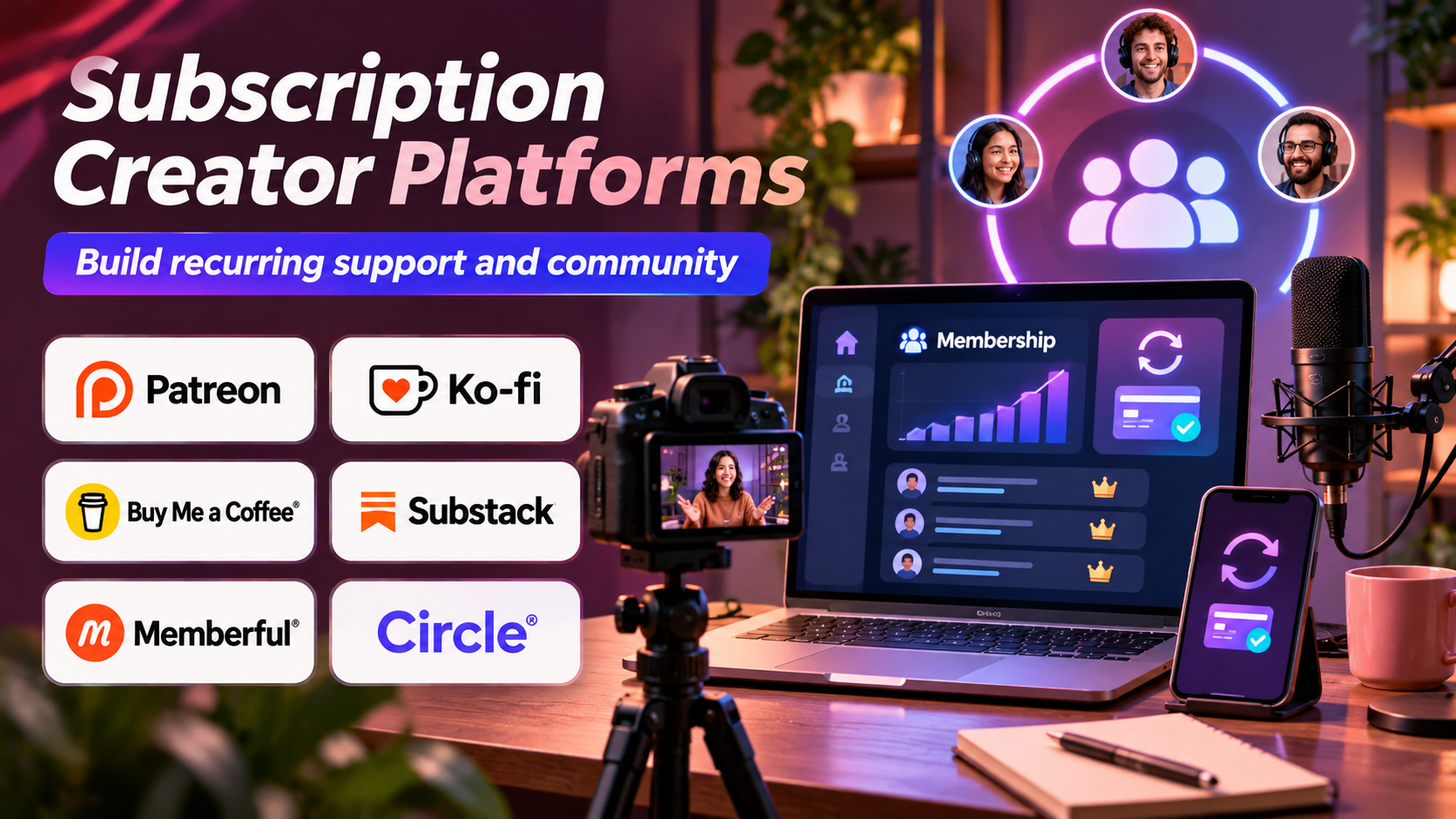
Introduction
Subscription-based businesses have become an important revenue model for independent creators.
Writers, podcasters, educators, artists, video producers, and community leaders can charge recurring fees for access to exclusive content, specialized knowledge, or ongoing experiences.
Unlike one-time product sales, subscriptions create continuing relationships between creators and paying audiences.
This can make revenue more predictable, but it also introduces new responsibilities.
Creators must consistently deliver value, manage access, communicate with members, handle failed payments, and reduce unnecessary cancellations.
Subscription creator platforms provide the technology needed to operate these businesses.
Some focus on exclusive content. Others specialize in paid communities, newsletters, courses, podcasts, or branded membership websites.
The right choice depends on what subscribers receive and why they continue paying.
This guide compares ten subscription creator platforms, explains their features and limitations, and provides practical guidance for selecting and operating a subscription business.
What Are Subscription Creator Platforms?
Subscription creator platforms are software services that allow creators to charge recurring payments for access to content, communities, services, or membership benefits.
Subscribers typically pay monthly or annually, although billing options vary.
Common subscription offerings include:
- Exclusive articles and newsletters.
- Bonus podcast episodes.
- Members-only videos.
- Private online communities.
- Educational resources and courses.
- Creative process updates.
- Live discussions and workshops.
- Premium research and analysis.
A subscription platform generally combines billing, access control, member records, content delivery, and reporting.
Some systems also include email marketing, community discussions, automation, and website creation.
Subscription businesses should be evaluated using more than total subscriber counts.
Important metrics include active paying members, recurring revenue, churn, retention, failed payments, and the cost of delivering promised benefits.
Top 10 Subscription Creator Platforms
1. Patreon
Best For: Creators offering ongoing exclusive content and membership benefits.
Short Description
Patreon is a creator membership platform built around recurring audience support.
Creators can establish paid membership levels and offer benefits such as bonus content, early access, exclusive posts, and community interaction.
It is particularly relevant to artists, podcasters, writers, and video creators who publish regularly.
Patreon reduces the need to develop a custom subscription billing system.
Its membership-focused environment helps creators manage access and communicate with supporters.
However, successful membership programs require clear expectations.
Offering too many benefits can create an unsustainable production schedule.
Creators should design membership levels around work they can deliver consistently.
Key Features
- Recurring billing: Supports paid memberships.
- Membership tiers: Organizes different benefit levels.
- Exclusive publishing: Restricts selected content to eligible members.
- Member communication: Supports updates and interaction.
- Access management: Connects membership status with benefits.
- Payment administration: Processes eligible recurring transactions.
- Supporter records: Organizes membership information.
- Revenue reporting: Provides membership earnings visibility.
Benefits
Patreon helps creators establish ongoing financial relationships with dedicated audiences.
Pros
- Established membership ecosystem.
- Multiple benefit levels.
- Exclusive content support.
- Creator-oriented administration.
- Suitable for many content categories.
Cons
- Platform and processing fees.
- Recurring content obligations.
- Limited control compared with fully self-hosted systems.
- Member acquisition remains the creator’s responsibility.
Use Cases
Podcasters can offer bonus episodes.
Artists can publish exclusive sketches.
Video creators can provide behind-the-scenes content.
Best Suited For
Creators with consistent publishing schedules and engaged supporters.
2. Memberful
Best For: Creators and publishers seeking subscription management for their own websites.
Short Description
Memberful provides membership and subscription management technology for creators and businesses.
Its approach is particularly relevant to organizations that want to maintain a branded website while adding paid access.
Instead of moving every customer interaction into a separate hosted creator platform, users can connect subscription functionality with their existing online presence.
Memberful is useful for publishers, podcasters, and membership businesses that value control over their brand and customer experience.
It supports recurring billing and member administration.
However, creators may still need separate website hosting, content production, and marketing systems.
The overall technical setup can therefore be more involved than using a fully hosted membership platform.
Key Features
- Subscription billing: Supports recurring membership payments.
- Member management: Organizes subscriber records.
- Website integration: Connects membership functionality with supported sites.
- Content access control: Restricts eligible content.
- Membership plans: Supports different subscription arrangements.
- Payment administration: Handles eligible recurring transactions.
- Customer communication: Supports membership-related notifications.
- Subscription reporting: Provides visibility into member activity.
Benefits
Memberful can help creators operate a subscription business while preserving a distinct branded website.
Pros
- Website-oriented memberships.
- Recurring billing.
- Flexible member administration.
- Relevant to publishers and podcasters.
- Greater brand control than some hosted marketplaces.
Cons
- Requires additional website infrastructure.
- Integration needs vary.
- Marketing may require separate tools.
- Technical administration can be more demanding.
Use Cases
Independent publishers can sell website memberships.
Podcasters can manage premium subscribers.
Professional associations can administer paid access.
Best Suited For
Creators and publishers with established websites.
3. Substack
Best For: Writers operating paid newsletters and subscriber-supported publications.
Short Description
Substack combines publishing, email distribution, and paid subscription capabilities.
Its model is especially relevant to writers who want to build a recurring revenue business around original editorial content.
A journalist can publish free articles to attract readers and reserve selected analysis for paying subscribers.
Substack reduces the technical complexity of managing email delivery, subscriptions, and content publishing.
It also offers community interaction features that can strengthen reader relationships.
However, the simplicity of the platform does not eliminate the need for editorial planning.
Writers must provide consistent value and manage subscriber expectations.
Key Features
- Paid newsletters: Supports recurring reader subscriptions.
- Email publishing: Delivers posts to subscribers.
- Free content: Helps attract and engage readers.
- Subscriber records: Organizes audience information.
- Publishing tools: Supports articles and selected multimedia.
- Community interaction: Provides reader engagement capabilities.
- Payment processing: Manages eligible subscriptions.
- Revenue reporting: Supports analysis of paid readership.
Benefits
Substack allows writers to operate subscriber-supported publications without custom publishing infrastructure.
Pros
- Writing-focused platform.
- Integrated email delivery.
- Paid and free publishing.
- Simple subscriber experience.
- Suitable for independent journalism.
Cons
- Platform fees on paid subscriptions.
- Limited suitability for complex course businesses.
- Subscriber retention depends on ongoing editorial quality.
- Platform-specific customization limits.
Use Cases
Journalists can sell premium reporting.
Researchers can publish paid analysis.
Essayists can build subscriber communities.
Best Suited For
Writers and independent newsletter publishers.
4. Ghost
Best For: Publishers seeking a branded membership website with substantial control.
Short Description
Ghost is a publishing platform that supports websites, newsletters, and paid memberships.
It is relevant to creators and publishers who want greater control over their publishing environment.
Ghost combines content management with membership and subscription functionality.
This makes it suitable for independent publications that want a professional website rather than relying entirely on a third-party creator marketplace.
Creators can publish free and paid content, organize subscribers, and manage newsletter delivery.
Ghost also offers self-hosting possibilities, although technical responsibilities differ from managed hosting.
Organizations should consider maintenance, payment integration, deliverability, and migration requirements before selecting a deployment model.
Key Features
- Website publishing: Supports branded content websites.
- Paid memberships: Enables recurring subscription access.
- Email newsletters: Delivers content to subscribers.
- Content access control: Restricts premium material.
- Member administration: Organizes subscriber information.
- Themes and customization: Supports branded publication design.
- Open-source software: Provides deployment flexibility.
- Publishing analytics: Supports review of content and membership activity.
Benefits
Ghost gives publishers a connected system for website content, newsletters, and paid memberships.
Pros
- Strong publishing functionality.
- Brand customization.
- Paid membership support.
- Open-source option.
- Suitable for independent publications.
Cons
- Self-hosting requires technical expertise.
- Managed hosting has recurring costs.
- Complex community features may require integrations.
- Subscription operations still need ongoing management.
Use Cases
Independent magazines can sell subscriptions.
Industry publications can publish premium research.
Writers can build branded membership websites.
Best Suited For
Independent publishers and technically capable creators.
5. beehiiv
Best For: Newsletter businesses combining paid subscriptions with audience growth.
Short Description
beehiiv provides newsletter publishing and audience management capabilities, including monetization options.
It is relevant to creators who want to build a newsletter into a sustainable media business.
Paid subscriptions are one possible revenue stream.
Depending on eligibility and plan features, publishers may also explore advertising and other monetization opportunities.
This can help reduce dependence on a single income source.
beehiiv’s audience growth orientation is useful for publications that actively invest in subscriber acquisition.
However, creators should evaluate whether its paid membership features provide the content access and customer experience their business requires.
Key Features
- Newsletter publishing: Supports recurring email content.
- Paid subscriptions: Enables eligible reader payments.
- Subscriber management: Organizes audience records.
- Growth tools: Supports selected referral and acquisition workflows.
- Audience analytics: Provides engagement information.
- Website publishing: Supports public content pages.
- Automation: Helps manage audience communication.
- Additional monetization: Offers selected advertising-related opportunities.
Benefits
beehiiv can help newsletter publishers combine audience growth and recurring revenue operations.
Pros
- Newsletter-specific workflows.
- Audience growth features.
- Paid subscription options.
- Publishing analytics.
- Multiple monetization opportunities.
Cons
- Advanced features may require higher plans.
- Not designed primarily for courses.
- Advertising revenue is not guaranteed.
- Newsletter quality and retention remain essential.
Use Cases
Industry newsletters can offer premium research.
Media startups can grow paid readership.
Independent writers can combine subscriptions and sponsorships.
Best Suited For
Growth-oriented newsletter publishers.
6. Circle
Best For: Creators building paid communities around shared interests or expertise.
Short Description
Circle provides online community software with membership and monetization capabilities.
Its platform is relevant to creators whose subscription value comes from interaction rather than content alone.
For example, a professional educator may operate a private learning community with discussions, events, and educational resources.
Circle supports structured community experiences within a branded environment.
This can help creators develop ongoing relationships among members.
However, community subscriptions require active moderation and engagement.
A community that receives little attention may struggle to retain paying members.
Creators should consider moderation capacity and the value of member-to-member interaction before launching.
Key Features
- Community spaces: Organizes discussions around topics.
- Paid memberships: Supports subscription-based access.
- Member profiles: Helps participants connect.
- Events: Supports selected community activities.
- Courses: Provides educational content capabilities.
- Access control: Restricts spaces according to membership.
- Community administration: Supports moderation and organization.
- Engagement reporting: Helps assess community activity.
Benefits
Circle can help creators monetize ongoing interaction, learning, and community participation.
Pros
- Community-focused design.
- Paid membership support.
- Discussions and events.
- Educational content options.
- Suitable for professional communities.
Cons
- Requires active moderation.
- Community engagement is not automatic.
- Can be expensive for small audiences.
- Less suitable for creators selling only downloads.
Use Cases
Career coaches can operate paid professional communities.
Educators can host learner discussions.
Industry experts can build member networks.
Best Suited For
Community-led creators and membership businesses.
7. Mighty Networks
Best For: Creators combining paid communities, courses, and member experiences.
Short Description
Mighty Networks provides community and membership software with capabilities for courses and events.
It is relevant to creators who want subscribers to participate in an ongoing shared experience.
A membership might include group discussions, educational sessions, events, and networking opportunities.
Mighty Networks helps organize these activities within a branded community environment.
Its approach can be useful for creators building long-term member relationships.
However, a successful community requires clear purpose and active participation.
Creators should avoid charging recurring fees for a community that lacks meaningful interaction or ongoing benefits.
Key Features
- Paid communities: Supports recurring member access.
- Discussion spaces: Organizes community interaction.
- Online courses: Provides structured learning experiences.
- Events: Supports member activities.
- Member profiles: Encourages connections.
- Access management: Controls eligibility for content and spaces.
- Branding options: Supports customized community experiences.
- Community analytics: Provides information about member activity.
Benefits
Mighty Networks can combine recurring subscriptions with educational and social experiences.
Pros
- Community-oriented platform.
- Course and event capabilities.
- Paid membership support.
- Branded member experiences.
- Useful for long-term engagement.
Cons
- Requires community management.
- Can involve substantial recurring platform costs.
- Complex setups may need planning.
- Not ideal for simple one-time product sales.
Use Cases
Wellness educators can build member communities.
Professional trainers can offer courses and events.
Niche experts can create paid networking groups.
Best Suited For
Creators building community-centered subscription businesses.
8. Uscreen
Best For: Video creators operating subscription-based video libraries.
Short Description
Uscreen provides video monetization technology for creators and businesses offering paid video content.
It is relevant to instructors, fitness professionals, entertainment creators, and other businesses with substantial video libraries.
Unlike general membership platforms, Uscreen emphasizes video delivery and subscription access.
A fitness creator might offer a library of workout classes, while an educator could provide premium recorded lessons.
The platform can support recurring access to these collections.
However, video businesses face specific costs involving storage, streaming, production, and customer support.
Creators should evaluate these costs alongside platform subscriptions and payment fees.
Key Features
- Video hosting: Supports premium video libraries.
- Subscription access: Enables recurring paid viewing.
- Content organization: Groups videos into collections.
- Branded experiences: Supports customized video businesses.
- Payment processing: Manages eligible subscription purchases.
- Member administration: Organizes subscriber access.
- Video analytics: Provides selected viewing and business information.
- Community features: Offers engagement capabilities under supported plans.
Benefits
Uscreen can help creators build subscription businesses centered on premium video content.
Pros
- Video-focused monetization.
- Subscription library support.
- Branded viewing experience.
- Relevant to fitness and education.
- Specialized video delivery capabilities.
Cons
- Video production is resource-intensive.
- Platform costs may exceed simple membership tools.
- Streaming performance is important.
- Requires a substantial ongoing content proposition.
Use Cases
Fitness instructors can sell workout libraries.
Educators can provide premium video lessons.
Entertainment creators can operate subscriber-supported video channels.
Best Suited For
Video-first subscription creators.
9. Fourthwall
Best For: Creators combining subscriptions with merchandise and branded commerce.
Short Description
Fourthwall provides creator commerce technology that includes memberships and product sales.
It is relevant to creators whose audiences want both exclusive access and physical or digital products.
A video creator might offer paid community benefits while also selling branded apparel.
Fourthwall can connect these activities within a recognizable creator storefront.
This approach can reduce the need to operate completely separate membership and merchandise businesses.
However, subscriptions and merchandise involve different operational responsibilities.
Recurring member benefits require consistent delivery, while physical products introduce fulfillment and customer service requirements.
Creators should evaluate both sides of the business carefully.
Key Features
- Memberships: Supports recurring supporter arrangements.
- Creator storefronts: Provides branded commerce pages.
- Merchandise sales: Supports eligible physical products.
- Digital products: Allows selected downloadable offerings.
- Member access: Manages eligible subscription benefits.
- Payment processing: Supports customer transactions.
- Order administration: Organizes commerce activity.
- Sales reporting: Provides revenue visibility.
Benefits
Fourthwall can help creators combine recurring membership income with commerce revenue.
Pros
- Membership and merchandise combination.
- Branded storefronts.
- Digital product support.
- Useful for established creator brands.
- Multiple revenue streams.
Cons
- Physical fulfillment introduces additional complexity.
- Subscription benefits require ongoing delivery.
- Profit margins depend on product economics.
- Less specialized for advanced learning communities.
Use Cases
Streamers can sell merchandise and memberships.
Video creators can offer exclusive content and products.
Online communities can operate branded stores.
Best Suited For
Creators combining paid memberships and merchandise.
10. Kajabi
Best For: Experts offering subscription-based education and digital memberships.
Short Description
Kajabi provides an integrated business platform for educational content, memberships, and digital product sales.
It is relevant to creators whose subscription offering includes structured learning, coaching, or professional development.
A business consultant might operate a monthly membership with lessons, workshops, and educational resources.
Kajabi supports several business processes within one platform, including content delivery, marketing, and customer administration.
This can reduce the number of separate applications required.
However, its extensive capabilities may be unnecessary for creators who only want to publish occasional subscriber posts.
Businesses should evaluate the total cost and operational complexity before selecting it.
Key Features
- Membership products: Supports recurring access arrangements.
- Course creation: Organizes educational materials.
- Website building: Provides branded business pages.
- Payment integration: Supports eligible recurring purchases.
- Email marketing: Helps communicate with members.
- Sales workflows: Supports customer acquisition.
- Customer management: Organizes subscriber records.
- Business analytics: Provides information about revenue and customer activity.
Benefits
Kajabi can centralize subscription delivery and marketing for knowledge-based businesses.
Pros
- Integrated digital business tools.
- Courses and memberships.
- Marketing capabilities.
- Branded website options.
- Suitable for professional educators.
Cons
- May be expensive for beginners.
- More features than simple memberships require.
- Setup takes planning.
- Platform migration can be complex.
Use Cases
Business coaches can operate recurring educational memberships.
Consultants can offer premium training libraries.
Experts can combine subscriptions and courses.
Best Suited For
Educators, coaches, and knowledge entrepreneurs.
Subscription Creator Platforms Comparison Table
| Platform | Subscription Focus | Main Strength | Best For |
|---|---|---|---|
| Patreon | Creator memberships | Exclusive supporter content | Artists and podcasters |
| Memberful | Website memberships | Subscription integration | Independent publishers |
| Substack | Paid newsletters | Email-based publishing | Writers |
| Ghost | Membership publishing | Website control | Digital publications |
| beehiiv | Newsletter subscriptions | Audience growth | Newsletter businesses |
| Circle | Paid communities | Member interaction | Community creators |
| Mighty Networks | Communities and courses | Member experiences | Educators |
| Uscreen | Video subscriptions | Premium video delivery | Video creators |
| Fourthwall | Memberships and commerce | Branded creator storefront | Streamers |
| Kajabi | Educational memberships | Integrated business tools | Coaches |
How to Choose the Best Subscription Creator Platform
1. Define the Membership Promise
Explain exactly what subscribers receive and why they should continue paying.
Avoid vague promises of exclusive access without meaningful benefits.
2. Identify the Primary Content Format
Written content, podcasts, videos, courses, and communities require different delivery capabilities.
3. Evaluate Recurring Billing
Check supported billing intervals, payment methods, currencies, refunds, and failed-payment handling.
4. Compare Platform Costs
Calculate fixed fees, transaction charges, payment processing, and any additional hosting or delivery costs.
5. Review Member Access Controls
Subscribers should receive the benefits they purchased without unnecessary access problems.
6. Assess Subscriber Data Portability
Understand which member records can be exported and what happens if the business changes platforms.
7. Examine Communication Tools
Email, notifications, announcements, and community features can help maintain member relationships.
8. Plan for Retention
Recurring revenue depends on continued satisfaction.
Measure cancellations and ask members why they leave.
9. Evaluate Moderation Requirements
Community subscriptions require appropriate rules, moderation, and conflict management.
10. Test the Entire Member Journey
Review signup, payment, content access, renewal, cancellation, and support before launching.
Best Subscription Creator Platforms by User Type
| User Type | Recommended Platform | Main Reason |
|---|---|---|
| Podcasters | Patreon | Bonus content memberships |
| Website publishers | Memberful | Website integration |
| Independent journalists | Substack | Paid newsletters |
| Branded publications | Ghost | Publishing control |
| Newsletter entrepreneurs | beehiiv | Subscriber growth |
| Professional communities | Circle | Discussions and memberships |
| Community educators | Mighty Networks | Courses and member experiences |
| Fitness video creators | Uscreen | Subscription video libraries |
| Streamers | Fourthwall | Memberships and merchandise |
| Coaches | Kajabi | Integrated educational memberships |
Practical Example: Launching a Paid Educational Community
Consider a technology educator who publishes free tutorials and wants to create a premium community.
Step 1: Define the Audience
Identify the learners most likely to benefit from ongoing guidance.
Step 2: Design the Membership
Offer a combination of monthly workshops, practical resources, and moderated discussions.
Step 3: Select a Platform
Compare Circle and Mighty Networks for community interaction, or Kajabi for a more course-centered experience.
Step 4: Calculate Financial Requirements
Estimate platform fees, payment costs, moderation time, and content production expenses.
Step 5: Establish Membership Pricing
Choose a price that reflects the actual value and ongoing delivery costs.
Step 6: Prepare Initial Content
Launch with useful resources already available rather than promising everything later.
Step 7: Configure Access
Test paid registration, community permissions, billing, and cancellation.
Step 8: Invite an Initial Group
Begin with a manageable audience and collect feedback.
Step 9: Monitor Engagement
Review participation, attendance, member satisfaction, and recurring revenue.
Step 10: Improve Retention
Adjust benefits based on what members actually use and value.
Understanding Subscription Revenue Metrics
Creators should track several basic financial indicators.
Monthly recurring revenue (MRR) estimates recurring subscription revenue normalized to a month.
If 200 members each pay $10 monthly, gross MRR is:
200 × $10 = $2,000.
This does not account for fees, refunds, taxes, or other deductions.
Subscriber churn measures the proportion of subscribers who cancel during a defined period.
If a business begins a month with 200 paying members and 10 of those members cancel, its subscriber churn rate for that cohort is:
10 ÷ 200 × 100 = 5%.
New subscribers should be tracked separately when evaluating retention.
Average revenue per paying member helps identify the typical financial contribution of active subscribers.
Customer acquisition cost measures how much the business spends to acquire a paying customer.
These metrics help creators distinguish healthy recurring revenue from temporary audience growth.
Frequently Asked Questions
What is a subscription creator platform?
It is software that enables creators to charge recurring fees for content, communities, services, or membership benefits.
How is a subscription platform different from a digital product storefront?
Subscription platforms manage recurring access, while digital storefronts often focus on one-time purchases.
Which platform is best for exclusive podcast content?
Patreon and Memberful are relevant options, depending on the creator’s publishing and membership requirements.
What is the best platform for paid newsletters?
Substack, Ghost, and beehiiv support newsletter subscription businesses.
Can creators run paid communities?
Yes. Circle and Mighty Networks specialize in community-centered experiences.
Can subscription platforms host video content?
Some can. Uscreen is particularly oriented toward premium video businesses.
What is subscriber churn?
Subscriber churn measures the proportion of existing subscribers who cancel during a period.
How can creators reduce cancellations?
Provide consistent value, communicate clearly, maintain reliable access, and respond to member feedback.
Should creators offer multiple membership tiers?
Multiple tiers can work when benefits are clearly differentiated. Too many tiers may confuse subscribers and increase workload.
Can creators migrate subscribers to another platform?
Migration possibilities vary. Payment authorization and subscription transfer rules may limit what can be moved.
Are annual memberships better than monthly memberships?
Annual plans may improve revenue visibility, while monthly plans offer customers greater flexibility. The right choice depends on audience preferences.
What is the biggest mistake in subscription monetization?
Promising more ongoing benefits than the creator can sustainably deliver.
Conclusion
Subscription creator platforms help creators build recurring revenue through content, education, communities, and member experiences.
Patreon is suited to ongoing supporter relationships, while Memberful and Ghost appeal to creators seeking branded publishing control.
Substack and beehiiv support paid newsletter businesses. Circle and Mighty Networks focus on community engagement, while Uscreen addresses subscription video delivery.
Fourthwall combines memberships with commerce, and Kajabi supports educational subscription businesses.
The best platform depends on the membership promise, audience expectations, content format, and operational resources.
Successful subscription businesses prioritize consistent value, transparent billing, reliable delivery, and long-term subscriber relationships.