An employee moves from finance to operations but retains access to sensitive financial reports. A contractor finishes an assignment, yet several application accounts remain active. During an audit, managers are asked to confirm whether hundreds of employees still need their existing permissions.
These situations reveal a problem that authentication alone cannot solve.
An organization may know exactly who its users are while having little confidence that their permissions remain appropriate.
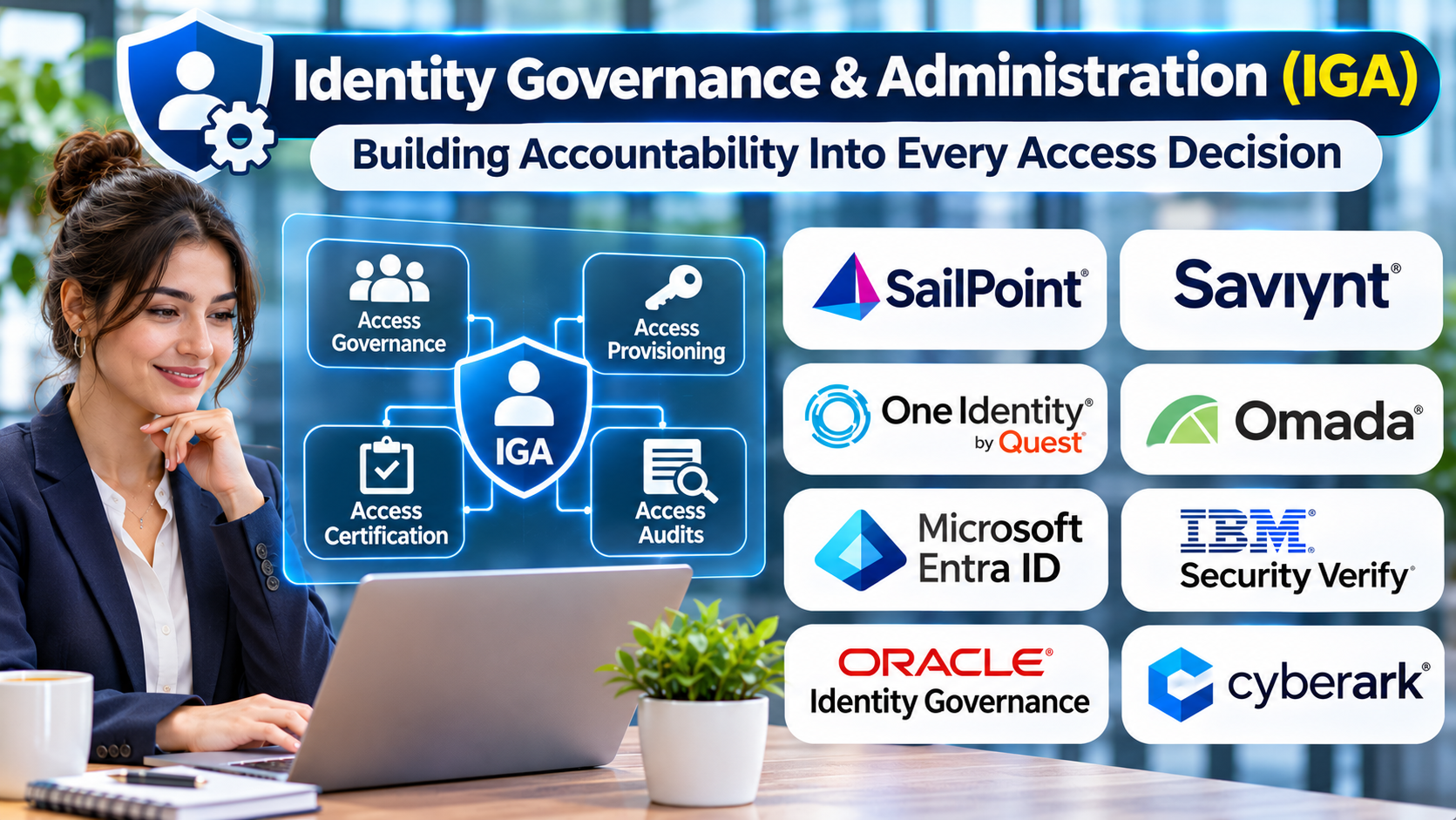
Identity Governance and Administration (IGA) addresses this gap by connecting identity lifecycle management, access approvals, entitlement visibility, and governance processes.
The objective is not simply to automate account creation. It is to establish a defensible answer to a more important question: Why does this identity have this access, and who is responsible for approving it?
What Is Identity Governance and Administration?
Identity Governance and Administration is a collection of technologies and processes used to manage digital identity lifecycles and govern access rights across business systems.
IGA platforms typically support:
- Identity lifecycle management
- Automated provisioning and deprovisioning
- Access requests and approvals
- Access certification campaigns
- Role and entitlement management
- Separation-of-duties controls
- Policy enforcement
- Audit reporting
- Integration with HR, directory, and application systems
IGA is especially valuable when organizations manage many applications, frequent personnel changes, complex permissions, or regulatory obligations.
However, software alone cannot establish effective governance. Organizations also need reliable identity records, accountable application owners, and clear access policies.
Why Access Governance Becomes Difficult
Permissions Accumulate Over Time
Employees often receive additional access as their responsibilities expand.
When they change roles, older permissions may remain because no one formally removes them.
This accumulation is commonly called privilege creep.
Application Permissions Are Inconsistent
One application may use simple administrator and user roles. Another may expose hundreds of detailed entitlements.
Governance systems must translate these technical permissions into information that business owners can understand.
Access Reviews Become Administrative Exercises
Managers may receive lengthy lists of permissions without knowing what those permissions actually allow.
If reviewers approve everything simply to complete the campaign, the process provides little security value.
Departures Are Not Always Reflected Immediately
Identity lifecycle processes depend on accurate information about employment and contractual relationships.
Delayed HR updates, disconnected applications, and unmanaged accounts can undermine deprovisioning.
The Core IGA Capabilities That Matter
Joiner, Mover, and Leaver Automation
IGA platforms help manage access throughout an identity’s lifecycle.
A joiner workflow provisions appropriate accounts when someone enters an organization.
A mover workflow adjusts permissions when responsibilities change.
A leaver workflow removes or disables access when a relationship ends.
The most difficult part is often defining which permissions are genuinely required for each role.
Access Requests
Users may request access to applications or specific entitlements through a governed workflow.
Approvals should involve the appropriate resource owner and reflect the sensitivity of the requested access.
Access Certifications
Access certification campaigns ask responsible reviewers to confirm whether permissions remain necessary.
Effective campaigns prioritize meaningful access decisions rather than overwhelming reviewers with technical details.
Separation of Duties
Separation-of-duties policies identify combinations of permissions that create unacceptable conflicts.
For example, an organization may want to prevent the same individual from both creating a supplier and approving payments to that supplier.
These controls must reflect actual business processes.
Role Management
Roles group permissions according to responsibilities.
Well-designed roles simplify administration. Poorly designed roles can conceal excessive access and become difficult to maintain.
IGA Platforms Worth Evaluating
SailPoint Identity Security
SailPoint provides identity governance capabilities for enterprise identity environments.
Its solutions address identity lifecycle management, access governance, and visibility into permissions.
Relevant use cases: Organizations with extensive application estates, complex entitlement structures, and formal governance requirements.
Evaluation priorities: Connector coverage, access review workflows, implementation complexity, and entitlement modeling.
Saviynt
Saviynt offers identity governance capabilities across cloud and enterprise environments.
It is relevant to organizations seeking to coordinate access governance and identity-related security controls.
Relevant use cases: Complex enterprise access, cloud applications, and governance workflows.
Evaluation priorities: Integration architecture, policy configuration, and administration requirements.
One Identity Manager
One Identity Manager provides identity lifecycle and access governance functionality.
It can be considered by organizations requiring detailed identity administration and governance processes.
Relevant use cases: Enterprise provisioning, access certifications, and role-based access management.
Evaluation priorities: Deployment architecture, customization effort, and ongoing operational ownership.
Omada Identity
Omada Identity focuses on identity governance and administration.
It is relevant to organizations seeking structured identity lifecycle processes and access governance.
Relevant use cases: Automated identity administration and access compliance programs.
Evaluation priorities: Workflow design, application connectivity, and governance reporting.
Microsoft Entra ID Governance
Microsoft Entra ID Governance provides identity governance capabilities within the Microsoft identity ecosystem.
It is especially relevant to organizations already using Microsoft Entra ID.
Relevant use cases: Access reviews, entitlement management, and lifecycle governance for supported identities and applications.
Evaluation priorities: Licensing, supported integrations, and governance requirements beyond the Microsoft environment.
midPoint
midPoint is an open-source identity governance and administration platform developed by Evolveum.
It provides an alternative for organizations that want greater control over deployment and customization.
Relevant use cases: Identity synchronization, provisioning, and governance in self-managed environments.
Evaluation priorities: Technical expertise, maintenance, customization, and support arrangements.
Comparing IGA Platforms
| Platform | Primary evaluation context | Important trade-off |
|---|---|---|
| SailPoint | Broad enterprise identity governance | Integration and implementation effort |
| Saviynt | Cloud and enterprise access governance | Configuration and operating complexity |
| One Identity Manager | Detailed identity lifecycle administration | Customization and maintenance |
| Omada Identity | Structured governance workflows | Connector and process fit |
| Microsoft Entra ID Governance | Microsoft-centered identity environments | Licensing and ecosystem coverage |
| midPoint | Open-source, self-managed governance | Internal technical responsibility |
This comparison is a starting point, not a ranking. Product capabilities and licensing should be verified against current vendor documentation.
IGA vs. IAM vs. PAM
Identity and Access Management (IAM) establishes the broader identity and access foundation.
Identity Governance and Administration (IGA) focuses on who should receive access, who approved it, and whether it remains appropriate.
Privileged Access Management (PAM) concentrates on controlling high-risk administrative access.
These functions overlap, but they address different parts of the identity security problem.
A mature organization may use IAM for authentication, IGA for access governance, and PAM for privileged account controls.
How to Choose an IGA Platform
Start With Identity Data Quality
If employee records are incomplete or inconsistent, automated provisioning may produce incorrect results.
Identify authoritative sources for employee, contractor, and organizational information.
Assess Application Integration
Create an inventory of applications, account types, and entitlements.
Determine whether the IGA platform can provision access directly or must rely on custom integrations.
Evaluate Access Review Usability
Reviewers need understandable descriptions of permissions and their associated risks.
Test certification workflows with actual business managers.
Examine Policy Flexibility
Governance rules should accommodate different business units, employment types, and resource sensitivity levels.
Avoid excessive customization that becomes difficult to maintain.
Consider Implementation and Operating Costs
Total cost includes software, connectors, integration work, role design, governance administration, and support.
Implementing IGA Successfully
Begin with a limited scope, such as employee access to a small group of important applications.
Establish identity ownership and define authoritative data sources.
Clean up duplicate identities and inactive accounts before introducing automation.
Map entitlements into understandable business descriptions.
Introduce access request and approval workflows.
Run a targeted access certification campaign and measure whether reviewers can make meaningful decisions.
Expand gradually to additional systems and more complex governance policies.
Useful success indicators include deprovisioning delays, unresolved access violations, orphaned accounts, and the time required to complete meaningful access reviews.
Common IGA Mistakes
Automating poor access policies: Automation can distribute excessive permissions more efficiently.
Launching organization-wide reviews too early: Large campaigns often produce reviewer fatigue.
Ignoring application owners: Technical administrators cannot always determine business access requirements.
Treating certification completion as proof of security: Approval quality matters more than campaign completion rates.
Overcomplicating roles: Excessive role definitions can make governance harder rather than easier.
Frequently Asked Questions
Is IGA the same as IAM?
No. IGA emphasizes identity lifecycle administration and access governance, while IAM includes broader authentication and access management functions.
Does IGA replace PAM?
No. PAM focuses on privileged access controls. IGA can help govern who is entitled to privileged access.
Can smaller organizations benefit from IGA?
Yes, particularly when access changes are frequent or compliance requirements are demanding. The implementation should match the organization’s complexity.
Does IGA guarantee compliance?
No. It can support governance and audit evidence, but compliance also depends on policies, implementation, and operating practices.
Final Thoughts
Identity governance is fundamentally about accountability.
An organization should be able to explain why access exists, who approved it, and when that decision was last reviewed.
SailPoint, Saviynt, One Identity Manager, Omada Identity, Microsoft Entra ID Governance, and midPoint offer different approaches to supporting those processes.
The strongest IGA program begins with reliable identity information, clear access ownership, and manageable governance workflows.
Technology then makes those decisions more consistent, measurable, and auditable.