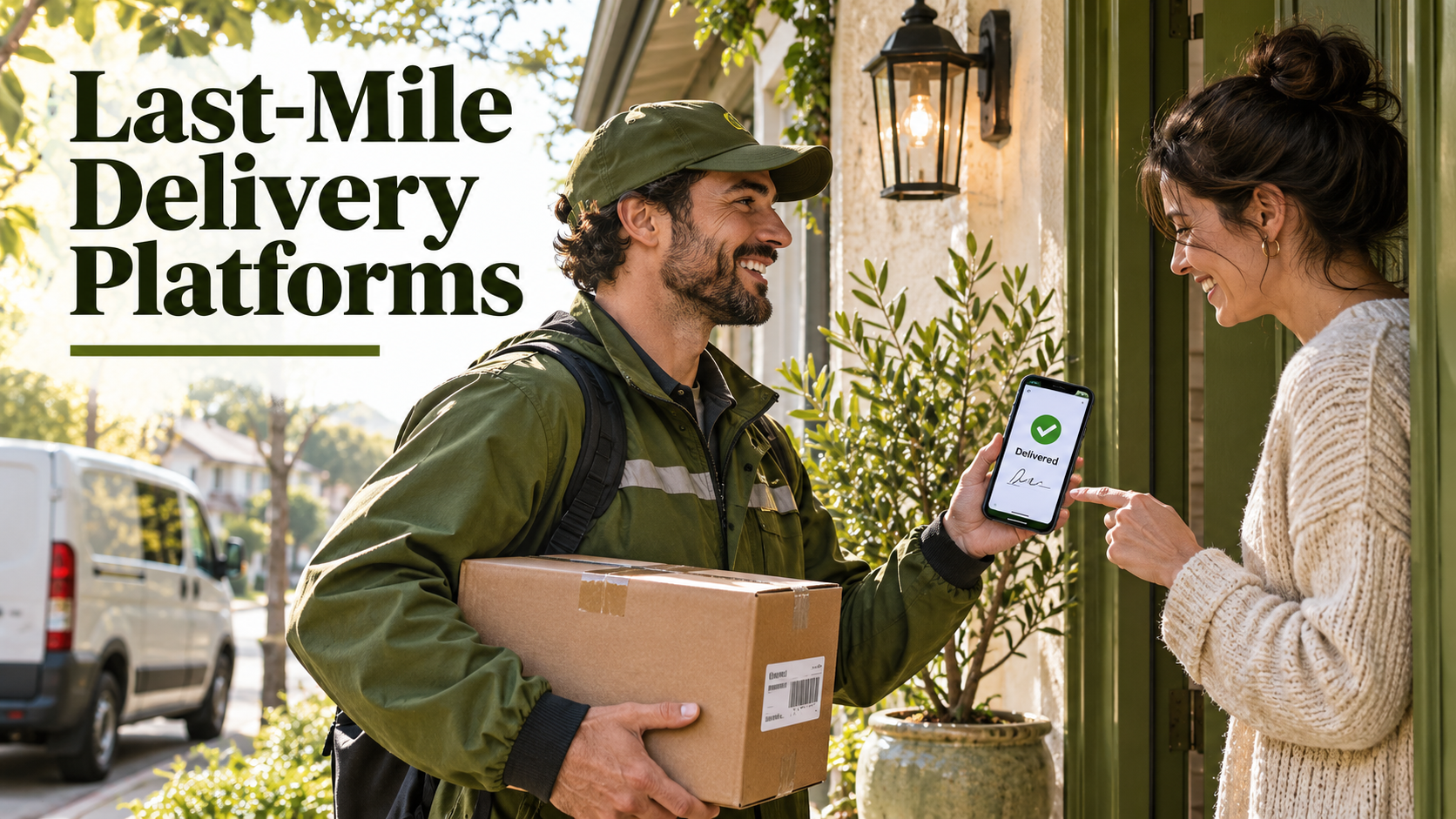
A customer sees that a parcel was delivered, but there is nothing at the front door. The driver left it with reception as instructed, took a photo, and moved to the next job. The evidence exists in one application. The customer service team sees only a generic status. The retailer is now paying someone to reconstruct a handover that could have been explained in seconds.
Last-mile delivery platforms coordinate the final leg between a fulfillment point and a customer or recipient. They can cover dispatch, driver workflows, customer notifications, proof of delivery, and exceptions. The useful comparison begins with the customer experience, then asks whether every participant has the information and authority needed to complete the next step.
Define the delivery promise in terms people can act on
A delivery window can be chosen at checkout, assigned after dispatch, or updated while a vehicle is on the road. Decide who owns each message. If the order system offers a two-hour window and the delivery platform later sends an exact estimated arrival, the two communications should have a clear relationship. Customers should know which one to use when deciding whether to be home.
Delivery instructions deserve a structured path. A customer may provide a gate code, authorize a safe place, or request a call at arrival. A dispatcher may need to correct the access point, while a driver needs to see the latest instruction on a phone. Establish what can change after dispatch and whether a driver acknowledges it. Decide which details expire or must be hidden from parties who do not need them.
Test notification timing on a delayed route. A stream of tiny ETA changes can frustrate people. A significant delay may require a new message and a rescheduling option. Use conditions that fit the service and test actual message delivery, including invalid phone numbers or addresses. Check language, accessibility, and the ability of support to see what was sent.
Give drivers a workflow for the actual door
A driver needs to know which parcel to hand over, who may receive it, and what evidence the service requires. A photograph may fit a permitted doorstep delivery. An attended delivery may use a signature or confirmation code, while a higher-value or specialized service can require additional checks. Match the evidence to the promise and have responsible teams verify policies that apply to your service and region.
Evaluate the app where connections fail. A driver can reach a basement reception desk or rural address with poor mobile coverage. Test which instructions remain available, whether the app can record an outcome, and how the evidence is synchronized later. If the event arrives late, support should see the difference between time of handover and time of upload. Confirm whether the driver can correct an erroneous status and how that correction is logged.
Onfleet documents configurable proof-of-delivery options. Bringg documents delivery notes and proof-related events in its developer materials. Treat those as entry points for a trial. Ask to see how the photo, note, or signature reaches the support agent’s application, which roles can view it, and what happens to the evidence when access expires. Onfleet proof of delivery · Bringg proof-of-delivery event
Use failure reasons that lead to the next action
A failed attempt can mean the customer was absent, access was blocked, an address was wrong, or the item was damaged before arrival. Those outcomes require different responses. The app should capture a clear reason and direct the driver or dispatcher to the next permitted action. Customer service should see enough context to reschedule, contact the customer, or initiate a return.
Test a delivery that fails after one parcel in a multi-parcel order succeeds. The outcome should apply to the right parcel or item. A damaged package may return to the depot, while another part of the order remains delivered. The order system needs that distinction for refund or replacement decisions, and the tracking page should describe the state in language customers understand.
Build clear rules for reopening a completed stop. A parcel can be left at the wrong door, a signature may be attached to the wrong item, or a carrier may correct a mistaken status. Preserve the first record and show the corrected outcome with evidence and a named actor. Test what the platform sends to the customer after the change, especially if a completion message already went out.
Work out what happens when someone else delivers
A business using its own fleet can configure its driver experience more directly. A business that sends some deliveries to third-party carriers depends on each carrier’s supported status, tracking, and evidence. A platform can normalize common events, but detailed outcomes may still differ. Decide what minimum information a partner must supply for each service type.
Create a coverage matrix by geography and service. Include status granularity, tracking link behavior, proof availability, exceptions, and the ability to cancel or reassign. During a test, let a carrier accept a job and then cancel it close to the delivery window. Ask who can bring the job back into dispatch, whether the customer is informed, and how costs and evidence are linked to the replacement delivery.
Pricing can depend on tasks, delivery volume, drivers, messaging, or carrier connections. Ask how attempts, cancellations, and returns count. Test the cost assumptions with a month that includes peak volume and an unusually high retry rate. Include support work and carrier onboarding. Those costs often matter more to the operation than the nominal charge for a successful first attempt.
Measure the outcome customers and staff actually experience
A useful pilot includes a normal delivery, a gated building, an offline stop, a partial delivery, and a failed attempt. Ask a support agent who did not participate to resolve a customer inquiry using the records provided. Check whether the agent can find the exact package, the promise communicated to the customer, and evidence of the outcome without contacting the driver.
Measure first-attempt completion, arrival-window adherence, time to close exceptions, and the share of jobs with usable proof. Compare results by carrier and service type, since pooled averages can hide a problem in one area. A last-mile platform has demonstrated its value when a driver can finish the stop correctly, a customer receives an accurate account of what happened, and staff can resolve the exceptions that remain.