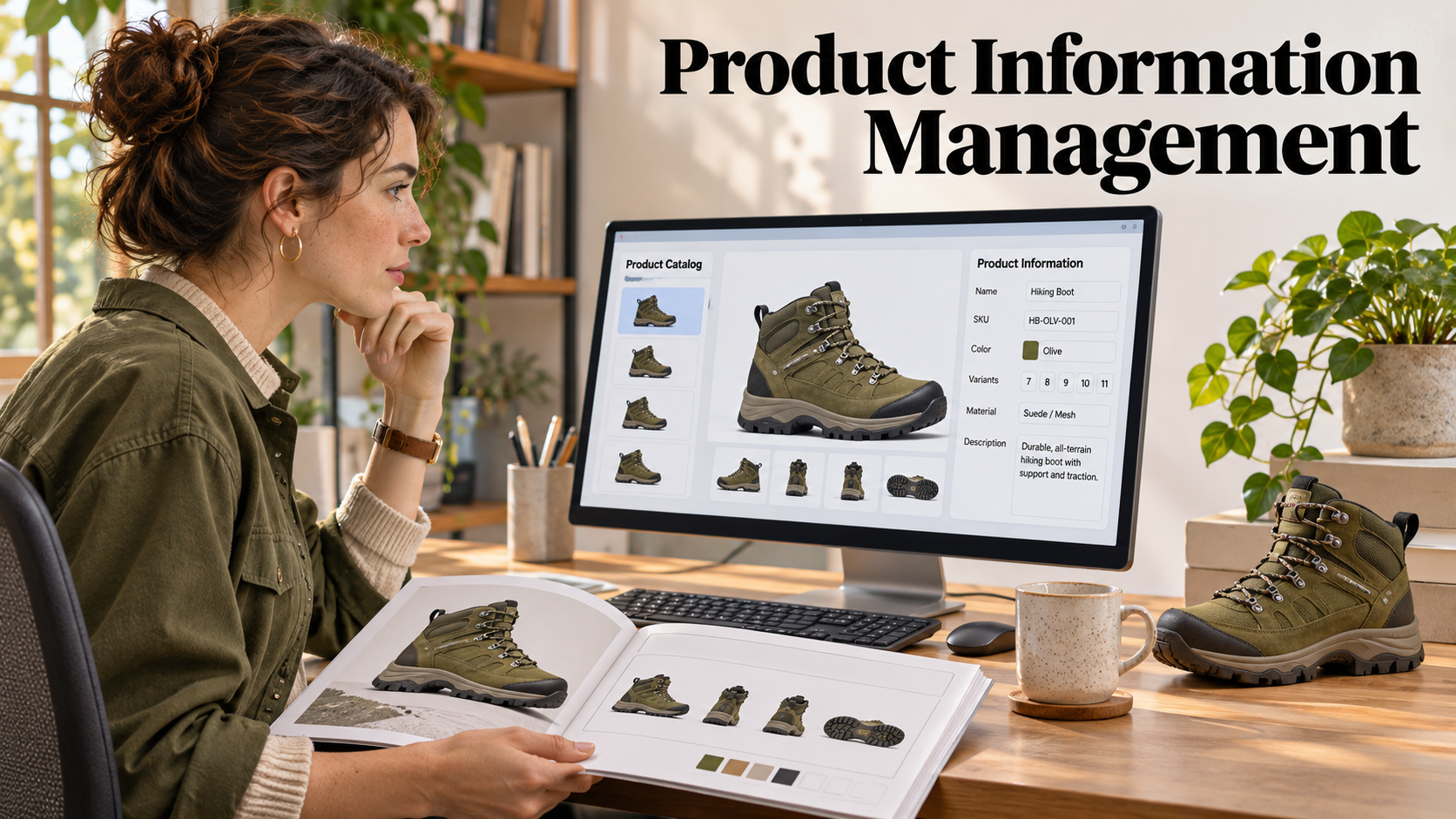
A footwear team prepares a new boot for its web store, a marketplace, and a retail partner. The website needs a size guide and localized descriptions. The marketplace requires a specific color value and identifiers for every sellable variant. The retail partner wants a feed with dimensions and images in a prescribed order. A spreadsheet can hold all of this. Every additional destination makes it harder to know which values can be reused and which need attention.
Product information management, or PIM, gives teams a place to organize, enrich, validate, and distribute product data. A useful buying decision starts with the differences among channels. Find out where those differences belong in the data model and who handles them when they change. A system with a tidy product form can still leave the merchandising team rebuilding feeds by hand if it models every destination as an afterthought.
Model the product before filling in the fields
Start with a real family of products. A hiking boot can have a style name, material specification, and general description shared across variants. Color images might belong at the color level. Size, barcode, and other sellable identifiers may belong to individual stock-keeping units. The exact hierarchy depends on how your business sells and how destination channels group listings.
A parent and child model helps teams maintain shared fields once, provided inheritance has clear rules. Test whether a child can override the inherited value, whether an editor can see where it came from, and what happens when the parent changes. Consider a style photo that applies to every color only until the individual shots arrive. The temporary fallback should be visible to the editor and removable without deleting legitimate variant assets.
Use typed attributes wherever meaning matters. A product weight entered as free text can be hard to convert, validate, or send to a partner that expects a number and a unit. Controlled lists make filters more consistent, but somebody must own allowed values. If suppliers use “olive,” “army green,” and “moss,” decide whether those labels represent genuine shades, a shared search category, or both.
Avoid creating an attribute for every destination’s label. Model the source concept once where the meaning is shared, then map it into each output. A shoe size system, for instance, needs enough context to distinguish what the number means. A channel’s size field may require conversion or a specified label. Treat this as a mapping decision that can be tested against sample products.
Separate a completed record from a successful listing
Completeness tells an editor whether required values are present for a defined context. A product can be ready for the home market and incomplete in another language. A French-language record can have every mandatory field filled and still fail a marketplace rule because an image or category mapping is wrong. The internal checks and destination responses answer different questions.
Akeneo documents completeness in relation to the attributes required for a product family, channel, and locale. Use that concept in a trial even if you evaluate other products. Create a record that passes for one locale and fails for another. Then supply a value that satisfies your own required field but is rejected by an external destination. Ask the system to show the difference and identify who should repair it. Akeneo completeness documentation
Where destination feedback is available, follow the identifier from published record to accepted listing. Record rejections with a reason, the destination, and the source version. If a product is republished while a prior submission remains pending, the team should be able to see which response belongs to which submission. The difference becomes important during a launch when several edits happen in quick succession.
Assign an owner to each kind of change
The ERP may supply item identity, and the PIM may own customer-facing copy and normalized product attributes. A digital asset management system may own the original photographs, while the PIM associates the relevant assets with variants and destinations. Ecommerce can own storefront merchandising decisions, and an inventory system can own stock availability. Define responsibility for individual fields before you connect the applications.
A concrete conflict can clarify the division. Suppose the supplier sends an updated description that includes a claim your team previously removed. An automated import should know whether to stage the update for review, preserve the existing approved text, or overwrite a field where the supplier is authoritative. If country teams manage localized descriptions, a global update may need to create translation tasks without deleting their completed work.
Build role permissions around the actual editorial flow. A contributor may draft a translated description, a local lead may approve it, and a channel manager may publish it. Establish who can override missing fields or authorize a fallback language. Review bulk updates in particular. A category reassignment for thousands of items should have a preview, an identifiable owner, and a way to correct an incorrect mapping.
Choose between a focused PIM and a flexible data platform
A focused PIM can be attractive when product families, enrichment, and publishing are the main job. Akeneo’s documented model gives buyers a concrete way to test those activities. Pimcore documents configurable data objects and relationships, making it a candidate where teams expect to model more varied business entities or need a broader data platform. That flexibility places more weight on the design and administration skills available to the team. Pimcore data objects
The closest practical alternative for a small single-store catalog may be the commerce platform’s existing product editor. If one team publishes to one destination and the data model fits comfortably, a separate PIM adds another place to maintain. The case strengthens when shared information is repeatedly copied, localization creates parallel versions, or rejected feeds delay launches. Sample those failures and estimate the ongoing work they generate.
Ask vendors which connectors they maintain, which partners own, and how marketplace schema changes are handled. A connection can export a feed while leaving category mapping and rejection management to your staff. Price the editing seats, languages, integrations, and feed maintenance that will actually be required. Also check whether your team can export the data model and product content in a form it can migrate later.
Pilot a small catalog with awkward products
Choose one family with shared values and many variants, one product with missing supplier data, and one product already live that needs a correction. Import the records, map fields, assign translations, and publish to two destinations with different requirements. Include an image change that affects one color and an update that must apply across all variants. Have the real merchandising team perform the edits.
Measure elapsed time from usable supplier data to accepted listing. Track rejection reasons, edits per product, and time spent finding the right place to fix a value. The strongest pilot also repeats the exercise after a channel changes one required field. If the team can identify the affected listings, update the mapping, and confirm acceptance without rebuilding its source catalog, the PIM has proved its value beyond the first launch.