Artificial intelligence is becoming part of everyday business operations.
Organizations use AI to summarize documents, support customers, analyze information, assist developers, and automate internal workflows.
These applications can improve productivity, but they also introduce risks.
An AI system may generate inaccurate information, expose confidential data, produce unfair outcomes, or perform actions beyond its intended authority.
The risks become more serious when AI affects employment, financial decisions, healthcare, security, or other consequential activities.
Managing these challenges requires more than a written policy.
Organizations need to understand which AI systems they use, who owns them, what risks they create, and how those risks are controlled throughout their lifecycle.
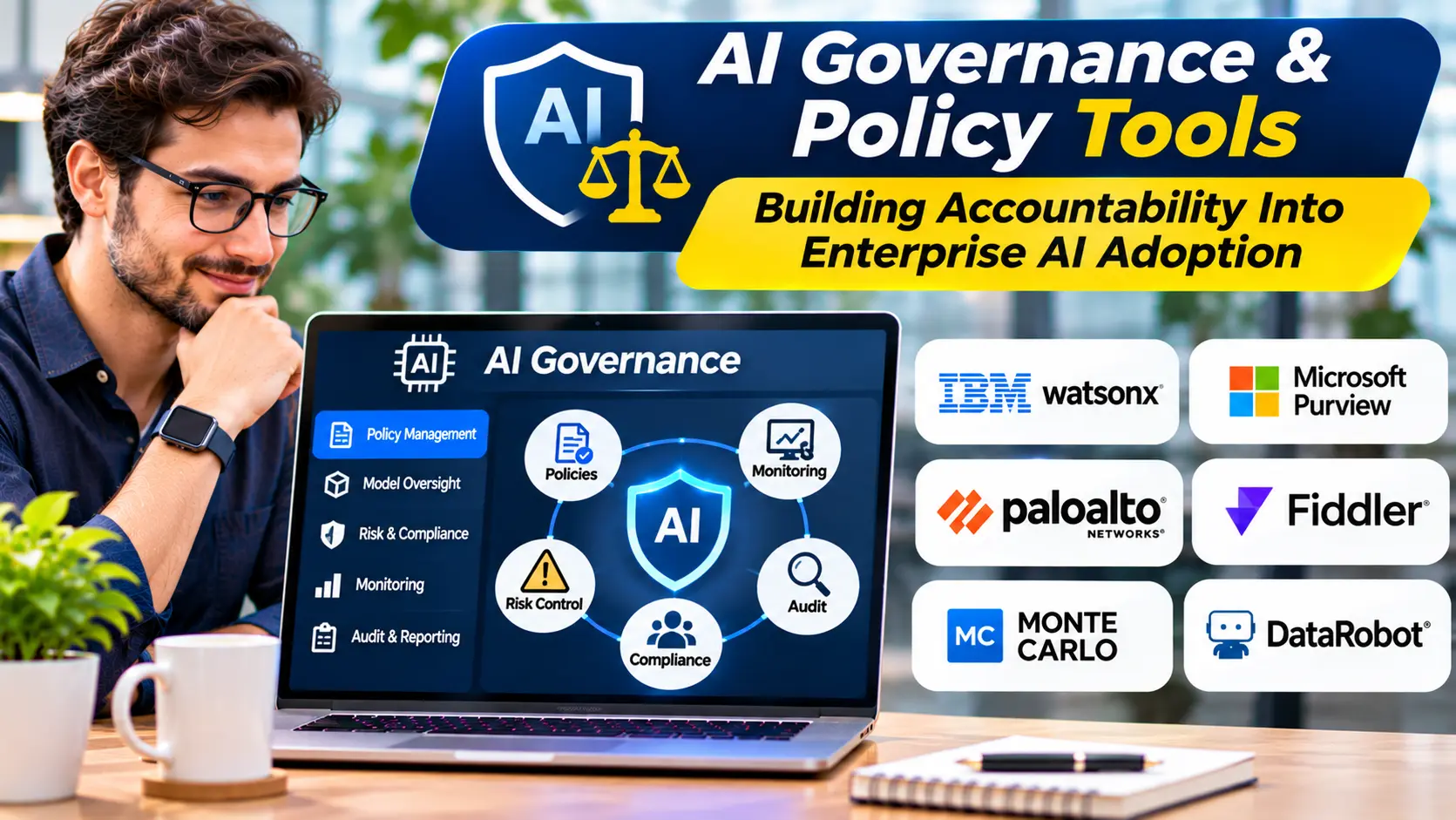
AI governance and policy tools help establish this structure.
They support activities such as AI inventories, risk assessments, policy management, documentation, monitoring, and compliance workflows.
However, software alone cannot make an organization responsible.
Effective governance depends on clear accountability, appropriate technical controls, and ongoing human oversight.
What Is AI Governance?
AI governance refers to the policies, responsibilities, processes, and controls used to guide the development, deployment, and use of artificial intelligence.
It addresses questions such as:
- Which AI systems are approved for use?
- Who is responsible for each system?
- What information may the system process?
- What decisions may it influence or automate?
- How are risks assessed?
- How are failures reported and corrected?
- When is human review required?
Governance provides the organizational structure for answering these questions.
AI governance tools help teams document, coordinate, and monitor the resulting activities.
What Are AI Governance & Policy Tools?
AI governance and policy tools are software platforms that support the management of AI-related policies, risks, controls, and evidence.
Depending on the product, capabilities may include AI system inventories, model documentation, risk scoring, approval workflows, audit trails, and compliance reporting.
Some platforms focus on enterprise governance processes.
Others emphasize technical monitoring, model evaluation, or security controls.
These categories overlap, but they are not interchangeable.
A model monitoring platform may detect performance drift without providing complete policy management.
A governance platform may maintain risk assessments without directly inspecting every model interaction.
Organizations should identify which functions they need before comparing vendors.
Why AI Governance Matters
Traditional software systems generally follow programmed logic.
AI systems can produce variable outputs based on model behavior, input data, and context.
This creates challenges for testing and accountability.
An AI application may work correctly during initial evaluation but perform poorly when users submit unfamiliar requests.
A model update may change behavior.
A connected agent may gain access to additional tools.
New regulations or internal policies may also affect acceptable use.
Governance provides a process for identifying and responding to these changes.
Its purpose is not to prevent useful innovation.
It is to establish appropriate controls for the risks involved.
The Main Components of an AI Governance Program
AI System Inventory
Organizations need to know which AI systems are in use.
An inventory may include internally developed models, third-party AI services, embedded AI features, and agent-based applications.
Each entry should identify the system’s purpose, owner, data sources, and deployment environment.
Risk Assessment
Risk assessments examine potential harms and operational consequences.
Relevant factors may include data sensitivity, decision impact, user population, autonomy, and exposure to external threats.
Policy Management
Policies establish acceptable uses, restrictions, and responsibilities.
Examples include rules for confidential information, human review, model procurement, and automated decision-making.
Documentation
Documentation helps explain how an AI system works and what controls apply.
This may include model information, intended use, limitations, evaluation results, and approval records.
Monitoring
Monitoring helps identify changes in system behavior after deployment.
It may include quality metrics, operational failures, security events, and other risk indicators.
Incident Management
Organizations need procedures for reporting and investigating AI-related incidents.
A governance system should help track corrective actions and responsible owners.
AI Governance Frameworks and Standards
Several established frameworks provide useful foundations for organizational AI governance.
NIST AI Risk Management Framework
The National Institute of Standards and Technology developed the AI Risk Management Framework, commonly called AI RMF.
It provides a voluntary structure for identifying and managing AI-related risks.
Its core functions are Govern, Map, Measure, and Manage.
Organizations can use these concepts to organize governance activities and risk-management responsibilities.
The framework is not a software product or automatic certification.
ISO/IEC 42001
ISO/IEC 42001 is an international standard for artificial intelligence management systems.
It defines requirements for establishing, implementing, maintaining, and continually improving an AI management system.
It is relevant to organizations seeking a structured approach to AI governance.
Software tools can support implementation, but purchasing a platform does not itself establish conformity with the standard.
European Union AI Act
The EU AI Act establishes a legal framework for artificial intelligence within its scope.
It uses a risk-based approach and includes obligations that vary according to the type of AI system and the role of the organization.
Applicability depends on legal definitions, jurisdiction, use case, and implementation timelines.
Organizations should seek qualified legal guidance when determining their obligations.
Governance software can help organize compliance activities but cannot independently determine legal compliance.
AI Governance Platforms to Evaluate
IBM watsonx.governance
IBM watsonx.governance provides capabilities associated with AI governance and lifecycle oversight.
It is relevant to organizations seeking governance processes for AI models and applications.
Evaluation should focus on supported environments, risk workflows, monitoring, and integration requirements.
OneTrust AI Governance
OneTrust offers AI governance capabilities related to managing AI use cases, risks, and organizational oversight.
It may be relevant to enterprises coordinating AI governance with privacy and compliance activities.
Teams should evaluate workflow flexibility, inventory capabilities, and integration with existing governance processes.
Credo AI
Credo AI focuses on AI governance, risk, and compliance workflows.
It is relevant to organizations that need structured oversight of AI systems and related policies.
Evaluation should examine supported assessments, evidence management, and organizational reporting.
Holistic AI
Holistic AI provides capabilities associated with AI governance, risk assessment, and assurance.
It may be relevant to organizations assessing AI-related risks across different applications.
Teams should verify the current scope of technical testing and governance features.
Microsoft Purview
Microsoft Purview provides data governance, compliance, and information protection capabilities.
These functions can support parts of an organization’s AI governance strategy.
However, data governance and complete AI governance are not identical.
Organizations should determine which AI-specific requirements are covered and which need additional processes or tools.
Comparing AI Governance Tool Categories
| Category | Primary focus | Important consideration |
|---|---|---|
| AI governance platforms | Policies, inventories, risk workflows | Organizational coverage |
| Model monitoring tools | Performance and behavior | Technical integration |
| AI security tools | Threats and misuse | Security control depth |
| Data governance tools | Data access and lifecycle | AI-specific risk coverage |
| GRC platforms | Enterprise risk and compliance | AI workflow customization |
| Evaluation platforms | Model and application quality | Connection to governance decisions |
A mature governance program may use several complementary systems.
Building an AI System Inventory
An inventory is a practical starting point.
Organizations cannot govern systems they do not know exist.
Each AI application should have an identified owner.
The inventory should describe its purpose, users, deployment status, and relevant dependencies.
It should also record whether the system uses external models, sensitive data, or autonomous tools.
AI features embedded within existing business software should not be overlooked.
An inventory must be maintained as applications change.
A static spreadsheet created once a year may quickly become outdated.
Risk Classification
Not every AI system requires the same level of oversight.
An internal writing assistant presents different risks from a system influencing employment decisions.
Risk classification helps organizations allocate resources.
Relevant factors may include the consequences of errors, degree of autonomy, data sensitivity, and ability to reverse outcomes.
A high-impact system may require more extensive evaluation, documentation, and human review.
However, risk categories should reflect actual use cases.
A general-purpose model may be used in both low-risk and high-risk applications.
The application context matters.
Policies for Generative AI Use
Organizations should establish clear rules for employee use of generative AI.
Policies may address confidential information, approved tools, verification requirements, and intellectual property concerns.
Employees should understand which information can be entered into external AI services.
They should also know when generated content requires human review.
Policies should be practical.
Rules that are difficult to understand or follow may encourage employees to use unapproved alternatives.
Training and accessible guidance are therefore important parts of governance.
Governance for AI Agents
AI agents create additional governance requirements because they may perform actions.
A conventional assistant might generate a recommendation.
An agent may call APIs, modify records, or initiate workflows.
Organizations should define permitted actions and approval boundaries.
For example, an agent might prepare a purchase request but require authorization before submission.
Tool permissions should be enforced through software controls.
Governance records should identify which agent performed an operation and under whose authority.
The level of oversight should reflect the potential consequences.
Data Privacy and Confidentiality
AI systems may process personal information, financial records, proprietary documents, and other sensitive data.
Governance should address collection, processing, storage, retention, and deletion.
Organizations need to understand where data is transmitted and which service providers may process it.
Access controls should restrict information to authorized users and applications.
Data minimization is also important.
An AI application should not receive more sensitive information than it needs to complete its task.
Governance tools can help document these controls, but technical enforcement remains necessary.
Bias, Fairness, and Human Impact
AI systems may produce outcomes that affect people differently.
This is especially important when applications influence consequential decisions.
Organizations should identify relevant fairness risks and select evaluation methods appropriate to the use case.
Testing may require representative data and domain expertise.
A single aggregate accuracy score may hide important differences between groups or scenarios.
Governance should also establish processes for investigating complaints and correcting harmful outcomes.
Fairness cannot be established solely by checking a box in a software platform.
Model Documentation and Transparency
Documentation supports accountability.
Useful records may include intended use, model dependencies, known limitations, evaluation results, and operating restrictions.
For third-party AI services, organizations may need to rely on provider documentation and contractual information.
Internal teams should document application-specific controls.
For example, an organization may need to explain how a model’s output influences a business decision.
The appropriate level of transparency depends on the system and applicable requirements.
Monitoring and Continuous Assessment
AI governance should continue after deployment.
Models, data, users, and operating environments can change.
Monitoring may identify declining accuracy, unusual usage patterns, or unexpected tool behavior.
Organizations should define thresholds for investigation.
Significant changes may require reassessment.
For example, adding a new external data source or enabling an agent to modify records can materially change risk.
Governance processes should capture these changes before deployment.
Third-Party AI Vendor Risk
Many organizations rely on external AI providers.
Vendor assessments should examine data handling, security, service availability, contractual terms, and relevant documentation.
Organizations should understand which responsibilities remain with them.
A provider may secure its infrastructure while the customer remains responsible for application permissions and appropriate use.
Vendor assessments should be proportionate to the sensitivity and impact of the intended deployment.
AI Incident Response
AI-related incidents can include data exposure, unauthorized actions, harmful outputs, and unexpected system behavior.
Organizations should establish reporting channels and investigation procedures.
Incident records should identify the affected system, observed behavior, potential impact, and corrective actions.
Technical logs may help reconstruct events.
However, organizations should avoid collecting unnecessary confidential information.
Lessons from incidents should inform updated controls and evaluation datasets.
Measuring Governance Effectiveness
Governance effectiveness should be assessed through operational evidence.
Useful measures may include inventory completeness, assessment coverage, unresolved high-risk findings, and overdue corrective actions.
Organizations may also monitor policy exceptions, incident response times, and review completion.
However, the number of completed assessments does not necessarily indicate reduced risk.
A governance program should focus on whether controls are working.
Evidence of effective prevention, detection, and remediation is more valuable than paperwork alone.
Understanding AI Governance Costs
Governance costs may include software subscriptions, personnel, technical evaluations, legal review, and training.
Organizations should also consider integration and documentation effort.
A centralized platform may reduce duplicated work across departments.
However, an expensive platform cannot compensate for unclear responsibilities.
The right investment depends on organizational scale, AI exposure, and regulatory obligations.
Smaller organizations may begin with structured processes and existing governance systems.
Larger enterprises may benefit from dedicated platforms.
A Practical AI Governance Implementation Plan
Start by identifying the organization’s AI systems and assigning owners.
Establish an acceptable-use policy.
Define a risk classification process.
Prioritize assessments for high-impact applications.
Document relevant data sources, model dependencies, and permissions.
Introduce approval procedures for sensitive deployments.
Establish monitoring and incident response responsibilities.
Review third-party providers.
Maintain evidence of evaluations and corrective actions.
Finally, reassess systems when their capabilities or operating conditions change.
Governance should evolve alongside AI adoption.
Common AI Governance Mistakes
One mistake is treating governance as a one-time compliance exercise.
AI systems change, and their risks can change with them.
Another mistake is relying entirely on vendor assurances.
Organizations remain responsible for how they configure and use AI systems.
Some teams also focus on model-level risk while overlooking application workflows and connected tools.
A model may be relatively safe in one context and unsuitable in another.
Finally, organizations may create policies without assigning ownership or establishing enforcement mechanisms.
Effective governance requires operational responsibility.
Choosing the Right AI Governance & Policy Tools
Begin with the organization’s actual governance requirements.
A small team may need an inventory, documented policies, and structured risk assessments.
A larger enterprise may require centralized workflows, integrations, audit trails, and reporting.
Organizations operating high-impact AI applications may need stronger technical evaluation and ongoing monitoring.
When comparing platforms, examine how they support existing responsibilities and evidence requirements.
Do not assume that a vendor’s compliance features guarantee legal conformity.
AI governance and policy tools can make oversight more consistent and manageable.
Their greatest value comes from connecting policies with real systems, responsible owners, technical controls, and measurable outcomes.
Responsible AI adoption is not achieved by slowing every project equally. It comes from applying appropriate scrutiny to the decisions and actions that matter most.