A traditional software service fails, and an engineer investigates an error message, a stack trace, or a failed database request.
An AI agent can fail differently.
It may call the wrong tool, retrieve an irrelevant document, misunderstand a user’s intention, or complete several technically successful steps before producing an incorrect result.
The application might return a polished response without generating a conventional software error.
This creates a difficult operational problem: how can engineering teams determine what happened inside an AI-driven workflow?
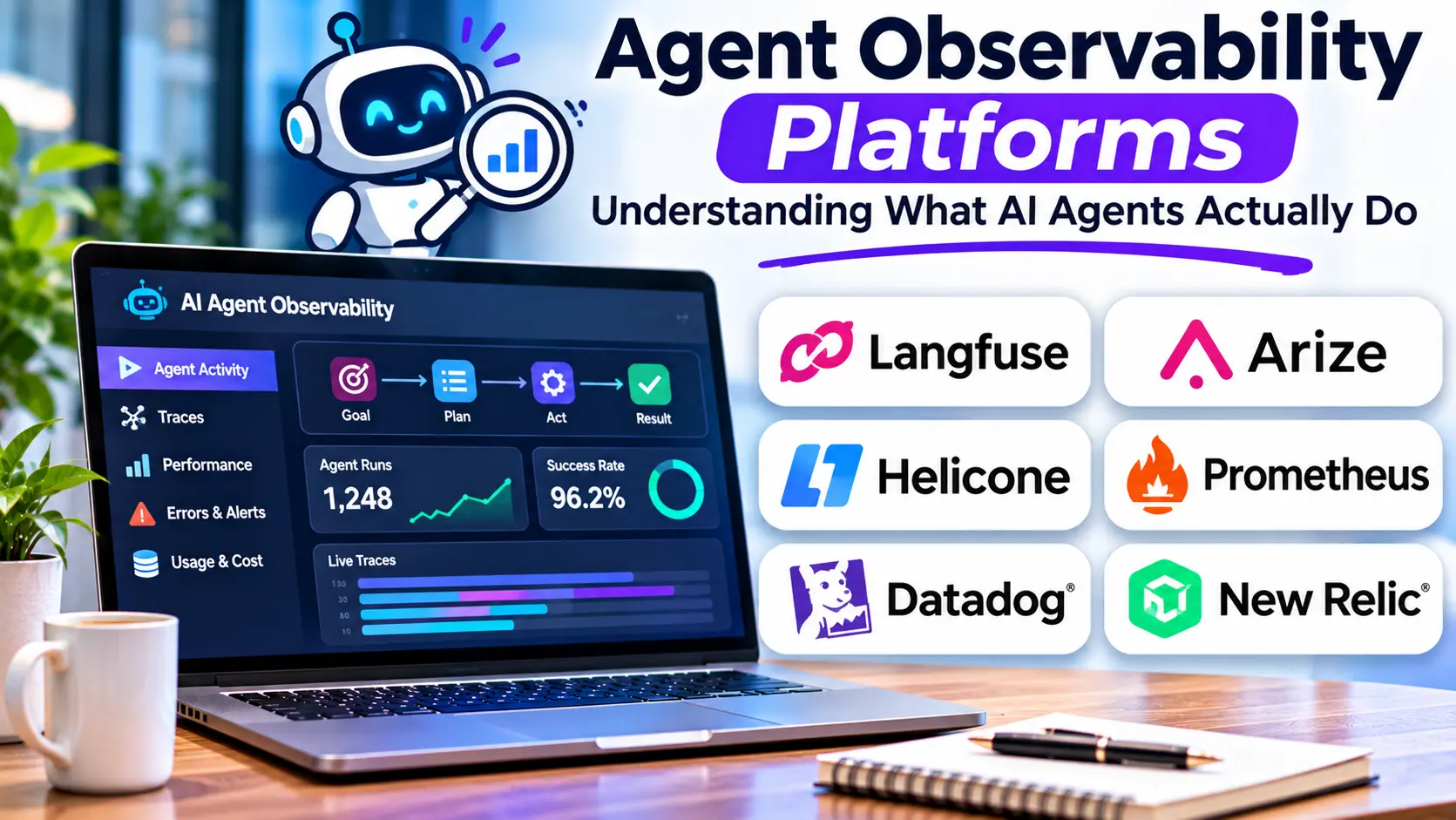
Agent observability platforms address that problem by recording and analyzing the behavior of AI applications across model calls, tool executions, retrieval operations, and workflow transitions.
Their purpose is not merely to show whether an application is running. It is to help teams understand whether an agent is completing the intended work correctly, safely, and efficiently.
Why Traditional Monitoring Is Not Enough
Conventional application monitoring focuses on signals such as availability, response time, error rates, and infrastructure utilization.
These remain important for AI applications.
However, an agent can return a successful HTTP response while making a poor decision.
Consider an agent that receives a request to summarize a customer’s recent support history.
It successfully calls a search tool and generates a summary.
The infrastructure reports no errors.
Yet the agent retrieved records belonging to the wrong customer.
Traditional availability monitoring may classify the request as successful.
An agent observability system should help identify the incorrect retrieval and trace how it influenced the final response.
This is why AI observability must connect technical execution data with application-level quality.
What Is Agent Observability?
Agent observability is the practice of collecting and analyzing information about AI agent execution.
It combines elements of traditional software monitoring with model-specific and workflow-specific evaluation.
Relevant information may include model requests, retrieved context, tool calls, intermediate decisions, execution state, latency, costs, and final outputs.
The goal is to reconstruct the execution path and understand the causes of success or failure.
Agent observability platforms provide tools for capturing, viewing, comparing, and analyzing this information.
Some focus on tracing.
Others combine tracing with evaluations, experiment management, dataset creation, or production monitoring.
The capabilities differ between products.
The Importance of Execution Traces
A trace represents the sequence of operations involved in a request or workflow.
For an AI agent, a trace might contain several connected events.
The agent receives a user request.
It calls a language model.
The model selects a search tool.
The search tool retrieves documents.
The agent processes the results.
A second model call produces the final response.
A useful trace connects these steps into one execution history.
This allows developers to identify which operation introduced an error.
Without tracing, engineers may see only the original request and final response.
That leaves much of the failure unexplained.
Spans, Events, and Metadata
Observability systems often organize execution data into traces and spans.
A span represents an individual operation within a larger workflow.
For example, a model inference request may be one span.
A database retrieval may be another.
Metadata can describe the operation, duration, model, tool, and outcome.
Events may capture significant occurrences during execution.
Structured telemetry makes it easier to analyze repeated failures and compare different workflow versions.
However, developers should avoid collecting unnecessary sensitive information.
The value of observability depends on recording the right details, not collecting every possible detail.
OpenTelemetry and AI Observability
OpenTelemetry provides an open framework for collecting and exporting telemetry.
It defines common concepts for traces, metrics, and logs.
Its generative AI semantic conventions aim to establish consistent descriptions of AI-related operations.
This can help organizations integrate AI observability with existing monitoring infrastructure.
However, support for particular conventions varies across instrumentation libraries and vendors.
Teams should verify the maturity of the relevant integrations before relying on them for production requirements.
Open standards can reduce integration friction, but they do not automatically provide complete agent evaluation.
Agent Observability Platforms to Evaluate
LangSmith
LangSmith provides tracing, evaluation, and related development capabilities for language-model applications.
It is relevant to teams building agents with LangChain, LangGraph, or other supported integrations.
Its usefulness should be evaluated through trace visibility, dataset workflows, evaluation support, and deployment requirements.
Langfuse
Langfuse is an open-source-oriented platform for LLM observability and related application workflows.
It is relevant to teams seeking tracing, usage analysis, and evaluation capabilities.
Organizations should compare its deployment options, integrations, access controls, and operational responsibilities.
Arize Phoenix
Arize Phoenix provides open-source-oriented tooling for AI application tracing and evaluation.
It is relevant to developers investigating retrieval behavior, model interactions, and application quality.
Teams should assess its instrumentation requirements and compatibility with their existing monitoring stack.
Weights & Biases Weave
Weave provides tools for tracking and evaluating AI application behavior.
It is relevant to teams connecting experimentation with application development and evaluation.
The main consideration is how well its workflow fits the organization’s development process.
OpenTelemetry-Based Monitoring
Organizations may also build observability pipelines using OpenTelemetry and compatible monitoring systems.
This can provide flexibility and integration with existing infrastructure.
However, teams must implement the additional evaluation logic needed to assess agent-specific quality.
These approaches are not mutually exclusive.
An organization may use open telemetry standards alongside a specialized AI evaluation platform.
What Should an Agent Observability System Measure?
| Dimension | Useful signals | Why it matters |
|---|---|---|
| Reliability | Completion and failure rates | Shows whether tasks finish |
| Tool behavior | Tool selection and execution outcomes | Reveals incorrect actions |
| Latency | End-to-end and per-step duration | Identifies slow operations |
| Cost | Model and tool usage | Supports budget control |
| Retrieval | Relevance and source quality | Helps detect context problems |
| Safety | Policy violations and unauthorized attempts | Supports risk management |
| Output quality | Task-specific evaluation results | Measures actual usefulness |
No single metric provides a complete picture.
A fast agent can be inaccurate.
A low-cost agent can require extensive human correction.
A technically successful execution can still produce an unacceptable business outcome.
Evaluating Agent Quality
Quality evaluation is one of the hardest parts of AI observability.
Some tasks have clear answers.
For example, an agent either extracted the correct invoice total or did not.
Other tasks are subjective.
A research summary may be judged according to factual accuracy, relevance, completeness, and clarity.
Evaluation methods should match the task.
Deterministic checks are appropriate for structured outputs and known requirements.
Human review is useful when judgment and context matter.
Model-based evaluators can help scale assessments, but their conclusions should not be treated as unquestionable ground truth.
They may introduce their own biases and errors.
Offline Evaluation Versus Production Monitoring
Offline evaluation tests an agent against a defined dataset before deployment.
It helps teams compare prompts, models, tools, and workflow changes.
Production monitoring examines real execution behavior.
Both are necessary.
Offline tests may miss unexpected user requests or environmental conditions.
Production monitoring can reveal those problems, but discovering failures after deployment may carry business consequences.
A mature process combines pre-release evaluation with ongoing monitoring.
Important production failures should become new test cases.
This creates a feedback loop between operational experience and development quality.
Tracing Multi-Agent Workflows
Multi-agent systems introduce additional observability challenges.
A task may pass between specialized agents.
Each agent may call tools, generate intermediate results, or update shared state.
Without connected traces, it can be difficult to identify which component caused a problem.
Observability systems should preserve relationships between agent executions.
They should also distinguish coordination failures from model-quality failures.
For example, two agents may individually produce reasonable outputs but disagree about which result is authoritative.
The problem is then partly architectural rather than purely model-related.
Detecting Tool Misuse
Tool calls deserve special attention because they can affect external systems.
An agent might select an inappropriate tool, provide incorrect arguments, or repeat an operation unnecessarily.
Observability should capture the intended operation and its actual outcome.
For sensitive workflows, execution records should also support security review.
However, monitoring alone cannot prevent harmful actions.
Permissions, validation, and approval controls must operate before execution.
Observability helps explain what happened and identify improvements.
Privacy and Sensitive Telemetry
AI traces can contain confidential information.
Prompts may include personal data, internal documents, or business records.
Tool outputs may expose credentials or sensitive application information.
Organizations should establish clear rules for telemetry collection.
Sensitive fields should be redacted or excluded where appropriate.
Access should be restricted according to operational responsibilities.
Retention policies should reflect legal and business requirements.
A platform that provides excellent debugging but stores excessive confidential data may introduce unacceptable risk.
Measuring Cost Without Losing Context
Model usage is often measured through tokens or other consumption units.
However, a single agent task may involve several model calls and external operations.
Cost analysis should therefore consider complete workflows.
A task that uses a larger model once may be less expensive than a workflow that repeatedly calls a smaller model.
Retries, failed tool calls, and excessive context can also increase costs.
Observability can help identify inefficient execution patterns.
The goal is not simply to minimize token consumption.
It is to reduce the cost of achieving correct, useful outcomes.
Production Alerts and Incident Response
Observability becomes more valuable when it supports timely action.
Teams may configure alerts for unusual error rates, latency increases, or unexpected cost growth.
However, quality-related alerts require careful design.
A temporary change in evaluation scores may reflect different user requests rather than a genuine system regression.
Alerts should use meaningful thresholds and sufficient context.
Incident procedures should identify who investigates failures and how risky workflows can be disabled.
For high-impact applications, the ability to stop execution safely is an important operational requirement.
Building an Agent Evaluation Dataset
A useful evaluation dataset should represent real tasks.
Include straightforward requests, ambiguous instructions, missing information, and tool failures.
Add examples involving outdated context or conflicting documents.
For tool-connected agents, test unauthorized operations and unexpected tool responses.
Each case should define the expected outcome or evaluation criteria.
Datasets should be maintained as the application changes.
A static test collection may become less representative over time.
Common Observability Mistakes
One mistake is measuring only latency and model usage.
These metrics are useful but do not establish task quality.
Another mistake is storing complete prompts and tool outputs without considering privacy.
Teams may also collect traces without defining how to investigate them.
Observability data is valuable only when it supports decisions.
Finally, organizations sometimes treat model-generated evaluation scores as definitive.
Important quality judgments should be validated against human review or objective outcomes where possible.
Choosing the Right Agent Observability Platform
Start with the failures the team needs to understand.
If the main problem is debugging tool execution, prioritize detailed tracing.
If the challenge is comparing prompt and model changes, evaluation workflows may matter more.
If the organization already operates a mature monitoring stack, interoperability with existing telemetry infrastructure may be important.
Enterprises should examine access controls, retention, deployment options, and audit requirements.
Before selecting a platform, instrument a representative workflow and attempt to investigate several realistic failures.
The strongest observability platform is the one that helps engineers move from unexplained behavior to actionable evidence.
AI agents become dependable not when every execution succeeds, but when teams can understand failures, improve behavior, and maintain accountability as applications evolve.