An automated search gives a subscription team an impressive churn model. The strongest input is a field that records when the account was closed. That field was available in the historical export but would have been blank on the day the team needed to act. The AutoML system did exactly what it was asked to do. It found patterns that scored well on the evaluation it was given.
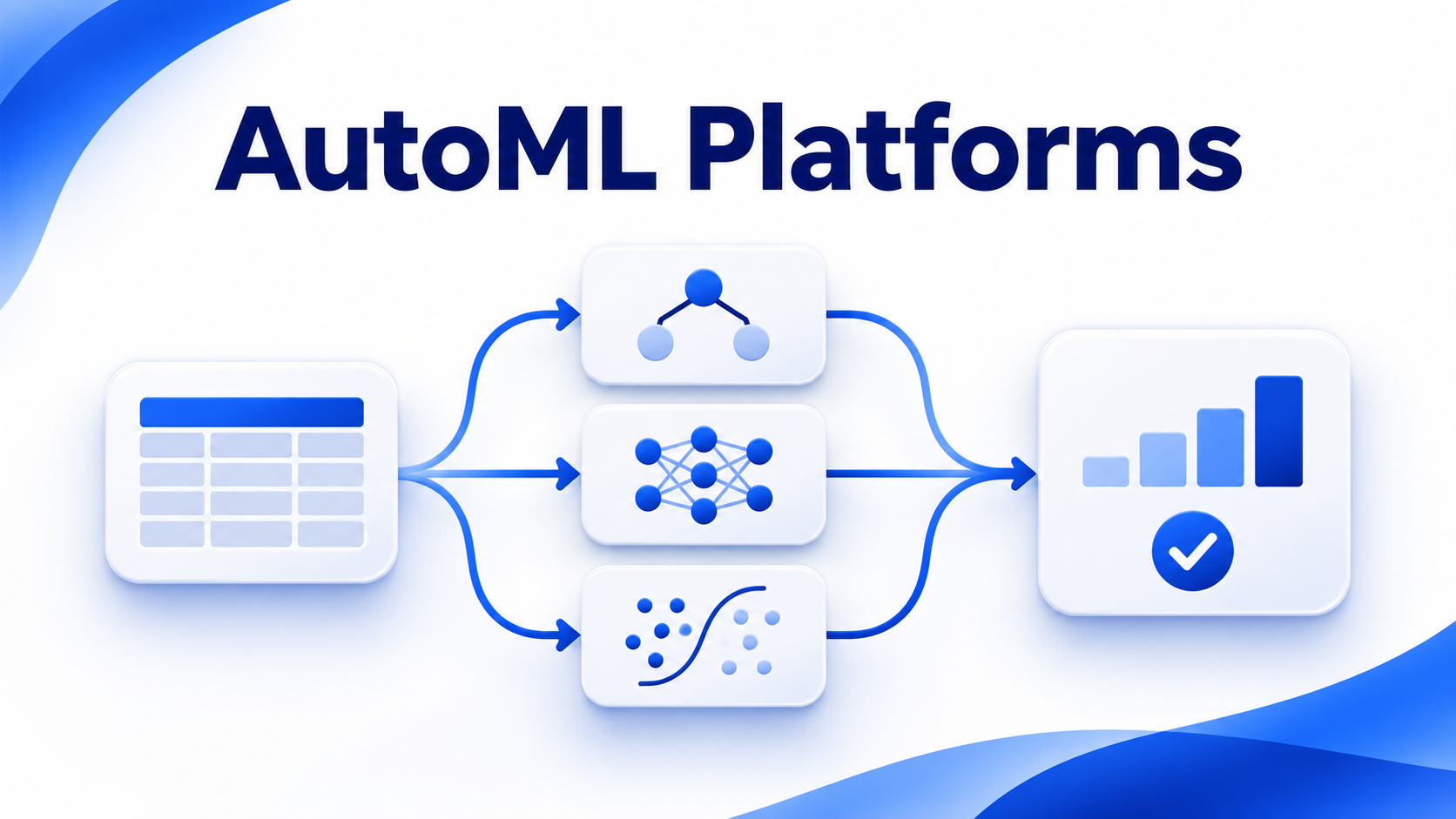
AutoML platforms automate parts of model selection, preprocessing, tuning, and sometimes ensembling. That can save considerable time on a well-defined prediction problem. It also lets teams make a flawed experiment more elaborate. The way to choose a tool is to design the evaluation first and see which parts of it the tool can automate without obscuring the underlying assumptions.
Write the prediction contract in plain language
Start with the unit being scored, the moment of prediction, and the outcome window. A churn model might score an account every Monday and predict whether it will cancel in the following thirty days. Only fields that were available on that Monday belong in the input. Include the delay between an event occurring and its appearance in the data. A purchase timestamp alone does not tell you when a late batch made that purchase visible.
Define the action. If the retention team can contact only a fixed number of accounts per week, precision among the highest-ranked accounts may matter more than an average across all thresholds. If some mistakes are expensive or if probabilities drive a staffing forecast, look at calibration and decision cost. Write these choices down before opening a leaderboard so the easiest available metric does not become the objective by accident.
A simple baseline should share the same inputs and validation rules as the automated candidates. A recent-activity rule or logistic regression can establish whether more search adds useful signal. If the baseline already supports the business action within its cost and latency constraints, a more complex ensemble needs to justify its maintenance and deployment requirements.
Make the split do the hard work
Random row splitting can be sensible when observations are independent and future data resembles past data. Repeated rows for one customer, supplier, or device break that assumption. A model may recognize the entity instead of learning a pattern that generalizes. A group-based split keeps related examples together. A time-based split, in which validation follows training, better reflects deployments that predict future outcomes from past behavior.
Keep a final holdout outside the search loop. When dozens of configurations compete on the same validation set, some may rise because they match its peculiarities. Reserve the holdout for a limited number of candidates. Record what happened to preprocessing at each boundary. Imputation, encodings, feature selection, and resampling can leak information when fitted before the split.
When the tool offers convenience defaults, inspect them. Bring explicit splits when the problem requires them, and check how the platform applies them to stacking or tuning. If its evaluation API cannot represent a critical constraint, train inside the tool and perform a separate evaluation outside it, or choose a tool that gives the team the necessary control.
Compare the search environments by the workflow they support
AutoGluon Tabular is a code-first candidate for teams comfortable with Python. It offers model comparison and can report fit and prediction times alongside scores. That is useful when a team needs to choose among candidates under a serving budget. Run the actual single-row or batch prediction shape through shortlisted candidates because an aggregate leaderboard timing may describe a different workload. AutoGluon Tabular guide
H2O AutoML makes sense when the organization already works in the H2O ecosystem or wants an automated leaderboard and stacked ensembles. Its model options and runtime fit should be checked against the planned deployment path. If an ensemble wins, compare its operational needs with those of a single candidate and check how the model is packaged and loaded. H2O AutoML documentation
Vertex AI AutoML is a managed option for teams that want supported training workflows inside Google Cloud. It is useful to assess when data, permissions, and downstream predictions already live in that environment. Check which task and data types the chosen workflow supports, how to supply splits, and what the selected model can export or serve. The convenience of provisioning compute can matter independently of the search results. Vertex AI AutoML documentation
Each approach should face the same baseline and the same untouched data. Compare total elapsed time, use of compute, and the time an analyst spends configuring and understanding the run. A team may prefer a managed job for repeatable resource controls, or a library for tighter integration with existing evaluation code. Those preferences are separate from predictive quality.
Test what happens when a candidate leaves training
A model serving thousands of predictions at a time has different constraints from a service answering one request before a page loads. Measure the selected candidate with its preprocessing on the intended hardware. A top-ranked stacked model may need multiple component predictions, extra memory, and a longer startup. If a smaller candidate performs similarly at the working threshold, its simpler runtime may be worth more.
Check how the tool handles new categories, missing values, and schema changes. Run the actual model artifact from a clean environment using a service identity. Capture the dependency versions, preprocessing state, artifact identifier, and approved input columns. A production job should be able to load the version that passed validation even after further searches run.
Test which information the team can retrieve for review. Feature importance can help identify suspicious columns, but it does not establish causal effects. A representative error sample can reveal a data problem that a summary cannot. Ask a domain specialist to inspect cases the model would send to people for action and classify errors by their practical consequence.
Also decide when a prediction is allowed to be absent. If an account has too little history for meaningful scoring, the service can mark the result as unavailable and follow a separate policy. Measure coverage on the holdout alongside quality on the accepted rows. A model that scores only easy cases can look unusually strong unless the review includes the number and types of records it declined.
Put a budget and a stop rule on search
Start with a small run to confirm that data and metrics behave as expected. Increase the budget only after the baseline and evaluation are sound. Record the point at which additional runs produce little useful gain. Include repeated training, failed experiments, managed compute, and storage of candidates in the cost estimate. A cheaper search that never generates a deployable artifact can be more expensive to use.
For recurring retraining, decide whether to repeat the search or train a proven configuration. Reopening the search can discover better candidates, but it can also add unpredictable resource use and introduce a new model family that needs separate checks. A stable model with a narrow tuning range may be easier to operate when input features change slowly. Trigger a broader search when evidence suggests the current design no longer meets its objective.
During the trial, assign the data owner, the person who approves the metric, and the person who will support the artifact. Ask them to sign off on one candidate and explain why a higher-scoring option could be rejected. If the decision can be justified from the split, performance at the working threshold, and deployment test, the platform is doing useful work. Its value is in the search it removes from the team’s workload and the evidence it leaves for the decisions the team still owns.