Not every application fits neatly into rows and columns.
A product catalog may contain thousands of items with different attributes. A messaging service may need to process enormous volumes of events. A gaming platform may require extremely fast access to player sessions, while an international application may need to distribute information across several geographic regions.
These requirements have encouraged organizations to adopt NoSQL database platforms.
NoSQL databases offer alternative approaches to storing, retrieving, and distributing information. They can support flexible data structures, specialized access patterns, and architectures designed for substantial workloads.
However, NoSQL is not one technology, and it is not automatically faster or more scalable than a relational database.
A document database, key-value store, and wide-column database may have very different strengths and limitations.
Choosing the right platform requires understanding the application before comparing products.
What Are NoSQL Database Platforms?
NoSQL database platforms are database systems that use data models other than, or beyond, the traditional relational table model.
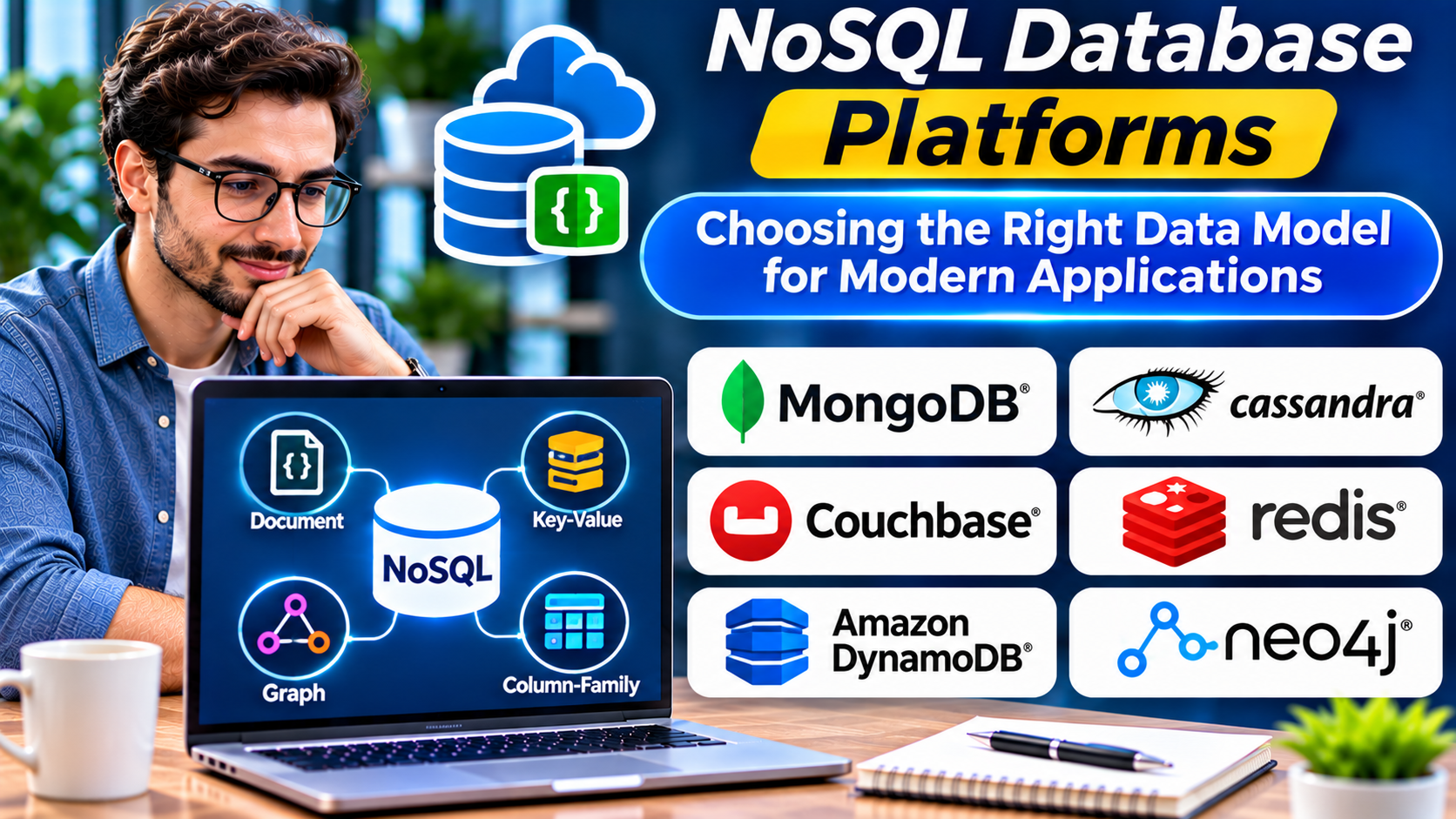
The term commonly includes document databases, key-value stores, wide-column databases, and graph databases.
Some NoSQL platforms support SQL-like query languages or transactional features.
Others prioritize specific access patterns or distributed-system behavior.
The defining characteristic is not simply the absence of SQL.
It is the use of database architectures designed around different ways of representing and accessing information.
Why Organizations Choose NoSQL Databases
Relational databases work extremely well for many applications, but certain workloads benefit from alternative structures.
Consider an online marketplace.
One product may have screen size, memory, and battery specifications.
Another may have clothing size, material, and color options.
A document database can store these different attributes within product documents without requiring every product to share an identical set of columns.
Now consider a service collecting events from millions of connected devices.
The workload may require large-scale writes distributed across multiple servers.
A wide-column database designed for distributed operation may be a suitable candidate.
The important point is that different workloads create different requirements.
NoSQL is useful when its data model and operational characteristics match those requirements.
The Main Types of NoSQL Databases
Document Databases
Document databases store information in document-like structures, commonly using JSON or related binary representations.
Documents can contain nested objects and arrays.
This model is useful when applications work with records that naturally contain related information.
Common examples include MongoDB and Couchbase.
Document databases can simplify some application data models, but poorly designed documents can create duplication, large updates, or complicated relationships.
Key-Value Databases
Key-value systems associate unique keys with values.
They are useful when applications primarily retrieve information using known identifiers.
Typical workloads include session storage, caching, user preferences, and selected high-throughput application operations.
Redis and Amazon DynamoDB support important key-value access patterns, although their broader capabilities and architectures differ.
Wide-Column Databases
Wide-column databases organize information around distributed storage models and query-oriented data structures.
Apache Cassandra is a prominent example.
These systems can be useful for large-scale workloads requiring distribution across nodes and geographic locations.
However, data modeling must reflect the queries the application will perform.
Graph Databases
Graph databases represent entities and relationships directly.
They are useful when applications need to traverse connected information.
Examples include fraud investigation, knowledge graphs, and relationship analysis.
Graph databases are part of the broader NoSQL landscape, but their requirements are distinct enough to deserve separate evaluation.
NoSQL Database Platforms Worth Evaluating
MongoDB
MongoDB is a document-oriented database that stores information using BSON documents.
It supports flexible data structures, indexing, aggregation, and transactional capabilities.
MongoDB is relevant to applications involving product catalogs, content management, customer profiles, and other document-oriented workloads.
Strengths: Flexible document modeling, a mature developer ecosystem, and managed deployment options.
Considerations: Document design, indexing, transaction requirements, and distribution architecture affect performance and complexity.
MongoDB is particularly useful when application objects map naturally to documents.
Apache Cassandra
Apache Cassandra is a distributed database designed for workloads requiring scalability and availability across multiple nodes.
Its architecture emphasizes partitioned data, replication, and configurable consistency behavior.
Strengths: Distributed architecture, scale-out capabilities, and support for demanding write-oriented workloads.
Considerations: Data modeling, partition design, query limitations, and cluster operations require specialist knowledge.
Cassandra is not a drop-in replacement for a relational database.
Applications must be designed around its storage and query model.
Amazon DynamoDB
Amazon DynamoDB is a managed NoSQL database service provided by AWS.
It supports key-value and document-oriented data access patterns.
Its managed architecture reduces many infrastructure administration responsibilities.
Strengths: Integration with AWS services, managed operations, and support for scalable application workloads.
Considerations: Partition-key design, access patterns, consistency requirements, and pricing models need careful evaluation.
DynamoDB is especially relevant to AWS-centered applications with well-understood access patterns.
Redis
Redis is a data platform commonly used for caching, session management, messaging-related workflows, and low-latency data access.
It supports multiple data structures rather than only simple string values.
Strengths: Fast access patterns, flexible data structures, and a broad application ecosystem.
Considerations: Persistence configuration, memory requirements, deployment architecture, and durability expectations must match the workload.
Redis should not automatically be treated as the primary system of record for every application.
Couchbase
Couchbase is a distributed document database platform supporting JSON-oriented data and query capabilities.
It is relevant to applications requiring document flexibility alongside distributed database features.
Strengths: Document-oriented development, distributed architecture, and support for selected operational workloads.
Considerations: Query design, indexing, deployment complexity, and licensing should be evaluated.
Couchbase may be suitable when organizations want a document model with enterprise database management capabilities.
Comparing NoSQL Database Platforms
| Platform | Primary Approach | Common Use Cases |
|---|---|---|
| MongoDB | Document database | Catalogs, content, application records |
| Cassandra | Distributed wide-column database | Large-scale distributed workloads |
| DynamoDB | Managed key-value and document database | Cloud applications and predictable access patterns |
| Redis | In-memory-oriented data platform | Caching, sessions, low-latency operations |
| Couchbase | Distributed document database | JSON applications and distributed data services |
These categories are useful starting points, not complete descriptions of every supported capability.
NoSQL vs. Relational Databases
The choice between NoSQL and relational databases should begin with the application’s data relationships and consistency requirements.
Relational databases provide a structured model with mature SQL capabilities, constraints, and transactional behavior.
NoSQL databases offer alternative models that may simplify selected workloads.
However, the distinction is not absolute.
Modern relational databases can store and query JSON documents.
Several NoSQL databases support transactions and increasingly sophisticated queries.
The practical differences concern how each platform handles data modeling, indexing, concurrency, distribution, and operational management.
For applications with complex joins and strict relational constraints, an RDBMS may remain the simplest choice.
For document-oriented records or specialized distributed access patterns, a NoSQL platform may reduce complexity.
Understanding Consistency in NoSQL Systems
Consistency is one of the most misunderstood aspects of distributed databases.
Some systems provide strongly consistent operations under supported configurations.
Others offer eventual consistency or configurable consistency levels.
Eventual consistency means that replicas may temporarily return different values before converging.
This behavior can be acceptable for some workloads.
For example, a minor delay in updating a social media counter may not affect the application significantly.
Financial transactions or inventory reservations may require stronger guarantees.
Organizations should evaluate consistency at the operation level rather than assuming all NoSQL databases behave alike.
Data Modeling Is the Most Important Design Decision
In relational databases, developers often begin with entities and relationships.
In many NoSQL systems, developers must give particular attention to how applications access information.
A document database may benefit from embedding related information that is commonly retrieved together.
A key-value database requires careful selection of keys.
A wide-column database may require tables designed around specific queries.
Poor data modeling can create performance problems that additional hardware cannot easily solve.
Before choosing a platform, document the application’s most important read and write operations.
Then test whether the database can support them efficiently.
NoSQL Database Scalability
Scalability is a major reason organizations evaluate NoSQL platforms.
Some systems distribute information across multiple nodes using partitioning or sharding.
This can support increasing data volumes and workloads.
However, horizontal scaling introduces new challenges.
Applications may encounter uneven partition distribution, replication delays, network failures, and complicated operational procedures.
A poorly selected partition key can create a hotspot where one portion of the database receives disproportionate traffic.
Scalability therefore depends on architecture and workload design, not simply the presence of a distributed database engine.
Security and Governance Considerations
NoSQL databases require the same disciplined security practices as relational systems.
Use authentication and narrowly scoped permissions.
Restrict network access.
Encrypt sensitive information where appropriate.
Protect backups and credentials.
Monitor administrative activity and unusual access patterns.
Managed services may simplify selected infrastructure tasks, but application owners remain responsible for data classification, permissions, and secure integration.
Organizations should also understand how the database handles data residency, retention, and deletion.
Understanding NoSQL Costs
NoSQL costs depend on deployment architecture and workload behavior.
Self-managed platforms require infrastructure, administration, monitoring, backups, and operational expertise.
Managed services may charge according to storage, requests, provisioned capacity, compute resources, or other consumption measures.
A database with low administrative overhead may still become expensive when access patterns are inefficient.
For example, repeatedly scanning large datasets can increase resource consumption.
Evaluate costs using representative workloads and realistic growth estimates.
Common NoSQL Implementation Mistakes
Choosing NoSQL Because It Is Popular
NoSQL is not automatically the modern choice for every application.
A relational database may provide a simpler and more reliable design.
Ignoring Access Patterns
Data models should support the queries applications actually perform.
A flexible schema does not compensate for inefficient retrieval patterns.
Assuming All NoSQL Databases Are Eventually Consistent
Consistency guarantees vary between systems and configurations.
Verify the behavior required by each critical operation.
Overlooking Data Duplication
Denormalized models may duplicate information to improve read efficiency.
Applications must then manage updates carefully.
Underestimating Operational Complexity
Distributed databases require monitoring, capacity planning, recovery procedures, and an understanding of failure behavior.
How to Choose the Right NoSQL Platform
Begin with the workload.
Identify the data structure, query patterns, expected growth, and consistency requirements.
Then determine whether a document, key-value, wide-column, or graph model provides a meaningful advantage.
Evaluate application integration and developer experience.
A database that fits the data model but requires unfamiliar operational expertise may increase long-term costs.
Next, examine deployment and security requirements.
Finally, conduct performance and recovery tests using representative information.
Measure query latency, throughput, resource consumption, and failure behavior.
The best NoSQL platform is the one that supports the application’s requirements without introducing unnecessary complexity.
Frequently Asked Questions
Is NoSQL better than SQL?
Neither approach is universally better. They support different data models and workload requirements.
Which NoSQL database is best for beginners?
MongoDB is commonly approachable for developers familiar with JSON-like documents, but the best starting point depends on the application.
Can NoSQL databases support transactions?
Yes. Several NoSQL platforms provide transactional capabilities, although guarantees and limitations differ.
Is Redis a NoSQL database?
Redis is commonly categorized within the NoSQL ecosystem and supports key-value and other data-structure-oriented operations.
Can NoSQL replace relational databases?
It can replace relational databases for suitable workloads, but many applications benefit from retaining relational storage or combining multiple database technologies.
Final Thoughts
NoSQL database platforms offer valuable alternatives to traditional relational storage.
Their greatest advantage is not the absence of tables or SQL.
It is the ability to select a data model and architecture suited to specific application requirements.
Organizations should compare document, key-value, and distributed database approaches according to query patterns, consistency, scalability, security, and operational costs.
A well-chosen NoSQL platform can simplify application development and support growth.
A poorly chosen one can introduce complexity that the application never needed.