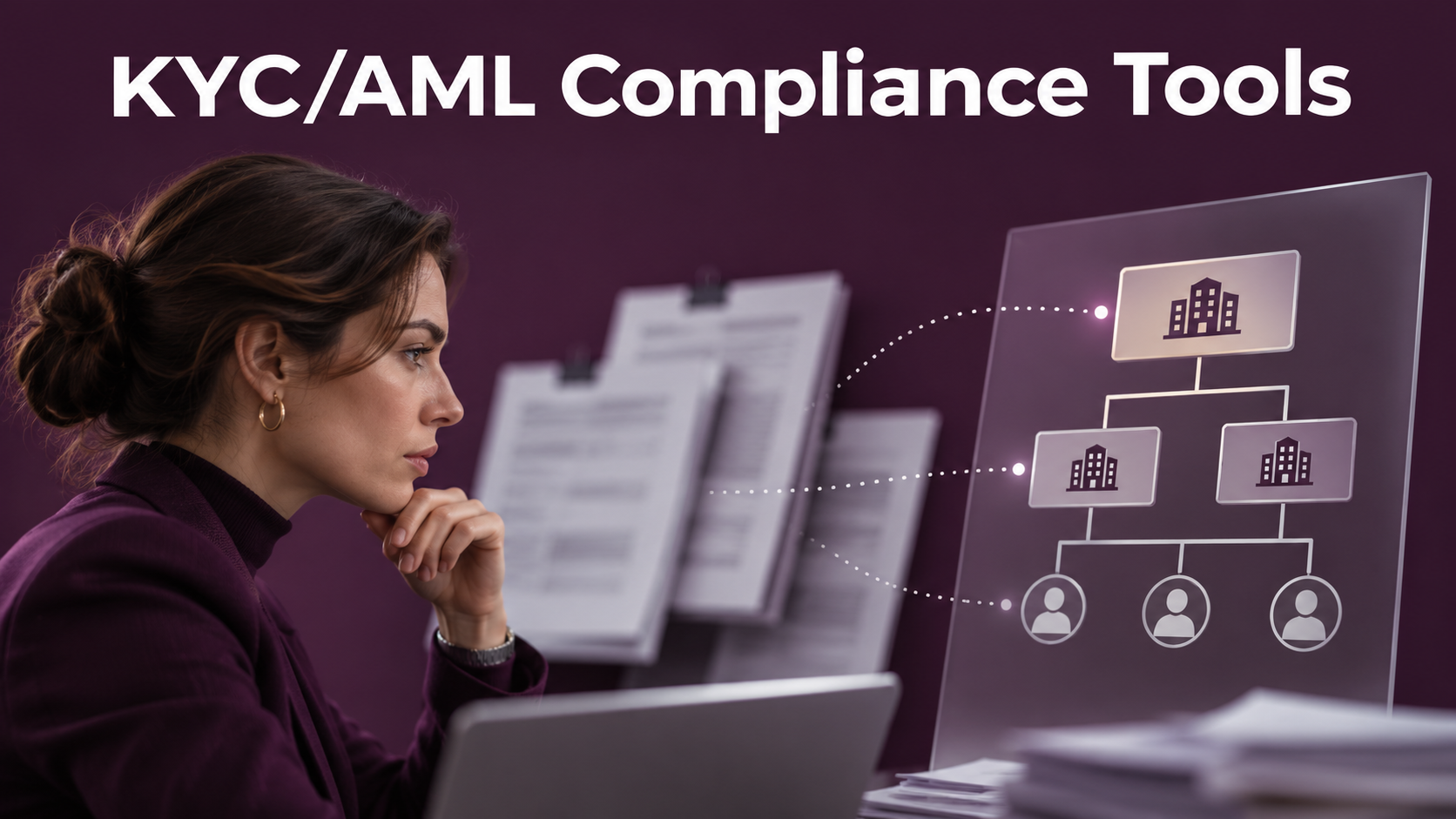
A business customer passes onboarding. Months later, its ownership changes, one controller appears in a screening result and activity begins to differ from the original customer profile. Three teams learn pieces of the story from different systems. The compliance officer needs a record that shows what the firm knew at onboarding, what changed and which person made the resulting decision.
KYC and AML compliance tools can support customer due diligence, screening, monitoring and case management. The categories overlap because the same customer record can inform several decisions over time. A strong evaluation starts with the lifecycle of a customer relationship and tests whether new evidence leads to an explainable change.
Separate the jobs before selecting the software
Know your customer, or KYC, commonly refers to identifying and understanding customers as part of onboarding and subsequent review. Anti-money laundering, or AML, covers a wider program. Depending on the organization and jurisdiction, it can involve ongoing due diligence, monitoring, investigation and applicable reporting. Software modules can support those activities. Compliance owners define which obligations apply and how the firm will discharge them.
FATF Recommendation 10 addresses customer due diligence, including the customer and beneficial owner, the purpose of the relationship and ongoing due diligence. FATF standards provide a reference point for understanding those concepts. Applicable duties are determined by local law and regulators, so have the authorized compliance team define coverage for the relevant entities and services. FATF Recommendations
An individual verification result may provide evidence about a person. A business customer can require records about legal entities, beneficial ownership and control. Screening may compare parties against selected data sources. Monitoring can generate alerts from transactions or other events. Assign each decision to the right system and person, with a record that can travel across those boundaries.
Make ownership and control visible over time
An entity structure can include several companies and individuals. Keep sources, effective dates and the relationship between each party visible. Ask how the tool handles conflicting evidence or gaps. A diagram of the current structure helps an analyst work. A retained history helps another analyst understand why a previous decision used a different structure.
Determine which sources support each jurisdiction and entity type you need. A registry check can establish certain facts about a company, while its ownership information may require additional evidence. Ask which fields were checked, when and against what source. Evaluate coverage on representative cases and confirm what an analyst does when information is unavailable or requires review.
Run an update where a person takes control through an intermediate entity. See whether the change reaches screening, risk assessment and review queues. Check that the update retains the original evidence and approval without copying unrelated personal information into every downstream case. Record where data can be exported and who can access it.
Treat screening as a candidate assessment
Screening can surface possible matches. Common names, transliteration and partial identifiers can create uncertainty. Give reviewers the information needed to distinguish a plausible match from a different person, within approved access limits. Store the source, time and version information available for the candidate and the reviewer’s reason for resolution.
Ask how scheduled and event-driven rescreening work. A list update, changed name or new owner may require different actions under the firm’s policy. Test a previously cleared candidate whose source information changes. Confirm that the tool preserves the earlier rationale and can bring the record back to an analyst when new evidence warrants it.
Review operational controls around overrides, watchlist selection and false positive handling. A decision that clears a candidate for one purpose should have a defined scope. A broad suppression can hide a later relevant result if it follows only a name. Ask what can be changed by a reviewer, what requires approval and how the policy change is logged.
Link customer context to monitoring
A transaction monitoring alert is easier to investigate when the analyst understands the customer’s expected activity, products and recent profile changes. Keep current and historical context available. Capture the events used for the alert and the rule or model version that generated it. A case should show how the analyst connected the information and what remains uncertain.
Test event arrival and data quality. An alert can be incomplete if a source feed is late or contains mismatched identifiers. Simulate a delay and a duplicate, and verify how the system flags gaps and reconciles records. Give operations a way to identify which customer populations were affected. A successful file transfer is only one part of proving monitoring coverage.
Confirm how investigators move from an alert to a case, escalate it and record decisions under the organization’s procedures. Set permissions for sensitive investigation material and document retention needs. If the product supports reporting workflows, test them with authorized sample data and verify that the applicable approval path and submission responsibility remain clear.
| Lifecycle event | Evidence the platform should retain |
|---|---|
| Customer onboarded | Identity and ownership checks, scope, sources and decision |
| Ownership or control changes | New relationships, effective dates and reassessment |
| Screening candidate appears | Source details, matching context and disposition |
| Activity departs from expectations | Alert inputs, profile context and investigation notes |
| Case escalates or closes | Decision, authority, rationale and any follow-up |
Buy for the exceptions your team handles
A focused identity service can support one stage. A broader compliance suite can be useful when many analysts need a common view across screening, monitoring and cases. An integrated stack can also connect specialist tools through well-designed data contracts. Test which system remains authoritative for customer identity, ownership and case disposition when records disagree.
Compare costs across verification checks, data sources, monitored customers, transactions, investigators and manual follow-up. Ask which changes require vendor services and how quickly new scenarios can be deployed. Include the cost of analyst time spent investigating low-quality alerts and updating records that lack reliable data.
Rebuild the case from a historical date
Pick a date before the ownership change and ask an analyst to reconstruct what the firm knew then. The organization’s current record may be accurate while omitting the evidence behind the previous decision. Look for dated ownership relationships, sources checked, list and rule information where available, and the customer profile the investigator used. The analyst should distinguish the date when a change took effect from the date when the firm received and evaluated it.
Next, show what happens when the new controller is also associated with a separate customer. A provider may model the same person once and link them to multiple records. That approach can help people update common facts, but access to a person’s relationship with one entity should not automatically expose a sensitive case for another. Test what investigators can see with their usual role and how they escalate a legitimate need for more context. Include a correction to a mistakenly merged identity and verify that related decisions are revisited where appropriate.
Check the consequences of changing a screening provider. Ask which decision history remains available, how old candidate references can be interpreted and what the team can export for oversight. If the replacement provider uses different identifiers or scoring, plan how to reconcile open cases and measure the change in review volume. Some migration work can be rehearsed using a synthetic customer record and a small batch of ambiguous names.
Have the compliance owner sign off on the evidence the pilot produces. Make unresolved limits visible, including data sources with partial coverage and work that still needs a manual check. A system can support a consistent decision process while leaving important judgment with the firm. The value of the record is that a second person can tell where that judgment was exercised.
Choose a pilot case that changes after onboarding. Include a corporate ownership update, an ambiguous screening candidate and an alert that needs historical context. Ask a second reviewer to reconstruct the decisions using exports and case history. That review will show whether the tools support a continuous relationship or leave compliance staff to assemble the same evidence by hand each time.