An attacker signs in using a legitimate employee account. The password is correct, and the authentication process appears normal. Shortly afterward, the account begins accessing unfamiliar systems, changing permissions, and requesting sensitive information.
Traditional security controls may struggle to distinguish this activity from legitimate work.
The problem is that a valid identity does not always represent a trustworthy session.
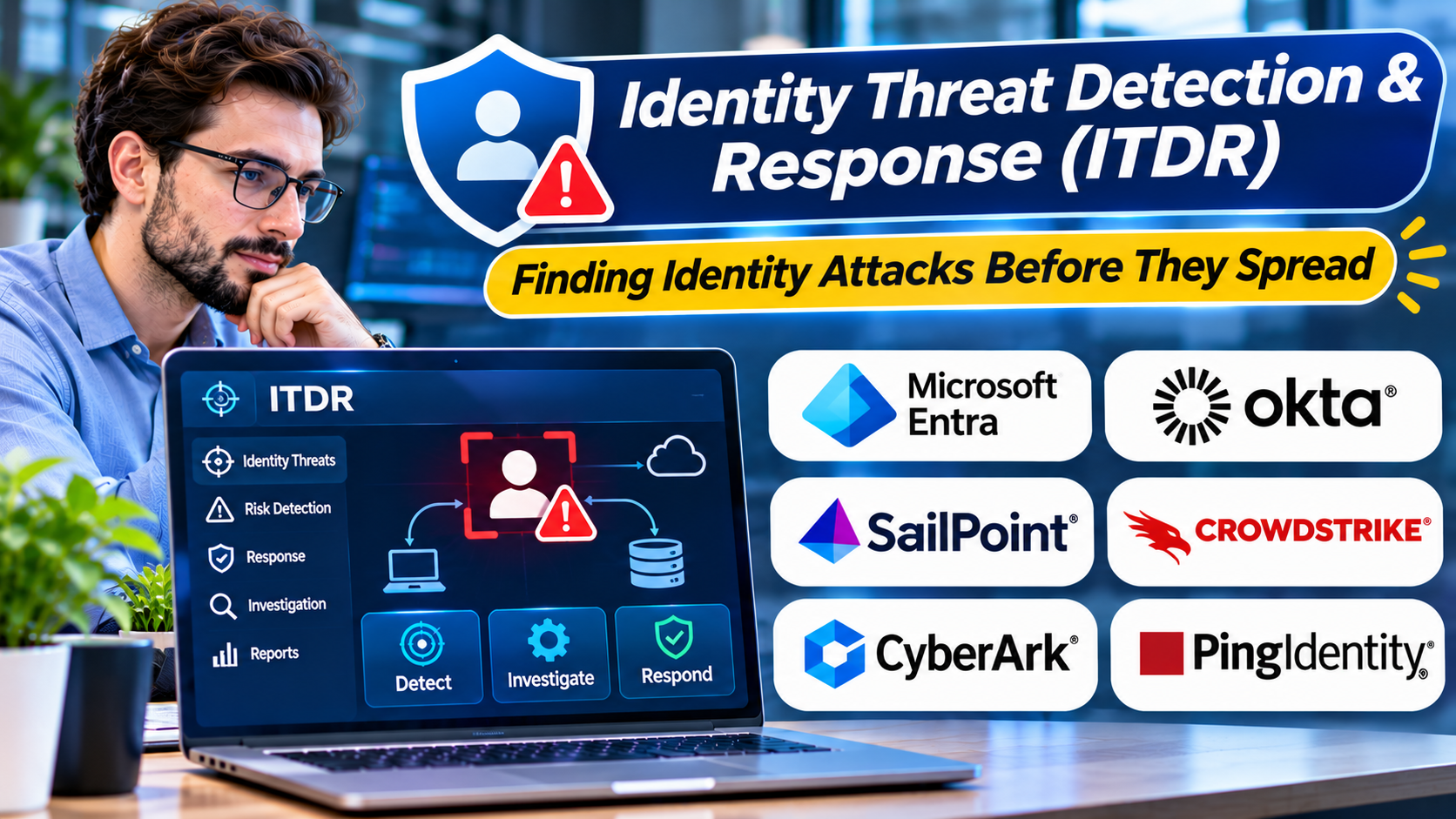
Identity Threat Detection and Response (ITDR) addresses this challenge by identifying suspicious identity activity, investigating potential compromises, and supporting actions that contain identity-based attacks.
As organizations rely increasingly on cloud applications, hybrid directories, and privileged identities, ITDR has become an important part of enterprise security operations.
What Is Identity Threat Detection and Response?
Identity Threat Detection and Response is a security discipline focused on detecting, investigating, and responding to threats involving digital identities and identity infrastructure.
ITDR capabilities may include:
- Identity-related threat monitoring
- Suspicious authentication detection
- Privilege escalation analysis
- Directory service security monitoring
- Compromised account investigation
- Identity configuration risk assessment
- Lateral movement detection
- Session and credential containment
- Security incident integration
- Identity attack investigation
ITDR is not simply another authentication product.
Identity and Access Management determines how users authenticate and receive access. ITDR investigates whether identities, permissions, and authentication systems are being abused.
Why Identity Attacks Are Difficult to Detect
Attackers increasingly exploit legitimate credentials and existing administrative capabilities.
This can make malicious activity appear similar to authorized behavior.
Credential Compromise
An attacker may obtain passwords through phishing, malware, or previously exposed credential databases.
Once authenticated, the attacker can operate within the permissions assigned to the account.
Session Theft
Attackers may steal authentication tokens or session material.
In some circumstances, this can allow access without repeating the original authentication process.
Privilege Escalation
A compromised identity may attempt to acquire additional permissions.
These changes can occur through legitimate administrative interfaces, making contextual monitoring essential.
Directory Infrastructure Attacks
Enterprise directories are valuable targets because they influence authentication and authorization across many systems.
Misconfigurations and excessive privileges can create opportunities for attackers.
Lateral Movement
An attacker may use one compromised identity to access additional systems.
Detecting unusual relationships between identities, devices, and resources can help reveal this behavior.
Core Capabilities of ITDR Platforms
Identity Threat Visibility
ITDR platforms collect or analyze identity-related information from supported environments.
Relevant sources may include cloud identity providers, directory services, endpoint telemetry, and security logs.
The quality of detection depends on which sources are available and correctly configured.
Behavioral Analysis
Identity behavior can be evaluated for suspicious changes.
Examples include unusual authentication patterns, unexpected administrative activity, or access to resources outside established workflows.
Behavioral signals should be interpreted carefully because legitimate changes in work patterns can resemble suspicious activity.
Identity Posture Assessment
Some platforms identify weaknesses such as excessive permissions, risky configurations, and exposed identity infrastructure.
Posture assessment is preventive, while threat detection focuses on potentially active abuse.
Both can support identity security.
Attack Path Analysis
Identity-related attack paths reveal how permissions and trust relationships could allow an attacker to reach sensitive systems.
This is particularly valuable in complex directory and hybrid environments.
Automated Response
Depending on the product and integration, response actions may include disabling accounts, revoking sessions, or initiating investigation workflows.
Automation should include safeguards to prevent unnecessary disruption.
ITDR Platforms Worth Evaluating
Microsoft Defender for Identity
Microsoft Defender for Identity focuses on identity-related threat detection, particularly in directory environments.
It is relevant to organizations using Microsoft identity infrastructure.
Evaluation priorities: Directory coverage, integration with Microsoft security products, detection visibility, and response workflows.
CrowdStrike Falcon Identity Protection
CrowdStrike Falcon Identity Protection addresses identity-based attacks and identity security risks.
It may be relevant to organizations seeking identity protection alongside endpoint and broader security operations.
Evaluation priorities: Identity environment coverage, attack detection, response integration, and product licensing.
Silverfort
Silverfort provides identity security capabilities that can help organizations extend authentication and protection controls across different resources.
It is worth evaluating where identity infrastructure includes systems that are difficult to protect through conventional authentication integrations.
Evaluation priorities: Authentication architecture, supported environments, detection capabilities, and deployment requirements.
Semperis Directory Services Protector
Semperis provides security capabilities focused on directory infrastructure, including monitoring for suspicious changes.
It is particularly relevant to organizations with critical Active Directory environments.
Evaluation priorities: Directory monitoring, change visibility, response workflows, and recovery integration.
Varonis
Varonis provides data security capabilities that include identity-related context and threat detection.
It can be relevant where the primary concern is how compromised identities interact with sensitive data.
Evaluation priorities: Data access visibility, identity context, supported repositories, and investigation capabilities.
SentinelOne Singularity Identity
SentinelOne offers identity-related security capabilities within its broader security portfolio.
It is worth examining for organizations seeking identity attack visibility and integration with other security operations.
Evaluation priorities: Current product scope, supported identity systems, detection coverage, and integration requirements.
Comparing ITDR Approaches
| Platform | Relevant security focus | Main evaluation consideration |
|---|---|---|
| Microsoft Defender for Identity | Directory identity threats | Microsoft environment coverage |
| CrowdStrike Falcon Identity Protection | Identity attack protection | Endpoint and identity integration |
| Silverfort | Identity security across diverse resources | Authentication integration |
| Semperis Directory Services Protector | Directory security monitoring | Directory change detection |
| Varonis | Identity-related data access risk | Sensitive data visibility |
| SentinelOne Singularity Identity | Identity security operations | Current capability and integration scope |
These products do not provide identical capabilities. Some focus heavily on directory infrastructure, while others emphasize authentication, endpoint relationships, or sensitive data access.
ITDR vs. IAM, PAM, and SIEM
IAM manages identities, authentication, and access policies.
PAM controls elevated permissions and privileged sessions.
SIEM collects and analyzes security information from multiple sources.
ITDR concentrates on identity threats, compromised accounts, and attacks involving identity infrastructure.
ITDR often depends on telemetry from IAM, PAM, endpoint security, and directory systems.
It may also send alerts to a SIEM or security operations platform.
The categories are complementary rather than interchangeable.
How to Evaluate ITDR Software
Identify Your Critical Identity Systems
Determine which identity providers, directories, and privileged access systems are most important.
A platform with limited coverage of those environments may leave major gaps.
Test Detection Scenarios
Use controlled security exercises to evaluate whether the product identifies suspicious identity activity.
Relevant scenarios may include unexpected privilege changes, suspicious authentication, and misuse of administrative accounts.
Examine Investigation Context
An alert should help analysts understand the affected identity, associated resources, relevant activity, and potential impact.
Evaluate Response Controls
Determine which containment actions are available and whether they require human approval.
Review Operational Requirements
Consider deployment architecture, telemetry collection, analyst workload, and ongoing tuning.
Building an ITDR Program
Begin by identifying critical identities and identity infrastructure.
Establish reliable logging and monitoring for authentication and administrative activity.
Review identity configuration risks and excessive permissions.
Connect relevant identity telemetry to security operations.
Develop incident response procedures for compromised accounts, stolen sessions, and directory attacks.
Test containment actions before relying on automation.
Finally, conduct periodic security exercises to validate detection and response processes.
Common ITDR Mistakes
Assuming MFA eliminates identity threats: Session theft and post-authentication abuse remain possible.
Ignoring directory infrastructure: Directory compromise can affect many connected systems.
Collecting alerts without response procedures: Detection provides limited value when teams cannot act.
Overautomating account suspension: Incorrect containment can disrupt legitimate operations.
Treating identity posture and threat detection as identical: Preventive assessment and active attack detection solve related but distinct problems.
Frequently Asked Questions
Is ITDR necessary when an organization already uses IAM?
IAM provides authentication and access controls. ITDR adds monitoring and response capabilities for identity-related attacks.
Does ITDR replace SIEM?
No. ITDR provides specialized identity security capabilities that can complement broader SIEM operations.
Can ITDR detect stolen sessions?
Some platforms can identify suspicious activity associated with compromised sessions, depending on available telemetry and integrations.
Is ITDR only for large enterprises?
No. Organizations of different sizes face identity threats, although platform complexity should match operational resources.
Final Thoughts
Identity security cannot end when authentication succeeds.
Compromised accounts, stolen sessions, excessive permissions, and directory attacks can allow malicious activity to occur through apparently legitimate access.
Microsoft Defender for Identity, CrowdStrike Falcon Identity Protection, Silverfort, Semperis, Varonis, and SentinelOne represent different approaches to identity threat protection.
The strongest ITDR strategy combines accurate identity visibility, meaningful detection, effective investigation, and carefully designed response procedures.
The goal is to recognize when trusted access becomes dangerous and contain the threat before it spreads.