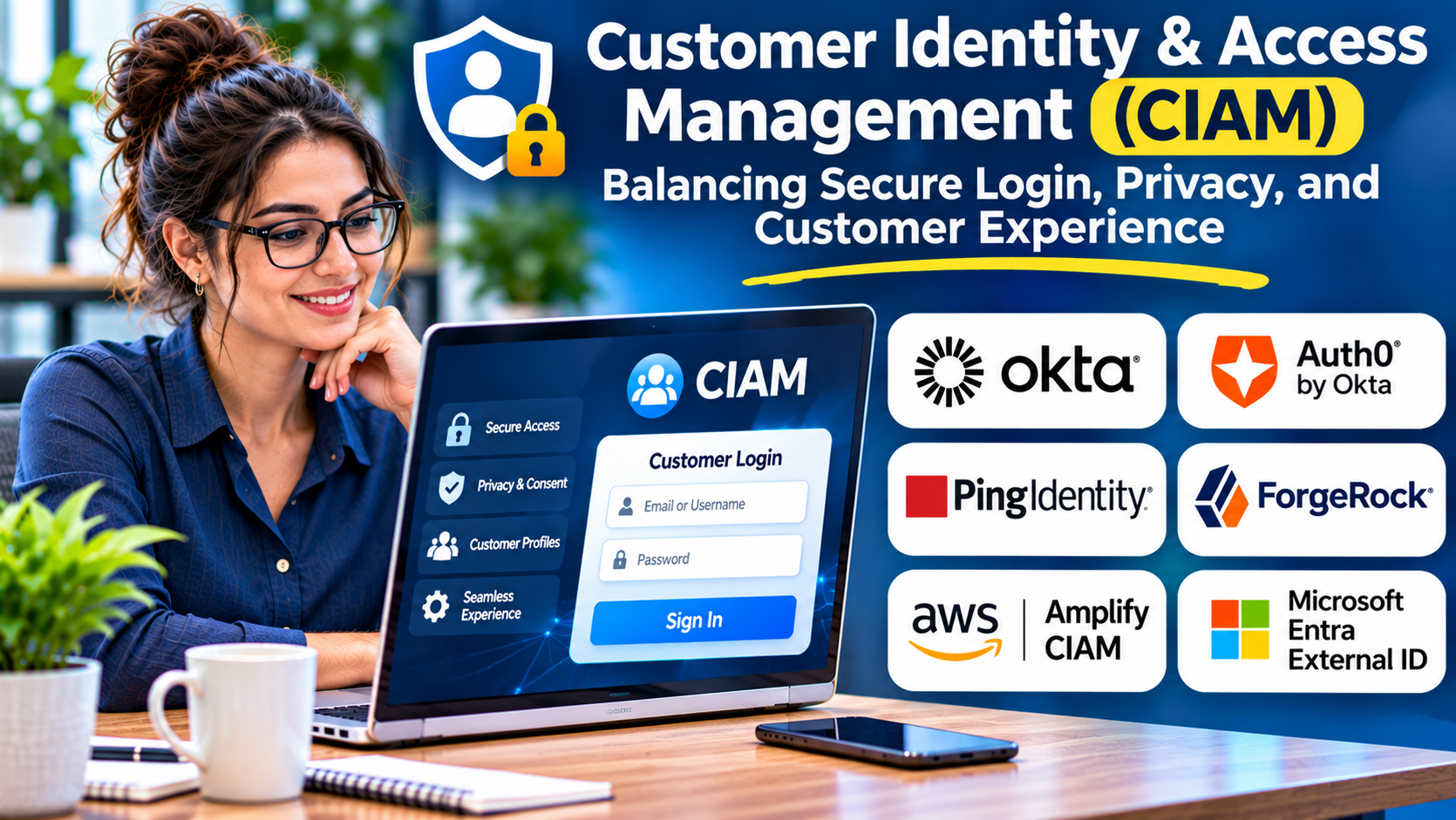
A customer visits an online service, creates an account, and expects to access it immediately. Later, the same customer may sign in from a different device, recover a forgotten credential, update personal information, or connect an external identity provider.
Each interaction depends on identity infrastructure.
When authentication is confusing, customers abandon registration. When recovery procedures are weak, attackers may take over accounts. When identity data is handled poorly, organizations create privacy and compliance risks.
Customer Identity and Access Management (CIAM) helps businesses manage these competing requirements.
The central challenge is building authentication that customers can trust without turning every interaction into a security obstacle.
What Is Customer Identity and Access Management?
Customer Identity and Access Management refers to technologies used to manage the identities, authentication, and access experiences of external users.
These users may include customers, subscribers, members, and users of digital products.
CIAM commonly supports:
- Customer registration
- Authentication and login
- Social login
- Single sign-on
- Multifactor authentication
- Passkeys and passwordless authentication
- Account recovery
- Customer profile management
- Identity federation
- Consent-related workflows
- Account lifecycle management
- Authentication analytics
CIAM differs from workforce IAM because its users, scale, application requirements, and experience expectations are often substantially different.
CIAM vs. Workforce IAM
Workforce IAM typically manages employees and contractors whose identities are associated with an organization.
CIAM serves external users who may create accounts independently.
| Consideration | Workforce IAM | CIAM |
|---|---|---|
| Primary users | Employees and contractors | Customers and external users |
| Registration | Usually organization-managed | Often self-service |
| Authentication experience | Business policy-driven | Customer experience-driven |
| Identity scale | Related to workforce size | May reach large consumer populations |
| Profile management | Employment information | Customer account information |
| Main operational concern | Secure workforce access | Secure, scalable customer access |
Some identity platforms support both categories, but their requirements should be evaluated separately.
Why CIAM Matters
Registration Friction Affects Conversion
Long forms and unnecessary verification steps can discourage new users.
A well-designed CIAM implementation collects only necessary information and introduces additional checks when appropriate.
Account Takeover Creates Business Risk
Attackers may use stolen credentials, phishing, automated login attempts, or compromised recovery channels to access customer accounts.
Authentication controls should reflect the sensitivity of customer information and transactions.
Customer Identity Data Requires Protection
Customer profiles may contain personal information, account preferences, and authentication-related records.
Organizations need appropriate privacy controls, retention policies, and access restrictions.
Authentication Must Scale
Consumer applications may experience sudden traffic increases during product launches, promotional campaigns, or seasonal events.
Identity infrastructure must remain available during those periods.
Multiple Applications Need Consistent Identity
A business may operate a website, mobile application, subscription portal, and customer support environment.
CIAM can help coordinate authentication across these experiences.
Core Features of a Modern CIAM Platform
Flexible Registration
Registration should support the application’s actual business requirements.
Some services need only an email address. Others require stronger identity verification because they handle financial or sensitive transactions.
Social Login
Social login allows customers to authenticate through supported external identity providers.
It can reduce registration friction but introduces dependencies on third-party services.
Passwordless Authentication
Passkeys and other passwordless methods can simplify authentication while reducing password-related risks.
Organizations should verify supported devices, recovery options, and user experience.
Adaptive Authentication
Some CIAM systems use contextual signals to determine whether additional authentication is appropriate.
These signals may include device characteristics, authentication history, or unusual activity.
Customer Profile Management
CIAM may provide tools for maintaining account information and preferences.
Businesses should avoid collecting unnecessary personal information.
Identity Federation
Federation enables applications to trust authentication performed by another identity provider.
Standards such as OpenID Connect and SAML may be relevant depending on the application.
CIAM Platforms Worth Evaluating
Auth0
Auth0, part of Okta, provides customer identity capabilities for application developers and organizations.
It supports authentication workflows, identity federation, and application integration.
Relevant strengths: Developer-oriented integration, configurable authentication, and support for varied application architectures.
Considerations: Pricing models, customization requirements, and the complexity of advanced identity workflows.
Amazon Cognito
Amazon Cognito provides customer identity capabilities within the AWS ecosystem.
It is relevant to organizations building applications on AWS infrastructure.
Relevant strengths: AWS integration, managed user directories, and application authentication.
Considerations: Implementation complexity, customization, and integration with services outside AWS.
Microsoft Entra External ID
Microsoft Entra External ID provides identity capabilities for external users and customer-facing applications.
It may be relevant to organizations using Microsoft identity technologies.
Relevant strengths: Integration with the Microsoft identity ecosystem and support for external identity scenarios.
Considerations: Product-specific capabilities, pricing, and application architecture.
Ping Identity
Ping Identity provides customer identity and authentication capabilities for enterprise applications.
It can be relevant to organizations with complex customer journeys and identity requirements.
Relevant strengths: Identity federation, authentication orchestration, and enterprise identity architecture.
Considerations: Implementation effort, deployment requirements, and operating complexity.
Firebase Authentication
Firebase Authentication provides application authentication services within Google’s Firebase development ecosystem.
It is particularly relevant to developers building web and mobile applications.
Relevant strengths: Developer integration and common authentication methods.
Considerations: Advanced enterprise identity requirements may require additional services or custom development.
Keycloak
Keycloak is an open-source identity and access management platform supporting customer-facing authentication scenarios.
It can be useful for organizations that want to operate and customize their own identity infrastructure.
Relevant strengths: Standards-based authentication, deployment control, and extensibility.
Considerations: Infrastructure maintenance, scaling, upgrades, and security operations.
CIAM Platform Comparison
| Platform | Relevant environment | Main evaluation priority |
|---|---|---|
| Auth0 | Developer-led customer applications | Customization and pricing |
| Amazon Cognito | AWS-based applications | AWS integration and implementation |
| Microsoft Entra External ID | Microsoft-oriented environments | External identity capabilities |
| Ping Identity | Complex enterprise customer identity | Architecture and orchestration |
| Firebase Authentication | Web and mobile development | Developer experience and requirements |
| Keycloak | Self-managed identity infrastructure | Hosting and maintenance |
These products differ in deployment models and supported capabilities. Current vendor documentation should be checked before making a final purchasing decision.
How to Choose a CIAM Platform
Define the Customer Journey
Map registration, login, account recovery, and profile management.
Identify where authentication friction could cause abandonment.
Evaluate Security Requirements
Determine whether customers need MFA, passkeys, adaptive authentication, or stronger verification for sensitive actions.
Examine Scalability
Consider expected customer volume, peak authentication traffic, and geographic distribution.
Review Privacy Requirements
Evaluate personal data collection, storage, retention, deletion, and consent-related capabilities.
Assess Developer Integration
Review SDKs, APIs, documentation, supported protocols, and customization options.
Understand Pricing
Some CIAM services charge according to monthly active users, authentication activity, or included features.
Evaluate costs using realistic growth scenarios.
Implementing CIAM Successfully
Start by documenting customer authentication requirements.
Choose authentication methods appropriate for the product’s risk profile.
Design registration and recovery experiences together.
Implement standards-based authentication using supported libraries.
Test login flows across browsers, mobile devices, and accessibility configurations.
Monitor authentication failures, account takeover attempts, and registration abandonment.
Finally, review identity data retention and security policies regularly.
Common CIAM Mistakes
Copying workforce authentication workflows: Customer experiences often require different registration and recovery designs.
Adding unnecessary registration fields: Excessive data collection increases friction and privacy obligations.
Ignoring account recovery: Weak recovery processes can undermine strong authentication.
Relying exclusively on passwords: Modern authentication methods may offer stronger protection and improved usability.
Underestimating identity infrastructure availability: Login failures can prevent customers from using the entire service.
Frequently Asked Questions
What is the main difference between IAM and CIAM?
CIAM focuses on external customer identities and customer-facing authentication experiences. Workforce IAM primarily manages organizational users.
Can CIAM support social login?
Yes. Many CIAM platforms support authentication through external identity providers.
Does CIAM replace customer relationship management software?
No. CIAM manages customer identity and access. CRM systems manage broader customer relationships and business interactions.
Is CIAM necessary for small applications?
A dedicated CIAM platform may be useful, but the appropriate solution depends on application complexity, security requirements, and available development resources.
Final Thoughts
Customer identity infrastructure influences security, conversion, accessibility, and trust.
Auth0, Amazon Cognito, Microsoft Entra External ID, Ping Identity, Firebase Authentication, and Keycloak offer different approaches to managing customer authentication.
The strongest CIAM implementation makes secure access straightforward, protects sensitive identity information, and supports customers throughout the account lifecycle.
A successful platform should serve both the business and the people using its digital products.