A cloud administrator signs in from an unfamiliar location. Minutes later, a sensitive storage policy changes. An endpoint generates a suspicious process alert, while a firewall records an unusual outbound connection.
Each event may appear in a different system.
Individually, the alerts might not provide enough information to identify an attack. Together, they could reveal a coordinated compromise.
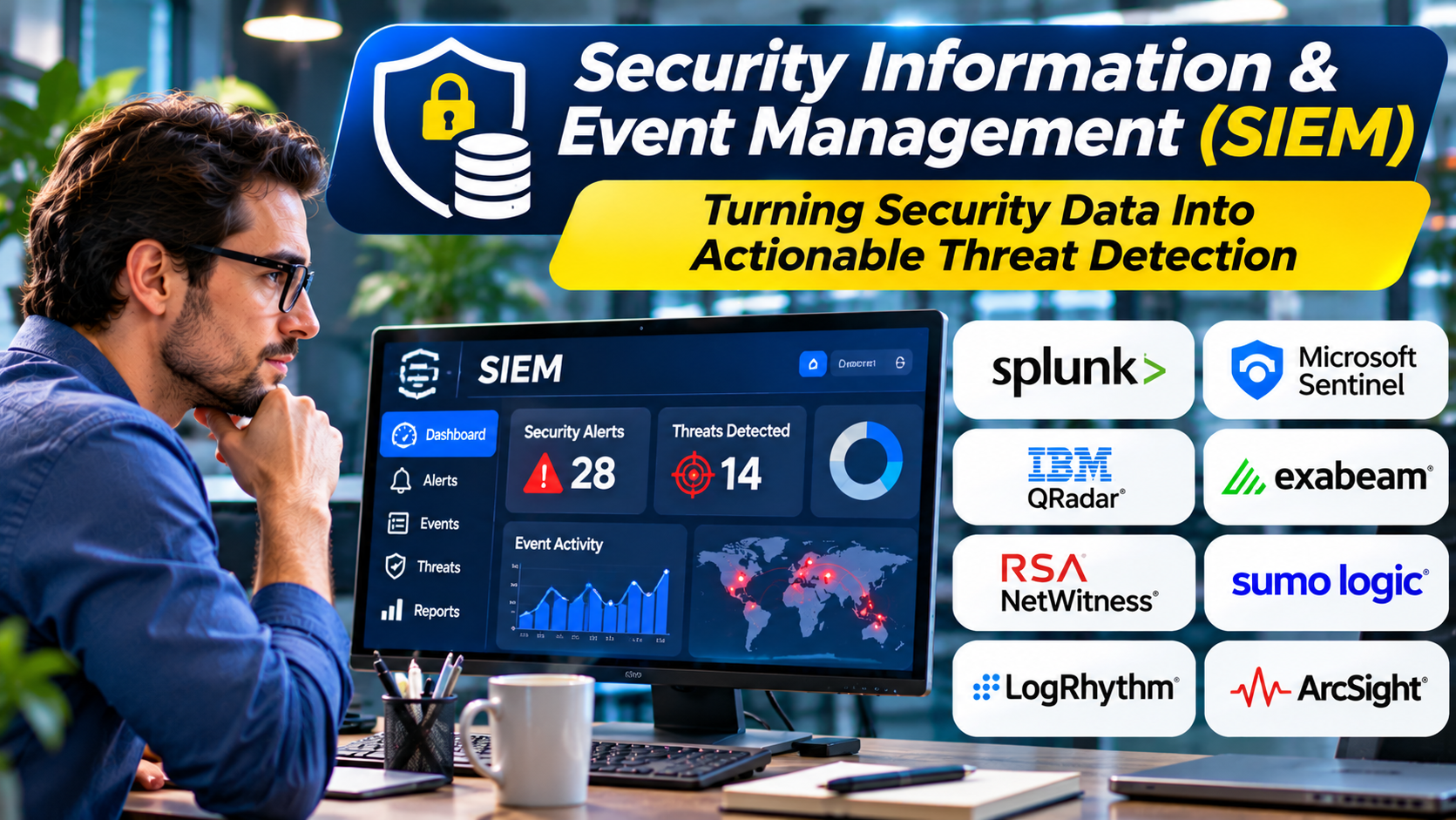
Security Information and Event Management (SIEM) platforms help organizations collect, analyze, and correlate security information across infrastructure and applications.
The challenge is not simply storing more logs. It is transforming security data into useful detection, investigation, and response capabilities.
What Is Security Information and Event Management?
Security Information and Event Management is a technology category that combines security event collection, analysis, correlation, monitoring, and reporting.
SIEM platforms typically ingest information from sources such as:
- Identity providers
- Endpoint security systems
- Firewalls
- Cloud infrastructure
- Servers
- Network devices
- Business applications
- Authentication services
- Databases
- Security monitoring tools
The platform processes this information to support threat detection and investigation.
Modern SIEM offerings may also include user and entity behavior analytics, threat intelligence, security automation, and incident management.
However, capabilities differ substantially between products.
Why SIEM Is Important
Security information is often distributed across many systems.
Without centralized analysis, security teams may struggle to connect events that belong to the same incident.
For example, an authentication failure on its own may be unremarkable.
A sequence involving repeated authentication failures, a successful privileged login, unusual permission changes, and suspicious data access deserves closer investigation.
SIEM platforms can help identify these relationships.
They also provide centralized search and reporting capabilities for incident investigations and security governance.
How SIEM Works
A typical SIEM architecture includes several connected processes.
Data Collection
Logs and events are collected from supported systems.
Collection may use agents, APIs, event forwarding, cloud integrations, or other mechanisms.
Parsing and Normalization
Raw events often use different formats.
Normalization converts relevant fields into consistent structures so information can be searched and correlated.
Enrichment
Events may be enriched with additional context, such as asset information, identity details, or threat intelligence.
Detection and Correlation
Detection rules and analytics identify suspicious patterns.
Some platforms also support behavioral analysis.
Investigation
Analysts search events, review related activity, and build incident timelines.
Response
Depending on the product, SIEM may integrate with security orchestration tools or provide built-in response workflows.
SIEM Platforms Worth Evaluating
Microsoft Sentinel
Microsoft Sentinel is a cloud-native SIEM platform within Microsoft’s security ecosystem.
It provides security analytics, incident investigation, and automation capabilities.
Relevant strengths: Microsoft integration, cloud-based deployment, and security operations workflows.
Considerations: Data ingestion costs, retention requirements, detection configuration, and Azure-related operational dependencies.
Splunk Enterprise Security
Splunk Enterprise Security provides security analytics and investigation capabilities built on the Splunk platform.
It is relevant to organizations managing diverse security data sources.
Relevant strengths: Flexible search, security analytics, and extensive data integration possibilities.
Considerations: Data management costs, implementation complexity, and detection engineering requirements.
Google Security Operations
Google Security Operations provides cloud-based security analytics and investigation capabilities.
It is relevant to organizations seeking scalable security data analysis and threat investigation.
Relevant strengths: Security telemetry analysis, threat intelligence integration, and cloud-based investigation workflows.
Considerations: Integration coverage, data architecture, pricing, and operating requirements.
Elastic Security
Elastic Security provides security analytics and detection capabilities built on the Elastic platform.
It is relevant to organizations that value flexible search, detection engineering, and control over data architecture.
Relevant strengths: Search capabilities, detection rules, and integration with broader Elastic technologies.
Considerations: Deployment architecture, data retention, infrastructure costs, and operational expertise.
IBM QRadar SIEM
IBM QRadar SIEM provides security event analysis, correlation, and investigation capabilities.
It may be relevant to enterprises with established security monitoring environments.
Relevant strengths: Security event correlation and centralized investigation.
Considerations: Deployment model, current product lifecycle, integration requirements, and migration planning.
Securonix Unified Defense SIEM
Securonix provides cloud-oriented security analytics with capabilities related to behavior analysis and threat detection.
It is relevant to organizations seeking advanced security analytics and investigation workflows.
Relevant strengths: Behavioral analytics and security operations capabilities.
Considerations: Data integration, detection tuning, commercial terms, and operating complexity.
SIEM Platform Comparison
| Platform | Relevant environment | Main evaluation priority |
|---|---|---|
| Microsoft Sentinel | Microsoft and multicloud security | Data costs and integration |
| Splunk Enterprise Security | Diverse enterprise security data | Search flexibility and operating costs |
| Google Security Operations | Cloud-based security analytics | Data architecture and investigation |
| Elastic Security | Flexible security data platforms | Deployment and engineering effort |
| IBM QRadar SIEM | Established enterprise monitoring | Product lifecycle and architecture |
| Securonix Unified Defense SIEM | Behavioral security analytics | Detection tuning and integration |
A SIEM platform should be selected according to the organization’s data sources, detection requirements, and operational capacity.
SIEM vs. SOAR, XDR, and EDR
These technologies overlap but serve different primary purposes.
| Technology | Primary role |
|---|---|
| SIEM | Collect and correlate security events |
| SOAR | Coordinate and automate security response workflows |
| EDR | Detect and investigate endpoint threats |
| XDR | Correlate detection and response across supported security domains |
Some modern platforms combine several of these capabilities.
However, integration quality and available functionality should be evaluated rather than assumed.
The Hidden Challenge: SIEM Data Costs
Security data volumes can grow rapidly.
Cloud services, endpoints, applications, and network devices may generate substantial amounts of telemetry.
A SIEM deployment that collects everything without prioritization can become expensive and difficult to operate.
Important cost factors include:
- Data ingestion volume
- Storage and retention
- Search and query activity
- Data transformation
- Licensing
- Infrastructure
- Integration maintenance
- Detection engineering
- Analyst time
Organizations should estimate costs using representative production data rather than relying exclusively on vendor pricing examples.
What Data Should a SIEM Collect?
Start with data that supports meaningful security decisions.
High-priority sources often include:
Identity and Authentication Logs
These help investigate suspicious logins, privileged access, and account changes.
Endpoint Security Events
EDR and endpoint protection alerts provide visibility into suspicious device activity.
Cloud Audit Logs
Cloud control-plane events can reveal sensitive configuration and permission changes.
Network Security Logs
Firewall, DNS, proxy, and other network events can support investigation of suspicious communication.
Critical Application Logs
Applications containing sensitive information may require additional monitoring.
The objective is not maximum ingestion. It is sufficient coverage of important threats.
Detection Engineering Matters More Than Rule Count
A SIEM with thousands of poorly maintained rules may produce excessive noise.
Useful detection engineering requires understanding attacker behavior, available telemetry, and business context.
A strong detection should explain:
- What suspicious behavior it identifies
- Which data sources it requires
- Why the activity matters
- What legitimate behavior might trigger it
- How an analyst should investigate
- Which response actions are appropriate
Detection rules should be tested and reviewed regularly.
How to Evaluate SIEM Platforms
Data Source Compatibility
Verify that the platform can ingest and correctly parse logs from critical systems.
Search and Investigation
Test whether analysts can investigate incidents efficiently.
Query performance and data accessibility matter.
Detection Capabilities
Evaluate correlation, behavioral analysis, threat intelligence integration, and custom detection development.
Automation
Determine whether the platform can support response workflows without creating unnecessary operational risk.
Data Governance
Examine access controls, retention policies, sensitive information handling, and audit capabilities.
Cost Predictability
Understand how ingestion, storage, search, and additional features affect pricing.
Operational Expertise
Determine whether internal teams can maintain integrations, detections, dashboards, and incident workflows.
A Practical SIEM Implementation Roadmap
Step 1: Define Security Use Cases
Identify the threats and investigations the SIEM must support.
Avoid beginning with an unrestricted log collection project.
Step 2: Prioritize Data Sources
Connect identity systems, endpoint security, cloud audit logs, and critical infrastructure.
Step 3: Validate Data Quality
Check timestamps, field normalization, event completeness, and ingestion reliability.
Step 4: Develop Initial Detections
Create a manageable set of high-value detection rules.
Document investigation procedures.
Step 5: Integrate Incident Response
Establish clear alert ownership, escalation, and containment processes.
Step 6: Optimize Costs
Review data volume, retention, and low-value telemetry.
Step 7: Measure Effectiveness
Track alert quality, detection coverage, investigation time, and operational outcomes.
Common SIEM Implementation Mistakes
Collecting everything immediately: Excessive ingestion increases cost without necessarily improving detection.
Ignoring data quality: Missing fields and inconsistent timestamps can undermine correlation.
Using default rules without tuning: Generic detections may produce unnecessary alerts.
Failing to assign alert ownership: Alerts are ineffective when no team is responsible for responding.
Treating SIEM as a compliance-only tool: Centralized logs are useful, but effective security monitoring requires detection and investigation processes.
Underestimating engineering effort: Integrations and detections require ongoing maintenance.
Frequently Asked Questions
Is SIEM necessary for every business?
Not every organization needs a dedicated enterprise SIEM. The decision depends on security complexity, compliance obligations, and monitoring resources.
Can SIEM detect ransomware?
SIEM can correlate events associated with ransomware activity, provided relevant telemetry and detections are available.
Does SIEM replace EDR?
No. EDR provides endpoint-focused visibility and response, while SIEM analyzes information from multiple systems.
Is cloud SIEM better than on-premises SIEM?
Neither deployment model is universally better. The choice depends on infrastructure, data requirements, cost, and operational preferences.
What is the biggest SIEM implementation challenge?
A common challenge is turning large volumes of security data into accurate, actionable detections without overwhelming analysts.
Final Thoughts
Security Information and Event Management helps organizations connect security events that would otherwise remain isolated.
Microsoft Sentinel, Splunk Enterprise Security, Google Security Operations, Elastic Security, IBM QRadar, and Securonix offer different approaches to collecting, analyzing, and investigating security information.
The strongest SIEM deployment begins with clear detection objectives, reliable telemetry, and realistic operational planning.
Success should be measured by improved threat visibility and incident response—not simply by the number of logs collected.