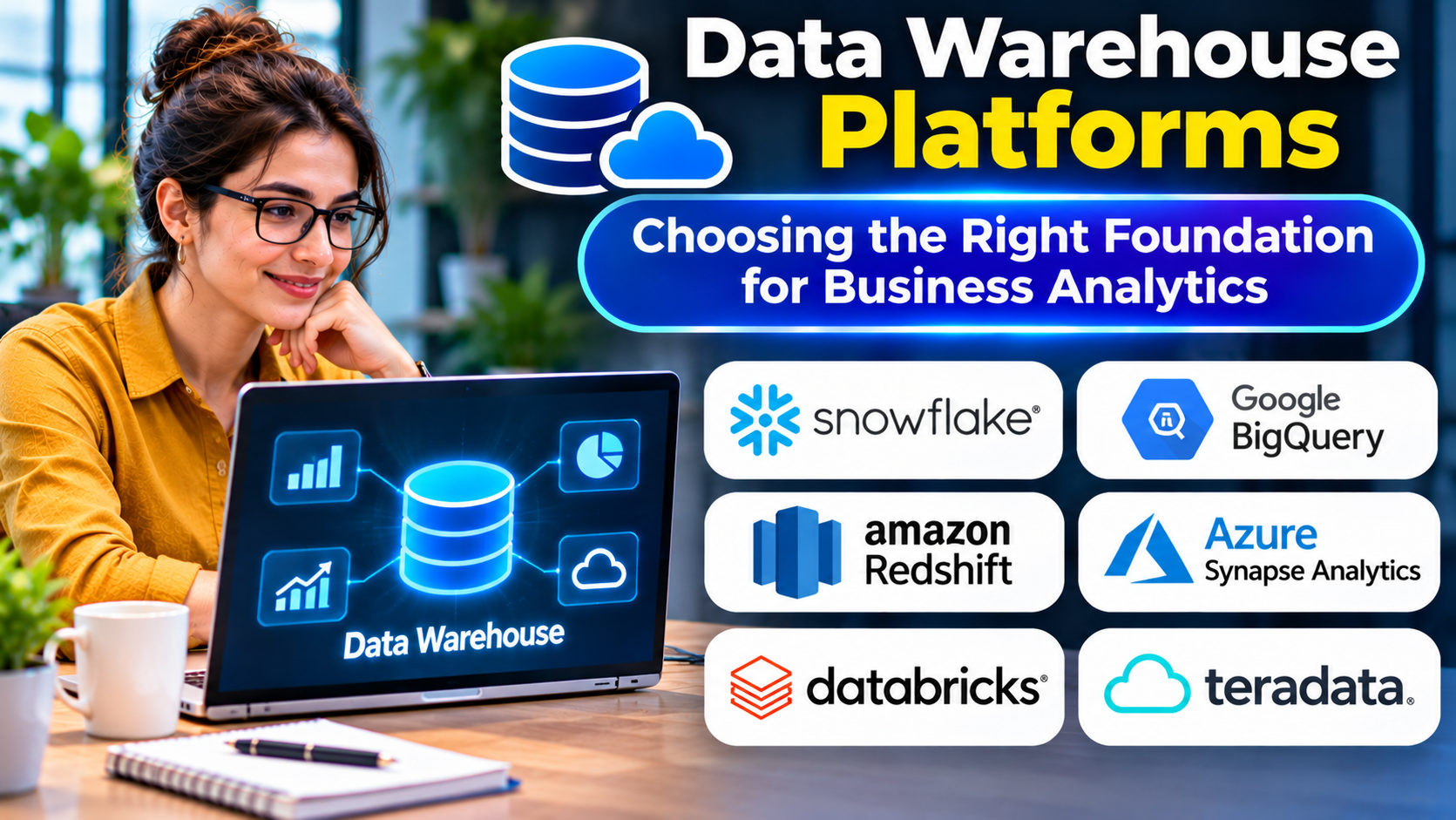
Businesses collect information from many systems.
Sales teams use customer relationship management software. Finance teams manage accounting records. Marketing platforms track campaigns, while product applications generate events and usage information.
Each system provides a partial view of business performance.
A company may know how much revenue it generated but struggle to connect that revenue to marketing activity, customer behavior, or product adoption.
Data warehouse platforms help organizations bring information together for reporting, analysis, and decision-making.
Modern warehouses can process substantial datasets using cloud infrastructure and SQL-based analytical tools.
However, choosing a data warehouse requires more than comparing storage capacity or query speed.
Organizations must evaluate data integration, governance, cost management, concurrency, performance, and how analysts will actually use the platform.
What Is a Data Warehouse?
A data warehouse is a system designed to store and analyze data collected from multiple sources.
It is typically optimized for analytical queries rather than individual application transactions.
For example, a transactional database may process one customer order at a time.
A data warehouse may analyze millions of orders to identify revenue trends, customer segments, and product performance.
Warehouses commonly support SQL queries, reporting tools, dashboards, and analytical workloads.
They often organize information into structures designed to make business analysis easier.
The objective is to provide a reliable environment for understanding business activity across systems.
How Data Warehouses Work
A typical data warehouse architecture includes several stages.
First, information is extracted from operational systems.
These sources may include relational databases, SaaS applications, files, event streams, and external services.
Next, data is loaded into a central analytical environment.
Transformations prepare information for analysis.
These operations may standardize formats, resolve inconsistencies, calculate business metrics, and connect related records.
Finally, analysts and business applications query the prepared data.
The warehouse becomes a foundation for dashboards, financial reporting, operational analysis, and other decision-support activities.
However, simply centralizing information does not guarantee that reports will be accurate.
Organizations still need reliable definitions, quality checks, and governance.
Data Warehouse vs. Transactional Database
Transactional databases and analytical warehouses serve different primary purposes.
Transactional systems are designed to support application operations such as placing orders, updating accounts, and processing payments.
They typically prioritize frequent, relatively small transactions.
Data warehouses are designed for analytical queries that may scan and aggregate large amounts of information.
For example, a warehouse query might calculate revenue by product category across several years.
Running such queries directly against a busy production database may interfere with application performance.
Separating analytical workloads from operational systems can improve reliability and simplify reporting.
However, modern database technologies increasingly support overlapping capabilities.
The correct architecture depends on workload requirements.
Key Features of Modern Data Warehouse Platforms
Analytical SQL Processing
SQL remains a central interface for many warehouse platforms.
Analysts can use it to filter, join, aggregate, and transform information.
Scalable Compute Resources
Cloud warehouses can provide computing resources for analytical workloads.
Different platforms use different approaches to compute allocation and scaling.
Column-Oriented Storage
Many analytical systems use column-oriented storage techniques.
These approaches can improve efficiency when queries read selected columns across large datasets.
Workload Management
Multiple teams may run queries simultaneously.
Workload management helps allocate resources and maintain predictable performance.
Data Governance
Organizations need controls for access, classification, auditing, and sensitive information.
Governance is essential when many departments share analytical data.
Integration with BI Tools
Warehouses commonly connect to business intelligence tools for dashboards and reporting.
The quality of these integrations affects analyst productivity.
Data Warehouse Platforms Worth Evaluating
Snowflake
Snowflake is a cloud data platform with capabilities for data warehousing, analytics, and related workloads.
Its architecture separates storage from configurable compute resources.
Strengths: SQL analytics, workload isolation options, and managed cloud operations.
Considerations: Compute usage, storage, data movement, and platform-specific pricing require active cost management.
Snowflake is relevant to organizations seeking a managed analytical platform with broad data integration requirements.
Google BigQuery
BigQuery is Google’s managed analytical data warehouse service.
It provides SQL-based analytics and integrates with Google Cloud services.
Strengths: Managed infrastructure, analytical SQL capabilities, and integration with Google’s data ecosystem.
Considerations: Query pricing, capacity models, data organization, and workload design influence operating costs.
BigQuery may be particularly attractive to organizations already using Google Cloud.
Amazon Redshift
Amazon Redshift is an AWS data warehouse service designed for analytical workloads.
It supports SQL-based analysis and integration with the AWS ecosystem.
Strengths: AWS integration, analytical processing, and deployment options for different workload requirements.
Considerations: Resource configuration, data distribution, query optimization, and pricing models require evaluation.
Redshift is a natural candidate for organizations with substantial data infrastructure on AWS.
Databricks SQL
Databricks SQL provides analytical SQL capabilities within the Databricks data platform.
It supports warehouse-style querying over data managed in the platform’s lakehouse architecture.
Strengths: Integration with data engineering, analytics, and lakehouse workflows.
Considerations: Organizations should evaluate SQL workload requirements, governance, compute costs, and compatibility with existing tools.
Databricks SQL is relevant when data warehousing and broader data engineering workloads share a common platform.
Microsoft Fabric Warehouse
Microsoft Fabric provides a data warehousing experience within its broader analytics platform.
Fabric Warehouse integrates with other Microsoft Fabric capabilities and the Microsoft analytics ecosystem.
Strengths: Integration with Microsoft-oriented analytics workflows and shared platform services.
Considerations: Capacity planning, supported SQL functionality, licensing, and integration requirements should be reviewed.
It is particularly relevant to organizations using Microsoft Power BI and related services.
Comparing Data Warehouse Platforms
| Platform | Main Approach | Common Fit |
|---|---|---|
| Snowflake | Managed cloud data platform | Enterprise analytics and shared workloads |
| BigQuery | Managed cloud analytics warehouse | Google Cloud analytics |
| Amazon Redshift | AWS data warehouse | AWS-centered analytical systems |
| Databricks SQL | Lakehouse-based SQL analytics | Integrated data engineering and analytics |
| Microsoft Fabric Warehouse | Integrated analytics warehouse | Microsoft analytics environments |
These platforms differ in architecture, pricing, governance, and operational workflows.
A meaningful comparison requires testing actual queries and data pipelines.
Data Warehouse Architecture
A useful warehouse architecture should reflect how information enters, moves through, and leaves the system.
Source Systems
Sources may include operational databases, SaaS applications, spreadsheets, event streams, and external datasets.
Data Ingestion
Ingestion pipelines move information into the analytical environment.
They may run on schedules or process changes continuously.
Data Transformation
Transformations clean, standardize, and combine information.
This stage may create business-ready tables and metrics.
Analytical Storage
The warehouse stores information in structures suited to reporting and analysis.
Consumption
Business intelligence tools, notebooks, applications, and analysts access prepared datasets.
Each stage needs monitoring, security, and ownership.
A warehouse without reliable ingestion and transformation processes can produce misleading reports.
ETL vs. ELT in Data Warehousing
ETL stands for Extract, Transform, Load.
Data is transformed before being loaded into its final destination.
ELT stands for Extract, Load, Transform.
Data is loaded first and transformed within the analytical environment.
Cloud warehouses have made ELT workflows common because they provide substantial processing capabilities.
However, ETL remains useful when data must be transformed or filtered before entering the warehouse.
The choice depends on data sensitivity, architecture, transformation complexity, and operational requirements.
Organizations may use both approaches.
Data Modeling for Analytics
A data warehouse needs structures that help analysts answer business questions consistently.
Dimensional modeling is one common approach.
It organizes analytical information into fact and dimension tables.
A fact table may store sales transactions.
Dimension tables may describe products, customers, locations, and dates.
This structure supports queries such as revenue by region or product category.
Other approaches include normalized enterprise models and different forms of analytical data organization.
No single model is ideal for every organization.
The design should reflect business questions, update patterns, and governance needs.
Data Quality and Trust
A data warehouse is only useful when people trust its information.
Common data quality problems include missing values, duplicate records, inconsistent identifiers, and conflicting business definitions.
For example, marketing and finance teams may define an active customer differently.
Even when both reports are technically correct, the disagreement can undermine confidence.
Organizations should establish shared metric definitions and data ownership.
Automated quality checks can identify unexpected changes in record counts, null values, and data relationships.
Data lineage can help explain where information originated and how it was transformed.
Reliable analytics requires both technical controls and organizational agreement.
Query Performance and Optimization
Warehouse performance depends on data organization, query structure, compute resources, and workload characteristics.
Large analytical queries may scan substantial amounts of information.
Efficient partitioning, clustering, data layout, and appropriate aggregation can improve performance depending on the platform.
Repeatedly increasing compute resources is not always the best solution.
Poorly written queries and inefficient data models may continue to waste resources.
Teams should inspect query plans and execution statistics when supported.
Performance tuning should focus on important business workloads rather than isolated benchmark results.
Understanding Data Warehouse Costs
Cloud warehouse pricing can involve compute resources, storage, data movement, and additional platform services.
Different vendors use different billing models.
Some workloads consume resources based on query processing.
Others rely on allocated compute capacity or configurable warehouses.
Organizations should estimate costs using representative queries, concurrency, and data volumes.
They should also monitor unused resources and unnecessary data movement.
Cost governance becomes especially important when many teams can independently create workloads.
A warehouse that is inexpensive during a pilot may become costly without usage controls.
Data Warehouse Security and Governance
Warehouses frequently combine sensitive information from multiple departments.
This creates important access-control responsibilities.
Organizations should use role-based permissions and restrict access to sensitive datasets.
Where supported, row-level and column-level controls can limit what users can see.
Encryption, audit logging, and data classification should be part of the governance design.
Data sharing also requires care.
A dataset approved for one analytical purpose should not automatically become available to every user.
Organizations must understand applicable privacy and retention obligations.
Data Warehouse vs. Data Lake vs. Lakehouse
These terms describe related but different architectural approaches.
A data warehouse is primarily designed for structured analytical workloads.
A data lake stores data in a more flexible form, often using object storage and open file formats.
A lakehouse combines selected data lake characteristics with database-style management and analytical capabilities.
Modern platforms increasingly blur these boundaries.
Some warehouses can query external data.
Some lakehouse systems provide strong SQL analytics.
The practical decision should focus on required workloads, governance, interoperability, and total operating costs.
Common Data Warehouse Mistakes
Moving Data Without Defining Business Questions
Centralizing information is not a goal by itself.
The warehouse should support clear analytical needs.
Ignoring Data Quality
Incorrect or inconsistent source information produces unreliable reports.
Giving Everyone Broad Access
Shared analytics does not require unrestricted access to sensitive data.
Underestimating Compute Costs
Poor query design and uncontrolled workloads can increase spending.
Creating Too Many Conflicting Metrics
Departments need agreed definitions for important business measures.
Treating the Warehouse as a Complete Data Strategy
A warehouse is infrastructure.
Reliable analytics also requires people, processes, governance, and data ownership.
How to Choose a Data Warehouse Platform
Begin with the organization’s analytical requirements.
Identify the data sources, expected volumes, query patterns, reporting tools, and concurrency needs.
Next, evaluate the existing technology ecosystem.
Integration with current cloud services and BI tools can reduce implementation effort.
Review security and governance capabilities.
Then estimate total costs, including ingestion, transformation, storage, compute, and administration.
Finally, conduct a proof of concept.
Use realistic data and representative queries.
Test query performance, concurrent workloads, access controls, and operational monitoring.
A successful evaluation should demonstrate that the platform supports the organization’s actual analytical workflows.
Frequently Asked Questions
What is the best data warehouse platform?
There is no universal best platform. Snowflake, BigQuery, Amazon Redshift, Databricks SQL, and Microsoft Fabric serve different architectural and operational requirements.
Is a data warehouse the same as a database?
A data warehouse is a specialized analytical data system. Traditional operational databases primarily support application transactions.
What is the difference between ETL and ELT?
ETL transforms data before loading it into the destination. ELT loads data first and performs transformations within the destination environment.
Can small businesses use cloud data warehouses?
Yes. Managed cloud platforms can support smaller workloads, although organizations should evaluate costs and implementation complexity.
Do data warehouses support real-time analytics?
Some platforms support near-real-time ingestion and analytical workflows. The achievable freshness depends on the ingestion architecture and service capabilities.
Is a data warehouse still necessary with a data lake?
Not always. Some organizations use both, while others rely on lakehouse or integrated analytics platforms.
Final Thoughts
Data warehouse platforms help organizations turn fragmented operational information into useful business insight.
Their value comes from supporting reliable analytical queries, shared metrics, and controlled access to information across departments.
However, choosing a warehouse is only one part of building a successful analytics environment.
Organizations also need dependable ingestion, effective data models, quality controls, governance, and cost management.
The best platform is the one that helps teams answer important business questions accurately, efficiently, and consistently.