Business information rarely lives in one system.
Customer records may be stored in a CRM platform. Financial transactions appear in accounting software. Marketing data comes from advertising platforms, while product activity is recorded in application databases.
Each system serves a different purpose.
However, business decisions often require information from several systems to be combined.
A company might want to understand which marketing campaigns generate customers who remain active for several months.
Answering that question may require connecting advertising costs, customer records, purchases, and product activity.
Data integration and ETL tools help organizations move, transform, and synchronize information across systems.
They support analytics, operational reporting, application integration, and data-platform modernization.
However, not every integration tool solves the same problem.
Some specialize in managed data replication. Others provide complex transformation workflows, real-time streaming, or enterprise integration capabilities.
Choosing the right platform requires understanding the data movement and processing requirements before comparing products.
What Are Data Integration and ETL Tools?
Data integration tools connect information from different systems and make it available where needed.
ETL stands for Extract, Transform, Load.
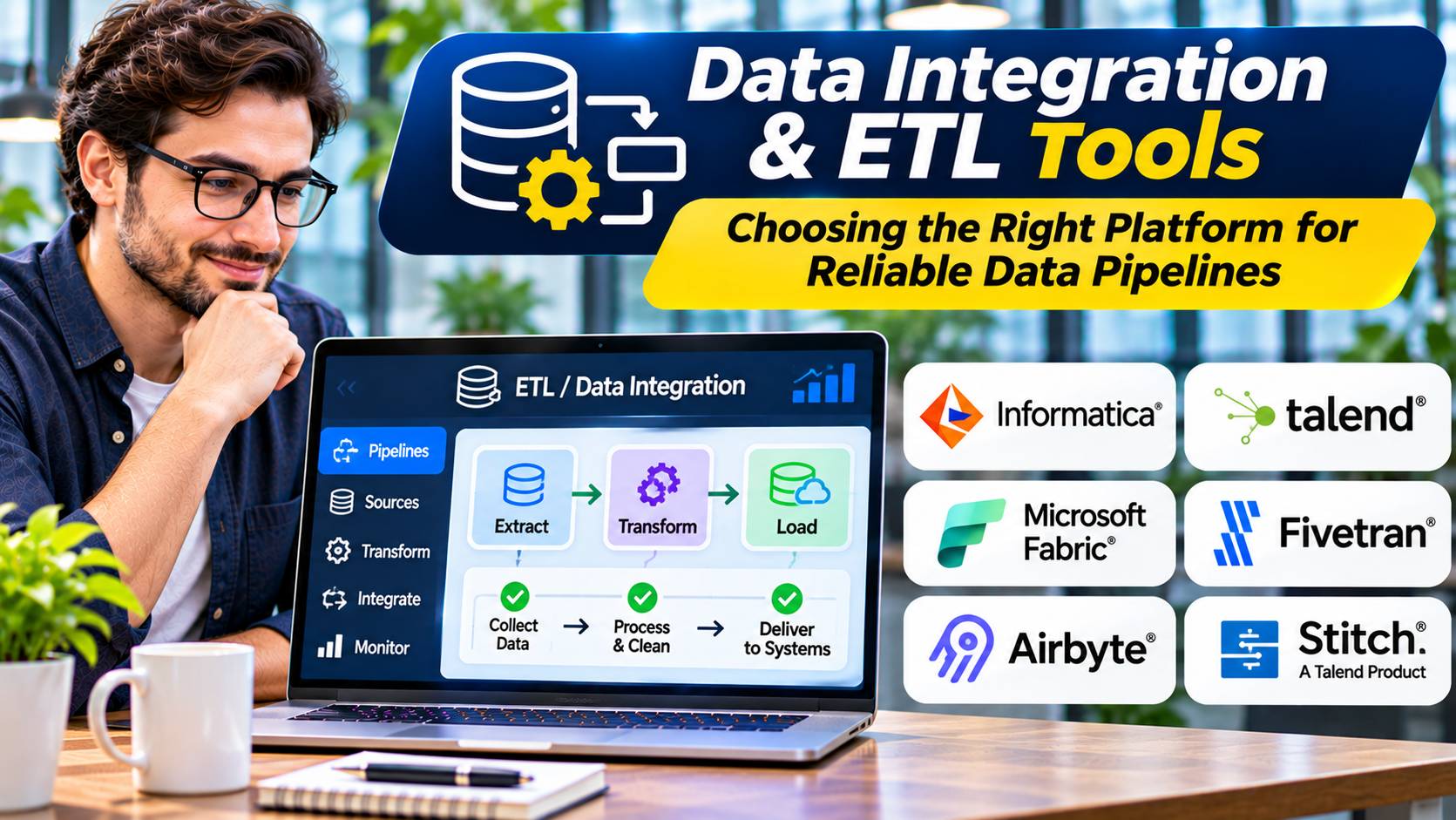
An ETL pipeline extracts information from a source, transforms it into a suitable structure, and loads it into a destination.
For example, a pipeline might extract sales records from an application database, standardize currency values, and load the results into a reporting warehouse.
Data integration is broader than ETL.
It can include data replication, synchronization, change data capture, streaming, transformation, and movement between applications.
The right approach depends on whether information is needed for analytics, operational workflows, or another purpose.
ETL vs. ELT: Understanding the Difference
ETL and ELT use different processing sequences.
ETL: Extract, Transform, Load
ETL transforms information before loading it into the final destination.
This approach can be useful when information must be cleaned, filtered, or protected before entering a target system.
For example, a company may need to remove selected sensitive fields before transferring records into an analytical environment.
ELT: Extract, Load, Transform
ELT loads information into a destination before performing transformations.
Modern cloud warehouses and lakehouse platforms can execute substantial transformations directly.
This approach can simplify ingestion and allow multiple downstream transformations.
However, it requires appropriate controls over raw data and destination access.
Neither approach is universally better.
Organizations may use ETL and ELT for different workloads.
Why Data Integration Matters
Data integration affects the quality and timeliness of business information.
Without reliable pipelines, teams may rely on manual exports and inconsistent spreadsheets.
Reports may use outdated information.
Departments may calculate the same metric differently.
Applications may also operate with conflicting customer or product records.
Reliable integration helps establish consistent information flows.
However, moving data does not automatically make it accurate.
Organizations must still define business rules, resolve source inconsistencies, and monitor quality.
A successful integration platform should make these responsibilities easier to manage.
The Main Categories of Data Integration Tools
Managed Data Pipeline Services
Managed services connect supported sources to analytical destinations.
They may handle scheduling, schema changes, and selected replication responsibilities.
These platforms are useful when organizations want to reduce custom connector maintenance.
ETL and Data Transformation Platforms
ETL platforms provide workflows for extracting, transforming, and loading information.
They may support visual pipeline design, scheduling, and complex data processing.
Open-Source Data Integration Tools
Open-source platforms offer flexibility and control over integration components.
They may require additional deployment and maintenance effort.
Change Data Capture Tools
Change Data Capture, or CDC, identifies changes in source systems and transfers them to downstream destinations.
It is useful when applications require frequent updates without repeatedly copying entire datasets.
Streaming Data Platforms
Streaming technologies process continuous flows of events.
They are relevant when information must be handled with low delay.
These categories overlap, but they represent different architectural needs.
Data Integration and ETL Tools Worth Evaluating
Fivetran
Fivetran provides managed data movement and integration capabilities.
It is commonly associated with connecting business applications and databases to analytical destinations.
Strengths: Managed connectors, automated data movement, and reduced custom pipeline maintenance for supported integrations.
Considerations: Connector availability, data synchronization behavior, pricing, and supported transformations should be reviewed.
Fivetran may be attractive to organizations that want to minimize operational responsibility for common analytical integrations.
Airbyte
Airbyte is a data integration platform with open-source and managed offerings.
It provides connectors and tools for moving information between supported sources and destinations.
Strengths: Connector ecosystem, flexible deployment approaches, and customization possibilities.
Considerations: Connector maturity, deployment responsibilities, synchronization behavior, and operating costs vary.
Airbyte is relevant to teams seeking greater flexibility over integration architecture.
Informatica Intelligent Data Management Cloud
Informatica provides enterprise data integration and management capabilities.
Its offerings cover areas such as data integration, data quality, governance, and related workflows.
Strengths: Enterprise integration functionality and a broad data-management ecosystem.
Considerations: Product selection, implementation complexity, licensing, and administration require careful evaluation.
Informatica is particularly relevant to large organizations with diverse systems and formal data-governance requirements.
Talend
Talend is associated with data integration, transformation, and data quality capabilities.
Its technology has been incorporated into Qlik’s broader data integration portfolio.
Strengths: Data integration workflows, transformation capabilities, and data-quality functionality.
Considerations: Organizations should verify current product packaging, support arrangements, and available deployment options within the Qlik ecosystem.
Talend-related tools may be appropriate when transformation and quality requirements are substantial.
Matillion
Matillion provides data integration and transformation capabilities for cloud data environments.
It is commonly evaluated for workflows involving cloud warehouses and analytical platforms.
Strengths: Cloud-oriented data pipelines, transformation workflows, and integration with analytical destinations.
Considerations: Supported connectors, orchestration capabilities, pricing, and destination compatibility should be evaluated.
Matillion may be suitable for organizations building data pipelines around cloud analytics infrastructure.
Apache NiFi
Apache NiFi is an open-source system for automating and managing data flows.
It supports configurable processors and flow-based data movement.
Strengths: Visual flow management, flexible routing, and control over data movement.
Considerations: Infrastructure administration, flow design, security, and operational maintenance require expertise.
NiFi can be useful when data routing and processing involve varied systems and protocols.
Comparing Data Integration Platforms
| Platform | Primary Focus | Common Fit |
|---|---|---|
| Fivetran | Managed data movement | Analytical data replication |
| Airbyte | Flexible connector-based integration | Customizable data pipelines |
| Informatica | Enterprise data management | Complex integration and governance |
| Talend / Qlik | Integration and data quality | Transformation-oriented workflows |
| Matillion | Cloud data integration | Warehouse-centered data pipelines |
| Apache NiFi | Flow-based data movement | Routing and processing diverse data flows |
These products should be compared according to the required integration architecture rather than treated as identical alternatives.
Understanding Data Pipeline Architecture
A reliable pipeline begins with clearly defined source and destination systems.
The source may be a database, SaaS application, file service, or event stream.
The pipeline extracts or receives information.
Processing stages may validate records, standardize formats, and apply business rules.
The destination may be a warehouse, data lake, application, or another system.
Orchestration coordinates the sequence and timing of pipeline operations.
Monitoring identifies failures and unexpected behavior.
Metadata records information about datasets and transformations.
Each component contributes to operational reliability.
Batch Integration vs. Real-Time Integration
Batch integration moves information at scheduled intervals.
For example, a company may update financial reporting tables every night.
Batch pipelines can be easier to manage and may be sufficient when immediate updates are unnecessary.
Real-time or near-real-time integration transfers information more frequently.
This may be necessary for fraud detection, operational dashboards, or event-driven applications.
However, lower latency usually introduces additional architectural complexity.
Organizations should define acceptable data freshness before selecting a platform.
A business report that updates daily does not necessarily benefit from a streaming infrastructure.
Change Data Capture Explained
Change Data Capture identifies modifications to source data.
Rather than repeatedly copying an entire table, CDC pipelines transfer selected inserts, updates, and deletes.
This can reduce source-system load and improve data freshness.
CDC implementations may use database transaction logs or other supported mechanisms.
However, CDC introduces challenges.
Applications must handle ordering, duplicate events, schema changes, and recovery after interruptions.
Some changes may require special handling depending on the source database and connector.
Organizations should test CDC behavior under realistic failure conditions.
Data Transformation and Quality
Data integration pipelines frequently need to standardize information.
For example, one system may store country names while another uses country codes.
One application may represent dates in local time, while another uses UTC.
Customer identifiers may also differ between systems.
Transformations can resolve these differences.
However, transformation logic should be documented and tested.
A pipeline that silently changes values may create serious reporting errors.
Data quality checks should verify expected fields, valid values, record counts, and important business relationships.
Organizations should establish ownership for both source information and transformation rules.
Pipeline Orchestration and Scheduling
Integration pipelines often depend on multiple tasks.
A reporting transformation may need to wait until source data has arrived.
A quality check may need to complete before information becomes available to analysts.
Orchestration systems coordinate these dependencies.
They can schedule tasks, manage retries, and record execution status.
Apache Airflow is one example of a workflow orchestration technology frequently used in data engineering.
However, orchestration is not the same as data integration.
A workflow scheduler may coordinate pipelines without providing every connector or transformation capability.
Organizations should understand which responsibilities belong to each tool.
Reliability and Failure Recovery
Production pipelines need predictable behavior when something goes wrong.
A source application may become unavailable.
A network connection may fail.
An API may enforce rate limits.
A destination may reject records because of a schema change.
Reliable pipelines should detect failures and provide actionable information.
Retry behavior should be carefully designed.
Blindly repeating an operation can create duplicate records or unexpected side effects.
Idempotent processing, where supported, helps ensure repeated operations do not produce incorrect results.
Organizations should also establish procedures for replaying missing data and reconciling source and destination records.
Security in Data Integration
Data integration tools frequently access sensitive systems.
They may require credentials for production databases, cloud services, and business applications.
These credentials should be protected using appropriate secret-management practices.
Connections should use encryption where supported and required.
Permissions should follow least-privilege principles.
A reporting connector generally should not receive unrestricted administrative access to an operational database.
Sensitive information may also require filtering or masking before transfer.
Organizations must understand where data is processed, stored temporarily, and logged.
Security reviews should cover the entire pipeline, not just the final destination.
Understanding Data Integration Costs
Integration costs can include subscription fees, connector charges, data volume, infrastructure, processing resources, and operational staffing.
Managed platforms may reduce engineering effort but introduce usage-based charges.
Open-source systems may reduce licensing costs while increasing infrastructure and maintenance responsibilities.
A realistic comparison should include expected data volume and synchronization frequency.
Frequent full-table transfers may be expensive and inefficient.
Incremental loading or CDC may reduce unnecessary processing when supported.
Organizations should also account for the cost of pipeline failures and delayed reporting.
Common Data Integration Mistakes
Choosing Tools Based Only on Connector Count
A large connector catalog is useful, but connector quality and support for required operations matter more.
Ignoring Schema Changes
Source systems evolve.
Pipelines need clear behavior when fields are added, removed, or modified.
Failing to Monitor Data Freshness
A pipeline may appear operational while delivering outdated information.
Mixing Business Rules Without Documentation
Undocumented transformations create inconsistent metrics and difficult troubleshooting.
Granting Excessive Source Permissions
Integration services should access only the information and operations they require.
Underestimating Maintenance
Connectors, APIs, authentication methods, and destination schemas change over time.
Reliable integration requires ongoing ownership.
How to Choose the Right Data Integration Tool
Begin by documenting source and destination systems.
Identify the exact connectors required.
Next, define data volume, update frequency, and acceptable latency.
Determine whether the pipeline needs batch loading, CDC, streaming, or complex transformations.
Evaluate data quality and governance requirements.
Then compare deployment models and operational responsibilities.
A managed service may be appropriate for common SaaS-to-warehouse integrations.
A more flexible platform may be necessary for specialized transformation and routing requirements.
Finally, run a realistic proof of concept.
Test the most important connectors, expected data volumes, schema changes, failure recovery, and monitoring.
The right platform should support dependable data movement with acceptable cost and operational effort.
Frequently Asked Questions
What is the difference between ETL and data integration?
ETL is a specific process for extracting, transforming, and loading information. Data integration is broader and includes replication, synchronization, streaming, and other approaches.
Which ETL tool is best?
The best option depends on requirements. Fivetran, Airbyte, Informatica, Talend-related offerings, Matillion, and Apache NiFi serve different needs.
Is ELT better than ETL?
Not universally. ELT is useful when destinations provide substantial processing capabilities, while ETL remains appropriate when transformations must occur before loading.
What is change data capture?
CDC is a technique for identifying and transferring changes from source systems.
Are open-source ETL tools suitable for enterprises?
They can be, provided the organization has the expertise and processes needed for security, reliability, maintenance, and support.
Can data integration tools improve data quality?
Many platforms support validation and transformation capabilities. However, data quality also depends on source systems, business rules, and governance.
Final Thoughts
Data integration and ETL tools connect the systems that modern organizations depend on.
Their value comes from making information available accurately, consistently, and at the right time.
However, successful integration requires more than moving records between applications.
Organizations need reliable pipelines, documented transformations, security controls, quality checks, and effective monitoring.
The strongest platform is the one that supports actual data movement requirements while minimizing unnecessary maintenance and complexity.
A dependable integration architecture helps organizations trust their information and make better decisions across the business.