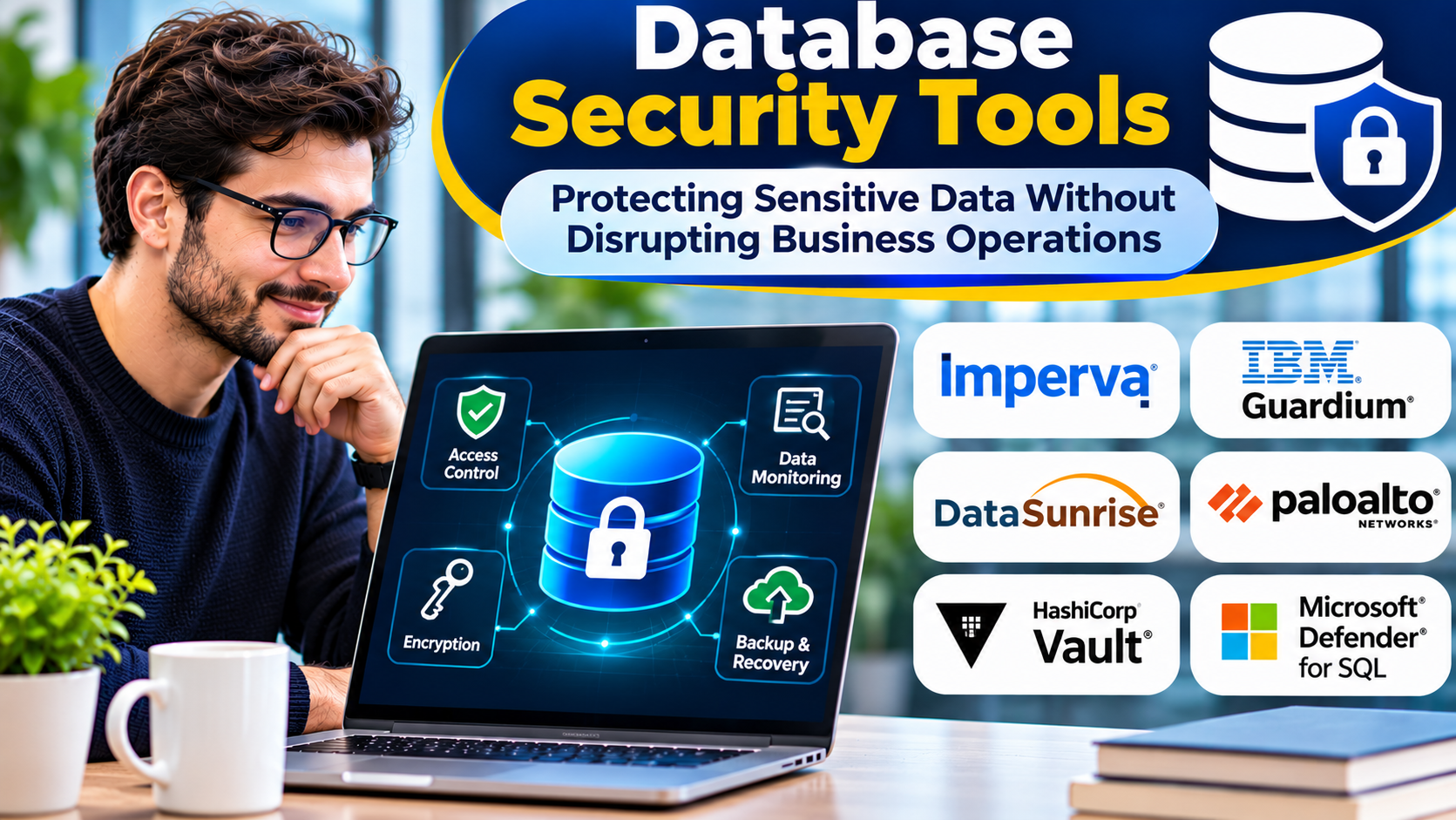
A database can be encrypted, backed up, and protected by a firewall while still being dangerously exposed.
The reason is simple: most database security failures do not involve someone breaking a cryptographic algorithm. They involve excessive permissions, stolen credentials, insecure applications, misconfigured services, or legitimate access being used for illegitimate purposes.
For organizations storing customer information, financial records, employee details, or proprietary business data, database security requires more than a single protective product.
The real challenge is establishing control over who can access information, what they can do with it, and how suspicious activity is detected before it becomes a serious incident.
Database security tools help address these challenges through access management, activity monitoring, vulnerability assessment, encryption, data masking, and other specialized controls.
Choosing the right combination depends on the database environment, the sensitivity of stored information, and the threats the organization needs to manage.
What Are Database Security Tools?
Database security tools are software products and services designed to protect database systems, stored information, and related administrative activities.
Their functions may include:
- Discovering sensitive data and exposed databases
- Identifying configuration weaknesses and vulnerabilities
- Monitoring database queries and user activity
- Restricting privileged access
- Encrypting stored information and connections
- Masking or tokenizing sensitive information
- Generating audit records
- Detecting suspicious database behavior
- Supporting security investigations and compliance reviews
Not every database security product performs all these functions.
Some platforms specialize in database activity monitoring. Others focus on vulnerability assessment, encryption, access governance, or data discovery.
Understanding these distinctions prevents organizations from purchasing overlapping products while leaving important security gaps unresolved.
Why Traditional Network Security Is Not Enough
Network firewalls and endpoint security products remain important, but they cannot fully explain what happens inside a database.
Consider an employee who has legitimate access to a customer database.
A firewall may allow the connection because the employee is using an approved application or network path.
However, the employee could still attempt to export unusually large volumes of customer information.
Similarly, an attacker who compromises an application account may issue database queries using credentials that appear legitimate.
Detecting these situations requires visibility into database identities, permissions, activity, and data access patterns.
Database security must therefore operate alongside network, identity, application, and infrastructure security.
The Main Categories of Database Security Tools
Database Activity Monitoring
Database Activity Monitoring, or DAM, focuses on observing database operations.
Depending on the platform and integration method, monitoring may capture query activity, administrative changes, access attempts, and other events.
Organizations use these records to investigate suspicious behavior and support audit requirements.
Monitoring coverage varies considerably.
A product may observe network traffic, use database-native audit logs, deploy agents, or combine multiple collection methods.
The chosen approach affects visibility, performance, and operational complexity.
Database Vulnerability Assessment
Database vulnerability assessment tools examine database configurations and known security weaknesses.
They may identify outdated software, risky permissions, insecure settings, or deviations from established security baselines.
Their purpose is to help teams discover and prioritize weaknesses before attackers exploit them.
However, identifying a vulnerability does not automatically fix it.
Remediation still requires careful planning, testing, and change management.
Database Encryption
Encryption protects information from selected forms of unauthorized exposure.
Database systems may support transparent data encryption, encrypted connections, or more targeted application-level encryption.
These approaches protect against different threats.
For example, storage encryption can protect database files or backups, but it does not necessarily prevent an authorized database session from reading decrypted records.
Data Masking and Tokenization
Data masking replaces sensitive values with modified or substitute information.
It is useful when developers, testers, or analysts need realistic datasets without receiving unrestricted access to production personal information.
Tokenization replaces sensitive values with tokens whose relationship to the original values is managed separately.
These techniques are not interchangeable with encryption.
The appropriate choice depends on whether original values must be recoverable, who needs access, and how applications process the information.
Privileged Database Access Management
Database administrators often possess powerful permissions.
Privileged access controls can restrict administrative sessions, enforce approval processes, and improve accountability.
These controls are especially important when multiple employees, contractors, or automated systems share responsibility for critical databases.
Database Security Platforms Worth Evaluating
The following products address different aspects of database protection rather than representing identical alternatives.
IBM Guardium
IBM Guardium is an enterprise data-security product family that includes capabilities related to database activity monitoring, data protection, and security governance.
It is relevant to organizations operating complex database environments with significant audit and security requirements.
Potential strengths: Enterprise-focused monitoring and governance capabilities.
Important considerations: Organizations should confirm support for their specific database engines, cloud services, collection methods, and deployment architecture.
Its value depends on the exact product components and implementation.
Imperva Data Security
Imperva offers data-security capabilities associated with discovering, monitoring, and protecting sensitive information.
It is relevant to organizations seeking visibility into database access and security activity.
Potential strengths: Database-focused monitoring and data-security workflows.
Important considerations: Buyers should verify supported databases, activity collection methods, alerting capabilities, and licensing arrangements.
Oracle Data Safe
Oracle Data Safe provides security capabilities for supported Oracle database environments.
Its functions include areas such as security assessment, user assessment, activity auditing, and sensitive-data protection workflows.
Potential strengths: Integration with supported Oracle database services.
Important considerations: Its suitability depends on the Oracle database deployment and supported service capabilities.
Organizations operating diverse database technologies may need additional tools.
Microsoft Defender for SQL
Microsoft Defender for SQL provides security assessment and threat-detection capabilities for supported SQL environments.
It can be relevant to organizations already using Microsoft’s cloud and database security ecosystem.
Potential strengths: Integration with Microsoft security services and supported SQL deployments.
Important considerations: Coverage, configuration requirements, and pricing depend on the database environment and service plan.
Native Database Security Features
PostgreSQL, Microsoft SQL Server, Oracle Database, MySQL, and other database engines provide security capabilities of their own.
Depending on the product and edition, these may include authentication, authorization, encryption, logging, and auditing.
Native controls are often the most practical starting point.
A separate security platform should address a documented gap rather than duplicate functionality that the organization already operates effectively.
The Most Important Database Security Features
Sensitive Data Discovery
Organizations cannot protect information effectively if they do not know where it resides.
Discovery capabilities help identify databases, sensitive fields, and data locations.
However, automated classification can produce false positives and miss context-specific information.
Human review remains important.
Fine-Grained Access Control
Database permissions should reflect actual business responsibilities.
A reporting application may need read-only access to selected views rather than unrestricted access to every table.
Administrative privileges should be limited and reviewed regularly.
Activity Auditing
Audit records should help investigators determine who accessed information, what operations occurred, and when those operations happened.
The organization must also protect logs from unauthorized modification.
Threat Detection
Security platforms may identify suspicious activity using rules, behavioral analysis, or other detection methods.
Examples include unusual query patterns, unexpected privilege changes, and access from unfamiliar environments.
Detection quality depends on data coverage, configuration, and the organization’s ability to investigate alerts.
Encryption and Key Separation
Encryption keys should be protected separately from the data they secure whenever the architecture permits.
Key access should follow narrowly scoped authorization policies.
Cloud and Hybrid Support
Many organizations operate databases across cloud services, private infrastructure, and managed platforms.
Security products must support the actual deployment models in use.
A product that works well with a self-managed database may have different visibility into a fully managed cloud database.
How to Evaluate Database Security Tools
Begin with a database inventory.
Document the database engines, versions, deployment locations, owners, and sensitivity of stored information.
Next, identify existing protections.
Review authentication, access permissions, encryption, audit logging, network restrictions, and backup procedures.
Then assess the most important threats.
For one organization, privileged-user monitoring may be the priority. For another, the greatest risk may come from exposed cloud databases or weak application credentials.
Use these findings to establish evaluation criteria.
A realistic product trial should test whether the tool detects meaningful events, produces useful evidence, and operates without unacceptable performance or administrative overhead.
Database Security and Regulatory Compliance
Database security tools can support requirements associated with frameworks and regulations such as GDPR, PCI DSS, and applicable privacy laws.
However, no product automatically makes an organization compliant.
Compliance depends on the information processed, relevant legal obligations, organizational policies, and implemented controls.
For example, audit logs may help demonstrate access oversight, but they do not replace lawful data processing, retention management, or incident-response procedures.
Security teams should map product capabilities to specific control requirements rather than relying on broad vendor compliance claims.
Common Database Security Mistakes
Giving Applications Excessive Permissions
Applications often receive broader database privileges than they need.
This increases the impact of compromised application credentials.
Use separate service identities and restrict permissions according to each workload.
Ignoring Non-Production Databases
Development and testing environments sometimes contain copies of sensitive production information.
These systems may have weaker controls than production databases.
Data masking and appropriate access restrictions help reduce this exposure.
Collecting Logs Without Reviewing Them
Logging creates evidence, but evidence alone does not stop an incident.
Organizations need alerting, investigation procedures, and responsible owners.
Assuming Encryption Prevents Every Data Breach
Encryption protects against particular threats.
It does not prevent an attacker from accessing plaintext through an authorized but compromised application.
Neglecting Database Patching
Database engines and supporting components require regular maintenance.
Security updates should follow a risk-based process that includes compatibility testing and recovery planning.
A Practical Database Security Implementation Plan
Start by identifying the most sensitive databases.
Review access permissions and remove unnecessary privileges.
Enable supported encryption and auditing controls.
Establish secure backup and recovery procedures.
Then introduce additional monitoring or assessment tools where existing capabilities leave meaningful gaps.
Security teams should test alerts using controlled scenarios and confirm that investigators can interpret the results.
Finally, review the security posture after major application changes, migrations, or infrastructure updates.
Database security is an ongoing operational discipline, not a one-time deployment.
Frequently Asked Questions
What is the best database security tool?
The best choice depends on the database environment and security requirement. IBM Guardium and Imperva address enterprise data-security use cases, while native database controls and cloud security services may be more appropriate for other environments.
What is database activity monitoring?
Database activity monitoring observes selected database operations to support security visibility, auditing, and investigation.
Is database encryption enough to protect sensitive data?
No. Encryption should be combined with access controls, secure applications, monitoring, patch management, and tested backups.
Can database security tools prevent SQL injection?
Some security controls may help detect or limit suspicious database activity, but SQL injection prevention primarily requires secure application development, parameterized queries, and appropriate application-level protections.
Do small businesses need enterprise database security software?
Not always. Small organizations may meet many requirements using properly configured database-native controls and managed cloud security capabilities.
Final Thoughts
Database security tools are most effective when they address clearly identified risks.
Organizations should begin with database visibility, disciplined access control, encryption, and reliable auditing.
Specialized platforms can then improve monitoring, assessment, and governance where necessary.
The objective is not to install the greatest number of security products. It is to establish dependable protection around sensitive information while keeping critical business applications available and manageable.