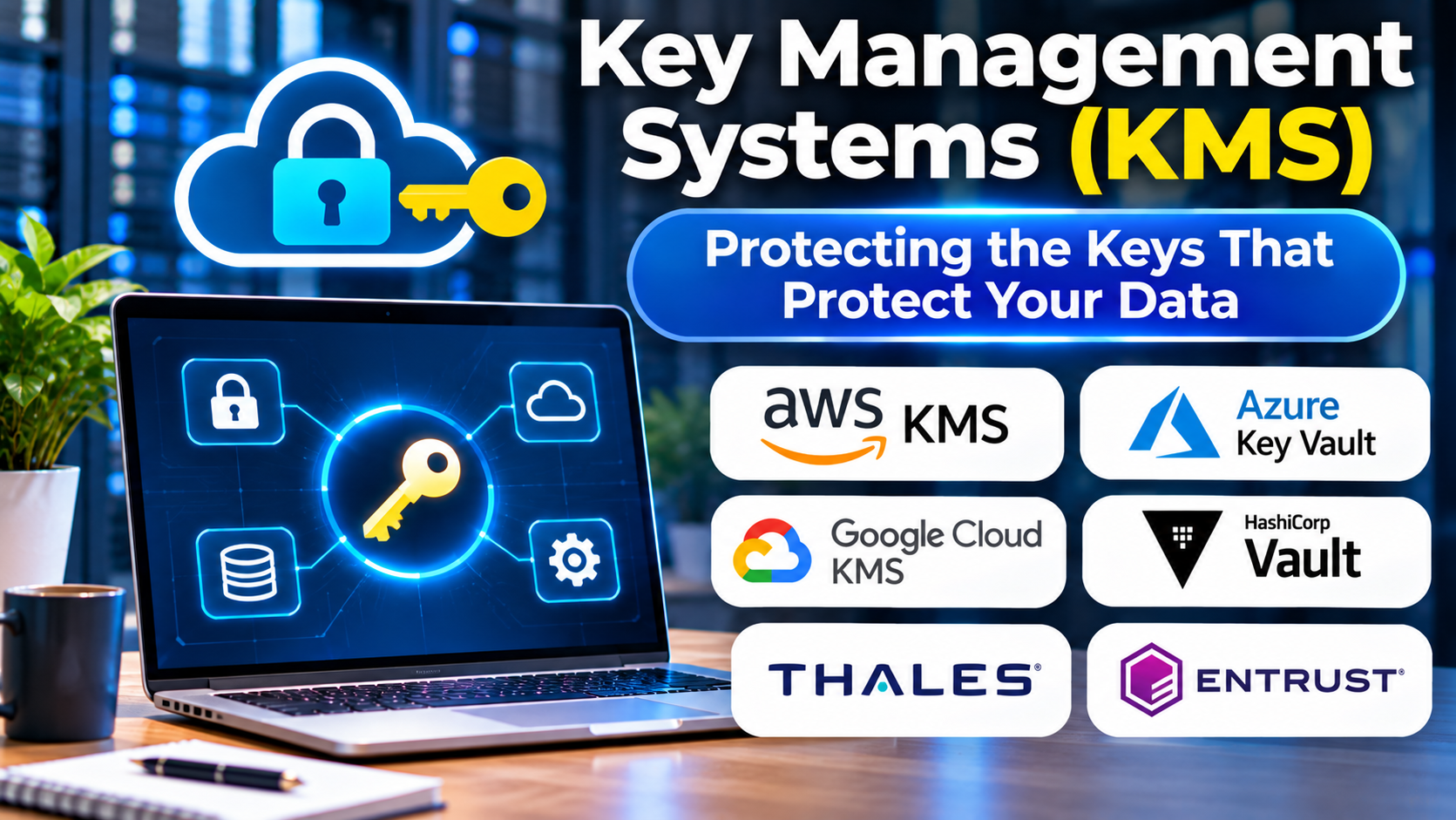
Encryption is only as dependable as the system responsible for its keys.
An organization may encrypt every database, backup, and storage volume while still exposing sensitive information through weak key-management practices.
Keys stored in application configuration files, excessive administrative permissions, missing recovery procedures, and poorly planned rotation policies can undermine otherwise strong encryption.
Key Management Systems, commonly called KMS, address these operational challenges by providing controlled ways to create, protect, use, and manage cryptographic keys.
Choosing a KMS is therefore not simply a security purchasing decision. It is an architectural decision that affects application availability, compliance, operational costs, and long-term control over encrypted information.
What Is a Key Management System?
A Key Management System is a service or platform that manages cryptographic keys throughout their lifecycle.
Depending on the product, a KMS may support:
- Key creation and import
- Secure key storage and protection
- Encryption and decryption operations
- Key access policies
- Rotation and version management
- Disabling and deletion
- Audit logging
- Integration with applications and infrastructure
Some systems perform cryptographic operations directly. Others manage keys that protect separate data-encryption keys.
The exact security boundary matters.
A KMS may prevent applications from exporting particular keys while still allowing authorized applications to request cryptographic operations using those keys.
Why Encryption Key Management Is Difficult
Consider a business application that encrypts customer records.
The application needs a key to encrypt information and another authorized process must be able to decrypt it later.
If developers store the key directly in application source code, anyone who gains access to that code may obtain the key.
Moving the key into an environment variable may improve separation from source code, but it does not automatically solve access control, rotation, or auditing.
A centralized KMS provides a more structured approach.
Applications authenticate to the service and receive permission to perform specific operations.
Administrators can define policies, review key usage, and manage lifecycle events.
However, centralization also creates dependencies that must be understood and managed.
How a KMS Works
Many KMS implementations use a technique called envelope encryption.
Envelope encryption separates the key used to encrypt data from the key used to protect that encryption key.
A typical workflow follows these steps:
- An application obtains or generates a data-encryption key.
- The application encrypts information using that key.
- A higher-level key protects the data-encryption key.
- The encrypted data and protected data key are stored.
- An authorized application later requests access to the protected key.
- The application decrypts the information after obtaining the necessary key material.
The higher-level key is often called a key-encryption key.
This architecture allows organizations to manage access to encryption keys without requiring a centralized service to process every byte of application data.
Actual workflows vary between products.
Cloud KMS vs. Self-Managed Key Management
One of the first decisions is whether to use a managed cloud service or operate key-management infrastructure directly.
Managed Cloud KMS
Cloud KMS services are integrated with cloud identity, logging, storage, and application environments.
They can reduce the infrastructure burden of operating a dedicated key-management service.
Common examples include AWS Key Management Service, Azure Key Vault, and Google Cloud Key Management Service.
These services are not identical.
Their key types, supported operations, geographic configurations, integrations, and security boundaries differ.
Self-Managed Key Management
Self-managed approaches give organizations more direct responsibility for deployment, access policies, availability, and maintenance.
They may be appropriate when workloads operate across multiple environments or when regulatory and architectural requirements call for specific control over key infrastructure.
However, self-management creates operational responsibilities involving software updates, backups, disaster recovery, and service reliability.
Hybrid Approaches
Some organizations combine cloud-managed services with external or customer-controlled key infrastructure.
This can support particular separation-of-duties or governance requirements.
Hybrid designs also introduce additional complexity, including dependencies between services and failure scenarios that must be tested.
Key Management Platforms to Evaluate
AWS Key Management Service
AWS KMS is designed to manage cryptographic keys and integrate with supported AWS services and applications.
It is particularly relevant to organizations already operating workloads within AWS.
Its strengths include integration with AWS identity and auditing capabilities and support for common cloud encryption workflows.
Organizations should evaluate key policies, cross-account access, regional requirements, quotas, and costs associated with their expected usage.
Azure Key Vault
Azure Key Vault provides capabilities for managing keys, secrets, and certificates within Microsoft Azure environments.
It is useful for applications and infrastructure that depend on Azure identity and security services.
However, key management, secret storage, and certificate management are distinct functions.
Organizations should understand which capabilities they need and which service configuration supports them.
Google Cloud Key Management Service
Google Cloud KMS provides managed cryptographic key capabilities for Google Cloud workloads.
It supports integration with selected Google Cloud services and application workflows.
Evaluation should focus on key location, access policies, supported algorithms, operational limits, and compatibility with the organization’s data architecture.
HashiCorp Vault
HashiCorp Vault is a secrets-management platform with cryptographic capabilities, including its Transit secrets engine.
Transit can provide encryption-related operations without requiring applications to manage every underlying cryptographic key directly.
Vault is relevant to organizations seeking programmable security services across different infrastructure environments.
Its deployment and operational complexity depend on the chosen architecture and service offering.
Thales CipherTrust Manager
Thales CipherTrust Manager addresses enterprise key-management and related data-security administration requirements.
It may be relevant to organizations managing encryption across diverse enterprise systems.
Buyers should validate supported integrations, deployment options, licensing, and the exact responsibilities assigned to the platform.
KMS vs. Hardware Security Modules
A Hardware Security Module, or HSM, is a specialized device or service designed to protect cryptographic keys and perform security-sensitive operations.
A KMS is a broader management system.
Some KMS products use HSMs as part of their underlying architecture.
Others offer HSM-backed options or integrate with external hardware.
An HSM does not automatically replace key lifecycle management, application authorization, or organizational governance.
Likewise, using a KMS does not guarantee that every key is protected within a dedicated HSM under every configuration.
Organizations should evaluate the actual protection model rather than relying on product labels.
Essential KMS Security Features
Fine-Grained Authorization
Applications and administrators should receive narrowly scoped permissions.
An application that needs to encrypt data should not automatically receive permission to delete keys.
Key Rotation
Rotation helps organizations replace cryptographic keys according to operational or security requirements.
However, rotation is not the same as re-encrypting all existing data.
Depending on the system, old key versions may remain necessary for decryption.
Audit Logging
Audit records help security teams investigate key usage and administrative changes.
Logs should capture relevant activity without exposing sensitive key material.
Availability and Recovery
Applications may depend on a KMS to access encrypted information.
A service outage, inaccessible key, or incorrect permission change can therefore affect business operations.
Recovery design must consider service availability, key durability, regional dependencies, and operational procedures.
Separation of Duties
Key administrators should not automatically have unrestricted access to every protected dataset.
Separating administrative responsibilities reduces the consequences of excessive permissions and compromised accounts.
Understanding KMS Costs
KMS costs can involve several components.
Managed cloud services may charge for stored keys, cryptographic requests, specialized key types, or additional capabilities.
Self-managed systems may require infrastructure, operational staff, monitoring, support, and disaster-recovery resources.
A low initial subscription cost does not necessarily indicate a low total cost.
Organizations should model expected key counts, application request volumes, deployment environments, and recovery requirements.
Avoid selecting a KMS based only on the advertised entry price.
How to Evaluate a KMS Before Deployment
Start with an inventory of the systems requiring cryptographic keys.
Identify databases, applications, storage services, certificates, and other workloads.
Next, determine which operations each system requires.
Some applications need encryption and decryption. Others require digital signatures, key wrapping, or certificate-related operations.
Then document security and governance requirements.
These may include geographic restrictions, access approval procedures, audit retention, and separation of duties.
Finally, test a realistic application integration.
Confirm that applications can authenticate securely, handle permission failures, recover from temporary service interruptions, and continue accessing previously encrypted information after planned key changes.
Common KMS Implementation Mistakes
A common mistake is granting applications broad key permissions because narrow policies appear inconvenient.
Another is rotating keys without understanding how existing encrypted data will remain accessible.
Organizations also sometimes overlook the relationship between KMS availability and application availability.
A further problem is treating key deletion as an ordinary administrative operation.
Destroying the only usable key for important encrypted information can permanently prevent recovery.
For critical systems, destructive operations should require carefully designed authorization and recovery procedures.
Frequently Asked Questions
What is the difference between KMS and encryption software?
Encryption software performs or manages encryption. A KMS focuses on cryptographic key lifecycle management and controlled key operations.
Is a cloud KMS secure?
Managed cloud KMS services can provide strong security capabilities, but protection depends on correct configuration, permissions, architecture, and operational practices.
Does a KMS store passwords?
Some related platforms manage secrets, but cryptographic key management and password or secret management are not identical functions.
Can a KMS prevent data breaches?
A KMS can reduce risks associated with exposed or poorly managed keys. It cannot independently prevent every form of unauthorized data access.
Final Thoughts
A reliable KMS turns encryption key handling from an informal application responsibility into a controlled security process.
The most important selection criteria are not simply the number of supported algorithms or integrations.
Organizations should prioritize clear security boundaries, dependable access policies, operational resilience, recoverability, and compatibility with their actual workloads.
Strong encryption protects information. Strong key management helps ensure that protection remains trustworthy and usable.