Businesses generate more information than traditional reporting systems were originally designed to handle.
Customer transactions, application logs, images, documents, sensor readings, and event streams all contain potentially useful information. Yet much of this data arrives in different formats and at different speeds.
Organizations often want to preserve this information before deciding exactly how it will be analyzed.
Data lake platforms provide a flexible foundation for storing large and varied datasets.
Unlike traditional analytical systems that often require information to follow a predefined structure, data lakes can retain data in its original format.
This flexibility supports analytics, data science, machine learning, and long-term information processing.
However, a data lake is not simply a large storage folder.
Without governance, metadata, security, and reliable processing, a data lake can become difficult to navigate and expensive to maintain.
Choosing the right platform requires understanding both the storage technology and the wider data architecture.
What Is a Data Lake?
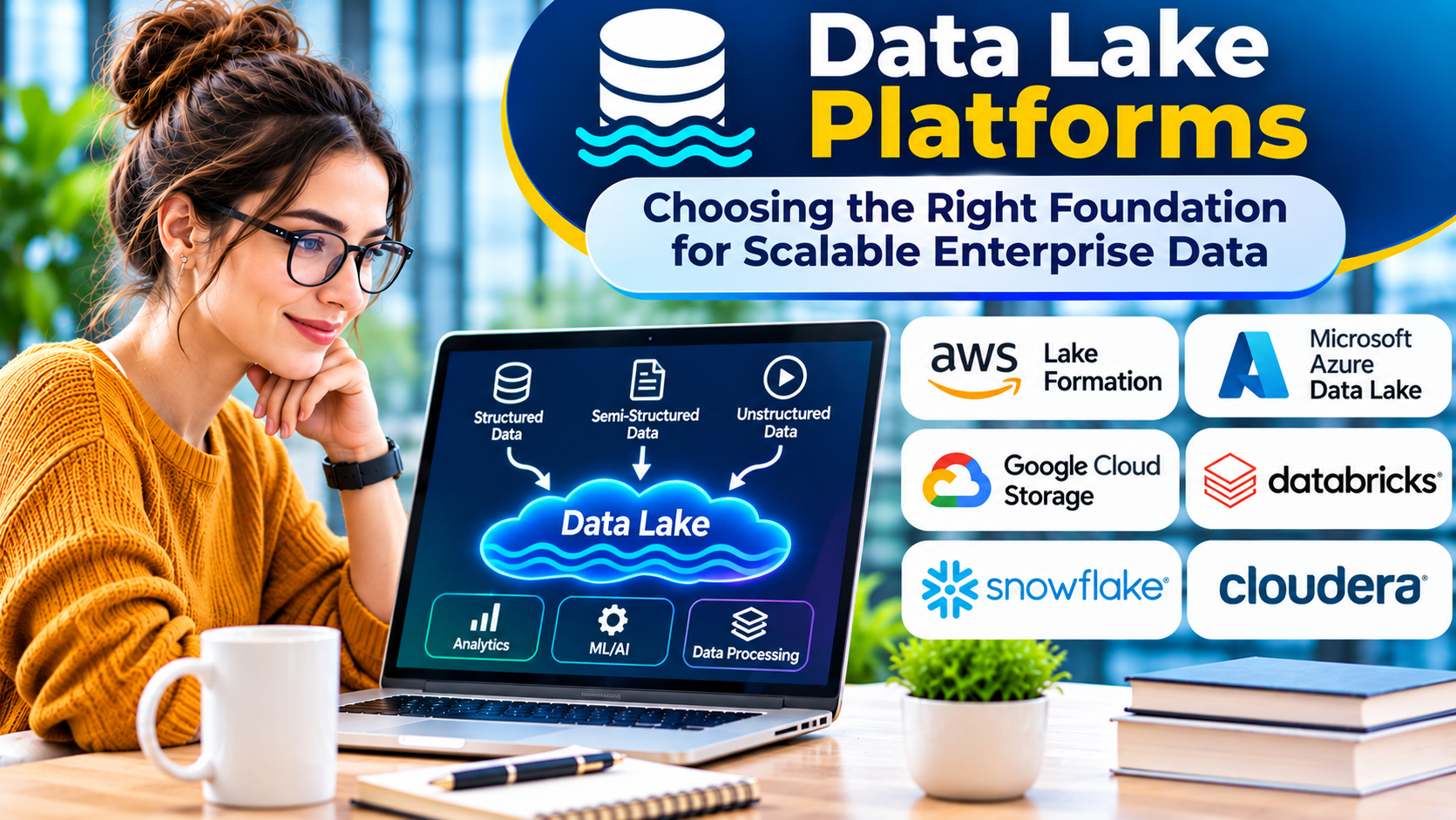
A data lake is a centralized environment designed to store large amounts of structured, semi-structured, and unstructured data.
Structured information includes records organized into defined fields, such as sales transactions.
Semi-structured information includes formats such as JSON documents and application events.
Unstructured information includes documents, images, audio, and other content that does not naturally fit into conventional database tables.
Data lakes commonly use object storage as their foundation.
Organizations can ingest information from different systems and process it later using appropriate analytical tools.
This approach is often called schema-on-read because structure can be applied when information is processed or queried.
However, not every data lake workload uses schema-on-read exclusively. Many production environments also enforce schemas and quality rules during ingestion.
Why Organizations Build Data Lakes
A data lake can solve several important problems.
First, it provides a common storage destination for information generated by different business systems.
Second, it supports retaining raw data for future processing.
Third, it can reduce the need to force every dataset into a conventional relational model before storage.
Fourth, it enables analytical and machine learning workflows that use different data types.
For example, a logistics company might collect vehicle telemetry, delivery records, customer feedback, and route information.
These datasets may not belong in the same operational database.
A data lake can provide a shared storage foundation while allowing specialized processing systems to analyze the information.
However, the organization still needs to establish reliable data ownership and access controls.
Data Lake Architecture Explained
A practical data lake architecture contains several layers.
Data Sources
Information may originate from applications, operational databases, SaaS platforms, connected devices, files, and external providers.
Ingestion Layer
Data pipelines transfer information into the lake.
Ingestion may happen through scheduled batch processes, streaming systems, or change data capture.
Storage Layer
Object storage holds the data.
Organizations may use formats such as Parquet, JSON, CSV, Avro, and other supported file types.
Metadata and Catalog Layer
Metadata describes datasets, their structure, ownership, location, and other characteristics.
Catalogs make information easier to discover and manage.
Processing Layer
Processing engines clean, transform, aggregate, and analyze data.
Apache Spark and SQL query engines are common examples.
Consumption Layer
Analysts, data scientists, business applications, and machine learning workflows use prepared information.
Each layer contributes to the reliability of the overall environment.
Data Lake Platforms Worth Evaluating
Amazon S3 with AWS Lake Services
Amazon S3 is a cloud object storage service widely used as the storage foundation for data lakes.
Organizations can combine S3 with services such as AWS Glue, AWS Lake Formation, Amazon Athena, and other AWS analytical technologies.
Strengths: Scalable object storage, integration with AWS analytics services, and flexible architecture options.
Considerations: Storage permissions, catalog configuration, data processing, governance, and consumption costs require planning.
S3 alone does not provide every capability of a complete governed data lake.
The surrounding services and operational processes determine the final architecture.
Azure Data Lake Storage
Azure Data Lake Storage provides data lake storage capabilities within Azure’s storage ecosystem.
It supports analytical workloads and integration with Microsoft data services.
Strengths: Integration with Azure identity, storage, and analytical services.
Considerations: Access-control configuration, data organization, lifecycle policies, and processing costs should be evaluated.
Azure Data Lake Storage is particularly relevant to organizations using Microsoft’s cloud infrastructure.
Google Cloud Storage with Google Cloud Analytics
Google Cloud Storage can serve as the storage foundation for data lakes.
Organizations may combine it with services such as BigQuery, Dataproc, and other Google Cloud data technologies.
Strengths: Cloud object storage, integration with Google Cloud analytics, and flexible processing options.
Considerations: Data movement, governance, storage classes, query architecture, and operating costs require evaluation.
Google Cloud Storage should be considered part of a broader data lake architecture rather than a complete analytical platform by itself.
Cloudera Data Platform
Cloudera provides enterprise data-management capabilities for analytical and data engineering environments.
Its platform can support data lake-oriented architectures and governance workflows.
Strengths: Enterprise data-management functionality and support for complex data environments.
Considerations: Deployment requirements, platform complexity, licensing, and operational expertise should be reviewed.
Cloudera may be relevant to organizations with established enterprise data infrastructure or hybrid deployment requirements.
Open-Source Data Lake Architecture
Organizations can build data lakes using open-source processing and catalog technologies combined with compatible storage systems.
Examples include Apache Spark, Apache Hadoop ecosystem components, Apache Hive Metastore, and open table formats.
Strengths: Flexibility and control over architectural components.
Considerations: Integration, maintenance, security, and support responsibilities can be substantial.
Open-source components require careful design to form a reliable production environment.
Comparing Data Lake Platform Approaches
| Platform or Approach | Primary Role | Important Consideration |
|---|---|---|
| Amazon S3 and AWS services | Cloud storage and data lake services | Service integration and governance |
| Azure Data Lake Storage | Azure data lake storage foundation | Identity, permissions, and analytics integration |
| Google Cloud Storage | Cloud storage for analytical architectures | Processing and catalog design |
| Cloudera | Enterprise data platform | Deployment and operational complexity |
| Open-source architecture | Customizable data lake components | Engineering and maintenance responsibilities |
The right platform depends on the organization’s infrastructure, data-processing needs, and governance requirements.
Data Lake vs. Data Warehouse
A data warehouse is primarily designed for structured analytical processing.
A data lake provides flexible storage for a wider variety of information.
Warehouses commonly support curated reporting datasets and business intelligence.
Data lakes often retain raw or lightly processed information for multiple downstream uses.
However, the distinction has become less rigid.
Modern data warehouses can work with external data, while data lakes can support structured analytical tables.
Organizations should compare capabilities rather than relying only on architectural labels.
Data Lake vs. Lakehouse
A data lake focuses on flexible storage and processing.
A lakehouse adds database-like capabilities such as transactional table management, schema enforcement, and stronger analytical integration.
For example, storing Parquet files in object storage can form part of a data lake.
Managing those files through a transactional table format such as Apache Iceberg or Delta Lake can support a lakehouse architecture.
The distinction matters because storage alone does not provide reliable concurrent table updates.
The Importance of Data Organization
Data lakes can become difficult to manage when information is stored without consistent organization.
Organizations should establish naming conventions, directory or object-prefix strategies, metadata standards, and dataset ownership.
Many architectures organize data into stages.
A raw area retains information close to its original form.
A processed area contains cleaned and standardized datasets.
A curated area contains information prepared for specific business uses.
These stages may be called bronze, silver, and gold layers in some architectures.
However, naming conventions are less important than clear responsibilities and reliable quality controls.
Metadata and Data Catalogs
Metadata is essential for making a data lake usable.
A dataset should have enough information to explain its purpose, origin, structure, owner, and expected update frequency.
Without metadata, analysts may struggle to locate the right information.
They may also misunderstand how fields should be interpreted.
Data catalogs help users discover datasets and understand their characteristics.
Catalogs can also support lineage, classification, and governance.
However, metadata must remain accurate as pipelines and schemas change.
An outdated catalog can be nearly as problematic as having no catalog.
Data Quality in Data Lakes
Flexible storage makes it easy to ingest information, but it does not guarantee quality.
A data lake may contain incomplete records, duplicated events, inconsistent identifiers, or unexpected schema changes.
These problems can affect downstream reports and machine learning models.
Organizations should implement quality checks at appropriate processing stages.
Useful checks include validating expected fields, identifying duplicates, monitoring record counts, and detecting unusual changes in data distributions.
Quality controls should reflect business requirements.
Not every raw dataset needs to be immediately transformed into a curated table, but its limitations should be understood.
Data Lake Security and Governance
Data lakes often contain information from multiple departments.
This creates substantial governance responsibilities.
Organizations should apply least-privilege access controls.
Sensitive datasets should be classified and protected.
Encryption should be configured according to security requirements.
Access logs and audit records should support investigation and accountability.
Data retention policies should also be enforced.
Special care is required when users access the same storage through different processing engines.
Permissions applied in one analytical tool may not automatically protect every other access route.
Security design must cover the storage, processing, and catalog layers together.
Data Lake Performance Considerations
Object storage is flexible, but query performance depends on how information is organized.
File formats matter.
Columnar formats such as Parquet can improve efficiency for analytical queries that read selected columns.
Partitioning can help reduce the amount of data scanned.
However, excessive partitioning can create operational complexity.
Large numbers of small files can also reduce processing efficiency.
Organizations should evaluate file sizes, compression, partition design, and query-engine behavior.
Performance optimization should be based on actual workloads.
Data Lake Costs
Data lake costs extend beyond raw storage.
Organizations may pay for storage capacity, data requests, network transfer, processing resources, and metadata services.
Different storage classes can offer different cost and retrieval characteristics.
Moving older data into lower-cost storage may reduce expenses, but retrieval delays and charges can affect usability.
Processing inefficiently organized datasets may also consume substantial compute resources.
A realistic cost model should include ingestion, storage, transformation, analytics, governance, and recovery.
Common Data Lake Mistakes
Storing Data Without Ownership
Every important dataset needs an accountable owner.
Ignoring Metadata
Information that cannot be discovered or understood provides limited value.
Allowing Unrestricted Access
Centralized storage can increase the impact of weak permissions.
Keeping Everything Forever
Unlimited retention can create unnecessary costs and legal risks.
Treating Raw Data as Business-Ready Information
Raw datasets often require cleaning and interpretation before they support reliable reporting.
Building Too Many Custom Components
A highly customized architecture can become difficult to operate and maintain.
How to Choose a Data Lake Platform
Begin by identifying the information the organization needs to store.
Consider data types, ingestion volume, retention periods, and expected growth.
Next, document the analytical workloads.
Determine whether users need batch processing, SQL queries, machine learning, or near-real-time analysis.
Evaluate existing cloud infrastructure and team expertise.
Then review governance requirements.
A platform should support appropriate identity integration, permissions, logging, and data management.
Finally, test a representative pipeline.
Ingest realistic data, catalog it, process it, and make it available to intended users.
Measure cost, reliability, performance, and operational effort.
The right data lake platform should make information easier to manage and use—not merely easier to accumulate.
Frequently Asked Questions
What is the best data lake platform?
The best option depends on existing infrastructure and requirements. AWS, Azure, Google Cloud, Cloudera, and open-source architectures provide different approaches.
Is Amazon S3 a data lake?
Amazon S3 can serve as the storage foundation of a data lake. A complete data lake also requires ingestion, processing, metadata, security, and governance capabilities.
Can data lakes store unstructured information?
Yes. Data lakes commonly store documents, images, logs, and other unstructured or semi-structured data.
What is a data swamp?
A data swamp is an informal term for a data lake that has become difficult to use because of weak organization, metadata, quality, or governance.
Are data lakes suitable for small businesses?
They can be, but smaller organizations should assess whether a simpler analytical database or managed platform would meet their needs with less complexity.
Final Thoughts
Data lake platforms provide a flexible foundation for storing and processing diverse information at scale.
Their greatest value comes from preserving data for multiple analytical and operational uses.
However, flexibility creates responsibilities.
Organizations need dependable ingestion, metadata, quality controls, security, and lifecycle management.
The strongest data lake architecture balances scalable storage with clear governance and practical access to information.
A successful data lake is not measured by how much data it holds, but by how reliably that data can be understood and used.