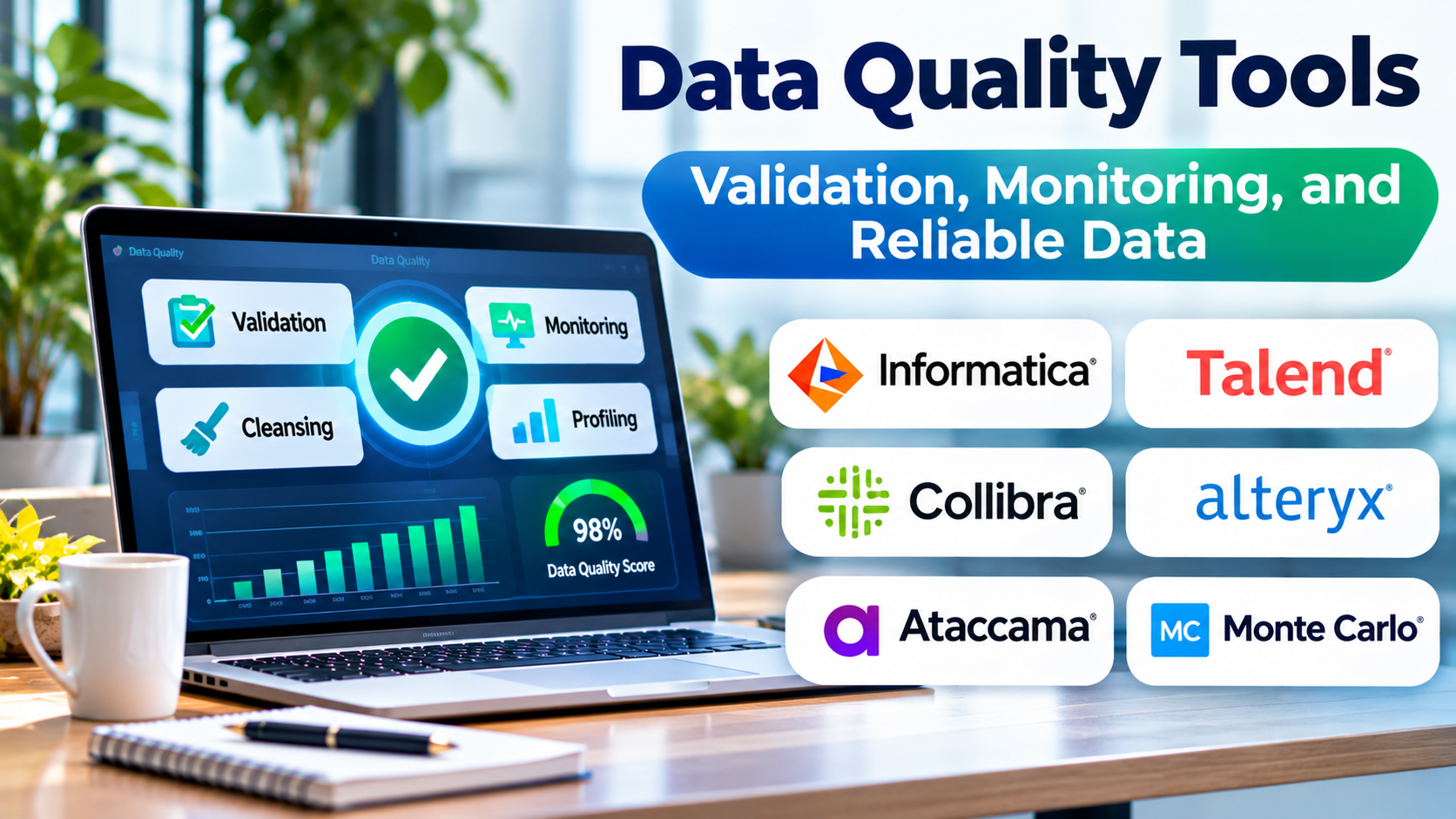
A dashboard can look impressive while showing incorrect information.
A customer database may contain duplicate accounts. A sales report may include transactions twice. A delivery system may store incomplete addresses. An artificial intelligence application may produce unreliable results because its source data contains inconsistent values.
These problems share a common cause: poor data quality.
Data quality tools help organizations identify, measure, prevent, and correct problems in their information.
However, choosing software is only part of the solution. Reliable data also requires clear definitions, ownership, and processes for handling errors.
What Are Data Quality Tools?
Data quality tools are software applications that evaluate and improve the condition of business data.
They help organizations determine whether information is accurate, complete, consistent, valid, unique, and sufficiently current for its intended purpose.
Consider a customer database containing these records:
| Customer ID | Country | |
|---|---|---|
| 1001 | customer@example.com | India |
| 1002 | customer@example.com | IN |
| 1003 | Missing | India |
The first two records may represent the same person. Their country values use different formats. The third record lacks an email address.
A data quality system can identify these potential problems.
It cannot always determine the correct answer automatically. Human review or an authoritative source may still be required.
The Six Core Dimensions of Data Quality
Organizations often evaluate data through several complementary dimensions.
Accuracy
Accuracy measures whether information correctly represents reality.
An incorrect customer address or transaction amount is an accuracy problem.
Accuracy can be difficult to verify without a trusted reference.
Completeness
Completeness examines whether required information is present.
For example, a shipping process may require a delivery address and postal code.
A missing optional middle name may not matter, while a missing shipping address can prevent an order from being completed.
Consistency
Consistency concerns agreement between values, systems, and business rules.
If one system records a subscription as active while another records it as canceled, the discrepancy needs investigation.
Validity
Validity checks whether data follows an expected format or rule.
A date field should contain a valid date. A product quantity may need to be a nonnegative integer.
Valid data is not necessarily accurate. A correctly formatted date can still be the wrong date.
Uniqueness
Uniqueness concerns unwanted duplicate records.
Duplicates can inflate customer counts, distort revenue reports, and create operational confusion.
Timeliness
Timeliness measures whether data is current enough for its intended use.
Yesterday’s inventory count may be sufficient for a monthly report but unsuitable for an application promising immediate stock availability.
The acceptable level of freshness depends on the business process.
How Data Quality Tools Work
Different products support different parts of the data quality lifecycle.
Data profiling
Profiling examines a dataset to understand its structure and characteristics.
It may reveal missing values, unusual distributions, inconsistent formats, or unexpected categories.
Profiling is especially useful when onboarding a new data source.
Data validation
Validation checks information against defined rules.
Examples include verifying that order identifiers are unique or ensuring that every transaction references an existing customer.
Validation rules should reflect business requirements rather than arbitrary technical preferences.
Data cleansing
Cleansing corrects or standardizes known problems.
This may include formatting phone numbers, normalizing country codes, or correcting values using an authoritative reference.
Automated correction requires caution when the intended value is uncertain.
Duplicate detection
Duplicate detection identifies records that may represent the same real-world entity.
Exact matching works when identifiers are consistent.
Fuzzy matching can identify similar names or addresses, but it introduces the risk of incorrectly combining distinct records.
Monitoring and alerts
Ongoing monitoring detects changes in quality after data enters production.
A sudden rise in missing values or unexpected record counts may indicate a broken integration or upstream application change.
Alerts should direct teams toward problems that require action.
Data Quality Tools to Evaluate
The market includes enterprise platforms, developer-oriented frameworks, and open-source projects.
| Tool | Relevant strengths or approach |
|---|---|
| Informatica Data Quality | Enterprise data profiling, standardization, and quality management |
| Ataccama ONE | Data quality within a broader data management environment |
| Talend Data Quality | Profiling and quality capabilities associated with data integration |
| Great Expectations | Declarative data expectations and validation workflows |
| Soda | Data quality checks and monitoring workflows |
| AWS Glue Data Quality | Data quality capabilities within AWS data processing environments |
| Deequ | Open-source data quality testing built around Apache Spark |
These products serve different audiences.
A large enterprise managing customer records across business systems may need different capabilities from a data engineering team validating analytical tables.
Enterprise data quality platforms
Informatica and Ataccama are relevant when data quality must be coordinated across complex organizational environments.
Such evaluations should consider stewardship workflows, data profiling, integration coverage, permissions, and how quality issues are assigned to responsible teams.
The potential benefit is centralized management.
The trade-off can be greater implementation complexity and organizational change.
Developer-oriented validation tools
Great Expectations and Soda are relevant to teams that want to express quality rules as repeatable checks.
For example, a data engineer may define an expectation that an order identifier cannot be null.
The check can run during a pipeline and report failures.
These approaches fit engineering workflows, although teams must still decide how failed checks affect production data.
Cloud-integrated quality capabilities
AWS Glue Data Quality is relevant when workloads already run in the AWS ecosystem.
Using a native service may reduce the need to operate another independent system.
However, organizations should evaluate portability, supported environments, and total service costs.
Open-source approaches
Deequ provides a programmatic approach to measuring data quality in Spark-based environments.
Open-source software can provide flexibility, but operating it still requires engineering effort.
Teams should consider maintenance, documentation, deployment, and monitoring rather than evaluating license cost alone.
Choosing the Right Data Quality Tool
The most useful starting point is a real data problem.
A product demonstration built around a clean sample dataset may reveal little about how software behaves with inconsistent production information.
Match the tool to your environment
Identify where data quality checks need to run.
Possible environments include relational databases, cloud warehouses, data lakes, streaming pipelines, and operational applications.
Confirm that the product supports your actual systems and authentication requirements.
Define the required checks
Different workloads need different forms of validation.
A financial reporting pipeline may prioritize reconciliation and completeness.
A customer database may need duplicate detection and address standardization.
A machine learning dataset may require distribution monitoring and checks for unexpected missing values.
Choose the product around these requirements.
Evaluate the user experience
Some platforms target business data stewards.
Others primarily serve engineers who work with SQL, Python, configuration files, and automated pipelines.
Neither approach is universally better.
The correct interface is the one that allows responsible teams to maintain quality rules consistently.
Consider remediation
Finding a problem is only the first step.
A complete operating process should answer who receives the alert, how the issue is investigated, and whether affected data is corrected, quarantined, or rejected.
A tool that detects hundreds of problems without supporting practical resolution may create more work than value.
Review scalability and cost
Quality checks consume computing resources.
Running complex validations against large datasets can increase warehouse or processing costs.
Evaluate sampling options, incremental checks, scheduling, and the cost of repeated execution.
Data Quality vs. Data Observability
These concepts overlap but are not identical.
Data quality focuses on whether information satisfies defined expectations.
Data observability emphasizes understanding the health of data systems and identifying unexpected behavior.
For example, a quality check may confirm that every order has a valid customer identifier.
An observability system may detect that a table stopped receiving new orders.
Many platforms combine elements of both approaches.
The important question is whether the product covers the failure modes your organization needs to detect.
Building an Effective Data Quality Program
Software works best when paired with clear responsibilities.
Identify critical data
Begin with information that directly affects revenue, customers, compliance, or operational decisions.
Trying to improve every field simultaneously can overwhelm a team.
Define measurable rules
A vague requirement such as “customer data must be accurate” is difficult to enforce.
A measurable rule is more useful.
For example, every completed order must reference an existing customer record.
Establish ownership
Each important dataset should have a responsible owner.
Ownership should cover definitions, acceptable quality thresholds, and decisions about remediation.
Automate checks
Place appropriate checks close to the point where data is created or transformed.
Early detection can prevent bad records from spreading into downstream applications.
Measure improvement
Track indicators such as failed validations, unresolved issues, duplicate rates, and time to resolution.
These measures reveal whether the data quality program is improving actual business reliability.
Common Mistakes to Avoid
One mistake is assuming that all missing values are errors.
Some fields are optional or not applicable to every record.
Another is using automatic cleansing without understanding the business context.
For example, two customers with similar names may be different people.
Organizations also make the mistake of creating too many low-value alerts.
When every minor anomaly generates a notification, teams may stop responding.
Finally, data quality cannot be delegated entirely to the engineering department.
Business owners must help define what correct information means.
Frequently Asked Questions
What is the main purpose of data quality tools?
Their main purpose is to detect, measure, and help resolve problems that make information unreliable for business use.
Can data quality tools automatically fix errors?
Some tools support automated standardization and correction. However, ambiguous or high-impact changes may require human review.
Are open-source data quality tools sufficient?
They can be sufficient for many engineering workflows, especially when teams can maintain validation rules and monitoring infrastructure.
How often should data quality checks run?
Frequency depends on the business requirement. Some checks belong in every pipeline run, while others can operate daily or periodically.
Does better data quality improve AI results?
Reliable source data can reduce certain errors and inconsistencies in AI workflows. It does not guarantee that an AI model will produce correct results.
Final Thoughts
Data quality is not simply about keeping databases tidy.
It determines whether organizations can trust reports, automate decisions, serve customers accurately, and use information responsibly.
The most effective approach begins with critical datasets, measurable expectations, and clear ownership.
Choose tools that fit your technical environment and support practical remediation.
Reliable data emerges when quality becomes part of everyday operations rather than an occasional cleanup project.