A financial dashboard suddenly reports lower revenue than expected. The underlying database appears healthy, and the reporting application loads without errors. Yet nobody can explain why the numbers changed.
The problem may have started several systems earlier.
A source application might have renamed a field. A transformation may have excluded certain transactions. An analytical model may have changed its calculation. By the time the incorrect result reaches the dashboard, identifying the original cause can become difficult.
Data lineage tools help organizations investigate these situations by showing how information moves through their data environment.
They reveal relationships between sources, transformations, datasets, and downstream applications. This visibility supports troubleshooting, change management, governance, and more reliable analytics.
However, a lineage diagram is only useful when it accurately represents the systems and transformations that matter.
What Are Data Lineage Tools?
Data lineage tools are software applications that document and visualize the origin, movement, transformation, and consumption of data.
They help answer important questions:
- Where did this information originate?
- Which systems processed it?
- What transformations changed its values?
- Which reports and applications depend on it?
- Who is responsible for the relevant datasets?
- What could break if a source or transformation changes?
Consider a simplified revenue reporting workflow.
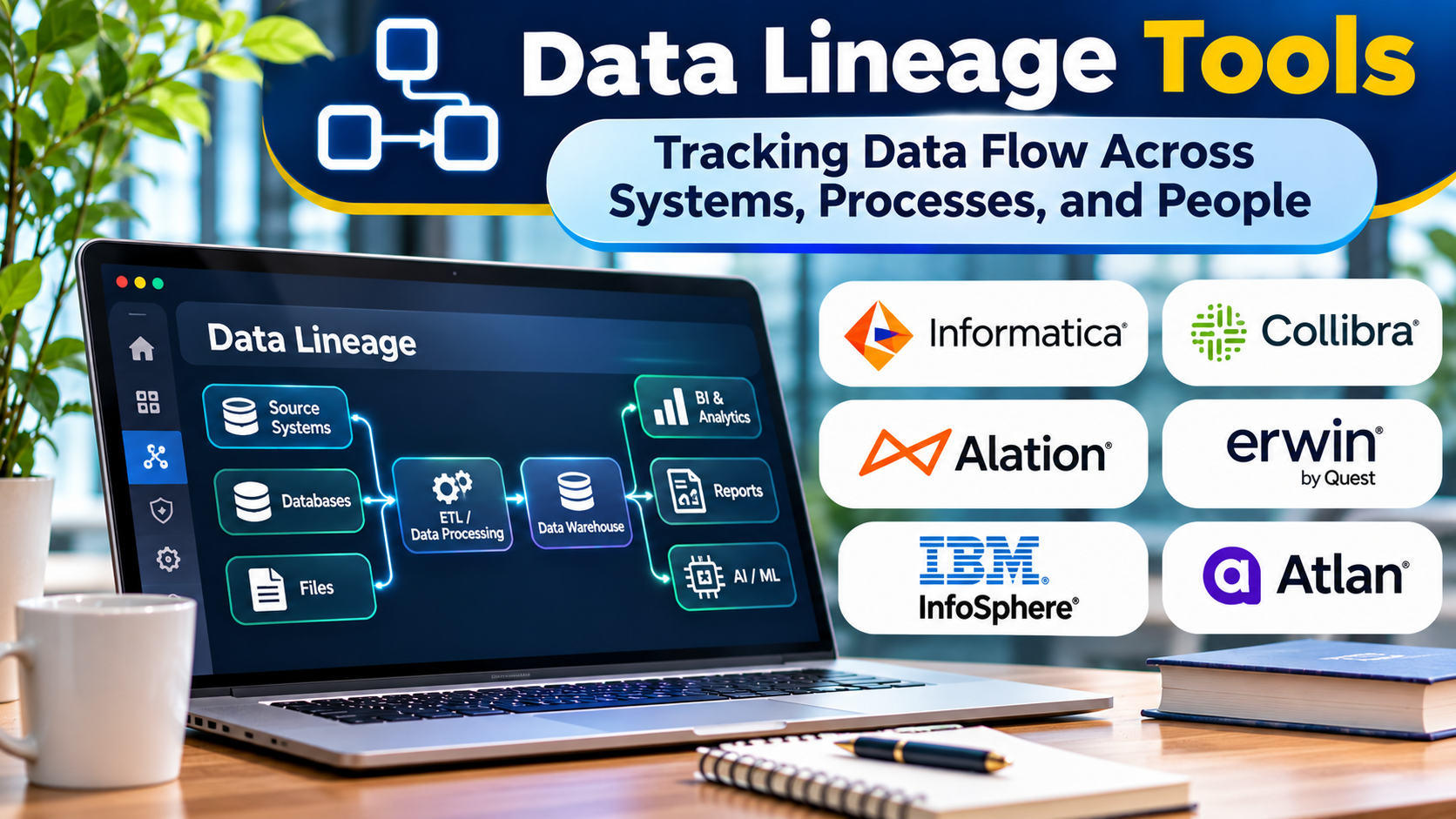
A payment application generates transaction records. An integration pipeline transfers them into a data warehouse. A transformation calculates recognized revenue. A business intelligence dashboard displays the resulting metric.
Data lineage connects these components into a traceable chain.
When the dashboard displays an unexpected result, analysts can investigate the upstream systems and transformations instead of searching blindly.
How Data Lineage Works
Lineage platforms collect information about relationships between data assets.
The information may come from database metadata, SQL queries, transformation frameworks, orchestration systems, execution logs, APIs, or manually maintained documentation.
The platform uses this information to construct a representation of data dependencies.
A typical lineage process contains four stages.
1. Metadata collection
The platform connects to supported systems and discovers relevant metadata.
This may include database schemas, tables, columns, views, analytical models, and scheduled jobs.
Some platforms also collect information about executed queries or transformation definitions.
2. Dependency identification
The platform determines how one asset depends on another.
For example, a reporting table may depend on two source tables and a transformation job.
A dependency relationship does not necessarily prove that every record follows the same path. The level of detail depends on the metadata and processing logic available.
3. Lineage visualization
The discovered relationships appear as a graph.
Users can follow data upstream toward its sources or downstream toward the applications that consume it.
4. Change and impact analysis
Teams use lineage relationships to understand the potential consequences of modifying a dataset.
If a database column is removed, the lineage graph may identify reports or transformations that depend on it.
This helps engineers investigate changes before deployment.
Different Types of Data Lineage
Not all lineage is equally detailed.
Table-level lineage
Table-level lineage shows relationships between datasets or tables.
For example, a customer summary table may depend on customer records and purchase transactions.
This provides a useful architectural overview.
However, it may not reveal which individual fields are involved.
Column-level lineage
Column-level lineage tracks relationships between specific fields.
A revenue field in a report might derive from a transaction amount after currency conversion and filtering.
Column-level visibility is valuable when investigating metric calculations or sensitive information flows.
It can also be difficult to reconstruct across complex SQL expressions, stored procedures, and unsupported systems.
Pipeline-level lineage
Pipeline-level lineage shows how processing jobs connect data sources and destinations.
It helps engineers understand operational dependencies and processing sequences.
Business lineage
Business lineage connects technical assets to business concepts.
For example, a metric named “Net Revenue” may be linked to its definition, analytical model, and reporting dashboard.
This context helps nontechnical users understand how information supports business decisions.
Why Data Lineage Matters
Faster troubleshooting
When a report becomes unreliable, lineage provides a starting point for investigation.
Teams can identify upstream dependencies and narrow the search for the problem.
It does not automatically prove the root cause, but it reduces the amount of unexplored infrastructure.
Safer changes
Data environments evolve continuously.
Engineers rename fields, replace applications, modify pipelines, and optimize analytical models.
Lineage helps identify which downstream assets might be affected.
Better governance
Organizations need to understand where sensitive information originates and how it moves.
Lineage can support investigations into personal data processing, access boundaries, and retention responsibilities.
It does not replace actual access controls or compliance assessments.
Improved collaboration
Data engineers, analysts, and business owners often understand different parts of a data workflow.
A shared lineage view can help them discuss the same dependencies without relying entirely on undocumented institutional knowledge.
More reliable analytics
When a business metric changes, lineage can help users identify its source and transformation history.
This makes analytical results easier to investigate and explain.
Data Lineage Tools Worth Evaluating
Several platforms provide lineage as a primary capability or as part of broader metadata management.
| Platform | Primary evaluation angle |
|---|---|
| MANTA | Automated lineage discovery across complex enterprise data environments |
| Collibra | Lineage connected with enterprise governance and stewardship |
| Alation | Lineage within a broader data catalog and discovery environment |
| Atlan | Metadata-driven lineage and data collaboration |
| DataHub | Open-source metadata platform with lineage capabilities |
| OpenMetadata | Open-source metadata management and lineage visualization |
| OpenLineage | Open standard and ecosystem for collecting lineage events |
These options have different purposes. OpenLineage, for example, is not a direct replacement for a complete enterprise lineage application.
MANTA
MANTA focuses on automated data lineage.
It is particularly relevant to organizations that need to investigate relationships across complicated data processing environments.
Evaluation should focus on supported technologies, transformation parsing, column-level coverage, and the accuracy of discovered dependencies.
Collibra
Collibra connects lineage with broader data governance activities.
It may be relevant when organizations want to understand technical dependencies alongside ownership, business definitions, and governance processes.
Buyers should confirm which lineage capabilities and integrations are included in the proposed deployment.
Alation
Alation provides data cataloging capabilities alongside lineage-related functionality.
It is relevant when the main objective is helping users discover, understand, and evaluate analytical assets.
The depth of lineage support should be tested against the organization’s actual transformation environment.
Atlan
Atlan offers metadata-oriented data management capabilities, including lineage.
It may appeal to teams seeking collaboration between engineering, analytics, and governance users.
Evaluation should emphasize connector coverage, dependency accuracy, permissions, and the usability of lineage views.
DataHub
DataHub is an open-source metadata platform that supports lineage relationships.
It is relevant to engineering teams that want extensible metadata infrastructure and integration with existing data systems.
The organization must account for deployment, maintenance, and metadata ingestion responsibilities.
OpenMetadata
OpenMetadata combines data discovery and metadata management with lineage capabilities.
It may suit teams seeking an open-source approach to understanding data assets and their relationships.
Organizations should validate connector behavior and transformation coverage before adopting it for critical impact analysis.
OpenLineage
OpenLineage provides a standard approach to collecting lineage information from supported processing systems.
It is especially relevant to engineering teams building interoperable lineage collection workflows.
A complete implementation generally requires compatible integrations and a system for storing, processing, or visualizing the resulting metadata.
How to Choose the Right Data Lineage Tool
The most important selection factor is not the visual appearance of the dependency graph.
It is whether the graph accurately covers the organization’s critical data flows.
Check integration coverage
Create an inventory of the systems involved in important workflows.
Include databases, warehouses, transformation frameworks, orchestration tools, reporting applications, and relevant legacy technologies.
Confirm which components the platform can discover automatically.
Evaluate lineage granularity
Table-level lineage may be sufficient for architectural documentation.
Financial reconciliation, sensitive-data investigations, and detailed impact analysis may require column-level lineage.
Choose the level of detail based on actual use cases.
Test complex transformations
Simple SQL queries are relatively easy to interpret.
Complex queries, dynamic SQL, stored procedures, and custom application logic can be more challenging.
Use representative production transformations during evaluation.
Examine metadata freshness
Lineage becomes misleading when it reflects an outdated environment.
Determine how frequently metadata updates and how the platform detects changed dependencies.
Review security
Lineage metadata can reveal application names, table structures, business relationships, and sensitive processing paths.
Access should be controlled appropriately.
Calculate operating costs
Consider subscription charges, infrastructure, metadata ingestion, connector maintenance, and the effort required to correct incomplete lineage.
A Practical Lineage Implementation Plan
Begin with one important reporting workflow.
For example, select the monthly revenue dashboard.
Identify the source systems, integration jobs, warehouse tables, transformations, and reporting assets involved.
Connect the supported systems to the lineage platform.
Then compare the discovered relationships against the actual processing logic.
Investigate missing dependencies and incorrect relationships.
Once the lineage is reliable, test a realistic change scenario.
For example, determine which reports would be affected if a source column changed.
This provides a meaningful measure of whether the platform supports impact analysis.
Expand coverage only after the initial workflow delivers useful results.
Common Data Lineage Mistakes
One mistake is assuming that automatic discovery guarantees completeness.
A platform may recognize standard SQL transformations while missing custom scripts or unsupported applications.
Another mistake is confusing lineage with data quality.
Lineage explains relationships between assets. It does not necessarily determine whether the data values are correct.
Organizations also sometimes create detailed lineage graphs without establishing ownership.
When nobody is responsible for correcting missing or inaccurate metadata, the graphs become less reliable over time.
Finally, collecting every possible dependency can overwhelm users.
Prioritize useful views and critical workflows rather than presenting enormous diagrams without context.
Data Lineage vs. Data Catalog
A data catalog helps users discover and understand available data assets.
Data lineage explains relationships between those assets.
For example, a catalog may describe a customer revenue table, its owner, and its approved business use.
Lineage can show the upstream transactions and transformations that produced the table.
Many platforms combine both capabilities.
The distinction remains important because strong search and documentation do not guarantee complete lineage coverage.
Frequently Asked Questions
What is the main purpose of data lineage tools?
They help organizations understand where data originates, how it changes, and which downstream systems depend on it.
Can data lineage tools detect incorrect data?
They can help locate potential sources of incorrect information, but they do not automatically verify the accuracy of every value.
What is column-level lineage?
Column-level lineage tracks dependencies between individual fields rather than only between complete tables or datasets.
Are open-source lineage tools suitable for enterprises?
They can be, provided the organization has the engineering resources to maintain integrations, metadata infrastructure, security, and operational support.
Does data lineage help with compliance?
It can support data flow documentation and investigations, but it does not independently establish regulatory compliance.
Final Thoughts
Data lineage tools make complex data environments easier to understand.
They help organizations investigate unexpected results, evaluate proposed changes, and explain how business information moves between systems.
The most useful platform is not necessarily the one with the most elaborate diagrams.
It is the one that accurately represents critical dependencies, remains current as systems change, and helps teams make better technical and business decisions.