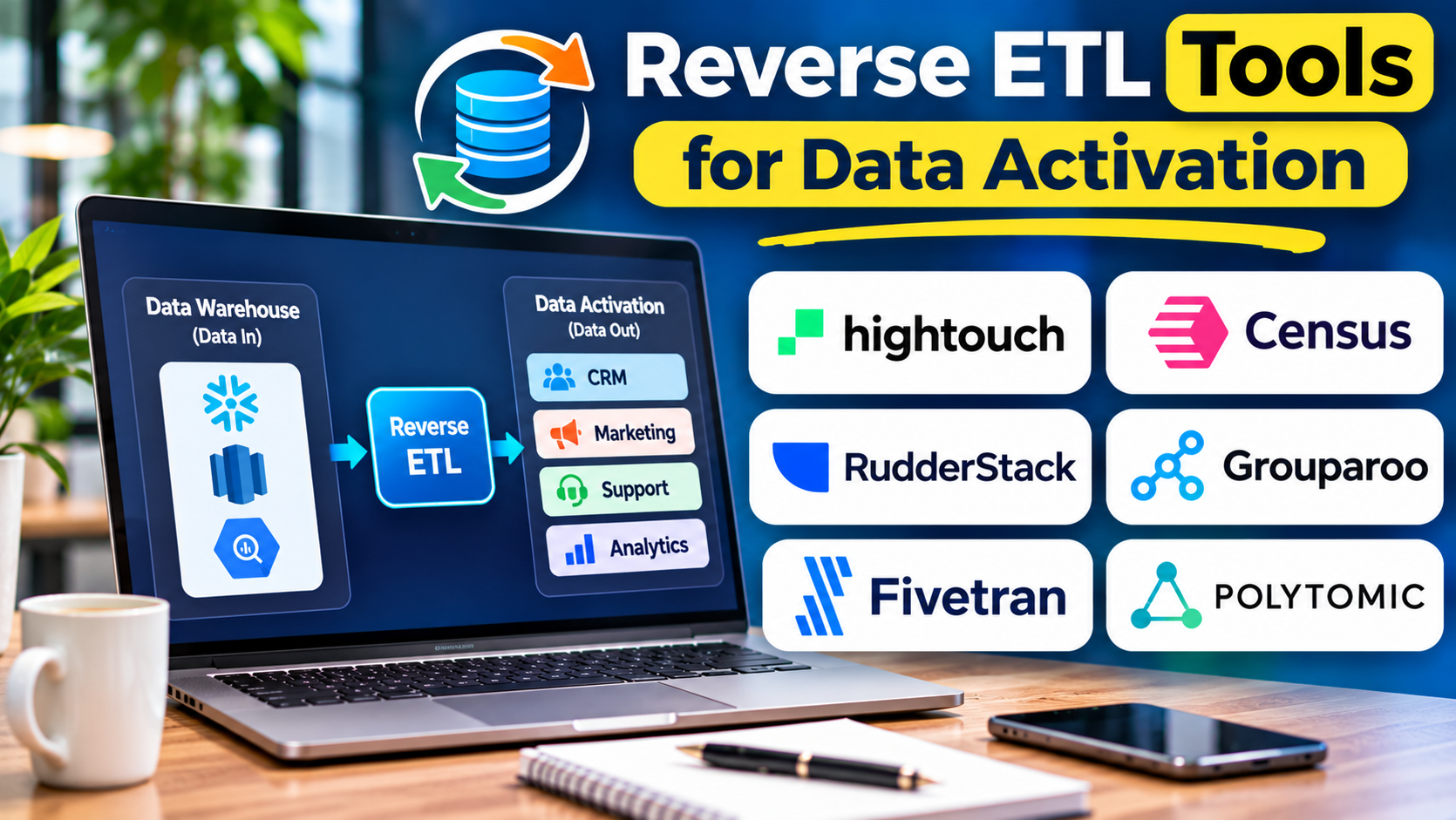
A company may have excellent customer data and still struggle to use it. Marketing teams work in one application, sales teams use another, and support teams rely on a third. Meanwhile, the most complete customer information often sits inside a central data warehouse.
Reverse ETL tools help close this gap.
Instead of simply moving information into a warehouse for reporting, reverse ETL moves selected, prepared data from the warehouse into the applications where employees work. This allows organizations to turn analytical insights into useful business actions.
However, moving data between systems introduces important decisions about identity matching, security, synchronization, reliability, and cost. Choosing the right platform requires more than checking how many integrations a vendor advertises.
What Are Reverse ETL Tools?
Reverse ETL tools are software platforms that transfer data from analytical systems, such as cloud data warehouses, into operational applications.
Traditional ETL stands for extract, transform, and load. It usually describes moving data from source systems into a destination where it can be stored and analyzed.
Reverse ETL moves in the opposite direction.
For example, a business might collect purchase histories, website activity, and customer support information in its warehouse. Analysts then calculate a customer health score.
A reverse ETL platform can send that score to a customer relationship management (CRM) system. Account managers can use the updated information without opening the warehouse.
Typical destinations include:
- CRM platforms
- Marketing automation applications
- Customer support systems
- Advertising platforms
- Customer success applications
- Sales engagement software
- Internal business applications
The important distinction is that reverse ETL generally works with prepared warehouse data rather than attempting to replace the warehouse itself.
How Reverse ETL Works
A reverse ETL workflow usually contains five stages.
1. Connect to the data warehouse
The platform connects to an analytical data source.
Common environments include Snowflake, Google BigQuery, Amazon Redshift, and other SQL-accessible systems.
The connection typically requires credentials and permissions to read selected datasets.
Organizations should avoid granting broader access than the workflow needs.
2. Select the data
Teams identify which records should reach a destination.
These records may come from SQL queries, modeled tables, or views.
For example, a marketing team might need customers who purchased twice during the previous month but have not purchased recently.
A data team can define that audience using warehouse data.
3. Match destination records
The platform must determine which destination record corresponds to each warehouse record.
Matching may rely on customer IDs, email addresses, account identifiers, or other supported keys.
This is one of the most important implementation decisions.
An incorrect match can update the wrong customer, create duplicates, or overwrite valid information.
4. Synchronize the data
The platform sends selected fields to the destination using its supported integration.
Depending on the destination and workflow, synchronization may create records, update existing records, or perform an upsert.
An upsert means updating an existing record or inserting a new one when appropriate.
5. Monitor synchronization results
A reliable workflow should reveal which records were successfully delivered and which failed.
Useful monitoring includes error logs, retry behavior, synchronization history, and alerts.
Without visibility, a business team may continue using outdated information without realizing anything has gone wrong.
Where Reverse ETL Creates Business Value
Reverse ETL is most useful when analytical data needs to influence operational decisions.
Customer segmentation
Marketing teams often need customer groups based on information spread across several systems.
A warehouse can combine transaction history, engagement activity, and customer attributes.
Reverse ETL can then send the resulting audience to a supported marketing application.
The marketing team receives a usable segment without manually exporting spreadsheets.
Sales prioritization
Sales representatives benefit from knowing which accounts show strong buying signals.
A warehouse might combine product usage, trial activity, and account information into a qualification score.
Sending that score into the CRM helps representatives prioritize their outreach.
The quality of the underlying score matters just as much as the synchronization technology.
Customer success
Customer success teams need timely information about product adoption and account health.
Reverse ETL can deliver usage summaries or risk indicators to the systems where account managers organize their work.
This reduces the need to switch constantly between analytical dashboards and operational tools.
Support personalization
Support teams may need account tier, product usage, or subscription information when responding to a customer.
Synchronizing appropriate warehouse fields can make that context available within a support application.
Sensitive information should only be transferred when the destination genuinely needs it.
Reverse ETL Platforms Worth Evaluating
Different platforms approach data activation differently.
| Platform | Primary consideration |
|---|---|
| Hightouch | Warehouse-based data activation and audience workflows |
| Census | Reverse ETL and operational data synchronization |
| RudderStack | Customer data infrastructure with warehouse activation capabilities |
| Polytomic | Data synchronization across business applications and databases |
| Custom SQL and API workflows | Greater implementation control with additional engineering responsibility |
These options are not interchangeable.
A platform designed around marketing audiences may offer a different experience from one focused on general-purpose data synchronization.
Organizations should confirm the current capabilities of each product against their own destinations, security requirements, and data models.
Hightouch
Hightouch is associated with warehouse-centered data activation.
It is relevant when organizations want to use modeled warehouse information across customer-facing applications.
Evaluation should focus on the required destinations, audience management, synchronization controls, and how the platform fits existing data transformation workflows.
Census
Census is another established name in reverse ETL.
Its approach is relevant to organizations that want to connect analytical data with operational business applications.
Buyers should examine record matching, field mapping, synchronization monitoring, and the specific integrations they need.
RudderStack
RudderStack approaches the problem from a broader customer data infrastructure perspective.
It may be worth evaluating when an organization needs customer event collection and downstream data activation within a connected architecture.
The key question is whether the broader platform simplifies operations or introduces capabilities the team does not need.
Polytomic
Polytomic is relevant to organizations exploring synchronization between business systems and databases.
Teams should examine whether its supported synchronization patterns match their required data movement direction, update frequency, and destination behavior.
Building a custom solution
A business can also build reverse ETL workflows using SQL, APIs, orchestration software, and custom scripts.
This approach may suit a small number of stable integrations.
However, custom development requires ongoing ownership of authentication, retries, API changes, monitoring, and failure recovery.
The apparent savings from avoiding a commercial license can disappear when maintenance becomes complex.
How to Choose the Right Reverse ETL Tool
A good evaluation begins with a specific workflow rather than a vendor demonstration.
Verify destination support
A platform may advertise hundreds of integrations without supporting the exact operation your business needs.
Confirm whether the required destination supports record creation, updates, deletion, and appropriate matching behavior.
Also examine API limitations and how synchronization failures are handled.
Evaluate data freshness
Not every workflow needs immediate updates.
A daily synchronization may be sufficient for customer segmentation. A time-sensitive operational workflow may require updates much more frequently.
Define the maximum acceptable delay before evaluating products.
Examine identity resolution
Customer identity is rarely simple.
One customer may have several email addresses, multiple accounts, or incomplete identifiers.
A platform should support the matching strategy your organization actually uses.
Assess security
Reverse ETL frequently moves customer information into additional systems.
Review:
- Access controls and permissions
- Credential storage
- Encryption during transmission
- Audit logs
- Sensitive-field restrictions
- Data retention and deletion behavior
- Applicable privacy requirements
A technically successful synchronization can still create a governance problem if unnecessary personal data reaches an unsuitable destination.
Understand total cost
Subscription pricing is only one component.
Additional costs may include warehouse queries, destination API usage, implementation work, monitoring, and maintenance.
A low-cost platform that repeatedly executes expensive warehouse queries may be more costly than expected.
Common Reverse ETL Mistakes
One common mistake is synchronizing too much data.
Business applications rarely need every warehouse field. Sending unnecessary information increases complexity and exposure.
Another mistake is treating synchronization as a substitute for data quality.
Reverse ETL cannot repair incorrect customer identities or unreliable business definitions on its own.
Teams also underestimate destination API limits. A warehouse may process millions of records efficiently while a CRM accepts updates at a much slower rate.
Finally, organizations sometimes overlook ownership.
Every production synchronization needs someone responsible for its business logic, data quality, failures, and ongoing changes.
A Practical Implementation Plan
Begin with one high-value workflow.
For example, send a customer health score from the warehouse into the CRM.
First, define the business outcome and the destination fields.
Next, verify that the warehouse contains accurate identifiers and suitable data.
Then, test the synchronization with a limited group of records.
Check whether records are matched correctly, whether updates arrive within the expected period, and whether failures are visible.
After validation, expand the workflow gradually.
Monitor synchronization success, destination data quality, and the business outcome the workflow was designed to improve.
This approach provides stronger evidence of value than launching many integrations simultaneously.
Reverse ETL vs. Other Data Integration Approaches
Reverse ETL is not the only way to move information between systems.
Traditional ETL and ELT primarily support analytical data preparation.
Customer data platforms may combine identity management, event collection, segmentation, and activation.
Integration platforms connect applications and automate workflows, often using events and APIs.
Reverse ETL is particularly relevant when the warehouse already contains trusted, modeled data that needs to reach operational systems.
The best choice depends on where the authoritative data lives and how quickly business applications need it.
Frequently Asked Questions
Is reverse ETL the opposite of ETL?
It describes a different direction of data movement, but the two approaches are complementary. ETL or ELT prepares analytical data, while reverse ETL activates selected results in operational systems.
Does reverse ETL replace a customer data platform?
Not necessarily. Some capabilities overlap, but customer data platforms may also provide event collection, identity resolution, and other functions beyond warehouse synchronization.
Can reverse ETL work without a cloud warehouse?
Some products support additional databases and analytical sources. Compatibility depends on the specific platform and connector.
Is reverse ETL suitable for small businesses?
It can be, particularly when a business already maintains a warehouse and needs several reliable operational integrations. For simpler workflows, direct application integrations may be more economical.
What is the biggest risk?
Incorrect record matching and poorly governed data transfers are especially important risks because they can affect customer records and expose information beyond its intended audience.
Final Thoughts
Reverse ETL turns analytical data into information that employees can use inside their existing applications.
Its value comes from connecting trusted business definitions with reliable operational workflows, not simply from moving more records.
Organizations should begin with one clearly defined use case, verify matching and destination behavior, and measure the outcome before expanding.
The right reverse ETL platform is the one that delivers useful data accurately, securely, and at a sustainable operational cost.