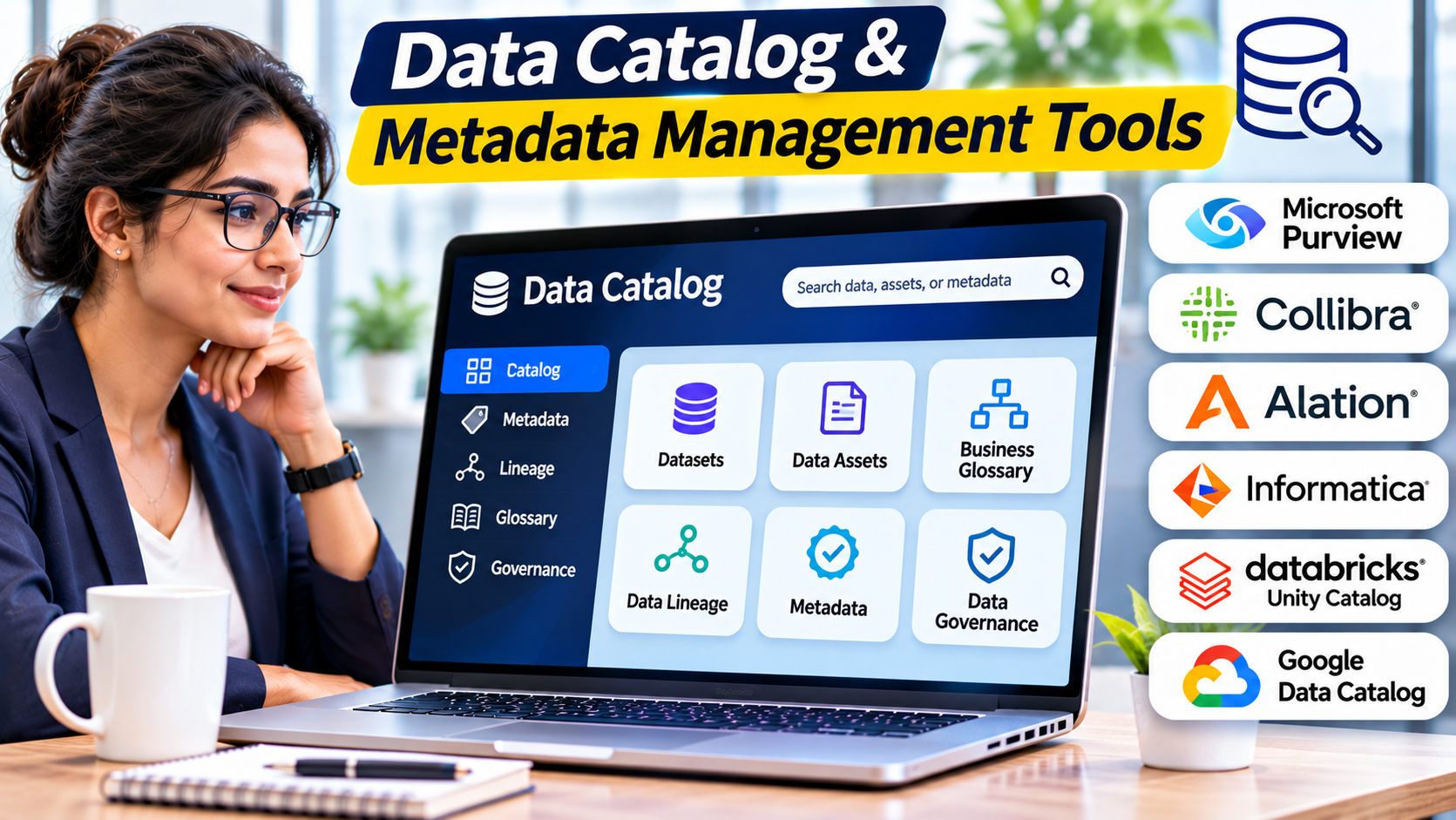
Finding the right information inside a large organization can be surprisingly difficult.
A company may have thousands of database tables, dashboards, files, and analytical models. Different departments may use different names for the same business metric. Employees may know that useful information exists but have no reliable way to locate it.
Data catalog and metadata management tools address this problem.
They help organizations organize information about their data so employees can discover relevant assets, understand their meaning, identify ownership, and assess whether the information is appropriate for a particular purpose.
Yet a catalog is not automatically useful because it contains many datasets. Its value depends on the accuracy, context, and maintenance of the metadata it provides.
What Is a Data Catalog?
A data catalog is a searchable inventory of data assets.
It provides information about datasets, tables, columns, reports, dashboards, and other resources.
A useful catalog may describe:
- Where a dataset is stored
- What its fields represent
- Who owns it
- How recently it was updated
- Whether it contains sensitive information
- Which systems use it
- Whether it is approved for business reporting
- How it relates to other assets
Consider an analyst searching for monthly recurring revenue.
Without a catalog, the analyst may find several similarly named tables and struggle to determine which one contains the approved business definition.
A well-maintained catalog can help identify the authoritative dataset and its responsible owner.
What Is Metadata Management?
Metadata is information that describes other data.
Metadata management is the process of collecting, organizing, maintaining, and governing that descriptive information.
Three categories are especially useful.
Technical metadata
Technical metadata describes how information is structured and stored.
Examples include table names, column types, schemas, database locations, and transformation dependencies.
Business metadata
Business metadata explains what information means.
Examples include metric definitions, business terms, ownership assignments, and approved usage guidelines.
Operational metadata
Operational metadata describes how data systems behave.
It may include execution history, update timestamps, processing activity, and other operational signals.
A catalog commonly uses metadata management capabilities to provide a searchable and understandable view of organizational data.
However, metadata management can extend beyond catalog search into governance, automation, lineage, and lifecycle management.
Why Organizations Need Data Catalogs
The need for cataloging grows as data becomes more distributed.
Faster data discovery
Analysts spend less time searching through unfamiliar databases when they can locate assets through descriptions, tags, and searchable metadata.
The benefit depends on the quality of the catalog’s indexing and documentation.
Consistent business definitions
Different teams may calculate the same metric differently.
For example, one department may count trial accounts as customers while another includes only paying accounts.
A catalog can document approved definitions and connect them to relevant datasets.
This does not automatically resolve disagreements. Business owners still need to agree on the correct definitions.
Clear data ownership
When a dataset produces unexpected results, users need to know who can investigate it.
Ownership information helps route questions and incidents to responsible teams.
Better governance
Catalogs can help organizations identify sensitive datasets and document usage restrictions.
They can also support classification and governance workflows.
However, cataloging sensitive information is not the same as enforcing access controls in the underlying storage system.
Improved analytical confidence
Users are more likely to trust information when they can see its meaning, source, ownership, and known limitations.
This confidence should be supported by evidence rather than a simple label declaring a dataset trustworthy.
Core Features to Look For
Automated metadata discovery
Manual cataloging becomes difficult as the number of assets grows.
Modern tools often connect to data platforms and collect supported metadata automatically.
Buyers should verify exactly which assets and metadata fields each connector can discover.
Search and filtering
Search should help users find relevant information even when they do not know the technical table name.
Useful filters may include source system, business domain, ownership, certification status, and sensitivity classification.
Business glossary
A business glossary provides agreed definitions for important terms.
It helps connect business language with technical assets.
For example, the term “active customer” may link to its approved definition and the analytical model used to calculate it.
Data lineage
Lineage describes how information moves and changes across systems.
A lineage view can help teams understand which reports depend on a particular source.
Coverage varies significantly between platforms, especially for complex transformations and unsupported systems.
Ownership and stewardship
The platform should allow organizations to assign responsibility for data assets.
It should also make ownership visible to users who need help interpreting information.
Classification and governance
Sensitive-data classification helps identify information requiring additional controls.
Organizations should examine how classifications are created, reviewed, updated, and connected to governance processes.
APIs and extensibility
A catalog becomes more useful when metadata can be exchanged with other systems.
APIs, integration frameworks, and supported metadata standards can help reduce isolated documentation.
Data Catalog Platforms Worth Evaluating
Several established products and open-source projects approach metadata management differently.
| Platform | Primary evaluation angle |
|---|---|
| Collibra | Enterprise data intelligence and governance workflows |
| Alation | Data discovery, cataloging, and business context |
| Atlan | Collaborative metadata management and data discovery |
| Microsoft Purview | Data governance and catalog capabilities within Microsoft environments |
| AWS Glue Data Catalog | Technical metadata management for AWS analytical services |
| DataHub | Open-source metadata discovery and management |
| OpenMetadata | Open-source cataloging, metadata, and related data management capabilities |
These platforms should not be treated as identical alternatives.
A cloud service’s technical catalog may meet engineering needs without providing the same business stewardship capabilities as a broader enterprise governance platform.
Collibra
Collibra is relevant to organizations emphasizing formal governance, business definitions, ownership, and stewardship.
Its suitability depends on whether the organization can support the governance processes that accompany the technology.
A comprehensive platform may offer limited value if teams do not maintain the information it contains.
Alation
Alation is associated with enterprise data discovery and cataloging.
It is relevant when organizations want employees to find and understand analytical assets more efficiently.
Evaluation should include search relevance, supported data sources, documentation workflows, and how business context is maintained.
Atlan
Atlan focuses on metadata-driven data collaboration and management.
Organizations evaluating it should examine integrations, asset discovery, lineage coverage, permissions, and how it fits their existing data stack.
Microsoft Purview
Microsoft Purview is relevant to organizations operating within Microsoft’s data and governance ecosystem.
Buyers should examine the specific Purview capabilities available to their environment rather than assuming every governance feature is included in one product configuration.
AWS Glue Data Catalog
AWS Glue Data Catalog provides technical metadata capabilities used by AWS analytical services.
It can be a practical choice for workloads centered on AWS.
However, teams requiring extensive business glossary, stewardship, or cross-platform governance capabilities should evaluate those requirements separately.
DataHub
DataHub is an open-source metadata platform designed around data discovery and metadata management.
It is relevant to engineering teams seeking extensibility and greater control over their metadata infrastructure.
Organizations should account for deployment, operations, integration maintenance, and internal support.
OpenMetadata
OpenMetadata provides an open-source approach to cataloging and managing data assets.
It is relevant when organizations want a platform they can evaluate and potentially operate within their own infrastructure.
As with other open-source options, teams should distinguish software availability from the effort required to maintain a dependable production service.
How to Choose the Right Data Catalog
The best catalog is not necessarily the one with the longest feature list.
It is the one that helps employees answer real questions about organizational data.
Start with user needs
Identify the people who will use the catalog.
Data engineers may prioritize schema discovery and technical lineage.
Analysts may need metric definitions and trusted datasets.
Governance teams may focus on ownership, classification, and policy documentation.
A successful platform should support the intended users without forcing every group into an unsuitable workflow.
Test your actual data sources
Connector coverage deserves careful attention.
A platform may support a database while providing limited visibility into its transformations, dashboards, or permissions.
Test the exact systems and metadata types your organization needs.
Evaluate metadata freshness
A catalog becomes misleading when its metadata is outdated.
Review how often assets are scanned, how changes are detected, and how obsolete information is handled.
Examine ownership workflows
Ask how users can report an incorrect definition or request clarification.
A catalog should make it practical to correct information.
Consider deployment and security
Review authentication, authorization, data residency, network requirements, and administrative access.
Metadata can reveal sensitive details even when the underlying records are not copied into the catalog.
Calculate the operating cost
Commercial licensing, infrastructure, integration development, stewardship effort, and ongoing administration all contribute to cost.
Open-source software may reduce licensing expenses while increasing internal operational responsibilities.
Data Catalog vs. Data Governance Platform
A data catalog primarily helps users discover and understand data assets.
A data governance platform supports the broader processes used to define ownership, policies, responsibilities, and acceptable data use.
Many products combine these capabilities.
The distinction matters because purchasing a catalog does not automatically establish a functioning governance program.
Organizations still need decision-making authority, documented policies, and responsible data owners.
Data Catalog vs. Data Lineage
Cataloging and lineage are closely related.
A catalog answers questions such as:
What is this dataset? Where is it located? Who owns it?
Lineage answers questions such as:
Where did this information come from? Which transformations changed it? What downstream assets depend on it?
A catalog may include lineage, but coverage should be tested rather than assumed.
For complex analytical environments, lineage completeness can become a major selection factor.
How to Implement a Data Catalog Successfully
A practical rollout should begin with a manageable business domain.
Identify priority assets
Choose datasets that support important reports, business processes, or regulatory responsibilities.
Avoid attempting to document every organizational asset immediately.
Connect relevant systems
Configure metadata collection for the selected sources.
Verify that the platform discovers the expected assets and reflects their current structure.
Add business context
Technical names alone rarely help nontechnical users.
Document the meaning, purpose, owner, and known limitations of important datasets.
Establish stewardship
Assign responsibility for maintaining critical definitions and classifications.
Create a process for reviewing changes and correcting outdated information.
Encourage adoption
Introduce the catalog through real tasks.
For example, ask analysts to locate an approved sales dataset using the catalog instead of relying on personal knowledge.
Observe where the experience fails and improve the metadata accordingly.
Measure outcomes
Useful measures include catalog adoption, coverage of critical assets, ownership completeness, and the time required to locate trusted information.
The number of indexed tables alone is not a reliable measure of success.
Common Implementation Mistakes
One mistake is treating metadata collection as the entire project.
Automated scanners can discover technical assets, but they cannot always explain business meaning.
Another mistake is documenting everything without prioritization.
A catalog filled with thousands of poorly described assets may be difficult to use.
Organizations also sometimes assign ownership without giving owners time or authority to maintain definitions.
Finally, catalog teams may overlook search quality.
If users cannot find relevant information quickly, they may return to spreadsheets, chat messages, and informal knowledge sharing.
Frequently Asked Questions
What is the main purpose of a data catalog?
A data catalog helps people discover, understand, and evaluate organizational data assets through searchable metadata.
Does a data catalog store the actual data?
Many catalogs primarily store metadata rather than complete copies of source datasets. Specific storage and processing behavior depends on the platform.
Are open-source data catalogs suitable for enterprises?
They can be, particularly when an organization has the engineering resources to deploy, secure, integrate, and maintain them.
Can a data catalog improve data quality?
A catalog can make quality information visible and help users identify responsible owners. It does not automatically correct inaccurate data.
Is a data catalog necessary for a small company?
Not always. A small organization with a limited number of well-documented datasets may manage effectively with simpler tools. The need increases as data sources, users, and governance requirements grow.
Final Thoughts
Data catalogs and metadata management tools help organizations turn scattered technical assets into information that employees can find and understand.
The strongest implementations combine automated discovery with accurate business definitions, visible ownership, and ongoing maintenance.
Begin with important datasets, test the platform against real user questions, and establish clear stewardship responsibilities.
A successful catalog should not merely describe where data exists. It should help people determine which information they can confidently use and why.