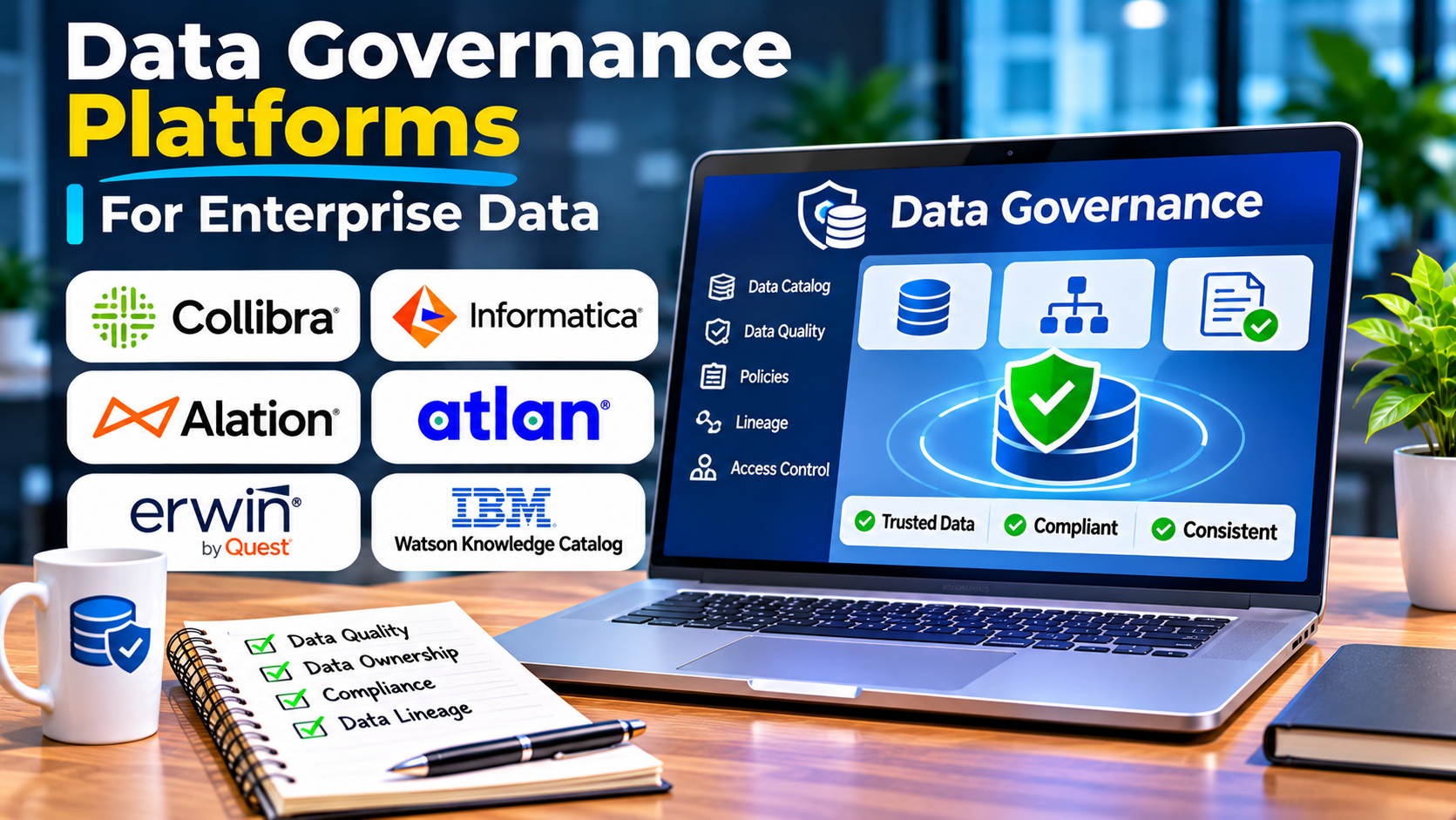
Organizations collect more information than ever before. Customer applications, financial systems, cloud platforms, analytical databases, and artificial intelligence tools all depend on data.
Yet collecting information is not the same as managing it responsibly.
A business may struggle to identify who owns a dataset, whether employees can access it, how long records should be retained, or which information is suitable for an AI application.
These problems are not always caused by missing technology. They often result from unclear responsibilities, inconsistent policies, and disconnected business processes.
Data governance platforms help organizations coordinate the rules, ownership, metadata, and workflows needed to manage information throughout its lifecycle.
However, purchasing governance software does not automatically create good governance. The platform must support a practical operating model that employees can understand and maintain.
What Are Data Governance Platforms?
Data governance platforms are software solutions that help organizations define, document, coordinate, and monitor how data is managed and used.
They commonly support activities such as:
- Data ownership and stewardship
- Business glossary management
- Metadata discovery
- Data classification
- Policy documentation
- Data quality oversight
- Data lineage
- Access request workflows
- Audit evidence collection
- Governance reporting
The purpose is to make data responsibilities visible and help organizations apply consistent management practices.
For example, a company may classify customer contact information as sensitive.
A governance platform can document that classification, identify the responsible owner, and connect the information to relevant policies.
Depending on the platform and integrations, it may also coordinate access approvals or help enforce certain controls.
However, documenting a policy is different from enforcing it in a database, cloud service, or application.
Organizations must verify how governance decisions translate into technical controls.
Why Data Governance Matters
Consider a company with several departments using customer information.
Marketing maintains campaign audiences. Sales manages customer accounts. Finance processes invoices. Support teams maintain service histories.
Each department has legitimate reasons to use customer information.
Problems arise when ownership, definitions, and access rules are inconsistent.
One department may define an active customer as someone who purchased within the previous month.
Another may use a six-month period.
Both reports may be technically correct according to their own calculations, but they cannot be compared reliably.
Data governance establishes processes for agreeing on definitions, assigning responsibility, and documenting approved usage.
It helps organizations make decisions about data rather than leaving those decisions to individual applications or employees.
The Core Components of Data Governance
Data ownership
Every important dataset should have an accountable owner.
The owner is responsible for decisions about its purpose, acceptable use, and business requirements.
Ownership does not necessarily mean that the person maintains the underlying database.
Technical maintenance may belong to a separate engineering team.
Data stewardship
Data stewards help maintain definitions, classifications, quality expectations, and documentation.
They may also investigate data issues and coordinate corrections.
Stewardship turns governance policies into ongoing operational work.
Business glossary
A business glossary defines important organizational terms.
For example, it may establish what counts as an active customer, completed transaction, or recognized revenue.
Shared definitions reduce confusion between departments.
Data classification
Classification identifies information that requires particular handling.
Examples include public information, internal business data, confidential records, and personal information.
The categories should reflect organizational policies and applicable legal requirements.
Data quality management
Governance establishes expectations for important data.
For example, a financial reporting dataset may require complete transaction records and documented reconciliation rules.
Data quality tools can help measure whether these expectations are met.
Data lineage
Lineage helps organizations understand where information originates and how it moves.
It supports impact analysis, investigations, and documentation of processing relationships.
Policy management
Governance policies define how information should be created, accessed, retained, shared, and deleted.
Policies need clear ownership and a practical enforcement process.
Auditability
Organizations may need evidence showing who approved access, how information was classified, and whether required processes were followed.
Governance platforms can help organize relevant records and workflows.
They do not independently guarantee regulatory compliance.
How Data Governance Platforms Work
Most governance implementations begin by collecting metadata from business and technical systems.
The platform may discover databases, tables, analytical assets, and other resources.
Teams then enrich that information with business definitions, classifications, and ownership assignments.
Governance workflows connect the metadata to organizational processes.
For example, an employee might request access to a customer dataset.
The platform may identify the data owner, route the request for approval, and record the decision.
If integrated with an appropriate access management system, the workflow may also help provision access.
The exact behavior depends on the platform and its integrations.
The important principle is that governance decisions should be traceable and connected to actual responsibilities.
Data Governance Platforms Worth Evaluating
The market includes dedicated governance platforms and broader data management suites.
| Platform | Primary evaluation angle |
|---|---|
| Collibra | Enterprise governance workflows, stewardship, and data intelligence |
| Microsoft Purview | Data governance and catalog capabilities within Microsoft-oriented environments |
| Informatica Cloud Data Governance and Catalog | Governance integrated with broader enterprise data management |
| Alation | Data cataloging, discovery, and governance context |
| Atlan | Metadata-driven governance and data collaboration |
| IBM watsonx.data intelligence | Cataloging, lineage, quality, and governance capabilities |
| Ataccama ONE | Data quality and governance within a broader data management platform |
These products have different strengths and deployment considerations.
A platform that works well for a Microsoft-centered organization may not be the most suitable choice for an enterprise with extensive legacy infrastructure.
Collibra
Collibra is relevant to organizations seeking structured data governance processes.
Its capabilities are associated with data intelligence, stewardship, ownership, and governance workflows.
It may suit enterprises that need formal responsibility assignments and consistent business definitions across departments.
Evaluation should focus on implementation effort, workflow flexibility, integration coverage, and whether business teams can maintain the governance information.
Microsoft Purview
Microsoft Purview provides data governance capabilities, including metadata discovery and cataloging.
It is particularly relevant to organizations already using Microsoft data services.
Microsoft’s governance environment includes capabilities such as Data Map and Unified Catalog.
Buyers should distinguish between the specific governance, security, and compliance products available under the broader Purview offering.
Licensing, deployment requirements, and integration coverage should be confirmed for the intended configuration.
Informatica Cloud Data Governance and Catalog
Informatica provides governance and catalog capabilities within its broader data management environment.
It is relevant to enterprises that want governance connected with data integration, quality, and metadata management.
Organizations should examine how the different capabilities interact and whether the proposed implementation fits their existing architecture.
Alation
Alation emphasizes data discovery and the business context needed to understand analytical assets.
It can be relevant when governance adoption depends heavily on helping employees find trusted data.
Evaluation should consider search, business glossary support, ownership workflows, and integration with existing governance processes.
Atlan
Atlan provides metadata-driven data management capabilities.
It is relevant to organizations seeking collaboration between data engineers, analysts, and governance stakeholders.
Buyers should assess metadata coverage, classifications, lineage, workflow support, and the platform’s fit with their data environment.
IBM watsonx.data intelligence
IBM watsonx.data intelligence brings together capabilities related to data discovery, metadata, lineage, quality, and governance.
It may be relevant to organizations with complex enterprise data environments and broader data management requirements.
Evaluation should focus on the exact capabilities included, integration needs, operational complexity, and governance responsibilities.
Ataccama ONE
Ataccama ONE combines data management capabilities that include data quality and governance-related functions.
It may appeal to organizations that want to connect quality management with broader governance activities.
Teams should examine whether the platform supports their required stewardship processes, metadata coverage, and data quality controls.
How to Choose the Right Data Governance Platform
The most important question is not which product offers the most governance features.
It is which product supports the organization’s actual governance responsibilities and workflows.
Start with governance objectives
Define the problems the organization needs to solve.
Examples include:
- Unclear data ownership
- Conflicting business definitions
- Difficulty locating sensitive information
- Inconsistent access approval processes
- Missing documentation for important datasets
- Weak visibility into data quality responsibilities
Prioritize a small number of measurable objectives.
Evaluate metadata coverage
A governance platform needs visibility into the data assets it is expected to manage.
Confirm support for the organization’s databases, warehouses, data lakes, analytical applications, and other relevant systems.
Test the actual metadata collected rather than relying only on connector lists.
Examine stewardship workflows
Governance requires people to make and maintain decisions.
The platform should make it practical to assign owners, approve changes, review classifications, and resolve disagreements.
Complex workflows that employees avoid can undermine adoption.
Verify policy enforcement
Some platforms primarily document governance policies.
Others integrate with systems that enforce access or usage restrictions.
Determine which controls are native, which require integrations, and which remain manual.
Assess security
Governance platforms may contain sensitive metadata about business systems.
Review authentication, authorization, audit logs, encryption, and administrative permissions.
The platform should not expose confidential information merely because it serves as a central inventory.
Consider scalability
A small governance initiative may involve dozens of critical datasets.
A large enterprise may need to manage thousands of systems and many organizational domains.
The platform should support the expected volume without making everyday governance work unnecessarily difficult.
Understand total cost
Costs may include licensing, metadata processing, implementation services, infrastructure, integration development, and ongoing stewardship.
Governance software should be evaluated as part of an operating program rather than a standalone purchase.
Centralized vs. Federated Data Governance
Governance programs can be organized in different ways.
Centralized governance
A central team defines and manages governance policies across the organization.
This can support consistency and standardization.
However, the central team may become a bottleneck if every decision requires its approval.
Federated governance
A federated model distributes some responsibilities to business domains while maintaining shared organizational standards.
For example, finance may own financial data definitions while marketing manages campaign-related datasets.
A central governance function establishes common policies and oversight.
This approach can scale across departments, but it requires clear accountability and coordination.
Hybrid governance
Many organizations combine centralized standards with domain-level ownership.
A central team defines security classifications and governance principles.
Business teams maintain the definitions and quality expectations relevant to their datasets.
The correct model depends on organizational structure and the maturity of its data management practices.
Data Governance vs. Data Management
Data management is the broader discipline of collecting, storing, processing, protecting, and using information.
Data governance establishes the decision-making framework that guides those activities.
For example, a data engineering team may build a pipeline that transfers customer records into a warehouse.
Governance determines who owns the information, what quality standards apply, and how it may be used.
Both are necessary.
Strong governance without reliable technical systems is difficult to implement.
Strong technical systems without governance can produce inconsistent or poorly controlled information.
Data Governance and Artificial Intelligence
AI systems create additional reasons to understand how organizational data is managed.
An AI application may retrieve documents, query databases, or use internal information to generate responses.
Organizations need to know whether the information is appropriate for the intended use.
Governance considerations include data classification, access permissions, source reliability, retention, and the handling of sensitive records.
Data lineage and metadata can help explain which sources are available to an AI workflow.
However, a governance platform does not automatically make AI outputs accurate, safe, or compliant.
Organizations still need model evaluation, application security, human oversight, and other appropriate controls.
How to Implement Data Governance Successfully
1. Establish executive accountability
Governance initiatives often require cooperation across departments.
Leadership should define the program’s purpose and support decisions about ownership and policy.
2. Select a critical business domain
Begin with information that has clear operational importance.
Customer records, financial reporting, or regulated information may provide a useful starting point.
3. Identify data owners
Assign responsibility for important datasets and business definitions.
Avoid creating ownership labels that have no practical meaning.
4. Document governance policies
Define the rules that matter for the selected domain.
These may include access approval, classification, quality expectations, and retention responsibilities.
5. Connect relevant systems
Use the governance platform to discover and document the selected assets.
Verify that metadata is accurate and sufficiently current.
6. Establish stewardship workflows
Create processes for reviewing definitions, resolving issues, and approving changes.
Keep workflows simple enough for employees to use consistently.
7. Measure outcomes
Track practical indicators such as:
- Percentage of critical datasets with assigned owners
- Completion of required classifications
- Time needed to approve data access
- Number of unresolved governance issues
- Coverage of approved business definitions
- Adoption of governed data assets
These measures provide more useful evidence than the total number of policies stored in the platform.
Common Data Governance Mistakes
Treating governance as an IT-only responsibility
IT teams can implement technical controls, but business departments must define how information should be used.
Without business participation, governance rules may not reflect operational needs.
Creating too many policies
A large collection of documents does not necessarily produce effective governance.
Policies should be understandable, actionable, and connected to clear responsibilities.
Ignoring employee experience
Governance processes that make legitimate work unnecessarily difficult can encourage informal workarounds.
The goal is controlled and responsible data use, not preventing employees from accessing information they need.
Failing to maintain metadata
Ownership assignments, classifications, and business definitions change.
A governance platform becomes less reliable when information is not updated.
Assuming software guarantees compliance
Governance software can support documentation, controls, and evidence collection.
Legal compliance depends on applicable requirements and how the organization actually operates.
Frequently Asked Questions
What is the main purpose of a data governance platform?
A data governance platform helps organizations coordinate ownership, policies, metadata, classifications, and workflows for responsible data management.
Is data governance the same as data security?
No. Data security focuses on protecting information from unauthorized access and other threats. Data governance addresses broader questions about ownership, quality, acceptable use, and accountability.
Do small businesses need data governance software?
Not always. Smaller organizations may begin with documented responsibilities and basic controls. Dedicated software becomes more useful as data systems, users, and governance requirements grow.
Can data governance improve data quality?
Yes. Governance establishes ownership and quality expectations, while data quality processes and tools help measure and address problems.
Does data governance support regulatory compliance?
It can support compliance activities by documenting policies, responsibilities, classifications, and relevant workflows. It does not independently guarantee compliance.
What is the difference between data governance and MDM?
Data governance establishes the rules and responsibilities for managing information. MDM focuses on maintaining consistent records for important business entities.
Final Thoughts
Data governance platforms help organizations establish accountability and consistency across increasingly complex information environments.
Their value comes from connecting data assets with clear ownership, trusted definitions, practical policies, and measurable processes.
The strongest governance programs begin with real business problems rather than extensive documentation exercises.
Choose a platform that fits the organization’s data environment, supports everyday stewardship, and connects governance decisions to operational controls.
Good governance should make information easier to understand, safer to use, and more dependable for business decisions.