Modern applications generate information continuously.
An online store records purchases, product views, and inventory changes. A payment service processes transactions throughout the day. A manufacturing plant receives measurements from connected equipment.
For some business processes, waiting until the next scheduled data processing job is not practical.
A fraud detection system may need to evaluate transactions immediately. A delivery application may need current shipment information. An operational dashboard may need to show activity within seconds.
Stream processing frameworks help organizations analyze and transform data as it arrives.
They provide tools for building applications that continuously process events, calculate results, and deliver information to downstream systems.
However, continuous processing introduces challenges that traditional scheduled jobs may not encounter. Event ordering, late-arriving information, state management, failure recovery, and operational costs all influence the success of a streaming architecture.
Choosing the right framework requires understanding these challenges before comparing individual technologies.
What Are Stream Processing Frameworks?
Stream processing frameworks are software systems used to perform computations over continuously arriving data.
Instead of waiting for an entire dataset to accumulate, they process events as those events become available.
An event may represent a purchase, sensor measurement, application error, or customer interaction.
For example, an e-commerce platform may generate an event every time a customer completes a purchase.
A stream processing application could calculate total sales for the previous five minutes and update the result continuously.
Another application might identify unusual transaction patterns and send relevant events to a review system.
Stream processing frameworks make these workflows possible by providing distributed execution, data transformation, aggregation, and recovery capabilities.
How Stream Processing Works
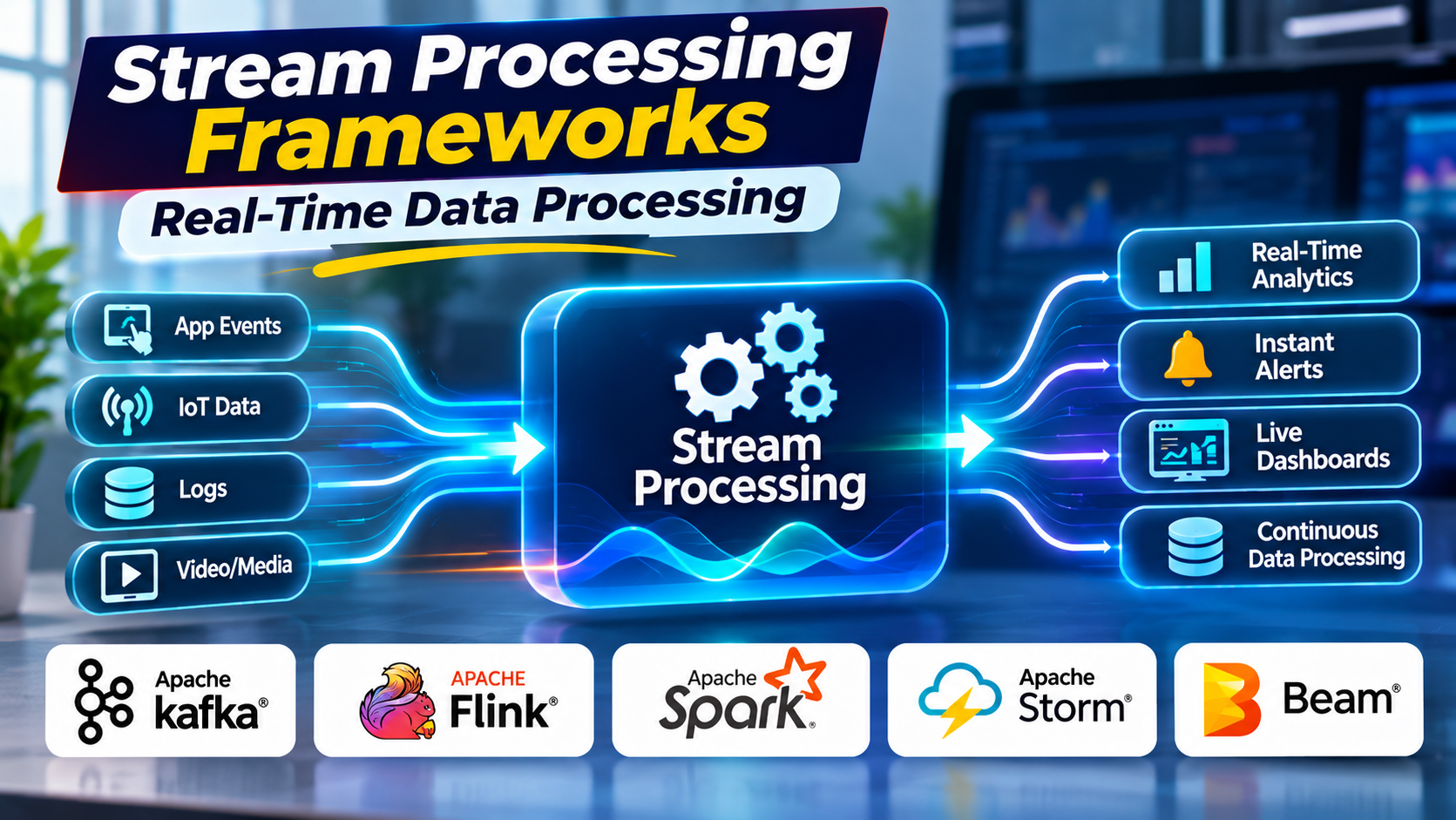
A typical stream processing architecture contains several components.
Event sources
Events originate from applications, databases, devices, or messaging systems.
They may be delivered through Apache Kafka, Amazon Kinesis, Apache Pulsar, or another supported source.
Stream ingestion
The processing application reads events from one or more sources.
Depending on the framework, events may be consumed continuously or through small processing batches.
Transformations
The application applies operations to incoming records.
Common transformations include filtering, mapping, enrichment, and normalization.
For example, a transaction event may be enriched with product category information.
Stateful processing
Some calculations require remembering information from previous events.
A rolling transaction count, for example, must maintain a record of activity within a defined period.
Frameworks use state management mechanisms to support these calculations.
Output
Processed information may be written to databases, analytical platforms, messaging systems, or other applications.
The destination depends on the business use case.
Stream Processing vs. Batch Processing
Stream processing and batch processing solve related problems using different execution models.
| Consideration | Stream processing | Batch processing |
|---|---|---|
| Input | Continuously arriving events | Accumulated datasets |
| Execution | Continuous or incremental | Scheduled or bounded |
| Typical priority | Low processing delay | Efficient large-scale processing |
| State management | Often persistent across events | Usually bounded by job execution |
| Common use cases | Fraud signals, monitoring, live analytics | Historical reporting, bulk transformations |
Neither model is inherently superior.
A monthly financial reconciliation may be better suited to batch processing.
A real-time operational alert may require continuous event processing.
Many organizations combine both models within one data architecture.
Important Stream Processing Concepts
Event time vs. processing time
Event time describes when an event actually occurred.
Processing time describes when the framework processes it.
These timestamps may differ.
For example, a mobile device may record an activity while offline and transmit the event several minutes later.
A framework must determine how to handle this delay when calculating time-based results.
Windowing
Windows group events into meaningful periods.
A tumbling window divides events into fixed, nonoverlapping intervals.
A sliding window creates overlapping intervals.
A session window groups activity based on periods of user or system engagement.
The appropriate window depends on the analytical requirement.
Watermarks
Watermarks help a processing system estimate how far event-time progress has advanced.
They are useful for managing out-of-order events and deciding when time-based results can be finalized or updated.
Watermark behavior varies by framework and configuration.
Stateful processing
Stateful operations maintain information across events.
Examples include running totals, session tracking, and complex event patterns.
State introduces memory, storage, and recovery requirements.
Checkpointing
Checkpointing records processing progress and relevant application state.
After a failure, a framework may use a checkpoint to restore execution.
The effectiveness of recovery depends on the framework, source, destination, and application configuration.
Delivery guarantees
Streaming systems commonly discuss at-most-once, at-least-once, and exactly-once processing.
These guarantees should be evaluated carefully.
Exactly-once state updates inside a framework do not automatically guarantee exactly-once effects in every external database or application.
Stream Processing Frameworks Worth Evaluating
Several established frameworks support continuous data processing.
| Framework | Primary evaluation focus |
|---|---|
| Apache Flink | Stateful, event-time stream processing |
| Spark Structured Streaming | Streaming within the Apache Spark ecosystem |
| Kafka Streams | Embedded stream processing for Kafka applications |
| Apache Beam | Portable programming model for batch and streaming |
| Apache Samza | Distributed stream processing integrated with messaging systems |
| RisingWave | SQL-oriented streaming computation |
| Hazelcast | Distributed computation and stream processing |
These technologies differ in execution architecture, deployment model, programming interfaces, and operational complexity.
Apache Flink
Apache Flink is an open-source framework for stateful computation over data streams.
It is especially relevant when applications require event-time processing, complex state management, and continuous computation.
Flink supports operations such as windowing, aggregations, and event-driven transformations.
Organizations should evaluate state size, checkpointing behavior, deployment requirements, connector compatibility, and operational expertise.
Flink can be powerful, but complex stateful applications require careful design and monitoring.
Spark Structured Streaming
Spark Structured Streaming provides stream processing capabilities within Apache Spark.
It is relevant to organizations already using Spark for data engineering and analytical workloads.
Its APIs allow teams to express streaming transformations using familiar Spark concepts.
The default execution approach uses micro-batches, although supported execution modes and capabilities depend on the Spark version and workload.
Buyers should evaluate latency requirements, state management, recovery, and compatibility with their existing Spark environment.
Kafka Streams
Kafka Streams is a client library for building stream processing applications using Apache Kafka.
Unlike frameworks that require a separate processing cluster, Kafka Streams runs within application processes.
It supports transformations, aggregations, joins, and stateful processing.
It can be appropriate for teams building Kafka-centered applications that need embedded stream processing.
However, its tight relationship with Kafka makes it less suitable when broad source independence is a primary requirement.
Apache Beam
Apache Beam provides a unified programming model for batch and streaming data processing.
Applications can be executed using supported runners.
This separation between programming model and execution engine can help organizations maintain flexibility.
However, portability is not absolute.
Runner support, available features, and operational behavior may differ.
Teams should test the capabilities they need on the intended execution engine.
Apache Samza
Apache Samza is a distributed stream processing framework associated with event-driven data applications.
It supports stateful processing and integration with messaging infrastructure.
Organizations considering Samza should carefully evaluate current project activity, ecosystem support, available expertise, and long-term maintenance requirements.
RisingWave
RisingWave provides SQL-oriented streaming computation.
It is relevant to teams that want continuously maintained analytical results without building every transformation through a general-purpose programming framework.
Evaluation should focus on supported sources, SQL capabilities, state management, consistency, and operational requirements.
Hazelcast
Hazelcast provides distributed computing capabilities, including stream processing.
It may be relevant to organizations seeking event processing alongside distributed application infrastructure.
Buyers should evaluate the specific capabilities available in the selected product and deployment model.
How to Choose the Right Stream Processing Framework
The best choice depends on the processing workload and the organization’s technical capabilities.
Define acceptable latency
Determine how quickly results must become available.
A monitoring dashboard may tolerate a delay of several seconds.
A time-sensitive automated workflow may require lower latency.
Avoid selecting a complex architecture solely because it advertises faster processing.
Evaluate state requirements
Simple filtering requires little persistent state.
Session analysis, event joins, and complex aggregations may require substantial state.
Large state increases the importance of checkpointing, storage, and recovery design.
Examine event-time requirements
If events can arrive late or out of order, evaluate watermarking and windowing support.
Test real examples rather than relying only on feature descriptions.
Review connector compatibility
Confirm support for the required event sources and output systems.
A framework may provide strong processing capabilities but require custom development for a critical integration.
Assess development skills
Some frameworks emphasize Java, Scala, or Python APIs.
Others provide SQL-oriented workflows.
Choose an approach that the team can develop, test, and maintain reliably.
Measure operating costs
Consider computing resources, state storage, checkpoints, network transfer, and operational staffing.
Continuous jobs may consume resources even during periods of low traffic.
Common Stream Processing Use Cases
Fraud signal detection
Financial applications can evaluate transaction patterns as events arrive.
A streaming framework may identify unusual activity and send signals to a separate decision system.
Fraud prevention still requires suitable models, business rules, and review processes.
Operational monitoring
Organizations can calculate recent error counts, transaction rates, or equipment measurements.
Customer activity analysis
Streaming applications can track user sessions, purchases, and engagement patterns.
Inventory updates
Retailers may process order and stock events to maintain more current inventory information.
Internet of Things
Connected devices generate continuous measurements.
Stream processing can aggregate, filter, and evaluate this information.
Real-time data enrichment
Events can be combined with reference information before being delivered to downstream applications.
Building a Reliable Stream Processing Pipeline
Start with a clearly defined event source and business requirement.
For example, an organization may want to calculate purchase totals every minute.
Define the event schema, timestamp rules, and expected volume.
Next, choose a framework that supports the required windowing and state behavior.
Build the initial transformation using a small representative dataset.
Test late events, duplicates, and missing fields.
Then connect the processing application to a suitable output system.
Verify that calculated results match expected values.
Introduce failure testing before production deployment.
Stop a processing instance, interrupt a source connection, and verify recovery behavior.
Finally, establish monitoring for processing lag, checkpoint failures, state growth, and resource usage.
Common Stream Processing Mistakes
One mistake is ignoring event time.
Using processing time for every calculation can produce misleading results when events arrive late.
Another mistake is underestimating state growth.
A poorly designed aggregation may retain information indefinitely and consume excessive resources.
Organizations also sometimes assume that exactly-once processing eliminates duplicate business actions.
External systems may still require idempotent operations.
Finally, teams may adopt streaming infrastructure for workloads that could be handled more simply through scheduled processing.
Frequently Asked Questions
What is the main purpose of stream processing frameworks?
They help applications continuously transform, aggregate, and analyze incoming events.
Is Apache Flink better than Spark Structured Streaming?
Neither is universally better. Flink is especially relevant to complex stateful streaming, while Spark Structured Streaming may fit organizations already using Spark.
Is Kafka a stream processing framework?
Apache Kafka is primarily an event streaming platform. Kafka Streams is a separate library for building stream processing applications.
Can stream processing replace batch processing?
Some workloads can use streaming, but scheduled batch processing remains useful for many large-scale and periodic tasks.
What is the biggest challenge in stream processing?
Managing state, event timing, recovery, and correctness across distributed systems is often challenging.
Final Thoughts
Stream processing frameworks make it possible to transform continuously arriving events into timely, useful information.
They support applications that need low processing delay, stateful computation, and reliable event handling.
The strongest implementation begins with clear business requirements and realistic expectations about latency, consistency, and recovery.
Choose a framework that fits the workload, integrates with existing systems, and can be maintained by the engineering team.
Reliable stream processing is not simply about moving data faster. It is about producing correct results continuously, even when events arrive late and systems fail.