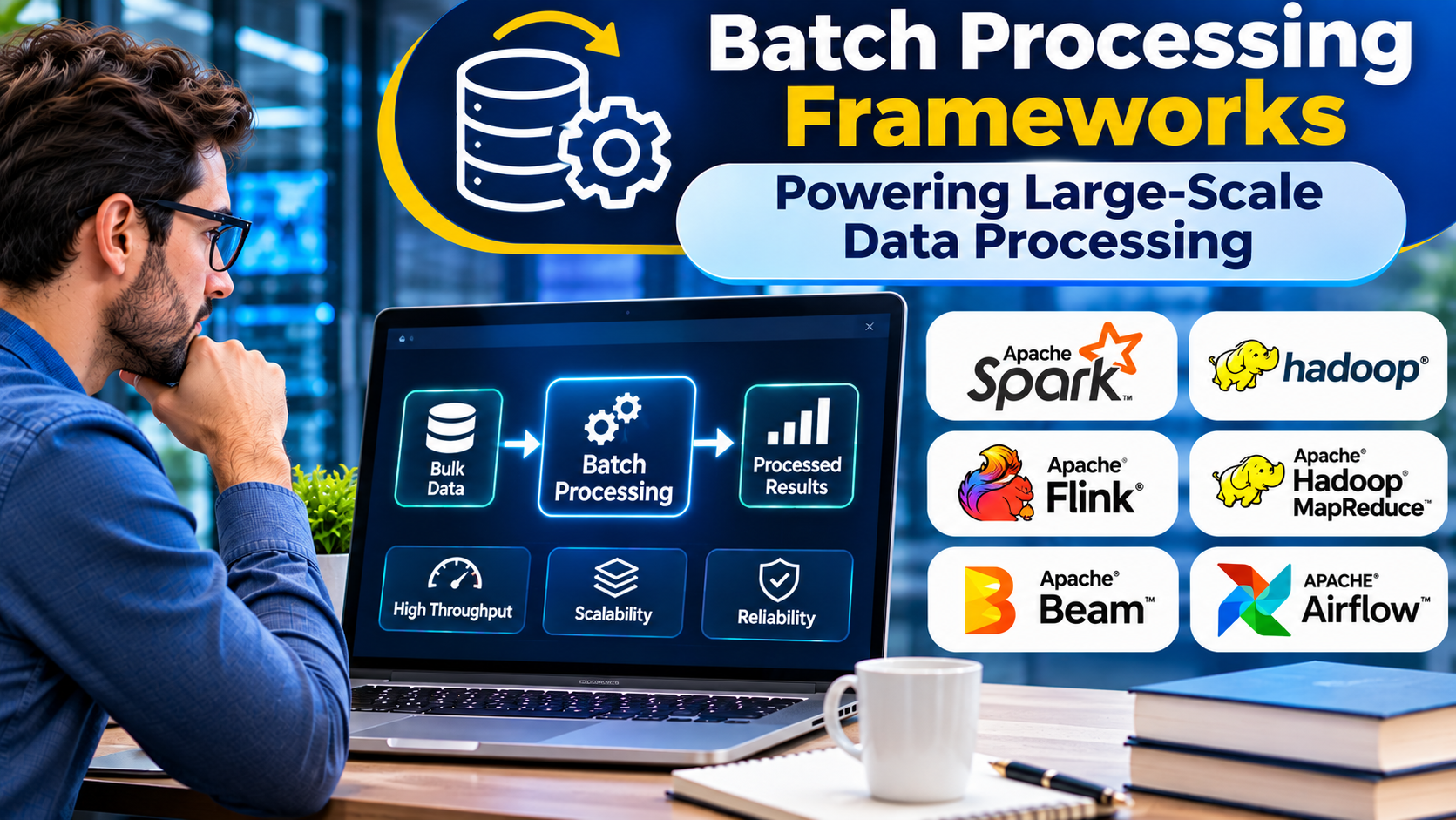
Not every business decision requires information to be processed immediately.
A finance department may calculate daily revenue after transactions close. A retailer may update product recommendations overnight. A healthcare organization may prepare scheduled operational reports. A data engineering team may transform historical records before loading them into an analytical warehouse.
These activities involve processing accumulated information rather than responding to each event as it arrives.
Batch processing frameworks provide the infrastructure and programming capabilities needed to perform such work efficiently.
They divide large workloads into manageable operations, distribute computation across available resources, and help organizations process datasets that may be too large for a single machine.
However, batch processing is not automatically simple.
Large jobs can encounter memory limitations, uneven data distribution, expensive data movement, failed tasks, and unexpected processing delays.
Choosing the right framework requires understanding the workload, storage architecture, processing requirements, and operational responsibilities.
What Are Batch Processing Frameworks?
Batch processing frameworks are software systems that execute computations over bounded collections of data.
A batch may contain records accumulated during an hour, a day, a month, or another defined period.
The framework processes the available dataset and produces results.
For example, an online retailer may collect purchase transactions throughout the day.
At night, a batch processing job calculates daily sales totals, updates analytical tables, and prepares information for business reports.
The processing job does not need to run after every individual purchase.
Instead, it works with a defined collection of records.
This model is useful when workloads involve large volumes of information and the business can tolerate scheduled processing.
How Batch Processing Works
A typical batch processing workflow contains several stages.
1. Data collection
Information accumulates in databases, files, object storage, or other source systems.
The input may include structured tables, logs, documents, or semi-structured records.
2. Job scheduling
A scheduler or orchestration system starts the processing job.
Execution may occur at a fixed time, after another job completes, or when new files become available.
3. Data reading
The framework reads the required input.
Large datasets may be divided into partitions so multiple workers can process information in parallel.
4. Transformation
The framework applies operations such as filtering, joining, aggregation, sorting, and normalization.
For example, a job may combine order records with product information to calculate sales by category.
5. Distributed execution
For workloads that require multiple machines, the framework coordinates computation across a cluster.
This can improve throughput and support datasets larger than the memory of a single computer.
6. Output generation
Results are written to databases, analytical tables, files, or other destinations.
7. Validation and monitoring
Teams verify that the job completed and produced correct results.
Successful execution alone does not guarantee data accuracy.
Why Organizations Use Batch Processing
Efficient large-scale transformation
Batch processing is well suited to workloads that involve substantial amounts of historical data.
It can perform transformations without requiring continuous event-by-event execution.
Scheduled reporting
Many business reports follow daily, weekly, or monthly schedules.
Batch processing can prepare the required data before those reports are generated.
Historical analysis
Organizations often need to examine years of records.
Batch frameworks can support large joins, aggregations, and transformations over historical datasets.
Data warehouse preparation
Batch jobs frequently prepare information for analytical databases.
They may standardize records, calculate derived fields, and combine information from multiple sources.
Cost management
Scheduled processing can be economical when computing resources are allocated only when needed.
However, poorly optimized jobs can still consume substantial resources.
Repeatability
Well-designed batch jobs can be rerun for defined input periods.
This supports recovery, backfills, and historical recalculation.
Core Concepts in Batch Processing
Data partitioning
Partitioning divides a dataset into smaller units.
Different workers can process separate partitions in parallel.
The partitioning strategy affects workload balance and performance.
Parallelism
Parallel execution allows multiple tasks to run simultaneously.
The useful degree of parallelism depends on available resources and workload characteristics.
More workers do not always produce proportionally faster results.
Data shuffling
A shuffle redistributes information between workers.
Operations such as large joins and aggregations may require shuffling.
Excessive data movement can become a major performance bottleneck.
Fault tolerance
Distributed systems must handle worker failures and interrupted tasks.
Some frameworks can retry failed operations or reconstruct intermediate results.
Recovery behavior depends on the execution engine and job design.
Idempotency
An idempotent operation can be repeated without creating unintended additional effects.
For example, rerunning a daily transformation should not duplicate the day’s revenue records.
Idempotency is important for reliable recovery.
Backfilling
Backfilling means processing historical information that was missed or needs recalculation.
A reliable framework should support controlled reprocessing without corrupting existing results.
Batch Processing Frameworks Worth Evaluating
Several established technologies support large-scale batch computation.
| Framework or service | Primary evaluation angle |
|---|---|
| Apache Spark | Distributed processing for analytical and engineering workloads |
| Hadoop MapReduce | Traditional distributed batch processing |
| Apache Beam | Portable programming model for batch and streaming |
| Dask | Parallel computing within Python environments |
| Ray | Distributed Python computation and scalable workloads |
| AWS Glue | Managed data integration and batch processing |
| Google Cloud Dataflow | Managed execution of Apache Beam pipelines |
| Azure Databricks | Managed Spark-based data engineering and analytics |
These technologies operate at different layers.
Apache Spark and Dask provide computation capabilities, while services such as AWS Glue and Google Cloud Dataflow also manage portions of the execution infrastructure.
Apache Spark
Apache Spark is an open-source distributed processing engine.
It supports large-scale transformations, SQL analytics, and other data processing workloads.
Spark is especially relevant to organizations working with data lakes, cloud storage, and analytical datasets.
Its APIs support multiple programming languages, including Python and Scala.
Organizations should evaluate memory requirements, shuffle performance, cluster configuration, and integration with their storage systems.
Hadoop MapReduce
Hadoop MapReduce is a distributed batch processing model associated with the Apache Hadoop ecosystem.
It divides work into map and reduce operations.
MapReduce remains relevant to understanding traditional large-scale batch architectures and maintaining some existing environments.
However, organizations designing new analytical systems often evaluate more flexible engines such as Spark.
Migration decisions should account for existing applications, data formats, and operational dependencies.
Apache Beam
Apache Beam provides a programming model for expressing batch and streaming pipelines.
Pipelines can run on supported execution engines.
This may help organizations maintain flexibility in how workloads are executed.
However, runner capabilities differ, so portability should be tested against the required transformations and execution behavior.
Dask
Dask supports parallel and distributed computation in Python.
It is relevant to teams using Python libraries for analytical processing.
Dask can help scale selected workloads beyond a single process or machine.
Organizations should evaluate compatibility with existing code, memory behavior, scheduling overhead, and cluster management.
Ray
Ray provides a distributed computing framework for Python applications.
It supports parallel tasks and stateful actors, making it relevant to broader distributed workloads, including certain data processing and machine learning applications.
Ray should be evaluated according to the application’s computational structure.
It is not necessarily a direct replacement for a SQL-oriented data transformation engine.
AWS Glue
AWS Glue provides managed data integration capabilities within AWS.
It can execute data processing jobs and support integration with other AWS services.
Organizations should examine supported runtimes, job configuration, data catalog integration, security, and pricing.
Managed infrastructure reduces some operational work but does not eliminate the need for efficient transformations.
Google Cloud Dataflow
Google Cloud Dataflow is a managed service for executing supported Apache Beam pipelines.
It supports batch and streaming processing.
It may be relevant to organizations operating within Google Cloud.
Evaluation should include pipeline compatibility, autoscaling, monitoring, data transfer, and execution costs.
Azure Databricks
Azure Databricks provides a managed environment for Spark-based data engineering and analytical workloads.
It is relevant to organizations using Azure and lakehouse architectures.
Buyers should evaluate workload orchestration, governance, cluster management, data formats, and total computing costs.
How to Choose the Right Batch Processing Framework
The correct choice depends on workload requirements rather than popularity.
Understand data volume
Estimate input size, growth rate, and processing frequency.
A dataset that fits comfortably on one machine may not need a distributed framework.
Examine transformation complexity
Simple filtering and aggregation may require relatively little infrastructure.
Complex joins, large shuffles, and iterative calculations may benefit from specialized execution engines.
Define processing deadlines
A daily report may need to finish before employees begin work.
A monthly reconciliation may have a longer processing window.
These deadlines determine how much computing capacity is necessary.
Evaluate storage compatibility
The framework must work with the organization’s data sources and destinations.
Confirm support for databases, object storage, file formats, and authentication methods.
Review development skills
A Python-focused team may prefer a different framework from an organization with extensive Spark experience.
Development productivity and maintenance should influence selection.
Assess failure recovery
Test interrupted jobs, incomplete outputs, and historical reprocessing.
A framework should support predictable recovery procedures.
Compare costs
Include infrastructure, storage operations, data transfer, orchestration, engineering effort, and monitoring.
Distributed processing can become expensive when jobs are poorly optimized.
Batch Processing vs. ETL Tools
Batch processing frameworks provide computational capabilities.
ETL tools coordinate extracting, transforming, and loading data between systems.
The categories overlap.
An ETL platform may use Spark internally to execute transformations.
Likewise, engineers can build ETL pipelines directly using a batch processing framework.
The distinction matters when deciding whether the organization needs a complete data integration product or a flexible execution engine.
Batch Processing vs. Workflow Orchestration
Batch processing executes computational work.
Workflow orchestration coordinates when jobs run and how dependencies are managed.
For example, Apache Airflow can schedule a Spark job after a source ingestion task finishes.
Spark performs the computation, while Airflow coordinates the workflow.
Some managed platforms combine these capabilities.
Organizations should distinguish execution requirements from scheduling and dependency management.
Performance Optimization Techniques
Reduce unnecessary data reads
Read only the columns and partitions required by the job.
This can reduce storage access and processing costs.
Choose efficient file formats
Columnar formats such as Parquet can improve analytical processing efficiency.
The benefit depends on query patterns and implementation.
Avoid unnecessary shuffles
Large data redistributions can increase network and disk usage.
Review join strategies and partitioning.
Address data skew
Data skew occurs when some partitions contain much more information than others.
A small number of overloaded workers can delay an entire job.
Reuse appropriate intermediate results
Caching or materialization may improve performance when the same information is used repeatedly.
However, caching consumes resources and should be applied selectively.
Monitor actual workloads
Measure execution time, memory usage, task failures, and processing costs.
Optimization should be based on evidence rather than assumptions.
Building a Reliable Batch Pipeline
Begin by defining the business output.
For example, a finance team may need a verified daily revenue table.
Identify the required sources and reporting deadline.
Design transformations with clear input and output schemas.
Use stable identifiers and define how duplicate records will be handled.
Make the output process safe to rerun.
Test the job with representative datasets.
Validate totals, record counts, and important business rules.
Then simulate failures and verify recovery procedures.
Once the workflow is reliable, configure scheduling, monitoring, and alerting.
Document how historical periods can be reprocessed when source information changes.
Common Batch Processing Mistakes
One mistake is using distributed infrastructure for workloads that a single machine can process efficiently.
Another is ignoring data skew and excessive shuffling.
These problems can cause unexpectedly long execution times.
Organizations also sometimes treat a successful job status as proof of correct output.
Data validation remains necessary.
Finally, batch pipelines may be designed without safe rerun behavior.
A failed job that partially writes results can create duplicate or inconsistent records when restarted.
Frequently Asked Questions
What is the main purpose of batch processing frameworks?
They execute transformations and computations over accumulated datasets, often using parallel or distributed processing.
Is Apache Spark a batch processing framework?
Yes. Spark supports batch processing and also provides other capabilities, including structured streaming.
Is Hadoop MapReduce still useful?
It can remain useful in existing environments, although many new workloads use more flexible processing engines.
Can batch processing handle terabytes of data?
Yes. Suitable distributed frameworks can process very large datasets, depending on available infrastructure and workload design.
What is the difference between batch processing and scheduling?
Batch processing performs computations. Scheduling determines when those computations should execute.
Are managed batch processing services better?
They can reduce infrastructure administration, but their suitability depends on cost, workload requirements, governance, and deployment preferences.
Final Thoughts
Batch processing frameworks remain essential for large-scale data engineering.
They help organizations transform historical information, prepare analytical datasets, and execute repeatable reporting workflows.
The best framework is one that processes required workloads reliably within acceptable time and cost limits.
Start with the simplest architecture that meets the business requirement.
Prioritize correctness, recovery, and operational visibility before introducing unnecessary complexity.
Efficient batch processing is not only about completing large jobs quickly. It is about producing dependable results every time those jobs run.