A business wants to predict customer churn. A manufacturer hopes to identify equipment failures before they occur. A financial institution needs to investigate unusual transaction patterns.
These problems involve more than building a dashboard or running a database query.
They may require data preparation, statistical analysis, machine learning, experimentation, model evaluation, and ongoing monitoring.
Data science platforms help organizations coordinate these activities.
They provide environments where data scientists, analysts, engineers, and machine learning teams can work with information, develop models, and deliver analytical results.
However, the most sophisticated platform is not automatically the best choice.
A successful data science environment must fit the organization’s data infrastructure, technical skills, governance requirements, and ability to maintain models after deployment.
What Are Data Science Platforms?
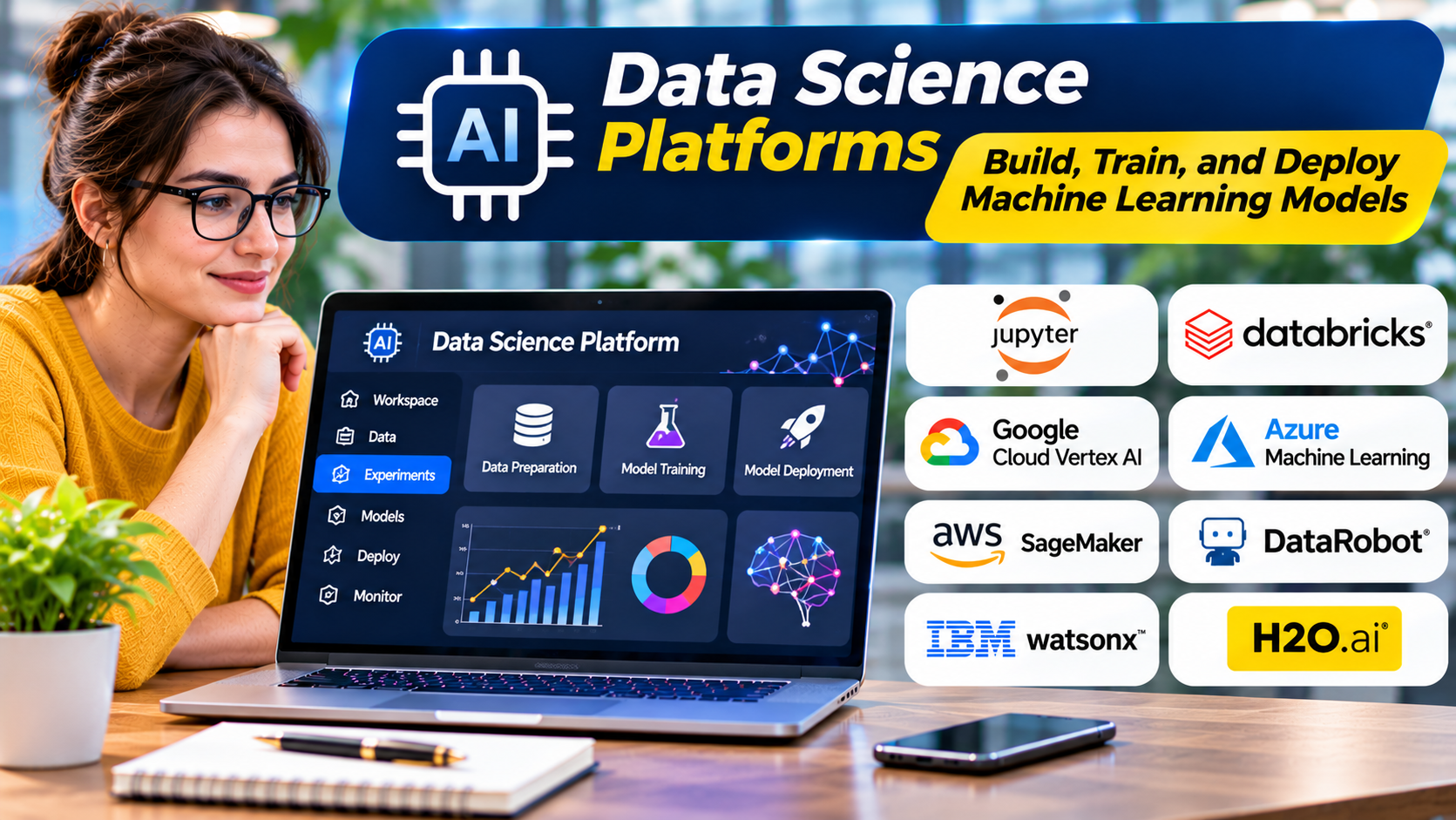
Data science platforms are software environments that support the development and operational use of data-driven analytical solutions.
Depending on the product, they may provide:
- Data access and preparation
- Interactive notebooks
- Statistical analysis
- Machine learning development
- Automated machine learning
- Experiment tracking
- Model training
- Model evaluation
- Model deployment
- Model monitoring
- Collaboration and governance
Some platforms focus on helping technical teams write code.
Others emphasize graphical workflows that make analytical modeling more accessible.
For example, a customer success team may want to predict which accounts are likely to cancel their subscriptions.
A data science workflow could combine historical account activity, support interactions, and subscription records.
The team might train a model to estimate cancellation risk.
The model’s predictions could then support a customer retention workflow.
However, the predictions must be evaluated carefully. A model may appear accurate during development but perform poorly when customer behavior changes.
How Data Science Platforms Work
A typical data science project contains several stages.
1. Define the business problem
The project begins with a specific question.
For example, a retailer may want to forecast product demand.
The team must define the prediction target, decision process, and measure of success.
2. Collect relevant data
Data scientists identify information that may help answer the question.
Sources can include databases, warehouses, application logs, spreadsheets, and external datasets.
Data access must follow applicable privacy and security requirements.
3. Prepare the data
Raw data often contains missing values, duplicates, inconsistent formats, and other issues.
Preparation may include cleaning, joining, transforming, and validating records.
This stage can require substantial effort.
4. Explore the information
Exploratory data analysis helps teams understand distributions, relationships, and unusual patterns.
Charts, summary statistics, and analytical queries are commonly used.
5. Develop models
Teams select suitable statistical or machine learning methods.
For example, a churn prediction project may use a classification model.
A demand forecasting project may use a time-series approach.
6. Evaluate results
Models are tested using appropriate data and metrics.
The evaluation should reflect the business problem and the conditions in which the model will operate.
7. Deploy the solution
A validated model may be integrated into an application, analytical workflow, or scheduled prediction process.
8. Monitor performance
After deployment, teams monitor model behavior, data changes, and operational reliability.
Models may need retraining, adjustment, or retirement.
Essential Features of Data Science Platforms
Data connectivity
The platform should connect to relevant data sources.
These may include cloud warehouses, databases, object storage, and analytical systems.
Notebook environments
Interactive notebooks allow users to combine code, calculations, visualizations, and explanations.
They are widely used for exploratory analysis and experimentation.
However, notebooks alone do not provide complete production lifecycle management.
Data preparation
Useful platforms support cleaning, transformation, validation, and feature engineering.
Feature engineering involves creating or selecting variables that help a model make predictions.
Experiment tracking
Teams need to record model configurations, datasets, metrics, and results.
Experiment tracking helps compare approaches and reproduce work.
Model training
The platform should support the required machine learning frameworks and computing resources.
Some workloads need standard CPUs.
Others benefit from GPUs or distributed computing.
Automated machine learning
Automated machine learning, often called AutoML, can help test models and preprocessing approaches.
It may reduce repetitive development work.
However, automated selection does not remove the need for validation, domain knowledge, or responsible evaluation.
Model deployment
Deployment capabilities help teams make predictions available to applications or scheduled workflows.
Model monitoring
Monitoring helps detect changes in input data, prediction behavior, and operational performance.
Collaboration
Data scientists, engineers, and business stakeholders need ways to share work and manage changes.
Security and governance
Important capabilities include identity management, access permissions, audit records, data protection, and control over model artifacts.
Data Science Platforms Worth Evaluating
The market includes cloud-native machine learning services, enterprise analytical platforms, and open-source technologies.
| Platform | Primary evaluation focus |
|---|---|
| Databricks | Data engineering, analytics, and machine learning workflows |
| Amazon SageMaker AI | Managed machine learning development within AWS |
| Google Vertex AI | Managed AI and machine learning development within Google Cloud |
| Azure Machine Learning | Model development and lifecycle management within Azure |
| Dataiku | Collaborative analytics, data preparation, and AI workflows |
| KNIME | Visual data science and analytical workflows |
| H2O AI Cloud | Machine learning and AutoML capabilities |
| Domino Data Lab | Enterprise data science collaboration and model lifecycle management |
| MLflow | Open-source experiment tracking and model lifecycle components |
These options are not direct equivalents.
MLflow, for example, provides important lifecycle capabilities but does not independently replace every component of a full enterprise data science platform.
Databricks
Databricks provides an environment for data engineering, analytics, and machine learning.
It is relevant to organizations that want data science workflows connected to lakehouse infrastructure.
Teams can use notebooks, distributed processing, and machine learning lifecycle capabilities.
Evaluation should consider integration with existing data systems, compute costs, governance, and deployment requirements.
Amazon SageMaker AI
Amazon SageMaker AI provides managed capabilities for developing, training, and deploying machine learning models.
It is relevant to organizations operating within AWS.
Evaluation should focus on supported development workflows, computing options, security, deployment architecture, and cost.
Teams should also confirm which capabilities belong to SageMaker AI and which are part of other AWS services.
Google Vertex AI
Vertex AI provides managed AI and machine learning capabilities within Google Cloud.
It supports workflows involving model development, training, deployment, and related services.
Organizations should evaluate integration with Google Cloud data systems, governance, model requirements, and pricing.
The exact capabilities available depend on the selected services and configuration.
Azure Machine Learning
Azure Machine Learning supports machine learning development and lifecycle management.
It is relevant to organizations using Azure infrastructure and Microsoft-oriented enterprise environments.
Evaluation should include development tools, compute management, model deployment, identity integration, and operational monitoring.
Dataiku
Dataiku provides collaborative data preparation, analytics, and AI development capabilities.
It may appeal to organizations with both technical data scientists and business-oriented analytical users.
Evaluation should consider workflow design, code integration, governance, model deployment, and collaboration requirements.
KNIME
KNIME provides visual analytical workflows through its data science environment.
It is relevant to teams that want to build repeatable transformations and analytical processes through graphical components.
It can support integration with programming languages and machine learning tools.
Organizations should evaluate workflow complexity, deployment needs, collaboration, and production automation.
H2O AI Cloud
H2O AI Cloud offers capabilities associated with machine learning and automated model development.
It may be relevant to organizations seeking assistance with model experimentation and training.
Evaluation should examine supported algorithms, explainability, deployment, governance, and the capabilities included in the proposed offering.
Domino Data Lab
Domino Data Lab focuses on enterprise data science collaboration and model lifecycle workflows.
It may suit organizations managing multiple data science teams and regulated or controlled analytical environments.
Buyers should assess environment management, reproducibility, access controls, infrastructure integration, and operational responsibilities.
MLflow
MLflow provides open-source capabilities for managing parts of the machine learning lifecycle.
These include experiment tracking and model management components.
It is relevant to teams building customized machine learning platforms.
However, organizations may need additional infrastructure for data preparation, computing, deployment, and monitoring.
How to Choose the Right Data Science Platform
The right choice depends on the organization’s maturity and intended analytical work.
Identify the primary use cases
A company developing forecasting models has different requirements from one building large generative AI applications.
List the main projects the platform must support.
Assess team skills
Some teams prefer Python and notebooks.
Others need graphical interfaces and guided workflows.
The platform should support the people responsible for developing and maintaining models.
Review data infrastructure
Determine where the organization’s data is stored.
Moving large datasets between cloud environments can introduce cost, latency, and governance challenges.
A platform that works close to existing data may simplify operations.
Evaluate reproducibility
Data science experiments should be reproducible.
Teams need to know which data, code, parameters, and dependencies produced a particular result.
Examine deployment requirements
Some organizations generate predictions through scheduled batch jobs.
Others require low-latency prediction APIs.
The platform should support the intended operating model.
Assess monitoring capabilities
A model that performs well during development may become less reliable over time.
Evaluate how the platform monitors inputs, predictions, and relevant performance metrics.
Review security and compliance
Data science projects may involve personal, financial, or proprietary information.
Review access controls, encryption, auditability, retention, and applicable regulatory obligations.
Calculate total cost
Costs may include user licenses, computing, GPU resources, storage, networking, model hosting, and operational support.
Large training workloads can create substantial expenses.
Data Science Platforms vs. Business Intelligence Tools
Business intelligence tools primarily help users analyze existing information and communicate results.
Data science platforms support broader analytical experimentation and predictive modeling.
For example, a BI dashboard may show historical customer churn.
A data science project may attempt to predict which customers are likely to leave.
The distinction is not absolute.
Some BI platforms include predictive features, while data science platforms often provide visualization and reporting capabilities.
The correct choice depends on the analytical workflow.
Data Science Platforms vs. MLOps Platforms
MLOps refers to practices and systems for managing machine learning development and operations.
It includes versioning, testing, deployment, monitoring, and lifecycle management.
Data science platforms may include MLOps capabilities.
However, a platform focused on experimentation may require additional tools for reliable production deployment.
Organizations should evaluate the entire lifecycle rather than assuming that model training capabilities are sufficient.
Data Science and Generative AI
Generative AI has expanded the range of workloads supported by data science and AI platforms.
Teams may need to evaluate language models, manage prompts, build retrieval workflows, or monitor AI applications.
These activities introduce additional concerns.
For example, a retrieval-based application must use appropriate source information and enforce access permissions.
A generated answer may sound convincing while containing factual errors.
Model evaluation should consider accuracy, reliability, safety, latency, and cost.
Organizations should also understand how sensitive data is handled by the selected services.
Traditional machine learning capabilities remain important even when generative AI receives more attention.
Building a Successful Data Science Workflow
Start with a measurable business objective
Define the problem before selecting algorithms.
For example, an organization may want to improve demand forecasting accuracy.
Establish a baseline
Compare proposed models against a simple existing method.
A sophisticated model is not valuable if it fails to improve the outcome.
Prepare reliable data
Check for missing values, inconsistent definitions, and inappropriate data leakage.
Data leakage occurs when training information includes details that would not be available at prediction time.
It can make evaluation results appear unrealistically strong.
Use appropriate validation
Separate training and evaluation data.
For time-dependent problems, use validation methods that respect chronological order.
Track experiments
Record data versions, model settings, evaluation metrics, and relevant code.
Review responsible AI considerations
Assess privacy, potential bias, explainability, and the consequences of incorrect predictions.
The required controls depend on the application.
Deploy gradually
Begin with a controlled release when practical.
Monitor results before expanding usage.
Establish ongoing ownership
Assign responsibility for monitoring, updating, and retiring models.
A model should not remain in production indefinitely without review.
Common Data Science Platform Mistakes
Buying software before defining use cases
Organizations may invest in extensive AI infrastructure without identifying projects that deliver measurable value.
Ignoring data quality
Sophisticated algorithms cannot reliably compensate for unsuitable training data.
Overlooking deployment
A model that performs well in a notebook may require substantial engineering work before it can support a production application.
Failing to track experiments
Without reproducibility, teams may struggle to explain why model results changed.
Underestimating operational costs
Computing, storage, model serving, and monitoring can become expensive as workloads grow.
Treating model accuracy as the only objective
Accuracy matters, but business impact, fairness, reliability, explainability, and operational performance may be equally important.
Frequently Asked Questions
What is the main purpose of a data science platform?
A data science platform supports analytical exploration, model development, experimentation, and the operational use of data-driven solutions.
Are data science platforms only for machine learning?
No. Many also support statistical analysis, data preparation, visualization, and general analytical workflows.
Which data science platform is best for beginners?
Visual workflow tools such as KNIME may be accessible to beginners. The best choice depends on the user’s technical skills and intended projects.
Do data science platforms require programming?
Not always. Some provide graphical interfaces and automated modeling. Advanced customization often benefits from programming knowledge.
What is the difference between data science and machine learning?
Data science is a broader discipline involving data analysis, statistics, experimentation, and communication. Machine learning is one set of methods used within data science.
Can a company build its own data science platform?
Yes. Organizations can combine open-source notebooks, processing engines, experiment tracking, and deployment infrastructure. This provides flexibility but requires engineering and maintenance resources.
What should businesses measure when evaluating data science projects?
Useful measures include business impact, model performance, reliability, operating cost, and whether the solution improves the intended decision or workflow.
Final Thoughts
Data science platforms help organizations turn information into analytical models, predictions, and practical applications.
They bring together tools for exploration, experimentation, collaboration, and model lifecycle management.
However, technology alone does not guarantee successful data science.
Reliable information, suitable validation, responsible governance, and clear business objectives remain essential.
Choose a platform that fits the organization’s existing data environment and the skills of its teams.
Start with measurable projects, establish reproducible workflows, and expand capabilities as genuine requirements emerge.
The best data science platform is not the one with the longest feature list. It is the one that helps teams develop useful solutions and maintain them reliably over time.