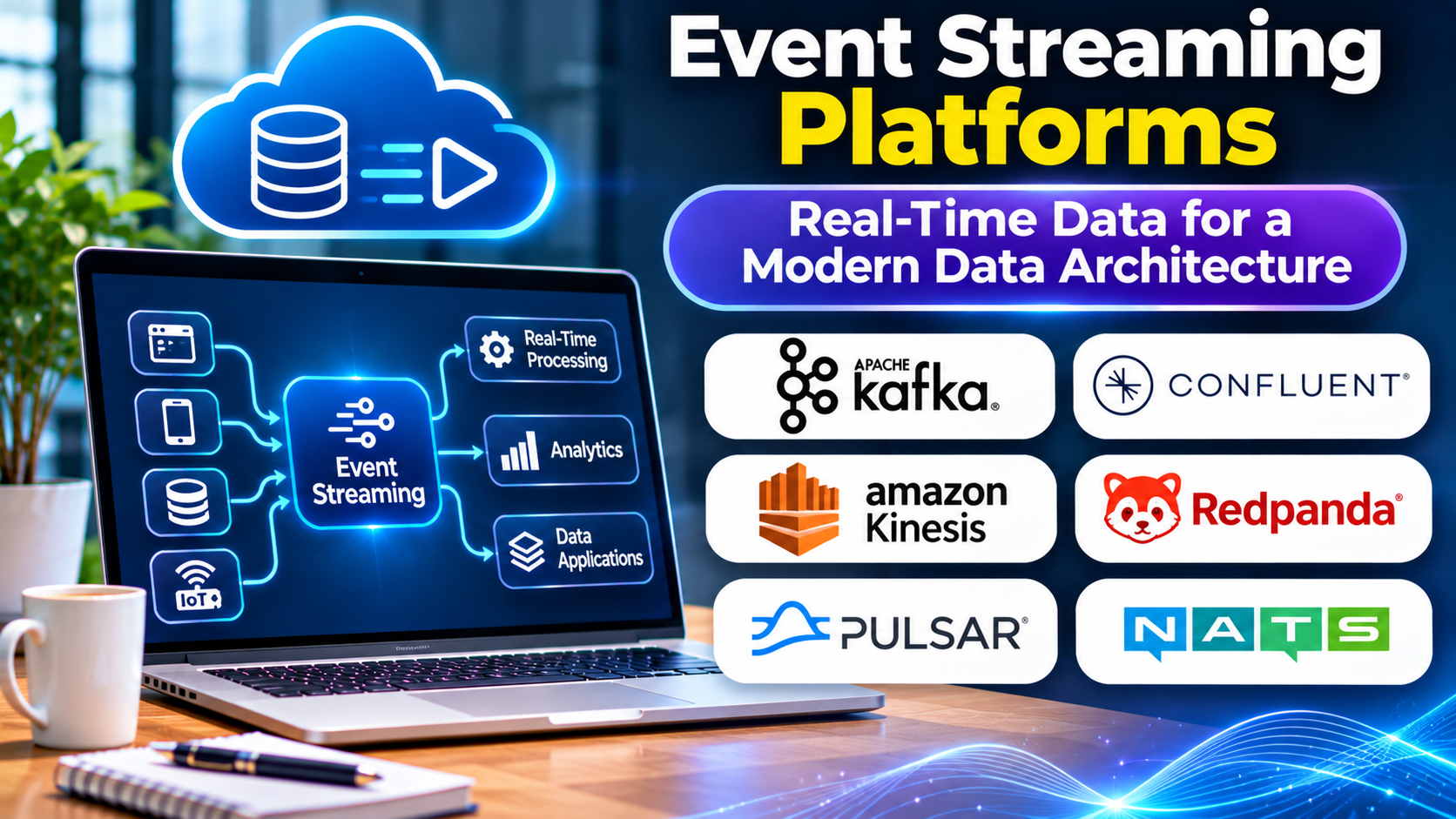
Modern businesses depend on information moving between applications.
An online store receives an order. The payment system processes a transaction. The warehouse updates inventory. A delivery service prepares a shipment. An analytics platform records the activity.
These systems must exchange information, but connecting every application directly to every other application creates complexity.
When one service becomes unavailable, dependent workflows may fail. When traffic increases, tightly connected systems may struggle to keep up.
Event streaming platforms provide an alternative architecture.
They allow applications to publish events representing important activities while other systems consume those events independently.
This approach can support scalable integration, real-time analytics, operational automation, and event-driven applications.
However, event streaming also introduces challenges involving ordering, delivery guarantees, retention, schema management, and operational complexity.
Choosing the right platform requires understanding how events move and what reliability guarantees the business actually needs.
What Are Event Streaming Platforms?
Event streaming platforms are software systems that collect, store, distribute, and make event records available to consuming applications.
An event represents something that happened.
Examples include:
- A customer created an account
- An order was submitted
- A payment was completed
- A product was added to inventory
- A device reported a temperature
- A shipment changed status
- An application generated an error
Each event generally contains information about the activity, such as an identifier, timestamp, event type, and relevant attributes.
Applications that generate events are called producers.
Applications that receive and process events are called consumers.
The event streaming platform connects these components without requiring every producer to communicate directly with every consumer.
How Event Streaming Works
Consider an online retail system.
When a customer completes a purchase, the order application publishes an event.
Several downstream services may need the information.
The inventory service updates stock.
The shipping service begins fulfillment.
The analytics system records the purchase.
The notification service sends a confirmation.
Instead of making separate synchronous requests to every service, the order application can publish an event to a streaming platform.
Authorized consumers process the event according to their own responsibilities.
This reduces direct dependencies between applications.
However, it also means the architecture must handle delayed processing, duplicate events, failures, and differences in consumer progress.
Core Components of an Event Streaming Architecture
Producers
Producers are applications or services that publish events.
A producer may be a web application, payment service, database connector, or connected device.
The producer must use an appropriate event format and delivery mechanism.
Topics or streams
Events are commonly organized into named topics or streams.
For example, a retail system may maintain separate streams for orders, payments, and inventory changes.
The exact terminology depends on the platform.
Brokers or streaming services
The platform receives events and makes them available to consumers.
Depending on the architecture, it may also store events for a configured retention period.
Partitions
Some platforms divide streams into partitions to distribute storage and processing.
Partitioning can improve scalability.
However, ordering guarantees often apply within individual partitions rather than across an entire distributed topic.
Consumers
Consumers read events and perform downstream work.
Different consumers may process the same event for different purposes.
Consumer groups
In platforms such as Apache Kafka, consumer groups allow multiple consumer instances to share processing work.
This supports parallel consumption.
The exact assignment and ordering behavior depends on the platform.
Retention
Event retention determines how long records remain available.
Retention can support recovery, replay, and delayed processing.
However, keeping events indefinitely may increase storage and governance costs.
Event Streaming vs. Traditional Messaging
Event streaming and message queues share important concepts, but their common operating patterns differ.
Traditional work queues often focus on delivering a task to a worker for processing.
Event streaming platforms commonly emphasize durable event logs, independent consumers, and the ability to process retained events.
For example, a task queue may distribute image-processing jobs among workers.
An event stream may preserve order events so inventory, analytics, and fulfillment systems can consume them independently.
These distinctions are not absolute.
Modern messaging systems may support durable streams, and streaming platforms can support task-oriented workflows.
The appropriate choice depends on delivery requirements, retention, replay, and consumer behavior.
Why Organizations Use Event Streaming
Decoupled applications
Producers do not need detailed knowledge of every downstream consumer.
This makes it easier to add new services without changing the original application.
Real-time data movement
Events can become available shortly after they are generated.
This supports applications that need timely information.
Scalable processing
Partitioned architectures can distribute event traffic across multiple consumers and infrastructure resources.
Event replay
When retained events remain available, consumers may be able to reprocess historical information.
This can support recovery and new analytical use cases.
System integration
Event streaming can connect operational applications, databases, analytical platforms, and external services.
Operational resilience
Durable event storage can help systems tolerate temporary consumer failures.
However, resilience depends on replication, configuration, recovery procedures, and application design.
Essential Features of Event Streaming Platforms
Throughput
Throughput describes how much event traffic a platform can handle.
It may be measured in records or bytes per second.
Actual capacity depends on event size, partitioning, replication, hardware, and configuration.
Latency
Latency measures the delay involved in publishing and consuming events.
Organizations should test latency under realistic load.
Durability
Durability concerns whether acknowledged events remain available after failures.
Review replication, persistence, and acknowledgment behavior.
Ordering
Ordering guarantees are important when events must be processed in sequence.
For example, account balance updates may require careful ordering.
Distributed systems often provide ordering within specific partitions or keys rather than globally.
Delivery semantics
Common delivery models include at-most-once, at-least-once, and exactly-once processing guarantees.
These terms require careful interpretation.
At-least-once delivery can result in duplicate processing.
Exactly-once guarantees may apply only within particular processing boundaries and do not automatically cover external systems.
Retention and replay
A platform should support retention periods appropriate to recovery and business requirements.
Schema management
Event schemas describe the structure of event records.
Schema management helps producers and consumers evolve without unexpected compatibility failures.
Security
Important capabilities include authentication, encryption, authorization, and auditability.
Monitoring
Teams need visibility into broker health, throughput, consumer lag, storage usage, and processing failures.
Event Streaming Platforms Worth Evaluating
Several established technologies support event streaming and related messaging workloads.
| Platform | Primary evaluation angle |
|---|---|
| Apache Kafka | Distributed event streaming and durable event logs |
| Confluent Cloud | Managed Kafka-based event streaming |
| Amazon Kinesis Data Streams | Managed event streaming within AWS |
| Azure Event Hubs | Managed event ingestion and streaming within Azure |
| Apache Pulsar | Distributed messaging and streaming with a separated storage architecture |
| Redpanda | Kafka API-compatible streaming infrastructure |
| NATS JetStream | Lightweight messaging with persistence and streaming capabilities |
| Google Cloud Pub/Sub | Managed asynchronous messaging and event distribution |
These technologies have different architectures and operating models.
A platform suitable for a large Kafka-based data ecosystem may be unnecessarily complex for a small application requiring lightweight event distribution.
Apache Kafka
Apache Kafka is an open-source distributed event streaming platform.
It uses partitioned logs to store and distribute event records.
Kafka is relevant to organizations that need durable event streams, independent consumers, and integration with analytical or operational systems.
Its ecosystem includes connectors, stream processing capabilities, and schema management options.
However, self-managed Kafka requires expertise in cluster operations, partitioning, storage, security, monitoring, and recovery.
Confluent Cloud
Confluent Cloud provides managed event streaming services built around Kafka.
It is relevant to organizations seeking Kafka-based capabilities while reducing direct infrastructure administration.
Evaluation should focus on supported cloud environments, connectivity, governance, service limits, and pricing.
A managed service reduces some operational responsibilities but does not eliminate application-level concerns such as duplicate processing and schema compatibility.
Amazon Kinesis Data Streams
Amazon Kinesis Data Streams is a managed streaming service within AWS.
It is relevant to applications that need to collect and process event data in AWS environments.
Organizations should evaluate capacity modes, retention, consumer behavior, integration support, and service costs.
Its API and operating model differ from Kafka.
Azure Event Hubs
Azure Event Hubs provides managed event ingestion and streaming capabilities.
It is relevant to organizations using Microsoft Azure.
It supports high-volume event ingestion and integration with analytical processing services.
Evaluation should include throughput capacity, partitioning, retention, security, and compatibility requirements.
Apache Pulsar
Apache Pulsar is an open-source distributed messaging and streaming platform.
Its architecture separates serving and storage responsibilities.
It supports multiple messaging and subscription patterns.
Pulsar may be relevant when organizations need flexible messaging behavior and scalable event storage.
However, its distributed architecture introduces operational considerations that should be evaluated carefully.
Redpanda
Redpanda provides streaming infrastructure designed around Kafka API compatibility.
It may appeal to organizations seeking Kafka-compatible applications with a different implementation architecture.
Buyers should test compatibility with required clients, connectors, and operational tooling.
Compatibility should be verified against actual workloads rather than assumed to cover every Kafka feature.
NATS JetStream
NATS provides messaging infrastructure, while JetStream adds persistence and streaming capabilities.
It is relevant to applications that value lightweight messaging and flexible communication patterns.
Organizations should evaluate retention, consumer semantics, clustering, and suitability for their required event volumes.
Google Cloud Pub/Sub
Google Cloud Pub/Sub provides managed asynchronous messaging and event distribution.
It is relevant to organizations building event-driven applications within Google Cloud.
Its operating model differs from a traditional Kafka-style retained log.
Buyers should evaluate ordering, delivery behavior, retention, replay requirements, and integrations.
How to Choose the Right Event Streaming Platform
The best selection process begins with the application’s reliability and integration requirements.
Define the event workload
Determine the expected number of events, average event size, and peak traffic.
A system processing a few hundred events per second has different requirements from one handling millions.
Identify retention requirements
Decide how long events must remain available.
Short-lived operational messages may need limited retention.
Audit, replay, and analytical workflows may require longer periods.
Evaluate ordering guarantees
Determine whether events must be processed in a particular sequence.
For example, updates to the same customer account may require ordered handling.
Partitioning strategy becomes important when ordering matters.
Understand delivery behavior
Applications should be designed around the delivery guarantees actually provided.
When duplicates are possible, consumers may need idempotent processing.
Idempotency means that repeating the same operation does not produce unintended additional effects.
Review integration coverage
Check compatibility with source systems, databases, stream processors, and analytical destinations.
Compare managed and self-hosted options
Managed services can reduce infrastructure operations.
Self-hosted systems provide greater control but require engineering expertise.
Evaluate security
Review authentication, permissions, encryption, network isolation, and audit capabilities.
Calculate total cost
Consider computing, storage, network transfer, replication, retention, monitoring, and operational staffing.
Event streaming infrastructure can become expensive when large volumes are retained or transferred across environments.
Event Streaming vs. Stream Processing
Event streaming platforms primarily transport and retain event records.
Stream processing frameworks compute over those records.
For example, Kafka may receive payment events.
Apache Flink may analyze those events to calculate rolling transaction totals.
A real-time analytical database may then serve queries over the resulting information.
Some platforms include built-in processing capabilities.
The distinction is still useful when designing responsibilities within a larger architecture.
Event Streaming vs. Change Data Capture
Change Data Capture (CDC) captures changes occurring in a database.
These changes may include inserts, updates, and deletions.
CDC tools can publish change events into a streaming platform.
For example, a database connector may detect a new order and send the corresponding event to Kafka.
CDC and event streaming are complementary.
CDC describes how changes are captured, while the streaming platform distributes and retains the resulting events.
Event Schema Design
Event schemas are essential to reliable integration.
A well-designed event should communicate what happened and provide enough context for consumers.
For example, an order-created event may include:
- Event identifier
- Order identifier
- Customer identifier
- Event timestamp
- Order status
- Relevant transaction attributes
- Schema version
Avoid including unnecessary personal information.
Schemas should also support controlled evolution.
Adding or changing fields can affect downstream consumers.
Compatibility rules and testing help prevent unexpected failures.
Handling Duplicate and Out-of-Order Events
Distributed event systems must account for imperfect delivery conditions.
A producer may retry after a network interruption.
A consumer may process an event but fail before acknowledging it.
A later event may arrive before an earlier one.
These situations can create duplicates or unexpected ordering.
Applications should use appropriate event identifiers, idempotent operations, ordering keys, and recovery procedures.
For financial or inventory workflows, these controls are especially important.
Do not assume that selecting a platform with strong delivery guarantees eliminates the need for careful application design.
Event Streaming Security and Governance
Event streams can contain commercially sensitive information and personal data.
Security should begin with clear access boundaries.
Producers should only publish to authorized streams.
Consumers should only access information required for their work.
Encryption should protect information in transit and at rest where appropriate.
Organizations should also consider event retention and deletion requirements.
Long-lived event logs can complicate privacy obligations when personal information is stored directly in event payloads.
Data minimization and suitable retention policies reduce unnecessary exposure.
Implementing Event Streaming Successfully
Step 1: Choose one business workflow
Begin with a workflow that benefits from asynchronous event distribution.
For example, publish order-created events for inventory and fulfillment services.
Step 2: Define the event contract
Document event names, identifiers, schemas, and ownership.
Step 3: Select partitioning and ordering rules
Determine how related events should be grouped and processed.
Step 4: Configure durability
Choose replication, acknowledgments, and retention according to reliability requirements.
Step 5: Build resilient consumers
Implement retry handling, duplicate protection, and failure recovery.
Step 6: Test realistic failures
Simulate consumer downtime, broker failures, network interruptions, and traffic bursts.
Step 7: Monitor the system
Track throughput, latency, consumer lag, storage usage, and processing errors.
Step 8: Expand gradually
Add additional producers and consumers only after the initial workflow is reliable.
Common Event Streaming Mistakes
One mistake is using event streaming for every integration problem.
Simple synchronous API calls may be more appropriate when immediate responses are required.
Another mistake is treating event delivery as equivalent to successful business processing.
A consumer may receive an event but fail while updating its database.
Organizations also underestimate schema governance.
Uncontrolled event changes can break downstream applications.
Finally, teams may retain events indefinitely without understanding storage costs or privacy implications.
Frequently Asked Questions
What is the main purpose of an event streaming platform?
It enables applications to publish, distribute, and consume event records through a shared infrastructure.
Is Apache Kafka a message queue?
Kafka supports messaging use cases, but its durable, partitioned event log and independent consumption model distinguish it from many traditional work queues.
What is the difference between Kafka and Pulsar?
Both support distributed messaging and streaming. Their storage architectures, subscription models, and operational characteristics differ.
Can event streaming support real-time analytics?
Yes. Streaming platforms can deliver events to processing frameworks and analytical databases that support low-latency analysis.
Does event streaming guarantee exactly-once processing?
Not universally. Guarantees depend on the platform, configuration, processing boundaries, and downstream systems.
Are managed streaming services better than open-source deployments?
Managed services reduce some infrastructure responsibilities, while self-managed systems provide greater control. The right choice depends on workload, cost, and engineering capabilities.
Final Thoughts
Event streaming platforms provide an important foundation for modern event-driven applications and data architectures.
They allow systems to exchange information asynchronously, support independent consumers, and process continuously arriving events.
However, successful event streaming requires careful attention to event design, ordering, delivery semantics, retention, security, and recovery.
Begin with a clearly defined workflow and choose technology that meets its actual reliability requirements.
The right event streaming platform should make application integration more dependable without introducing unnecessary architectural complexity.