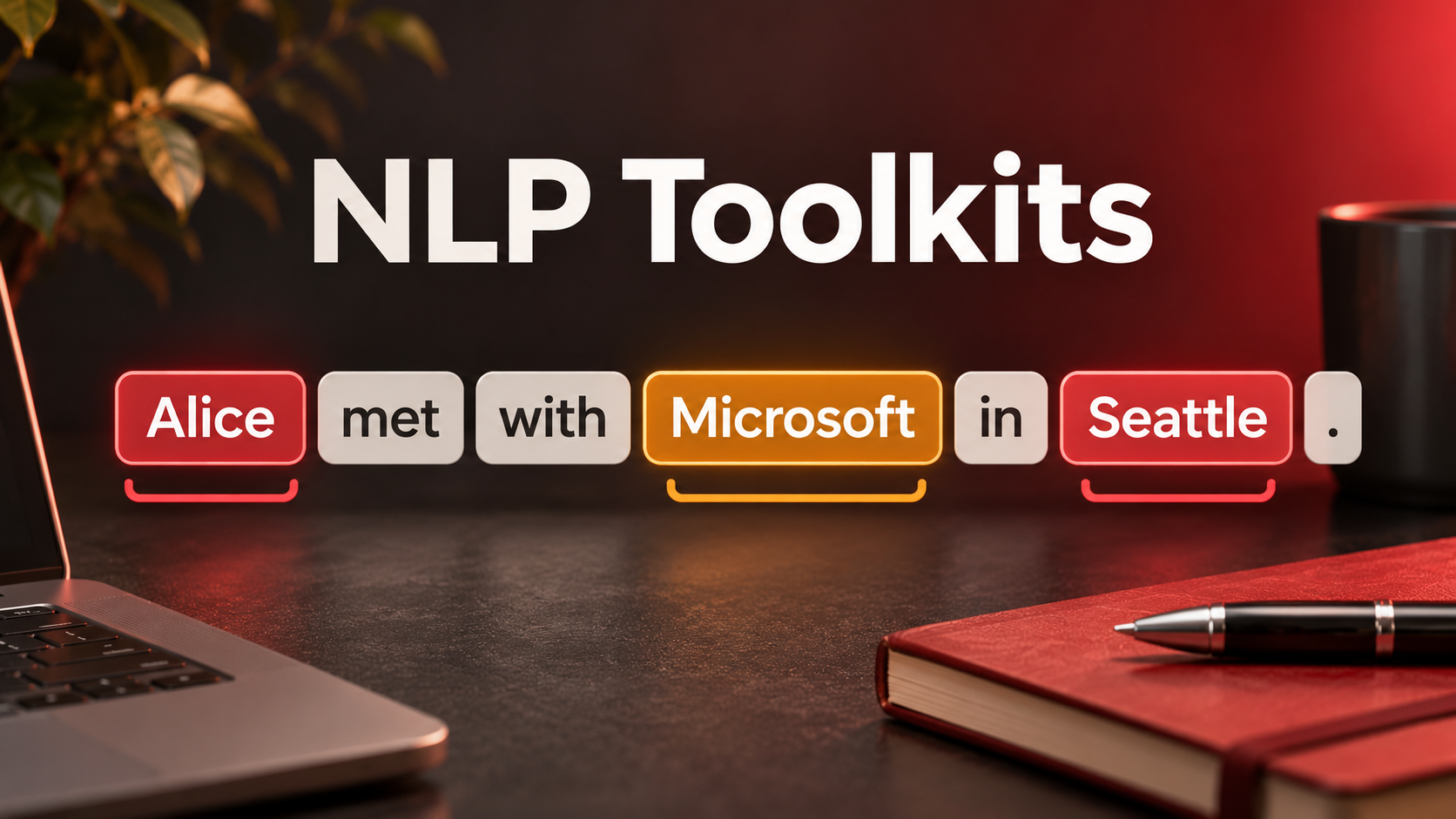
A team extracts product names and order references from support messages. A new product has a hyphen in its name, and a tokenizer upgrade splits it differently. The named entity model still runs, but some extracted spans now point to the wrong characters in the original message. An engineering decision about text boundaries has reached the interface used by the support team.
Natural language processing toolkits provide building blocks for applications that analyze or generate language. They differ in how much of the pipeline they manage, from basic tokenization to pretrained model inference. Choose a toolkit by the work your application must do and the interfaces you need to keep stable as models, data, or languages change.
Start with the representation your application depends on
A tokenizer splits text into units that later stages can process. Some split around words or punctuation. Others use subwords designed for a specific pretrained model. The correct choice depends on the task. A rule that extracts an invoice number might need punctuation preserved, while a transformer typically needs the tokenizer associated with its checkpoint.
Keep a mapping to the source text if downstream users need evidence. Lowercasing, normalizing Unicode, replacing whitespace, and removing markup can change the correspondence between processed text and original offsets. Decide whether a span refers to character positions, bytes, or tokens. Document the convention and test it on accents, emoji, and scripts with different boundaries.
Separate annotation types. Part-of-speech tags describe grammatical roles. Entities mark spans that correspond to categories such as organizations or products. A text classifier returns labels for a document or segment. These outputs can be combined, but each has a distinct schema and failure mode. Give downstream code a clear contract for empty input, ambiguous spans, and multiple labels.
Decide how much behavior should be learned
Rules are useful when a format is stable and can be defined precisely. A regex can identify a reference number, and a matcher can detect a maintained list of known product names. Rules are easy to inspect and can be tested with small examples. They require updates when formats or wording change. Define what takes precedence if a learned component disagrees with a rule.
Trained pipelines are valuable when language varies beyond what rules can cover. A named entity model may recognize unfamiliar organization names through context. Evaluate it on the language, domain, and formatting you expect. A general model can produce plausible labels on ordinary examples while failing on chat fragments or internal terminology. Make errors reviewable by retaining the input and predicted span under the appropriate access rules.
A transformer can handle tasks that benefit from contextual representations. It can also add memory use, processing delay, and input length limits. Assess whether the relevant context fits into the model’s input. If you split a long document, define how spans or classifications are combined across chunks. A decision may depend on a heading from an earlier section or a negation near a chunk boundary.
Choose toolkits by their responsibilities
spaCy is useful for building explicit processing pipelines. Its pipeline model applies components to a document after tokenization, and the components can support work such as tagging or entity recognition. It suits applications that benefit from a consistent document representation and a mix of rules and trained components. Check the available language pipelines and try a custom component on representative text before depending on its offsets or labels. spaCy processing pipeline documentation
Hugging Face Transformers is a candidate when the project needs pretrained transformer models or a common way to run them. Model choice, licensing, tokenization, memory, and deployment remain application decisions. Pin the model and tokenizer revisions together. Inspect the specific model documentation and verify that expected tasks and languages are covered. Test how its output maps back to your own schema and source spans. Hugging Face Transformers documentation
NLTK is useful for teaching, prototyping, and workflows that use classic NLP algorithms or linguistic resources. Its explicit components make it a useful environment for comparing tokenization or corpus-based techniques. An application may still need its own serving, model packaging, and operational controls. Check the terms for any resources you distribute alongside the code, since library and corpus terms can differ. NLTK documentation
These tools can be combined. A project might use spaCy to manage document structure and combine deterministic matchers with a transformer for a narrow task. Keep the boundary explicit. A model replacement should require an adapter and evaluation, while unrelated application code should continue to consume the same output contract.
Build a small, adversarial test collection
Collect cases where an apparently minor change can affect the application. Use contractions, mixed scripts, hyphenated names, copied email threads, line breaks, and text with unexpected capitalization. Include strings where one term is part of a longer term. Add examples of references that look valid but should be ignored. Ask domain reviewers to resolve boundary decisions before converting the cases to tests.
Measure performance at the right level. For extracted spans, report exact and partial matches separately if both have value. For document classification, inspect errors by language, input source, and class. If outputs are used to populate structured fields, test how often the complete record can be accepted. A pipeline can score well on individual labels while creating too many records that need manual repair.
Measure runtime on the production path. Include normalization, tokenization, batching, inference, and conversion of results. A CPU pipeline and an accelerator-backed transformer may have very different behavior across short single requests and long batches. Try empty text and input near the supported length limit. Confirm what the caller sees when the model times out or receives an unsupported language.
If the output will be used by multiple services, test one upgrade with each consumer. An entity viewer may tolerate overlapping spans while a structured extractor needs one value per field. Record how duplicate, nested, and crossing spans are represented. Where a confidence score is exposed, decide whether consumers should use it directly or act on a separately validated threshold. Scores from two model versions can differ in meaning even when their numeric ranges look the same.
When supporting several languages, organize tests by language and script rather than trusting a single multilingual score. A rule that assumes spaces between words can behave very differently in another language. Label fallback cases explicitly and let callers know when a pipeline cannot reliably provide the requested annotation.
Keep models and text resources maintainable
Pin code, packages, model files, tokenizers, and any rule dictionaries. Retain a way to reproduce approved artifacts without relying on a mutable download location. Treat upgrades as changes to the pipeline, even when they leave the code untouched. Compare versions on the same test collection, including output spans and the shape of structured fields.
Review how models are obtained and loaded. Use approved artifacts and inspect any model-specific code before running it. If the application processes private text, decide whether inference runs locally or sends input to another service. Keep logs focused on the diagnostics needed for support. Example text and model outputs may contain the very information the application is intended to protect or classify.
The most informative pilot takes one messy input through the complete path and lets a colleague explain the output back to the original text. Then replace one component and rerun the tests. A toolkit fits when that change is manageable and differences are visible in the application contract. The team can improve the language model without silently changing what the rest of the system receives.