Introduction
A restaurant’s most popular dish is not always its most profitable.
A bestselling entrée may require expensive ingredients, complicated preparation, or significant labor. Meanwhile, a less frequently ordered dish may generate a stronger contribution toward the restaurant’s operating expenses.
Without accurate data, managers can easily mistake sales volume for financial success.
Restaurant menu engineering tools help operators examine how individual menu items perform.
They combine sales information with recipe costs, pricing, and other operational data to support better decisions about menus.
The goal is not simply to raise prices or remove slow-selling dishes.
Effective menu engineering helps restaurants understand which items customers value, which products contribute to profitability, and how menu design influences purchasing behavior.
What Is Restaurant Menu Engineering?
Restaurant menu engineering is the process of evaluating menu items using measures such as popularity, selling price, and contribution margin.
Contribution margin is the amount remaining from a sale after subtracting the variable costs included in the calculation.
For a simplified food-cost analysis:
Item Contribution Margin = Selling Price − Ingredient Cost
Consider a dish sold for $18 with an ingredient cost of $6.
Its simplified contribution margin is $12.
Another dish may sell for $24 but require $15 in ingredients.
Its simplified contribution margin is $9.
The second dish has a higher selling price but a lower contribution margin under this calculation.
This distinction is central to menu engineering.
However, ingredient-only contribution margin is not the same as net profit.
Labor, packaging, payment fees, delivery commissions, rent, and other expenses can materially affect the financial outcome.
Restaurants should define their cost assumptions clearly.
What Are Restaurant Menu Engineering Tools?
Restaurant menu engineering tools are software applications that help operators analyze menu performance and make decisions about pricing, item selection, recipe costs, and menu presentation.
These capabilities may appear within:
- Restaurant inventory software
- Recipe costing applications
- Restaurant analytics platforms
- POS reporting systems
- Food cost management software
- Enterprise restaurant management systems
Some applications focus on ingredient costs and recipes.
Others emphasize sales analysis, pricing, or broader restaurant profitability.
A business should not assume that every inventory application provides complete menu engineering functionality.
Likewise, a POS report showing bestselling items may not include enough cost information to support profitability decisions.
The Four Traditional Menu Engineering Categories
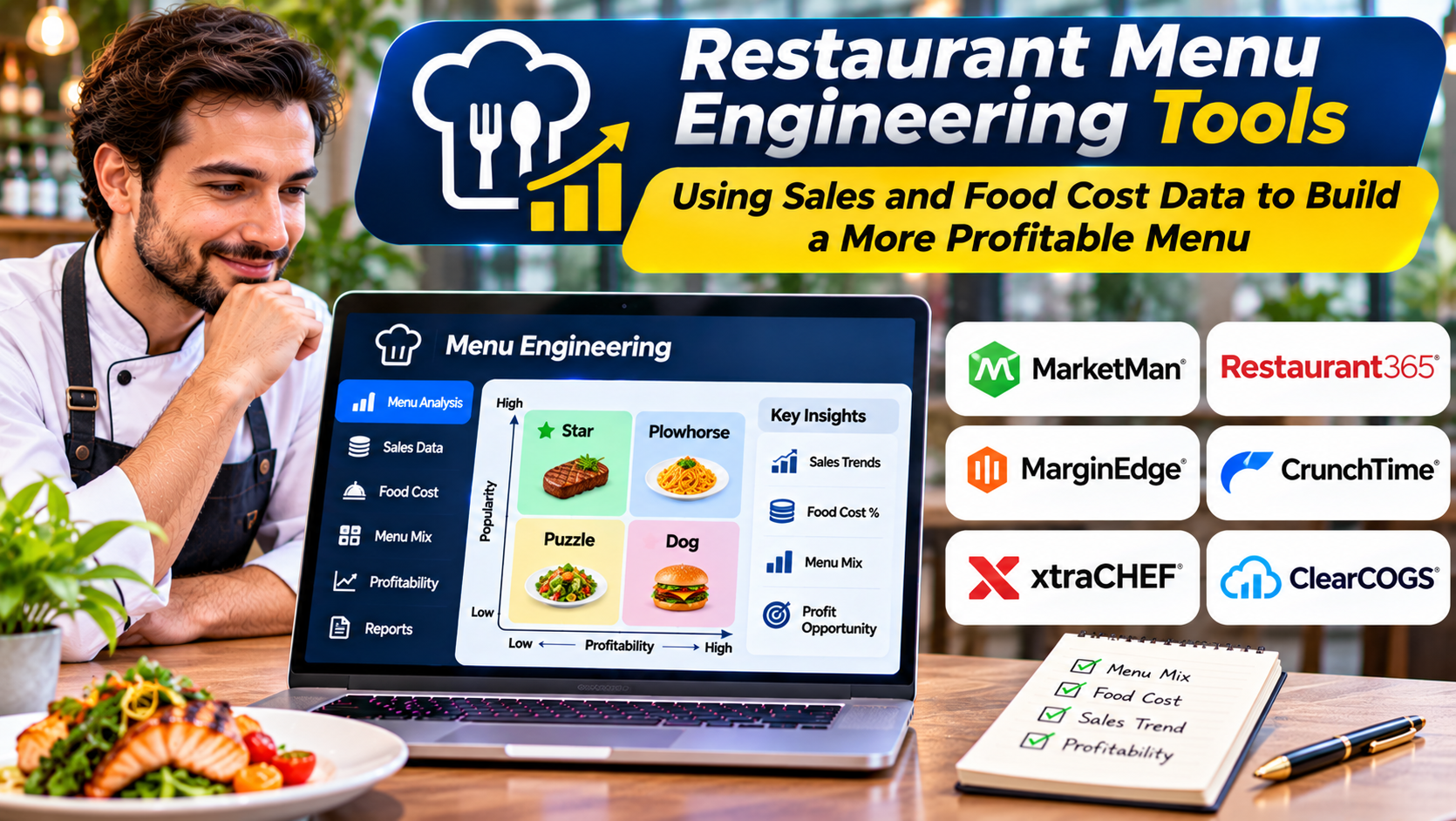
A common menu engineering framework compares item popularity with contribution margin.
Items are often grouped into four categories.
Stars: High Popularity, High Contribution Margin
Stars sell frequently and generate relatively strong contribution margins.
These items are often valuable parts of the menu.
Restaurants may want to maintain consistent quality, ensure ingredient availability, and make these dishes easy to find.
However, managers should still monitor changes in ingredient prices and customer preferences.
A dish can move out of this category when its costs increase.
Plowhorses: High Popularity, Low Contribution Margin
Plowhorses attract substantial demand but produce relatively low contribution margins.
These dishes may be important to the restaurant’s identity or customer expectations.
Removing them without further analysis can be risky.
Possible improvements include reviewing portion sizes, purchasing costs, preparation methods, or pricing.
Changes should preserve the qualities customers value.
Puzzles: Low Popularity, High Contribution Margin
Puzzles generate attractive contribution margins but sell less frequently.
The restaurant may need to understand why customers overlook them.
Possible causes include unclear descriptions, weak menu placement, unfamiliar ingredients, or limited demand.
Better presentation may help, but not every high-margin item deserves aggressive promotion.
Dogs: Low Popularity, Low Contribution Margin
Dogs perform poorly on both measures within the chosen analysis.
They may be candidates for removal, redesign, or repositioning.
However, the label should not be treated as an automatic instruction to delete the dish.
An item may support dietary needs, brand identity, menu variety, or customer groups that are strategically important.
Decisions should consider these factors alongside the numbers.
Why Menu Engineering Requires Accurate Data
A menu engineering report can look convincing while being fundamentally misleading.
For example, a restaurant may calculate recipe costs using outdated ingredient prices.
Another may use standard portions that differ from what kitchen staff actually serve.
A third may combine dine-in and delivery sales even though delivery commissions materially change the economics.
Software can organize calculations, but it cannot guarantee that the underlying data is accurate.
Three data sources are particularly important.
Sales Data
Sales records show how frequently items are purchased and at what prices.
Restaurants should account for discounts, promotions, refunds, and item variations where relevant.
Recipe and Ingredient Data
Recipe information connects menu items with ingredients and quantities.
The system may calculate theoretical food costs using purchasing prices and recipe quantities.
Accurate unit conversions and ingredient yields are essential.
Operational Cost Data
Depending on the analysis, restaurants may include packaging, preparation labor, channel commissions, and other relevant costs.
A simplified ingredient margin can be useful, but managers should understand what it excludes.
Calculating Menu Item Contribution Margins
Consider a hypothetical restaurant selling four dishes.
| Menu item | Selling price | Ingredient cost | Simplified contribution margin |
|---|---|---|---|
| Grilled chicken | $20 | $7 | $13 |
| Vegetable pasta | $17 | $5 | $12 |
| Premium steak | $34 | $19 | $15 |
| Signature burger | $19 | $8 | $11 |
The premium steak has the highest simplified contribution margin at $15.
However, that does not automatically make it the restaurant’s best-performing item.
The steak may sell infrequently.
It may also require more preparation time or create greater inventory risk.
To evaluate menu performance, managers need to combine margin with sales volume and other operational considerations.
Contribution Margin Versus Food Cost Percentage
Restaurants frequently use food cost percentage when evaluating menu items.
The simplified calculation is:
Food Cost Percentage = Ingredient Cost ÷ Selling Price × 100
For the grilled chicken example:
$7 ÷ $20 × 100 = 35%
For the vegetable pasta:
$5 ÷ $17 × 100 ≈ 29.4%
The pasta has a lower food cost percentage.
However, the chicken generates a higher dollar contribution margin under the simplified calculation.
This illustrates why percentage and dollar measures should be considered together.
A restaurant that optimizes only for the lowest food cost percentage may overlook dishes that contribute more dollars toward operating expenses.
Menu Engineering Software Worth Evaluating
Different products support different parts of menu analysis.
The following examples illustrate relevant software approaches rather than an independently tested ranking.
MarginEdge
MarginEdge provides restaurant back-office technology focused on areas such as invoice processing, food costs, inventory, and operational reporting.
Its capabilities are relevant to restaurants seeking better visibility into ingredient costs and financial performance.
Consider it when: The restaurant needs more dependable cost information connected to its operations.
Evaluate: Recipe costing, POS integrations, invoice workflows, reporting, and implementation requirements.
MarketMan
MarketMan provides restaurant inventory and purchasing technology with food cost and recipe-related capabilities.
It may be relevant to operators seeking to connect purchasing information with menu item economics.
Consider it when: Ingredient costs, inventory, and recipe management are central priorities.
Evaluate: Recipe configuration, supplier workflows, integrations, and reporting depth.
Restaurant365
Restaurant365 offers restaurant management technology covering accounting and operational functions, including inventory-related capabilities.
Its broader approach may appeal to restaurant groups seeking connected financial and operational reporting.
Consider it when: Menu analysis needs to fit into a larger restaurant financial management environment.
Evaluate: Module requirements, accounting integration, deployment effort, and multi-location reporting.
Apicbase
Apicbase provides food and beverage management software with capabilities associated with recipes, inventory, purchasing, and food cost control.
Its approach may be relevant to hospitality businesses with complex recipe and production requirements.
Consider it when: Recipe management and ingredient-level cost visibility are major operational needs.
Evaluate: Recipe structures, ingredient yields, integrations, and administrative effort.
POS Reporting and Business Intelligence Tools
Some restaurants may be able to perform basic menu engineering using POS sales reports combined with recipe costing data.
A business intelligence tool or spreadsheet can also support custom analysis.
Consider this approach when: The restaurant has reliable source data and relatively straightforward requirements.
Evaluate: Data preparation effort, consistency, automation, and ongoing maintenance.
Comparing Menu Engineering Software Approaches
| Approach | Primary value | Main limitation |
|---|---|---|
| POS reporting | Sales and item popularity | May lack accurate recipe costs |
| Recipe costing software | Ingredient-level margin estimates | May require separate sales data |
| Inventory management platforms | Purchasing and food cost visibility | Menu analysis depth varies |
| Restaurant financial platforms | Broader operational economics | Greater implementation complexity |
| Custom analytics | Flexible analysis methods | Data quality and maintenance demands |
The best solution depends on which information is currently missing.
A restaurant with excellent sales data but poor ingredient records should prioritize recipe costing and purchasing accuracy.
A restaurant with detailed recipes but limited sales analysis may need better POS reporting or analytics integration.
Menu Pricing Requires More Than a Cost Formula
Cost-plus pricing is one approach to menu pricing.
Under this method, a restaurant calculates a price using costs and a target margin or markup.
However, menu pricing also depends on customer expectations, competition, positioning, and perceived value.
A restaurant cannot assume that every ingredient cost increase can be passed directly to customers.
Likewise, a low-cost dish may justify a premium price if customers value its quality, uniqueness, or experience.
Menu engineering tools should support informed pricing decisions rather than automatically dictate prices.
Price Sensitivity
Price sensitivity describes how customer demand responds to price changes.
Some dishes may experience substantial demand changes after relatively small price increases.
Others may be less sensitive.
Restaurants should evaluate historical patterns carefully and avoid assuming that past behavior guarantees future results.
Menu Mix
Menu mix refers to the distribution of sales across menu items.
A pricing change may affect which dishes customers choose.
This can change ingredient demand, kitchen workload, and total contribution margin.
Channel-Specific Economics
A dish sold through a delivery platform may have different economics from the same dish sold in the dining room.
Packaging costs, commissions, and promotions can affect the result.
Restaurants should consider whether separate channel analysis is necessary.
How Menu Design Influences Purchasing Decisions
Menu engineering is not limited to financial calculations.
Presentation affects how customers understand available choices.
Clear descriptions can help diners identify dishes that match their preferences.
Logical grouping can reduce confusion.
Readable typography and accurate pricing improve transparency.
Some restaurants use visual emphasis to highlight selected dishes.
However, claims that a particular menu layout reliably increases sales should be treated cautiously unless supported by relevant evidence.
The goal should be to make the menu useful and appealing, not to manipulate customers through misleading presentation.
Building a Practical Menu Engineering Workflow
Step 1: Select a Representative Analysis Period
Choose a period that reflects normal business activity.
Avoid relying exclusively on unusually busy holidays or promotional events.
Seasonal restaurants may need multiple comparison periods.
Step 2: Clean Sales Data
Confirm that menu items, modifiers, discounts, and canceled transactions are handled consistently.
Duplicate or inconsistent item names can distort reporting.
Step 3: Update Recipe Costs
Review ingredient prices, quantities, and yields.
Account for relevant preparation losses where the costing method requires them.
Step 4: Calculate Item Margins
Use a clearly defined contribution margin calculation.
Document which costs are included.
Step 5: Evaluate Popularity
Compare item sales within relevant menu categories.
An appetizer should not necessarily be evaluated against an entrée using identical popularity expectations.
Step 6: Identify Opportunities
Look for items with strong demand but weak margins, or attractive margins but limited demand.
Investigate the reasons behind their performance.
Step 7: Make Controlled Changes
Test changes to pricing, descriptions, placement, portions, or preparation.
Avoid changing too many variables simultaneously.
Step 8: Measure the Results
Compare sales mix, contribution margin, customer feedback, and operational effects.
Continue refining the menu based on observed outcomes.
The Importance of Recipe Accuracy
Recipe costing software depends on accurate ingredient information.
Consider a pasta dish that uses cheese, sauce, vegetables, and pasta.
If the recipe lists 30 grams of cheese but kitchen staff regularly use 50 grams, the theoretical cost will understate actual consumption.
The discrepancy may appear small for one serving.
Across hundreds of orders, it can become significant.
Restaurants should combine software calculations with periodic physical inventory checks and practical kitchen observations.
Recipe records should reflect how food is actually prepared.
Menu Engineering for Multi-Location Restaurants
Restaurant groups face additional complexity.
Ingredient prices may differ by location.
Customer preferences may vary across regions.
Some locations may use different suppliers or preparation methods.
A centralized menu engineering platform can help standardize calculations while preserving relevant local differences.
However, comparing locations requires consistent definitions.
One restaurant should not calculate margins using ingredient costs alone while another includes packaging and labor.
The organization must establish a common reporting method before interpreting differences.
Common Menu Engineering Mistakes
Focusing Only on Bestsellers
High sales volume does not automatically indicate strong profitability.
Managers should examine contribution margins and operating costs.
Using Outdated Ingredient Prices
Supplier costs can change.
Reports based on old prices may produce misleading recommendations.
Removing Every Low-Performing Item
Some dishes serve important strategic or customer needs.
Financial analysis should inform decisions rather than replace judgment.
Ignoring Portion Variation
Actual ingredient usage may differ from standard recipes.
This can distort theoretical food costs.
Treating Menu Categories as Permanent
Item performance changes with pricing, customer preferences, seasonality, and costs.
Menu engineering should be repeated periodically.
Ignoring Kitchen Complexity
A profitable dish on paper may create preparation bottlenecks.
Operational impact should be considered alongside financial performance.
Frequently Asked Questions
What is restaurant menu engineering software?
It is software that helps restaurants analyze menu item sales, costs, margins, and popularity to support pricing and menu decisions.
Is menu engineering the same as food cost management?
No. Food cost management focuses on ingredient expenses and consumption. Menu engineering combines cost information with sales performance and menu strategy.
What is a menu engineering matrix?
It is a framework that categorizes menu items according to measures such as popularity and contribution margin.
Can small restaurants use menu engineering?
Yes. A small restaurant can begin with accurate POS sales reports and recipe cost calculations. Dedicated software becomes more useful as data volume and operational complexity increase.
Does a high food cost percentage mean a dish should be removed?
Not necessarily. A dish may still generate a strong dollar contribution margin or provide strategic value.
How often should restaurants review their menus?
Review frequency depends on purchasing volatility, seasonality, menu changes, and business needs. Restaurants should update analysis when costs or demand change materially.
Final Thoughts
Restaurant menu engineering tools help operators make better decisions by connecting what customers buy with what those dishes cost.
The most useful software provides accurate ingredient data, dependable sales information, and calculations that managers can understand.
But menu engineering is not a formula for automatically removing dishes or raising prices.
Successful decisions also consider guest expectations, kitchen capacity, menu identity, and the restaurant’s broader financial goals.
Before investing in a platform, restaurants should determine whether their greatest weakness is recipe accuracy, purchasing visibility, sales analysis, or financial reporting.
The right technology should solve that problem first.
When menu data becomes reliable and managers use it thoughtfully, menu engineering can support healthier margins without sacrificing the dining experience.