Introduction
A lender tests a new credit score on historical applications and finds that it separates higher- and lower-risk accounts well. Then it tries the score on a newer channel, where a larger share of applicants has limited credit history. The score is missing more often, and the performance of the scored population says little about the people the model could not evaluate. The buying decision changes when the lender looks at coverage alongside predictive performance.
Credit scoring platforms may supply an external score, help develop an internal model, or provide infrastructure for deploying and monitoring several models. These are different purchases. A lender evaluating them should start with the decision the score will inform, the data available at that moment, and the evidence required before putting the score into production.
Define the event the score predicts
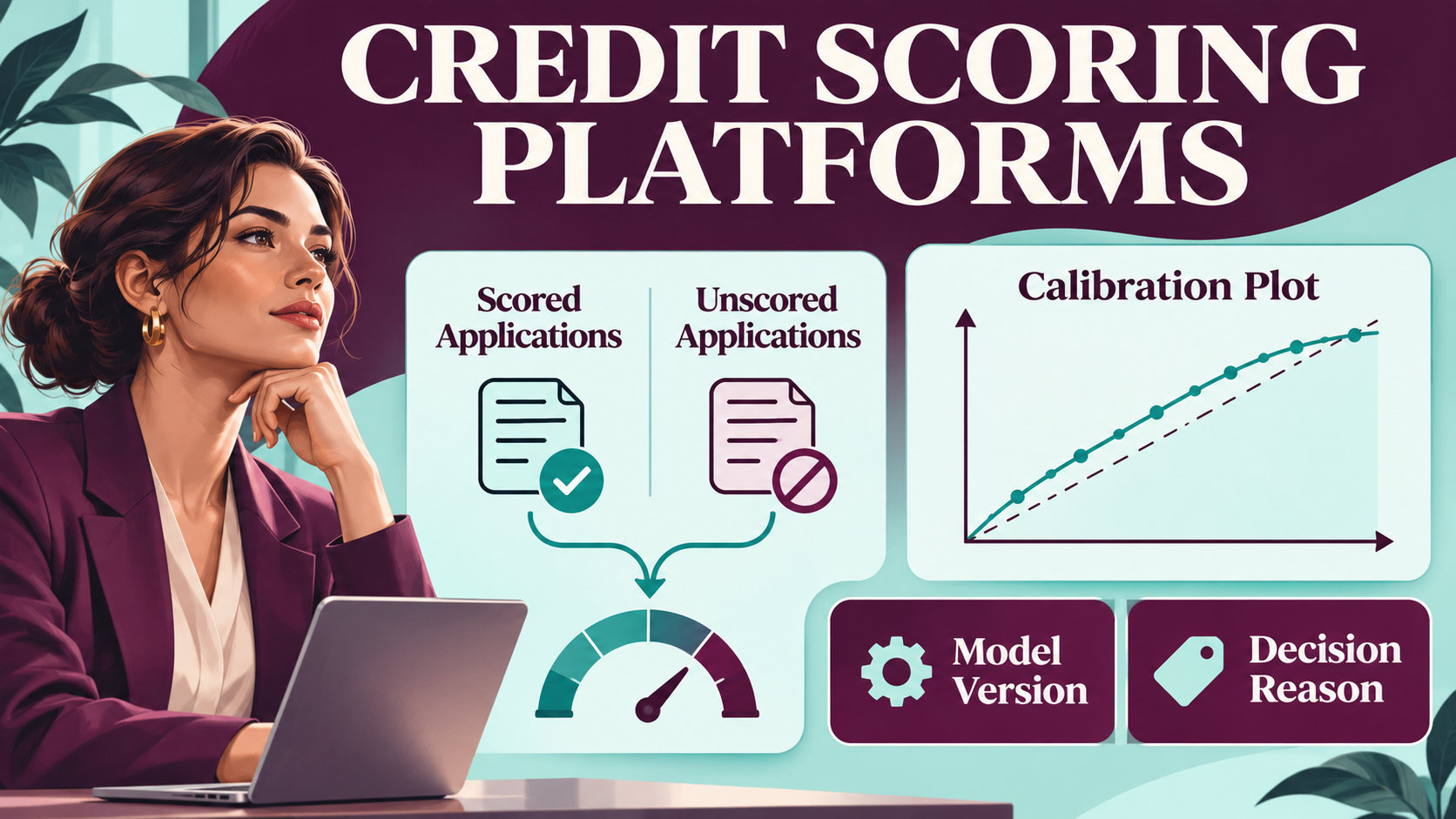
A model needs a defined outcome and a time horizon. A probability of default over a stated period has a different meaning from a score that simply ranks applicants. Two scores can produce similar rankings while implying very different probabilities for the same population. If the lender uses a model for pricing, expected losses, or limits, calibration can matter alongside ranking.
Specify the population and product as well. A model developed for an unsecured installment loan may behave differently on revolving credit or applicants entering through a new partner. The repayment schedule, customer mix, and information collected at application all shape the evaluation. Ask what the provider can establish about similar populations and what the lender needs to validate independently.
Document which outcomes are visible in the historical data. Lenders can generally observe repayment outcomes for loans they booked. They may have limited evidence about applicants they declined or people who chose another offer. Report that distinction when interpreting validation results. A backtest built only on previously approved applicants can be informative within that group while leaving uncertainty about a proposed expansion.
Compare coverage with the same care as performance
Measure the share of eligible applicants for whom the score can be produced. Then inspect the reasons for missing results. A bureau record may be unavailable, a data connection may fail, or an input may fall outside the model’s design. Each reason can call for a different response. A platform that reports a single missing-score code creates work for the lending operation and makes monitoring harder.
Test what happens when a required field is corrected or a data source returns inconsistent values. Record the input used and whether the platform recalculates the score. The ability to reproduce a score from the actual application-time data matters when analysts review the decision later. It also helps separate a model issue from a change in the data supplied to it.
Where the vendor proposes additional data, evaluate coverage and permission to use the data for the intended purpose. Determine how the lender would handle applicants who cannot or choose not to supply it. Review the effect on different populations under the institution’s legal and fair lending framework. An improvement for one segment can coexist with poorer coverage or larger errors elsewhere.
Evaluate how the model explains its output
A score explanation may identify inputs that influenced the model. A lending decision can also depend on eligibility rules, policy thresholds, or manual review. The platform should preserve the relationship between the model’s contribution and the reason the lender reached its decision. Treat reason codes as data that need validation across actual cases.
In the United States, Regulation B addresses notifications for covered credit decisions, including applicable adverse action requirements. Evaluate whether the institution can produce accurate reasons from the decisions it makes. A report describing generally influential variables is a different artifact from the reasons relevant to an individual outcome. CFPB Regulation B notification rules
Test cases close to a threshold and cases where a policy rule determines the outcome regardless of score. Have a reviewer explain the result using the retained record. If the explanation changes when the current model is substituted for the historical version, the platform needs a way to preserve the correct version and its associated reason logic.
Choose which parts the lender wants to own
A purchased score can reduce model development work and provide standardized inputs across channels. The lender still needs to validate the score’s suitability and understand what happens if the provider changes it or a source is unavailable. Contract terms should address change notice, historical access, and incident support.
A model development platform offers more control over data preparation, feature definitions, testing, and documentation. It suits an organization with the staff to maintain the model and independent review. Inspect whether features created during training can be calculated in the same way in production. Differences in timing, data completeness, or rounding can change model behavior even when the model file is identical.
A deployment and monitoring platform can be appropriate for a lender that already develops or purchases models but needs consistent release controls. Ask how it manages versions, approval, rollback, and parallel evaluation. Test that it can reproduce a particular score after a release and show which downstream decision systems used the new version.
Follow the score after approval
An initial validation establishes a baseline. In production, track applicant mix, missing data, score distribution, approval rates, and eventual repayment outcomes. Credit outcomes arrive with a delay, so distinguish early indicators from mature evidence. A shift in the score distribution may reflect a marketing campaign, a data issue, or a change in customer behavior. It is a reason to investigate.
Monitor by segment where data and permissions allow. An aggregate result can conceal a deterioration in a small product or channel. Set ownership for alerts, identify the data needed for investigation, and decide what actions are available if performance falls outside expectations. Options may include reviewing the data feed, tightening a policy, or returning to an earlier approved configuration, depending on the institution’s process.
For the pilot, use time-separated data and reserve cases the vendor has not used to tune the demonstration. Compare coverage, ranking, calibration where relevant, and the ability to explain decisions. Include outage handling and version recovery in the same exercise. The score should earn approval through evidence that it works for the intended applicants and that the lender can see when those conditions change.