Introduction
A restaurant can prepare an excellent meal and still disappoint the customer if delivery goes wrong.
Food may sit on a counter while employees search for an available driver. A courier may arrive before an order is ready. Another driver may receive several deliveries that are geographically close but difficult to complete within the expected time.
These problems become more common when restaurants manage orders from multiple channels.
Online ordering systems, mobile applications, telephone orders, and delivery marketplaces may all generate requests with different preparation times and delivery expectations.
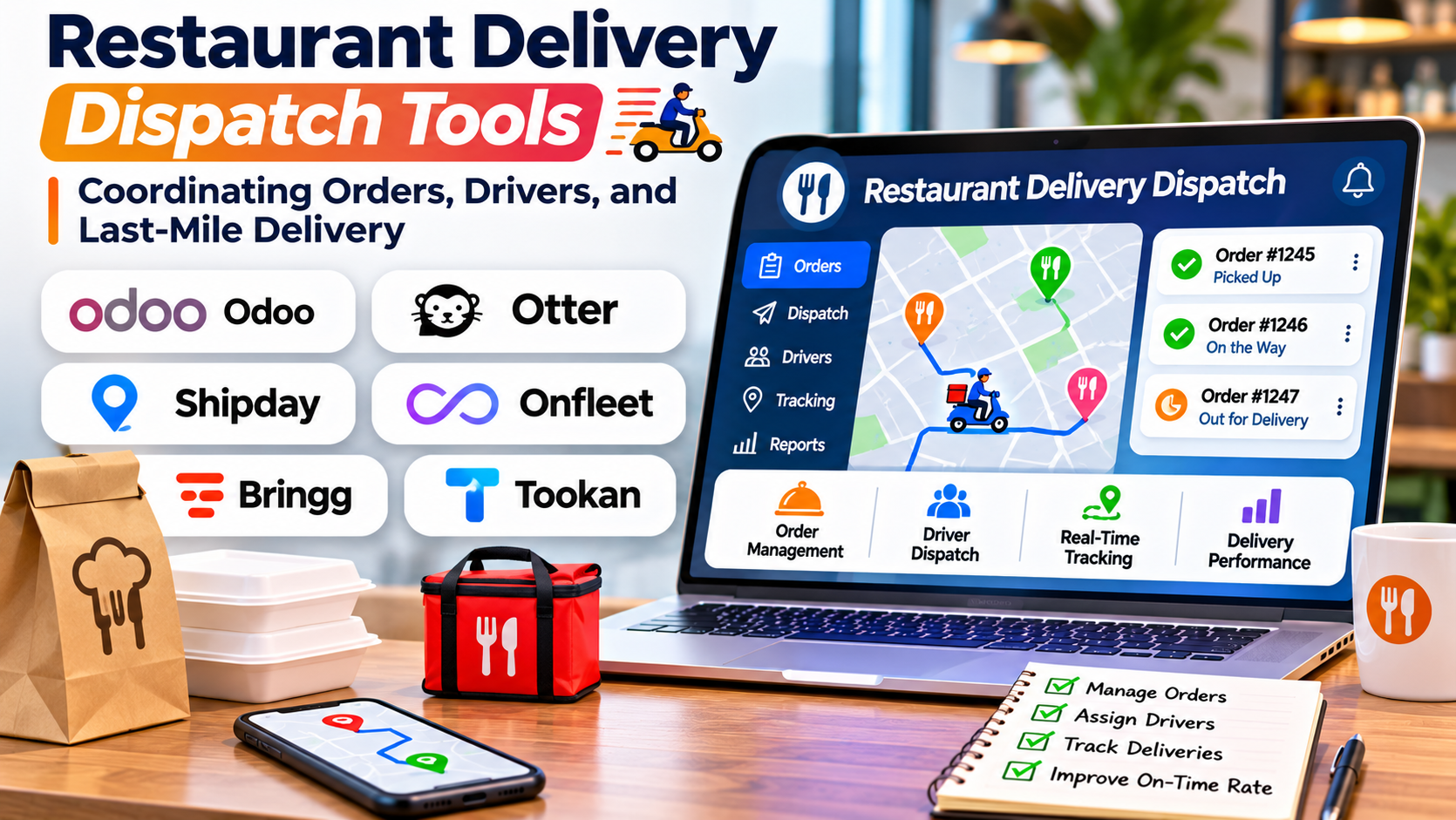
Restaurant delivery dispatch tools help businesses coordinate the movement of completed orders from restaurants to customers.
The software may automate driver assignments, provide live tracking, support delivery communications, and improve visibility into last-mile operations.
However, dispatch technology does not automatically guarantee faster delivery.
Its effectiveness depends on kitchen readiness, driver availability, geographic conditions, and the restaurant’s operating model.
What Are Restaurant Delivery Dispatch Tools?
Restaurant delivery dispatch tools are software applications that help restaurants and food delivery operators organize, assign, monitor, and complete delivery orders.
They connect delivery requests with available drivers or courier services.
Depending on the platform, capabilities may include:
- Delivery order intake
- Driver availability management
- Automated dispatch
- Manual delivery assignment
- Route planning
- Real-time delivery tracking
- Estimated delivery times
- Driver mobile applications
- Customer notifications
- Proof of delivery
- Delivery performance reporting
- Integration with restaurant ordering systems
- Third-party courier network access
Some products focus on managing a restaurant’s own drivers.
Others connect restaurants with external delivery fleets.
Enterprise platforms may coordinate both approaches.
These differences affect cost, operational control, and implementation requirements.
Why Restaurant Delivery Is Hard to Coordinate
Restaurant delivery differs from many conventional shipping operations.
Food has a limited window in which it can be delivered at the intended quality.
A meal that arrives late may be cold or otherwise unsuitable, even if the package reaches the correct address.
Unlike warehouse shipments, restaurant orders are usually prepared shortly before dispatch.
This creates a dependency between kitchen operations and transportation.
A driver arriving too early may wait unnecessarily.
A driver arriving too late may leave food waiting after preparation.
The ideal dispatch decision therefore considers both driver availability and expected order readiness.
Delivery conditions also change quickly.
Traffic congestion, weather, building access, customer instructions, and unexpected restaurant delays can affect completion times.
A dispatch system must support practical adjustments rather than assume every delivery will follow the original plan.
The Restaurant Delivery Lifecycle
Understanding the delivery lifecycle helps operators identify which software capabilities they need.
1. Order Acceptance
A customer places an order through a supported channel.
The restaurant confirms that the order can be fulfilled.
Relevant details may include the delivery address, ordered items, customer contact information, and requested delivery time.
2. Preparation Estimate
The restaurant estimates when the food will be ready.
This estimate may come from the ordering system, kitchen staff, or configured preparation rules.
Accurate readiness estimates are important because they influence driver assignment.
3. Driver Assignment
The dispatch system selects an eligible driver or sends a delivery request to an external courier provider.
Assignment decisions may consider distance, availability, workload, vehicle type, and delivery requirements.
Some platforms automate this process.
Others allow dispatchers to review and approve assignments.
4. Restaurant Pickup
The driver arrives at the restaurant and collects the order.
The system may record pickup confirmation.
Clear handoff procedures help prevent incorrect or missing orders.
5. Delivery Tracking
The driver travels to the customer’s location.
Where supported and permitted, the platform provides location or status updates.
The customer may receive notifications about progress.
6. Delivery Completion
The driver marks the order as delivered.
Depending on the workflow, completion may include a photo, recipient confirmation, or another form of proof.
7. Reconciliation and Reporting
The restaurant reviews delivery outcomes, expenses, delays, and exceptions.
These records can support customer service and operational improvement.
Delivery Dispatch Models Restaurants Should Understand
In-House Driver Management
Some restaurants employ or contract their own delivery drivers.
A dispatch system can help assign orders, monitor availability, and organize delivery routes.
This approach offers direct operational control but requires the restaurant to manage staffing, scheduling, and related responsibilities.
It may work well for businesses with consistent delivery demand within a defined service area.
Third-Party Courier Dispatch
Restaurants may use external courier networks to fulfill orders.
This can reduce the need to maintain a dedicated fleet.
However, availability, pricing, service coverage, and operational control depend on the provider.
Businesses should understand what happens when no courier accepts a request.
Hybrid Delivery Operations
Some restaurants use their own drivers during predictable periods and external couriers when demand increases.
A hybrid approach can offer flexibility.
However, it requires clear assignment rules and reliable coordination between systems.
The dispatch platform should support the restaurant’s chosen operating model rather than require unnecessary manual switching.
Essential Features of Restaurant Delivery Dispatch Software
Automated Driver Assignment
Automated dispatch can reduce the time employees spend deciding who should deliver each order.
The system may consider driver availability, location, and current assignments.
However, automation must respect operational constraints.
A driver should not receive an assignment that conflicts with an existing delivery or vehicle limitation.
Restaurants should also be able to intervene when unusual circumstances arise.
Live Order Tracking
Tracking provides visibility into delivery progress.
Managers can identify orders that appear delayed.
Customers may also receive status updates.
Location tracking should be accurate enough to support operations without collecting unnecessary personal information.
Delivery Time Estimates
Estimated delivery times influence customer expectations.
A useful estimate considers preparation time and transportation conditions.
Restaurants should avoid presenting highly precise estimates when the underlying information is uncertain.
Route Planning
Route planning can help drivers complete multiple deliveries efficiently.
However, the shortest route is not always the most suitable.
Food quality, promised delivery windows, and order readiness may affect sequencing.
Driver Applications
Driver-facing applications may provide pickup instructions, navigation, delivery details, and completion controls.
The interface should be practical for employees working away from a desk.
Driver safety should take priority over unnecessary interaction while operating a vehicle.
Customer Notifications
Automated messages can inform customers when orders are dispatched, approaching delivery, or completed.
Notifications should be useful and not excessive.
Restaurants should also provide a way to resolve delivery problems.
Proof of Delivery
Proof-of-delivery features can help investigate disputed or missing orders.
Depending on the system, evidence may include delivery status, timestamps, photographs, or recipient confirmation.
The business should establish appropriate privacy and retention policies for these records.
Restaurant Delivery Dispatch Platforms Worth Evaluating
The following products illustrate different delivery management approaches rather than an independently tested ranking.
Onfleet
Onfleet provides last-mile delivery management technology, including dispatch, driver applications, tracking, and delivery analytics.
Its general last-mile focus can be relevant to restaurants and delivery businesses managing their own operations.
Consider it when: A business needs structured delivery management for an in-house or managed fleet.
Evaluate: Integration requirements, dispatch rules, pricing structure, and driver workflows.
Shipday
Shipday provides delivery management and dispatch technology used in local delivery operations, including food delivery scenarios.
Its capabilities are relevant to businesses seeking order assignment, driver tracking, and delivery coordination.
Consider it when: A restaurant wants a focused delivery management application.
Evaluate: Ordering integrations, driver management, reporting, and geographic suitability.
Tookan
Tookan provides delivery management technology for assigning and tracking tasks across delivery operations.
Its configurable workflows may be relevant to businesses managing different types of local delivery activity.
Consider it when: The restaurant needs configurable dispatch and driver coordination.
Evaluate: Implementation effort, integrations, task workflows, and total operating cost.
Deliverect
Deliverect focuses on connecting restaurant ordering channels with operational systems.
Its broader restaurant technology offering includes delivery-related workflows and capabilities that vary by product.
Consider it when: A restaurant needs to coordinate online orders and delivery operations within a broader technology environment.
Evaluate: The exact dispatch capabilities included, delivery provider integrations, and POS compatibility.
Uber Direct
Uber Direct offers delivery fulfillment services through Uber’s delivery network in supported markets.
It differs from software primarily designed to manage a restaurant’s own drivers.
Consider it when: A restaurant wants external courier fulfillment for orders received through its own channels.
Evaluate: Geographic coverage, delivery fees, integration options, service terms, and operational support.
Comparing Delivery Dispatch Approaches
| Approach | Main benefit | Main consideration |
|---|---|---|
| In-house fleet dispatch | Direct control over drivers | Staffing and fleet responsibility |
| External courier fulfillment | Access to third-party delivery capacity | Provider availability and cost |
| Hybrid dispatch | Flexible delivery capacity | More complex coordination |
| General last-mile software | Configurable delivery workflows | Restaurant-specific integration needs |
| Restaurant-focused delivery technology | Connected ordering and fulfillment | Feature depth varies by vendor |
A restaurant should begin by deciding who will perform deliveries.
That decision determines whether the software must manage employees, external couriers, or both.
Understanding Restaurant Delivery Costs
Delivery profitability depends on more than the amount charged to customers.
A restaurant may incur:
- Driver compensation
- Vehicle-related expenses
- Delivery software fees
- Third-party courier charges
- Packaging costs
- Payment processing expenses
- Customer support costs
- Failed delivery expenses
Consider an illustrative order worth $35.
Suppose delivery-related expenses include $5 for courier fulfillment, $1.50 for packaging, and $0.50 in allocated software and communication costs.
The direct delivery-related expense is $7.
This simplified example excludes food production, other labor, payment charges, and overhead.
It demonstrates why restaurants should examine delivery contribution margins rather than order value alone.
A busy delivery channel is not automatically profitable.
The Connection Between Kitchen Readiness and Dispatch
A dispatch system can only make effective assignments when it has dependable preparation information.
Consider a restaurant that estimates every order will be ready in fifteen minutes.
During a busy period, actual preparation may take thirty minutes.
Drivers assigned using the original estimate may arrive too early and spend time waiting.
Alternatively, a restaurant may underestimate delivery demand and prepare meals long before drivers become available.
Connecting dispatch with kitchen status can help reduce these mismatches.
However, integration should be tested using real order changes and peak-service conditions.
Metrics That Matter for Delivery Operations
On-Time Delivery Rate
This measures the proportion of deliveries completed within a defined promised or target window.
The business should document how the target is calculated.
Driver Waiting Time
Waiting time at pickup locations can indicate poor coordination between preparation and dispatch.
Delivery Duration
Delivery duration measures the time between defined operational events, such as pickup and completion.
It should be analyzed alongside distance and traffic conditions.
Cost per Delivery
Cost per delivery helps operators understand transportation economics.
The calculation should consistently include relevant expenses.
Failed Delivery Rate
Failed deliveries can create refunds, additional transportation expenses, and customer dissatisfaction.
Businesses should investigate recurring causes.
Customer Complaints
Customer feedback can reveal problems that timing metrics alone do not capture.
An on-time delivery may still involve missing items or damaged packaging.
Security, Privacy, and Driver Considerations
Delivery platforms process customer addresses, contact details, order information, and potentially driver location data.
Businesses should examine access controls, data retention, secure integrations, and vendor privacy practices.
Driver monitoring should be limited to legitimate operational needs and comply with applicable requirements.
Restaurants should also establish procedures for handling customer contact information and proof-of-delivery records.
How to Implement Delivery Dispatch Software
Begin by mapping current delivery operations.
Identify where orders originate, how drivers receive assignments, and how completion is recorded.
Next, define delivery zones, service windows, and assignment rules.
Integrate the platform with relevant ordering and restaurant systems.
Test typical orders and exceptions, including cancellations, address problems, delayed preparation, and unavailable drivers.
Train restaurant employees and drivers on their responsibilities.
Start with a controlled rollout before relying on the system during peak demand.
Monitor delivery costs, timing, and customer complaints.
Use these results to refine dispatch rules.
Common Selection Mistakes
One common mistake is choosing software based only on route optimization.
Restaurants also need dependable order readiness information and pickup coordination.
Another is assuming an external courier network will always have sufficient capacity.
Availability can vary by location and demand.
Businesses may also overlook integration failures that create duplicate orders or incorrect delivery instructions.
Finally, restaurants should avoid optimizing solely for delivery speed.
Food safety, driver safety, customer expectations, and cost all matter.
Frequently Asked Questions
What is restaurant delivery dispatch software?
It is software that helps restaurants assign, track, and coordinate delivery orders and drivers.
Can dispatch software work with third-party delivery services?
Some platforms support external courier integrations. Coverage depends on the provider and geographic market.
Does dispatch software replace a restaurant POS?
Usually not. Dispatch software focuses on delivery operations, while POS systems manage sales transactions and ordering workflows.
Can restaurants use both their own drivers and outside couriers?
Some platforms support hybrid arrangements. Businesses should verify the exact assignment and integration capabilities.
Does route optimization guarantee faster food delivery?
No. Preparation delays, traffic, driver availability, and delivery conditions can affect results.
Final Thoughts
Restaurant delivery dispatch tools help operators coordinate the critical period between food preparation and customer delivery.
The best solution should connect order readiness, driver assignment, tracking, and completion without creating unnecessary work for employees.
Restaurants with dedicated drivers may prioritize fleet visibility and dispatch control.
Businesses relying on external couriers may focus on provider coverage and fulfillment reliability.
Hybrid operators need both.
Before choosing software, examine real delivery delays and determine whether the main problem involves preparation, assignment, transportation, or communication.
The right platform should solve those specific problems while protecting food quality, customer experience, and delivery profitability.