Introduction
A renewal invoice arrives for a trademark your company acquired last quarter. The brand team wants to keep the mark. Finance recognizes the outside law firm on the invoice but cannot match the charge to a cost center. The legal team finds two portfolio records, one under the previous owner and another under the buyer. Both show the same registration number and different next actions.
The problem starts with the record. Sending more reminders will spread the conflicting information faster. Before anyone approves a payment or tells counsel to proceed, the team needs to establish which record governs the decision, what the current ownership evidence shows, and who has authority to give instructions.
IP management software gives in-house teams and law firms a place to manage those facts over the life of a patent or trademark. The buying decision hinges on how much of that work belongs in one system and how reliably the software handles a change that affects several people at once.
A portfolio record has to answer four different questions
An asset record usually starts with identifiers, jurisdictions, parties, and status. An operational record also shows what has happened, what may happen next, who is responsible, and where the supporting evidence lives. Those questions often have different answers for the same asset.
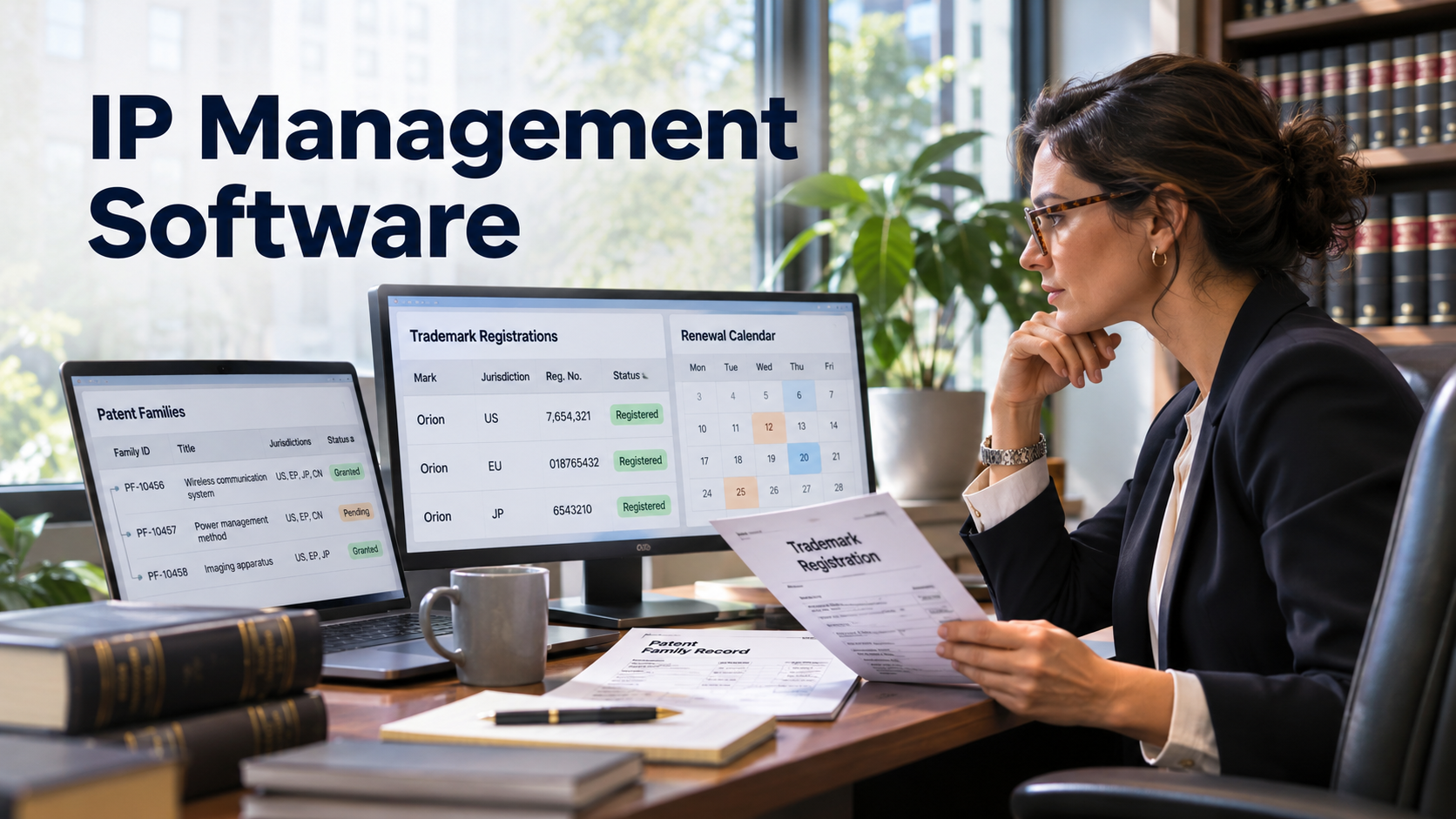
Consider a patent family with applications in several jurisdictions. The portfolio team may want a single family view for budgeting and strategy. Docketing staff still need separate records for each relevant application or right, with its own correspondence, status, and dates. A decision to stop funding one case should appear in the family view while preserving the ability to manage the other cases independently.
A trademark portfolio presents a different problem. The same brand can have word and design marks, registrations in multiple territories, and different goods and services on each record. The business may think in terms of a product line, while counsel works from particular registrations. A useful system connects those views and makes clear which record a decision applies to.
Official services remain part of the workflow. The WIPO IP Portal brings together WIPO online services, including trademark tools such as Madrid Monitor. Use those services for the records and transactions they cover, and evaluate portfolio software for your internal assignments, approvals, budgets, and evidence.
Put docketing under pressure during the demo
A docket is the working record of actions and dates. Some dates come from correspondence or verified rules. Others are internal milestones, such as a target date for receiving a decision from a business owner. Both matter, but they require distinct handling. A missed internal target should prompt follow-up. A date with external consequences may require escalation and immediate professional review.
Ask each vendor to work through a sample notice your team understands. Have the operator attach the document, record when it arrived, explain how the system determines the relevant date, and assign responsibility. Ask a second user to review the entry. Then introduce a correction to the underlying information and watch what happens to downstream reminders, assigned work, and the original audit trail.
This exercise exposes the distinction between recording a date and managing a change. A platform may show a convincing calendar while making it hard to see why a date moved. Check whether a reviewer can reconstruct the event from the source document, the rule or manual calculation, the user action, and the approval history. Include any external service that supplies dates or performs docketing on your behalf in the same exercise.
Follow the money and the instruction separately
Renewals and maintenance can involve business approval, fee estimates, outside counsel, and specialist service providers. A finance team may authorize spending while a separate legal owner has authority to issue instructions. If the software treats both steps as one approval, the status becomes ambiguous at exactly the point when people need certainty.
In a pilot, create a renewal with three possible outcomes. The business can continue the right, decline it, or defer a decision for review. Give finance an estimate and send a test instruction to the party responsible for execution. Then reconcile the instruction with its acknowledgment and the resulting evidence. Ask the vendor to show what happens if the estimate changes after approval or an acknowledgment fails to arrive.
A useful renewal dashboard distinguishes work awaiting a business decision, work ready to send, work already instructed, and work supported by completion evidence. A portfolio director may need the totals by quarter and currency. The docketing team needs the handful of exceptions it can act on today. Make sure both views derive from the same underlying events.
Decide which system owns each record
The right arrangement depends on where the work happens. An organization with a small portfolio and a single outside firm may need a reliable internal inventory, access to documents, and visibility into approvals. A company with several firms and business units may need independent control of data, consistent reporting across firms, and repeatable approval workflows. A law firm may care most about matter separation, correspondence, and the ability to apply its own review procedures across many clients.
| Operating model | Evidence to request before buying |
|---|---|
| Outside counsel maintains the working docket | A sample export with stable identifiers, upcoming dates, supporting documents, and responsibility assignments |
| In-house staff maintain a central docket | A demonstrated date correction, independent review, and escalation while the assigned owner is away |
| A service provider executes renewals | An exception workflow that links instructions, acknowledgments, invoices, and completion evidence |
| Multiple systems share data | A reconciliation report showing which changes synced, which failed, and who can resolve conflicts |
Include acquisition and divestiture in this discussion. Ask how the software handles a temporary owner, a change in outside counsel, or a partially transferred portfolio. The system should let users see the transition and the source of each material change. A simple overwrite can destroy context that a future reviewer needs to explain an instruction or payment.
Reconcile the migration before trusting the dashboard
Request an export from the current system early. Include active and closed matters, related documents, ownership history, open tasks, and any labels or custom fields that drive reporting. A field may look optional to a vendor and still determine which team receives an urgent notice.
Start with a varied sample. Include a patent family with several branches, an acquired trademark with incomplete ownership history, an item with a pending instruction, and a matter with a manual date override. Compare both systems at record level. A matching count of active assets tells you little about whether parent-child relationships, source documents, or upcoming responsibilities survived.
Build a separate cutover check for near-term obligations. Give every exception an owner and have someone reconcile new correspondence that arrives while records are moving. The length of any parallel review should reflect the volume of open matters and the consequences of a missed change. Agree in advance on who can authorize the switch and where users should record work if the migration slips.
Buy for the handoffs your team actually struggles with
Before requesting quotes, write down the recurring failures you want to remove. A team that loses time collecting outside-counsel updates has different needs from a team that cannot tie renewal spending to business decisions. Translate each failure into a demonstration using sample records, representative users, and a result the team can inspect.
Ask for pricing that reflects how you operate. Relevant costs can include implementation, historical migration, training, specialist services, additional data feeds, and time spent resolving exceptions. Get a sample exit export as well. A usable export includes relationships, document references or files, and the information needed to understand outstanding work.
The final demonstration should return to the acquired trademark and the unmatched invoice. Have someone find the governing record, trace the ownership evidence, identify the authorized decision-maker, record the instruction, and retrieve the result. If the team can complete that sequence and explain every handoff, it has evidence that the system can support the work the portfolio depends on.